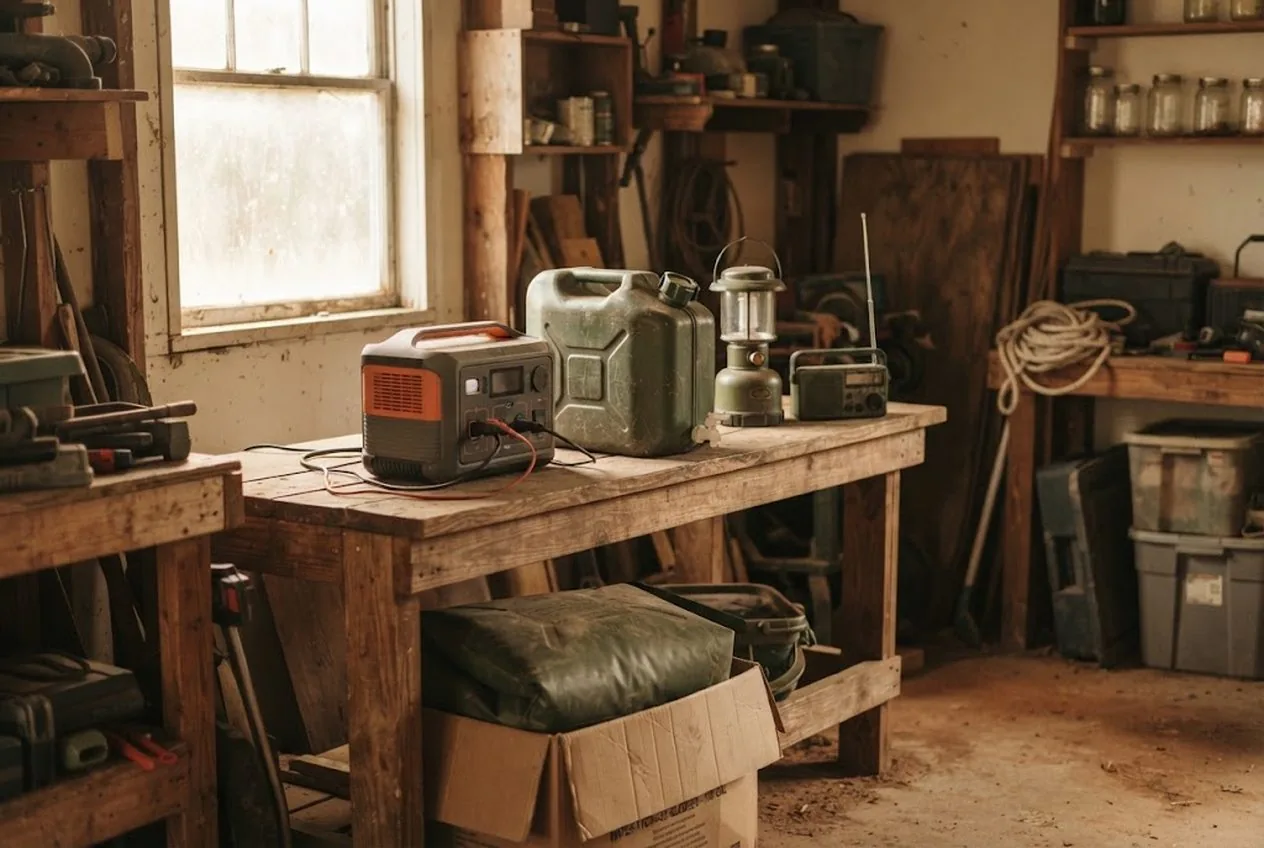
Hurricane season has a cruel bit of timing built into it. The peak — mid-August through mid-October, climaxing around September 10 (NOAA National Hurricane Center) — is exactly when a single storm can knock out power and water for days or a week at a stretch. And the worst moment to assemble a kit is the moment everyone else is: when a name appears in the forecast cone and the shelves of every store in three counties go bare in an afternoon.
The fix is to build the kit now, in the quiet part of July, and stage it in one place. This is a focused list built around the two needs that turn dangerous fastest in a long, hot outage — power and water — with the food, light, and communication layers that round it out.
Short answer: stage a 1,000Wh-class battery power station with a solar panel, at least two weeks of stored water plus a bathtub bladder you fill before landfall, and a compact stack of no-cook food, lighting, and a weather radio. Get those assembled before peak season and a multi-day outage becomes an inconvenience instead of an emergency.
The Hurricane Blackout Kit at a Glance
- Backup power — a 1,000Wh battery power station for the essentials
- Solar recharge — a folding panel to refill the battery between storm bands
- Stored drinking water — one gallon per person per day, two weeks’ worth
- Bathtub emergency water — a bladder that holds up to 100 gallons, filled pre-storm
- A renewable water backup — a way to produce or purify water if the outage runs long
- No-cook food — shelf-stable meals and a manual can opener
- Light and communication — lanterns, headlamps, and a hand-crank weather radio
- A written family plan — who does what, and where you meet
Disclosure: some links below are affiliate links, so we may earn a commission if you buy through them at no extra cost to you. Our picks follow FEMA and Red Cross preparedness guidance for water and power — the gear is the part we can point you to, but the plan is what makes it work.
1. Backup Power: The Heart of the Kit
A hurricane outage is precisely the scenario a battery power station was built for. You don’t need to run the whole house — you need to keep the fridge cycling, phones charged, a fan or two moving, and any medical device like a CPAP running. A 1,000Wh-class unit covers all of that, silently and, crucially, safely indoors, which a gas generator can never do during a storm (CDC).
For hurricane country, chemistry matters: a LiFePO4 battery like the Bluetti AC180 (Amazon) is built for long service life: BLUETTI rates it for 3,500+ charge cycles (BLUETTI). Our best power stations for a heat-wave blackout comparison sizes these units to real appliances if you want to run the math for your own home.
2. Solar Recharge: Power That Doesn’t Run Out
A battery alone gives you hours; a battery plus a panel gives you open-ended power. Hurricanes travel in bands, and the breaks between them — and the clear, bright days that often follow a storm’s passage — are your recharging windows. A folding solar panel lets a 1,000Wh station refill during daylight so it can carry the fridge through another night. Without solar, your kit has a hard expiration date; with it, you can ride out a genuinely long outage. If you’re weighing battery-plus-panel combinations by budget, our ranking of portable power setups for a summer blackout compares five of them.
An EcoFlow portable power station (Amazon) is a strong alternative here, prized for fast solar and wall recharging and a generous set of outlets — a versatile second unit or primary if you want speed of recharge.
3. Store Two Weeks of Drinking Water
Water is the need that gets dangerous fastest, and hurricanes attack it on two fronts: the outage stops your well pump, and storm surge or flooding can contaminate municipal supplies for days. The planning floor is one gallon per person per day, and for sheltering at home the recommendation stretches well past the three-day evacuation minimum — aim for two weeks where you can store it (American Red Cross). Remember that post-landfall heat drives demand up sharply; our guide to how much water to store for a heat wave runs the higher hot-weather numbers.
| Household | 3-day minimum | 2-week target |
|---|---|---|
| 1 person | 3 gallons | 14 gallons |
| Family of 4 | 12 gallons | 56 gallons |
Store it in food-grade containers, label the fill date, and rotate every six months (Ready.gov). Our full how to store emergency water at home guide covers containers, sanitizing, and rotation in detail.
4. The Bathtub Trick: 100 Gallons in Minutes
Here’s the move that separates the prepared from the scrambling. When a storm is forecast, you have a window — while the tap still runs clean — to bank a huge volume of water fast. A bathtub water-storage bladder (Amazon) lines your tub and holds up to about 100 gallons in a sealed, food-grade liner with a hand pump (waterBOB). Use it for flushing and washing; drink it only after boiling or treating it. An open, bare tub can’t do this — it’s exposed to soap residue, dirt, and evaporation. This is insurance for flushing, washing, and cooking that frees your bottled supply for drinking. And if long outages have you rethinking flushing altogether, a waterless option like the one in our Nature’s Head composting toilet buyer’s guide takes that demand off your stored water entirely.
5. A Renewable Water Backup for Long Outages
Stored water is finite, and a bad hurricane season can outlast your jugs. For a supply that keeps producing when the tanks run dry, a renewable source earns its place at the bottom of the water stack. In humid coastal air — exactly hurricane territory — pulling water from the atmosphere or a robust filtration-and-collection setup can bridge a long recovery. We examined one popular system in our Water Freedom System review, separating what it actually delivers from the sales-video promises.
6. No-Cook Food You Can Eat Cold
With the stove and microwave down and the fridge on borrowed time, the food that matters is what you can eat without cooking. Stock canned proteins and vegetables, peanut butter, crackers, nuts, dried fruit, and ready-to-eat pouches — and keep a manual can opener with them. Eat the fridge and freezer food first while it’s still cold (our keep food cold without power guide stretches that window), then move to the shelf-stable stash.
7. Light and Communication
When the sun sets on a powerless neighborhood, you want light that isn’t an open flame in a storm-stressed house. Keep LED lanterns and headlamps with fresh batteries — one per person. For information when cell towers and internet are down, a hand-crank or solar weather radio pulls in NOAA broadcasts and local emergency alerts (American Red Cross), which is exactly the information you can’t get any other way once the network drops.
8. Write Down the Plan
Gear without a plan turns into confusion at the worst moment. Put it on one page: who fills the bathtub bladder and water containers, who stages the coolers, where the family meets if you’re separated, and an out-of-area contact everyone can text (local lines jam first). Tape it inside a cabinet. If the person who built the kit is away when the storm hits, everyone else should still be able to run the list.
Build It Before the Cone Appears
The entire point of a hurricane kit is that you assemble it during the calm, not the panic. Stage the power station and panel, store and rotate your water, pre-position the bathtub bladder, and write the plan — then the next watch or warning is something you execute instead of something that overtakes you.
If you’re building broader storm-season readiness, our summer blackout prep checklist covers the heat-and-outage overlap that hurricane season brings, and pairs naturally with this kit. For the wider shopping list beyond storm gear, the backyard water, blackout, and garden starter gear list covers the fundamentals in one place. Start with the two heavy hitters — power and water — and layer the rest on top. Peak season arrives in weeks, not months; the best time to be ready is now.
Frequently Asked Questions
- When is peak Atlantic hurricane season?
- The Atlantic hurricane season officially runs June 1 through November 30, but most activity falls between mid-August and mid-October, with the statistical peak around September 10. That's the window to have your blackout kit fully assembled — not the week a named storm appears on the map, when stores empty fast. Build it in July, and you're ready for the whole stretch.
- How much water should I store for a hurricane?
- Plan for at least one gallon per person per day, and stock a minimum of three days' worth — with two weeks recommended for sheltering at home, since hurricane outages and water-system disruptions can last far longer than a summer blackout. For a family of four, that's 12 gallons minimum and closer to 56 gallons for a two-week buffer. A bathtub bladder adds up to 100 gallons of stored water on short notice.
- What size power station do I need for a hurricane outage?
- A 1,000Wh-class battery power station runs the essentials — fridge cycles, phones, fans, a CPAP, and lights — for the better part of a day, and pairs with a solar panel to recharge between storm bands. That's enough for most households' critical loads. If you need to power more, or run devices for many days, step up in capacity or add a second unit, and prioritize LiFePO4 chemistry for longevity.
- Is a battery power station safe to use indoors during a hurricane?
- Yes — that's its biggest advantage over a gas generator. A battery power station produces no exhaust, so it's safe to run inside, which matters enormously when a storm makes running a fuel generator outdoors dangerous or impossible. Gas generators must always run outdoors, more than 20 feet from windows, doors, and vents, because carbon monoxide kills. During a hurricane, a silent indoor battery is often the only usable option.
- How do you fill a bathtub for emergency water?
- Use a bathtub water-storage bladder, not the bare tub. A bladder like a WaterBOB lines the tub and holds up to about 100 gallons in a sealed, food-grade container with a pump, whereas an open tub is exposed to dirt, soap residue, and evaporation. Use it for flushing and washing; drink it only after boiling or treating it. Fill it before the storm makes landfall, while the municipal supply is still running and clean.
Sources & references
- NOAA National Hurricane Center, Tropical Cyclone Climatology (opens in new tab)
- American Red Cross, Survival Kit Supplies (opens in new tab)
- Ready.gov, Water (opens in new tab)
- CDC, Carbon Monoxide Poisoning Basics (opens in new tab)
- waterBOB, Product details (opens in new tab)
- BLUETTI, AC180 specifications (opens in new tab)
Before you go
The Renter's Homestead Pack
Self-reliance projects for the yard you don't own — container yields, a raised bed built to move with you, balcony preservation basics, and the landlord questions to ask first.
Free guide
The Renter's Homestead Pack
Self-reliance projects for the yard you don't own — container yields, a raised bed built to move with you, balcony preservation basics, and the landlord questions to ask first.