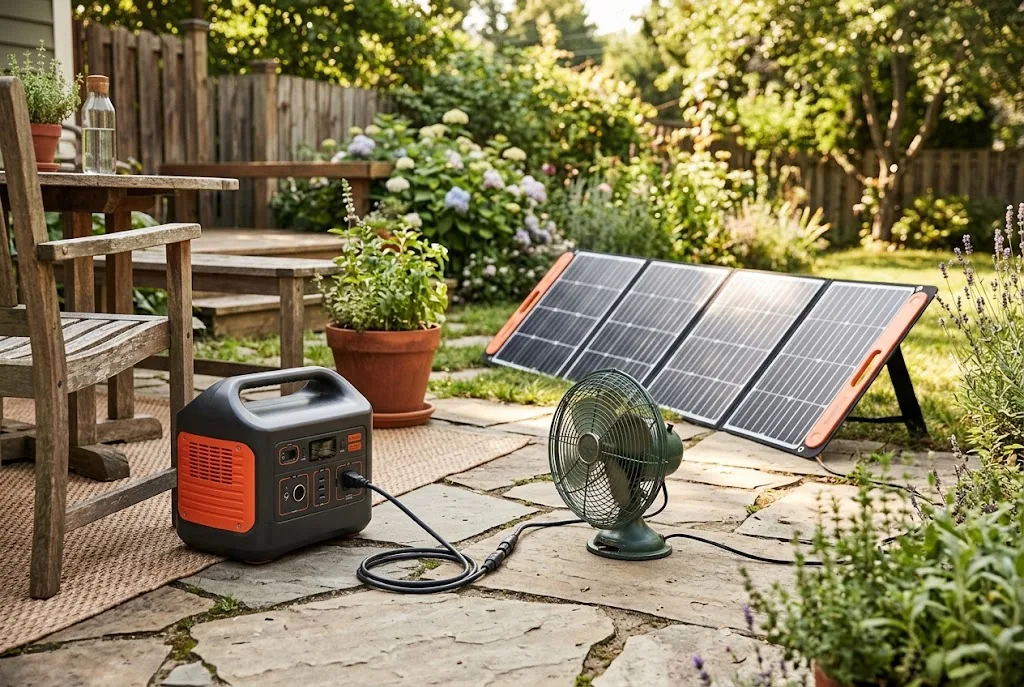
When the grid drops on the hottest afternoon of the year, the question is not “which brand?” It is “what do I actually need to keep running, and what is the cheapest, simplest way to do it?” The honest answer depends on your loads and your budget — a single overnight outage and a three-day off-grid stretch call for very different hardware.
Short answer: for most homes, a 1,000Wh-class power station with a pure sine wave inverter and solar input is the sweet spot for a summer blackout. If you need more runtime for less money and don’t mind wiring, a DIY inverter plus deep-cycle battery bank scales further per dollar. Below are five setups ranked from easiest to most capable, so you can match the hardware to your real needs.
Disclosure up front: we analyzed manufacturer specs and independent 2026 runtime reports rather than bench-testing the units, and the product links here are affiliate links. Here is how the tiers compare.
How to Size Any Setup First
Before you spend a dollar, do five minutes of math. Every appliance lists its wattage on its nameplate (Virginia Cooperative Extension); a power source lists its watt-hours (Wh). Divide watt-hours by watts for a rough runtime.
| Load | Typical draw | Runtime on 1,000Wh |
|---|---|---|
| Full-size refrigerator | ~1–2 kWh/day (cycles on and off) | 12–18 hrs |
| Two window fans | 55–250W each | 2–9 hrs |
| CPAP (humidifier off) | Low; check your model’s rating | Most of a night or more |
| Phone charge | Small | Dozens of charges |
| Window AC | Several hundred watts | A few hours at most |
The pattern is obvious once you see it: the essentials — fridge, fans, phones, a medical device — fit comfortably in a 1,000Wh budget for a night. Cooling the whole room does not. Size for the essentials and plan to stay cool the low-tech way with a DIY off-grid swamp cooler and good airflow.
1. The Grab-and-Go Starter (300Wh Station)
A small 300Wh station is the entry point: light enough to carry one-handed, big enough to charge phones dozens of times, run LED lights all night, and keep a CPAP going. What it cannot do is run a refrigerator for long: 300Wh is a fraction of the roughly 1 kWh or more a fridge uses in a day (U.S. DOE FEMP). Buy this tier only if your goal is communication and lighting, not food safety. It is a fine second unit to keep in a car, but it is not a blackout solution on its own.
2. The Household Sweet Spot (1,000Wh LiFePO4 Station)
This is the tier that solves a summer blackout for most families. A 1,000Wh unit with a LiFePO4 (lithium iron phosphate) battery runs a full-size fridge 12–18 hours, keeps fans and phones going, and uses a chemistry valued for safety and durability.
The reason LiFePO4 matters is durability. A backup battery sitting in a 95°F garage while it works is under stress; BLUETTI rates the AC180’s 1,152Wh LiFePO4 pack for 3,500+ charge cycles (BLUETTI). In 2026 it is the chemistry to look for on any station.
3. The All-Rounder (1,000Wh Station With Fast Solar)
If your unit will pull double duty — camping, tailgating, job-site power — an all-rounder with fast wall and solar recharging earns its keep. The runtime is the same 1,000Wh class, but the faster input means you top it back up sooner.
Pair either station with a folding panel and the equation changes entirely. A 200W solar panel (Amazon) can replace much of what a fridge draws overnight while the sun is up, turning “a few hours of backup” into open-ended power across a multi-day outage — and a summer blackout hands you exactly the long, cloudless days solar loves.
4. The DIY Inverter + Battery Bank (Most Capacity Per Dollar)
Here is where the ranking splits by temperament. If you are comfortable with basic wiring, a pure sine wave inverter connected to one or two deep-cycle batteries delivers more watt-hours per dollar than any sealed station, and you expand it simply by adding batteries.
The build is straightforward: connect the inverter to a bank of deep-cycle batteries (Amazon) with properly sized cables (Renogy advises the thickest wire available in the shortest practical length (Renogy)), then charge the bank from solar, a battery charger, or your vehicle. Two 100Ah 12V batteries store roughly 2,400Wh — more than double a mid-size station — at a lower cost per watt-hour. The trade-offs are real: it is heavier, it is not a carry-handle unit, and you must add charging and safety fusing yourself. But for a stationary home backup that needs to run a fridge for days, this is the value tier.
A note on safety
Whatever you build, keep it simple and correct: fuse every battery connection, use cable rated for the current, and never run a fuel-burning generator inside your home, garage, or carport; keep it at least 20 feet from doors and windows (CDC). Battery power is silent and fume-free, which is exactly why it belongs inside where a gas generator never can.
5. The Whole-Home Step-Up
A portable setup is outage insurance for the essentials. If your goal is bigger — running much of the house or cutting the power bill year-round — the next step is a permanent home solar and battery system.
The Verdict
- Easiest that actually works: a 1,000Wh LiFePO4 station like the Bluetti AC180 (Amazon) — heat-tolerant and big enough to carry a fridge overnight.
- Best all-rounder: an EcoFlow ~1,000Wh station (Amazon) for fast recharge and use beyond blackouts.
- Most capacity per dollar: a Renogy 1000W pure sine inverter (Amazon) with a deep-cycle battery bank, if you’ll do the wiring.
Whichever tier fits, add a solar panel and you turn the least reliable thing in your house — the grid — into a solved problem for the loads that matter. Pair it with a full summer blackout prep checklist and your plan to keep food cold without power, and a summer outage stops being an emergency.
Frequently Asked Questions
- How many watt-hours do I actually need for a summer blackout?
- Add up what you must run and for how long. A refrigerator uses roughly 1–2 kWh a day (the U.S. Department of Energy lists one ENERGY STAR top-freezer model at about 364 kWh a year), and fans, phones and lights add more on top. For a single hot night, a 1,000Wh unit covers the fridge and fans; for a multi-day outage you either need a 2,000Wh-plus unit or a smaller unit paired with a solar panel that recharges it every day.
- Is a DIY inverter-and-battery setup cheaper than a power station?
- Per watt-hour, usually yes — a pure sine wave inverter plus one or two deep-cycle batteries often costs less than an all-in-one station of the same capacity, and you can expand it by adding batteries. The trade-offs are weight, wiring, and the need to add charging yourself. An all-in-one station is more expensive per watt-hour but is sealed, portable, and works the moment it arrives.
- Can I run a window air conditioner during a blackout?
- Only briefly, and only from a large unit. A window AC draws several hundred watts while it runs, enough to flatten even a 1,000Wh station in a few hours. Staying cool in an outage is a job for shade, fans, and airflow, not for the battery. Reserve your stored power for the fridge, fans, phones, and any medical device.
- Do I need a pure sine wave inverter?
- For anything with a motor or sensitive electronics — a refrigerator, a CPAP, a laptop charger — yes. Per Renogy's inverter FAQ, modified sine wave power can make some equipment run hotter than normal and cause trouble with delicate electronics. Check that any all-in-one station lists pure sine wave output; if you build a DIY setup, buy a pure sine wave inverter, not a modified one.
Sources & references
- CDC, Avoiding Carbon Monoxide Poisoning (opens in new tab)
- U.S. DOE FEMP, Purchasing Energy-Efficient Residential Refrigerators (opens in new tab)
- Virginia Cooperative Extension, Estimating Appliance and Home Electronic Energy Use (opens in new tab)
- BLUETTI, AC180 Portable Power Station (opens in new tab)
- Renogy, 12V 1000W Pure Sine Wave Inverter (opens in new tab)
Before you go
The Renter's Homestead Pack
Self-reliance projects for the yard you don't own — container yields, a raised bed built to move with you, balcony preservation basics, and the landlord questions to ask first.
Free guide
The Renter's Homestead Pack
Self-reliance projects for the yard you don't own — container yields, a raised bed built to move with you, balcony preservation basics, and the landlord questions to ask first.