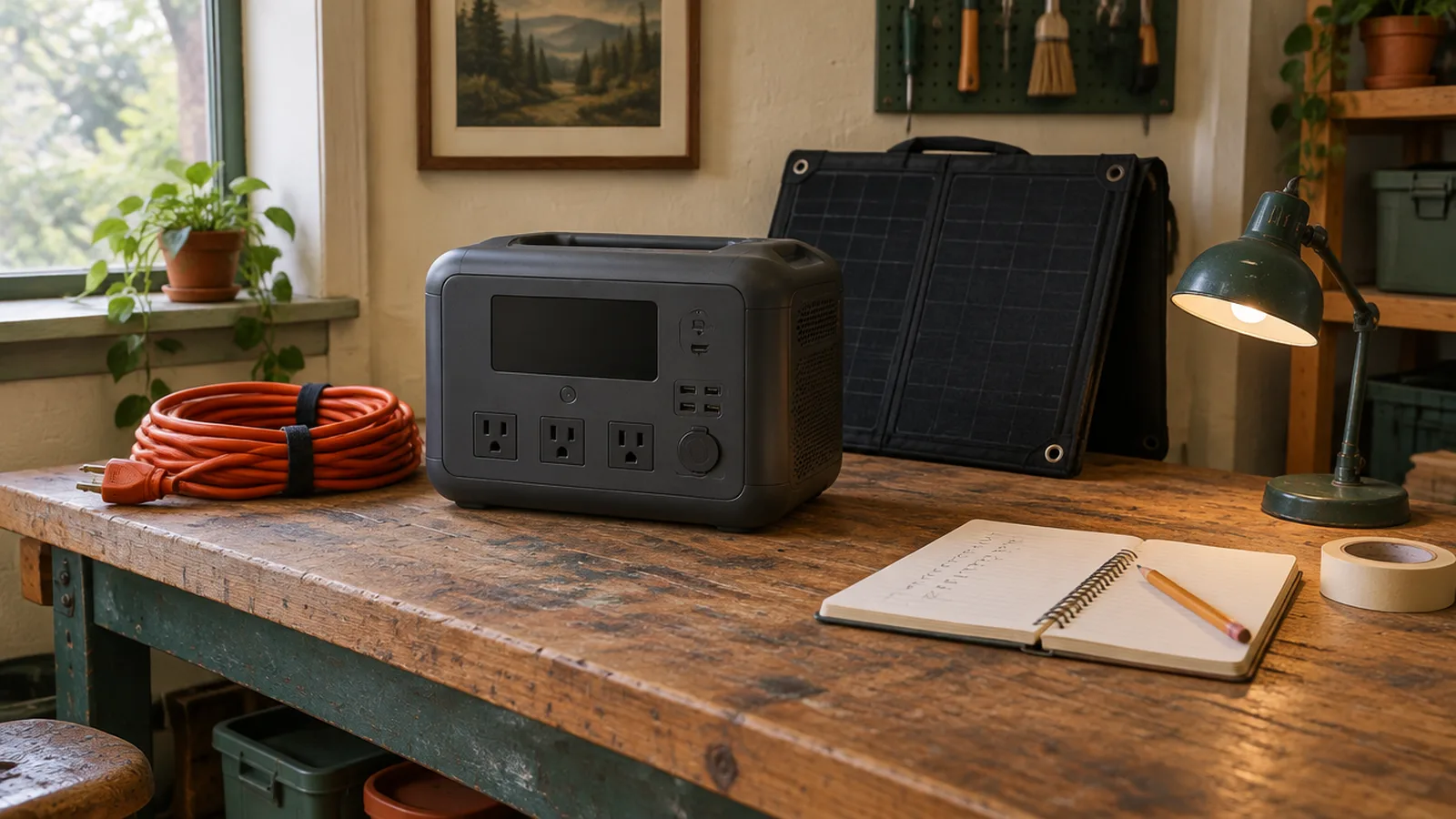
What do the numbers on a power station spec sheet actually mean?
- Watt-hours (Wh) are the tank. Watts (W) are how fast you can draw from it. A 1,152 Wh station with 1,800 W output can run a 40 W bulb for about 29 hours on paper, or a 1,800 W load for well under an hour.
- Usable energy is less than the label. One independent test measured the Bluetti AC180 delivering 85% of its rated Wh at a 380 W load and 39.9% at a 34 W load. Plan on the low end for small, steady loads.
- Boost and surge modes are fine print, not extra capacity. Both stations here list a higher output that only suits heating-type loads, and EcoFlow's manual says its boost mode is off while the station is charging.
- Price per usable Wh, checked against your own log, is the number that matters. On Nov. 3 the AC180 listed at $499.00 ($0.43 per rated Wh). The DELTA 3 Classic listed at $479 on EcoFlow's store and $462 on Amazon for Prime members ($0.47 and $0.45).
Every power station page leads with the biggest number it can find. Two numbers matter more: how much energy the battery holds, and how much it can deliver at once. Mix them up and a sale price looks like a bargain on a unit that cannot do your job.
Black Friday is November 27, less than four weeks away. Early promotions are live, so this is a good week to learn the spec sheet and work out your own numbers before a countdown clock does it for you.
The short answer: Watt-hours (Wh) tell you how long. Watts (W) tell you how much at once. Multiply a device’s watts by the hours you need to get its Wh, add them up, and divide by a realistic usable share of the battery, not the label. For small, steady loads, assume well under the 85% best case. Then compare units on price per usable Wh against your own price log.
This is a research-based guide. We have not bought or tested either power station named here. Spec numbers come from the makers’ pages, a user manual, agency and extension guidance, and one independent test, read on November 1, 2026. We re-read prices and terms on November 3. Some links below are affiliate links, so we may earn a commission if you buy through them, at no extra cost to you. Anything that ties into your home wiring is a job for a licensed electrician.
What We Saw on November 3
EcoFlow’s US store was running an “Early Black Friday” sale from November 2 to 18 when we checked, billed as up to 52% off. On November 3 it listed the DELTA 3 Classic on its own at $479, down from $599. Bluetti’s US store listed the AC180 at $499.00 the same day, with no discount shown. Two days earlier, a check of the same page showed US$449 with a $50 banner and a countdown clock, so prices there move fast.
Ready.gov tells households to inventory the items they need that rely on electricity, and to plan for batteries and other alternative power for when the power goes out (last updated June 4, 2026). Reading a spec sheet turns that inventory into a purchase.
Watts and Watt-Hours, Without the Jargon
The U.S. Energy Information Administration puts it simply. Watts measure power at a specific moment. Watt-hours measure how much electricity is used over a period of time. One watt-hour is one watt used for one hour. Its example is a 40 W bulb used for five hours, which is 200 Wh, or 0.2 kWh (EIA, read Nov. 1, 2026).
On a power station, that gives you a short glossary:
| Spec | Question it answers | Watch for |
|---|---|---|
| Capacity (Wh) | How much energy is stored? | A rated number. You will not get all of it out (see below). |
| AC output (W, continuous) | What can I run at the same time? | Add up the running watts of every device you plug in. |
| Surge or boost (W) | Can it start a motor or heater? | A short burst, not extra battery. Often limited to certain loads. |
| AC input (W) | How fast does it refill from the wall? | “0 to 80%” is not “full.” |
| Solar input (W, V, A) | How fast can panels refill it? | A ceiling, with a voltage window your panels must fit. |
| Cycles and warranty | How long will the battery last? | Cycles “to 80%” mean 80% of original capacity remains. |
Two Spec Sheets, Side by Side
We picked the two 1 kWh-class stations behind our affiliate links, the Bluetti AC180 and the EcoFlow DELTA 3 Classic. Both Amazon listings matched those model names on November 3. Bluetti is the seller on one, EcoFlow Inc. on the other.
| Spec | Bluetti AC180 | EcoFlow DELTA 3 Classic |
|---|---|---|
| Capacity | 1,152 Wh | 1,024 Wh |
| Continuous AC output | 1,800 W | 1,800 W |
| Surge or boost | 2,700 W “Power Lifting Mode,” for pure-resistive heating devices | 3,600 W surge, plus X-Boost to 2,600 W at 120 V |
| AC input (charge) | 1,440 W max | 1,400 W max |
| Solar input | 500 W max, 12 to 60 V open-circuit, 10 A | 500 W max, 11 to 60 V, 15 A |
| Chemistry | LiFePO4, 3,500+ cycles to 80% | LiFePO4. No cycle count on the pages we read |
| Weight | 35.3 lb, 35.27 lb and 37 lb on Bluetti’s pages, 37.4 lb on Amazon | 12.1 kg (about 26.7 lb), also 26.7 lb on Amazon |
| Warranty | ”5 years” on Bluetti’s product page. Its policy page says 24 to 72 months (see terms below) | 5 years (3 standard plus 2 with app registration) |
| Price we read (Nov. 3) | $499.00 on Bluetti’s US store and on Amazon | $479 on EcoFlow’s store (was $599). $462 on Amazon for Prime members (regular $559) |
The EcoFlow is lighter and holds 128 Wh less. The Bluetti shows four different weights across its own pages and Amazon, so check the one on the box before you plan a staircase.
The Fine Print That Changes Your Number
1. Usable energy is less than rated energy. Outdoor Life’s roundup of 12 power stations is the only independent figure we found for the AC180. It measured how much of the stated Wh each unit delivered. The AC180 gave 85% at a steady 380 W draw and 39.9% at a steady 34 W draw, with 14 W of inverter overhead. The page is undated, its text says about 47% where its own table says 39.9%, and it tested the older DELTA 2 rather than the DELTA 3 Classic, so treat it as a guide to the pattern, not a rating. Small, steady loads waste the most.
2. Boost modes have conditions. Bluetti says the AC180’s Power Lifting Mode is for pure-resistive heating devices like kettles and heaters. EcoFlow’s manual says X-Boost suits heating devices, does not support devices with voltage protection, and is unavailable while the station is charging or in bypass. Neither is extra capacity.
3. Fridges can trip an auto-off. EcoFlow’s manual warns that the AC output turns off after an idle period and that intermittent loads like refrigerators can trigger it. It advises setting the timeout to “never” in the app.
4. Recharge figures have conditions too. Bluetti lists 2.8 to 3.3 hours from 500 W of solar “with prime sunshine, ideal orientation and low temperature.” EcoFlow’s page says within 6 hours from a 220 W panel. At full panel rating that is 4.7 hours, so even the maker budgets for losses. In November, expect more. Our guide to sizing a solar setup for fall and winter shows how to work that out.
5. Storage and medical loads. Bluetti says to recharge a stored unit to 80% every three to six months. EcoFlow’s manual says the DELTA 3 Classic is not intended for life-sustaining medical equipment, and Ready.gov tells households to talk to a medical provider about an outage plan for powered medical devices.
Run the Math for Your Own House
Here is a worked example with assumed wattages, so replace them with the numbers on your own nameplates. The goal is to cover a 12-hour overnight outage for a refrigerator, a few lights and a router.
| Load | Assumed running watts | Hours | Energy |
|---|---|---|---|
| Refrigerator (150 W nameplate, runs about a third of the time) | 150 W | 12 h plugged in, 4 h running | 600 Wh |
| LED lights | 40 W | 5 h | 200 Wh |
| Router and modem | 10 W | 12 h | 120 Wh |
| Total | 200 W running at the same time | 920 Wh |
The one-third rule for the fridge comes from Virginia Cooperative Extension, which says to divide the hours a refrigerator is plugged in by three to estimate the hours it operates at its maximum wattage (Virginia Cooperative Extension, read Nov. 1, 2026). The 40 W for 5 hours is the EIA example. A plug-in watt meter measures the fridge’s start-up surge, which most labels omit.
Now work backward from 920 Wh. The rated Wh you need is the energy you want divided by the share you can actually use:
| Usable share | Where it comes from | Rated Wh needed for 920 Wh | AC180 (1,152 Wh) | DELTA 3 Classic (1,024 Wh) |
|---|---|---|---|---|
| 85% | Best case. AC180 at a 380 W load (Outdoor Life) | 1,082 Wh | Clears by 70 Wh | Short by 58 Wh |
| 60% | Our assumed midpoint | 1,533 Wh | Short | Short |
| 40% | AC180 at a 34 W load (Outdoor Life) | 2,300 Wh | Short | Short |
This house averages about 77 W over the 12 hours, between the two test points. On the best case the AC180 passes and the DELTA 3 Classic misses by a hair. On anything less, both miss. The cheapest fix is often fewer watts: cut the lights from 5 hours to 2 and the total drops by 120 Wh.
If you would rather score the whole house, our Blackout Readiness Score asks six quick questions about power, water, food and light and shows your three biggest gaps.
Price per Usable Watt-Hour
Take the price and divide it by capacity. Here is what we read, with the date and the seller:
| Date | Unit and seller | Price | Per rated Wh |
|---|---|---|---|
| Nov. 1, 2026 | AC180, Bluetti US store | $449 (list $499, countdown banner) | $0.39 |
| Nov. 3, 2026 | AC180, Bluetti US store | $499.00 | $0.43 |
| Nov. 3, 2026 | AC180, Amazon (seller Bluetti) | $499.00 | $0.43 |
| Nov. 3, 2026 | DELTA 3 Classic, EcoFlow store, unit alone | $479 (was $599) | $0.47 |
| Nov. 3, 2026 | DELTA 3 Classic, Amazon (seller EcoFlow Inc.) | $462 for Prime members (regular $559) | $0.45 ($0.55 at regular) |
At 85% usable, 979 Wh, the AC180 at $499 is $0.51 per usable Wh. Outdoor Life measured $0.66 per usable Wh for the AC180 at its undated test price. We did not apply a usable share to the DELTA 3 Classic because we found no independent test of it.
On November 3 the two units sat within two cents per rated Wh of each other, if you count the Prime price for the EcoFlow. At its regular $559 the Classic costs about 11 cents more per rated Wh. The Bluetti page also moved $50 in two days. Our guide to building a prep-gear price baseline shows the five fields to log, so a “was” price in a banner never sets your idea of a deal.
Returns, Warranty and Complaints
These are the other lines of the price tag, read on November 3, 2026.
Returns. Both Amazon listings say “Non-returnable,” with a note that transporting the item is subject to hazardous materials regulation. Bluetti’s policy page lists a 30-day money-back guarantee for its official store, and its product page says it refunds the difference if you find a lower price from Bluetti within 30 days of purchase. We did not read EcoFlow’s store return policy.
Warranty. Bluetti’s product page says “5-year.” Its policy page says power station warranties run 24 to 72 months, asks for proof of an order from official Bluetti stores, and excludes units from unauthorized resellers. The Amazon seller is Bluetti, but we could not confirm how Bluetti treats an Amazon order, so ask Bluetti support before you count on five years.
Ratings and complaints. Amazon showed 4.5 stars from 1,887 ratings for the AC180 and 4.7 from 1,390 for the DELTA 3 Classic. Bluetti’s store showed 4.8 from 447 reviews. Amazon’s review text needs a sign-in, so we did not read the complaints. The Solar Lab’s hands-on review of the Classic (undated) lists three AC outlets with one ungrounded, no 12 V car socket, no built-in light, no add-on batteries and a modest solar input, and calls the unit quiet. We found no independent complaint data for the AC180 beyond the usable-energy and weight points above.
Who Each Unit Fits, and Who Should Skip It
Bluetti AC180. It fits a household that wants the most rated energy in this class, mostly stays put, and plans around short outages. It does not fit someone who will carry 35 to 37 lb up stairs, or who mostly runs small steady loads such as a router all night, where the one independent test showed the lowest usable share. Read our Bluetti AC180 vs EcoFlow winter blackout comparison for how both behave in the cold.
EcoFlow DELTA 3 Classic. It fits a household that values a lighter unit, about 26.7 lb, and a fast 1,400 W wall charge, and whose loads fit inside 1,024 Wh. It does not fit anyone who wants the most energy per dollar at the regular price, a 12 V car socket, more outlets or add-on batteries. Amazon’s listing says the Classic is not compatible with the DELTA 2 Smart Extra Battery or the DELTA 3 Series Smart Extra Battery (read Nov. 3).
Other units to price against. Outdoor Life measured the older EcoFlow DELTA 2 at 67% of stated Wh at 34 W and 88% at 380 W, and the Anker SOLIX C1000 at 62% and 90%. Check current versions and prices first.
Your Spec-Sheet Checklist
Numbers are per household. Scale the example to yours.
| Step | Do this | Your number |
|---|---|---|
| Now (this weekend, no purchase) | List what must run in an outage. Read the wattage on each nameplate. Multiply watts by hours to get Wh. Add up the total. | 920 Wh in our example |
| This month (before Nov. 27) | Divide your Wh by 0.85 for the best-case rated size, then by lower shares for small steady loads. Write the price of two or three candidates in your log. Check each unit’s boost conditions, auto-off setting and panel voltage window. Read the return terms, seller and warranty channel before you order. | 1,082 Wh best case in our example |
| Optional (this winter) | Run your real loads on a plug-in watt meter for an evening and update the math. Add panels sized for November sun. Recharge a stored unit to 80% every three to six months. | Your measured watts |
Where Black Friday Fits
A sale does not change what you need. It changes what you pay for it. Settle your Wh number first, pick two or three units that clear it, log their prices today, and compare each live price against that log. EcoFlow’s early sale ends November 18, Black Friday is November 27, and Cyber Monday is November 30. A price on a sold-out page tells you nothing.
What We Could Not Confirm
- Amazon review text. It needs a sign-in, so we have not read buyer complaints. Read the lowest-rated reviews on the live page before you buy.
- Amazon price conditions. We read Amazon with a New York delivery ZIP code. Price and delivery can differ by location, and the $462 EcoFlow price is a Prime-member price.
- Why the Bluetti price changed. The page showed $449 with a countdown on November 1 and $499.00 on November 3. We did not see the promotion’s terms.
- Warranty and returns. We could not confirm whether a Bluetti order on Amazon qualifies for the longer warranty, and we did not read EcoFlow’s store return window.
- Black Friday prices. We have prices from November 3 only.
- Test coverage. EcoFlow’s pages give “10 years” but no cycle count. We found no independent usable-capacity test for the DELTA 3 Classic.
We will update this page when sale prices and review text can be checked.
The Takeaway
Wh is the tank, W is the pour rate. Add up your loads in Wh, divide by a usable share you can defend, and shop for that number. Log the price today, read the return terms, then use the sale to confirm it.
Frequently Asked Questions
- What is the difference between watts and watt-hours on a power station?
- Watts measure power at one moment. Watt-hours measure energy over time. The U.S. Energy Information Administration gives the example of a 40 W bulb used for five hours, which is 200 Wh. A power station's Wh rating is its tank, and its W rating is how fast it can pour. The AC180 lists 1,152 Wh and 1,800 W continuous output, so it can power up to 1,800 W of devices at once, for as long as the energy lasts.
- How do I estimate how long a power station will run my refrigerator?
- Virginia Cooperative Extension says a refrigerator cycles on and off, so divide the hours it is plugged in by three to estimate the hours it runs at full wattage. A fridge with a 150 W nameplate over 12 hours is about 4 hours at 150 W, or 600 Wh. Then divide by the share of rated capacity you can actually use, which runs from about 40% to 85% in one independent test, and add margin.
- Is the Bluetti AC180 or the EcoFlow DELTA 3 Classic better for a home outage?
- It depends on the load. As of Nov. 3 the AC180 lists 1,152 Wh and the DELTA 3 Classic lists 1,024 Wh, both with 1,800 W of AC output and a 500 W solar input limit. The AC180 gives more rated energy and weighs about 35 to 37 lb. The DELTA 3 Classic lists 12.1 kg, about 26.7 lb, and a 1,400 W AC input. On Nov. 3 the prices were close per rated Wh: $0.43 for the AC180 at $499, and $0.45 for the Classic at the $462 Prime price on Amazon. For an overnight fridge, lights and router plan, the extra 128 Wh of the AC180 is the difference between a pass and a miss in the best case of our worked example.
- Will a power station's solar input rating charge it that fast?
- Not as a rule. The solar input rating is a ceiling. Bluetti lists 2.8 to 3.3 hours from 500 W of panels and attaches the words prime sunshine, ideal orientation and low temperature to that figure. In November, with short days and a lower sun, expect longer. The panels also have to fit the voltage window on the spec sheet, 12 to 60 V open-circuit on the AC180.
- Should I wait for Black Friday to buy a power station?
- Only if you know your number. Black Friday is Nov. 27 and Cyber Monday is Nov. 30. EcoFlow's US store runs an early Black Friday sale from Nov. 2 to Nov. 18 and listed the DELTA 3 Classic at $479, down from $599, on Nov. 3. Bluetti's store showed the AC180 at $499.00 on Nov. 3, and $449 with a countdown banner on Nov. 1. Prices on these pages move within days. Log the price now, then compare it to the live price in the sale.
Sources & references
- Ready.gov (FEMA), Power Outages (last updated June 4, 2026) (opens in new tab)
- U.S. Energy Information Administration, Measuring electricity (opens in new tab)
- Virginia Cooperative Extension, Estimating Appliance and Home Electronic Energy Use (publication 2901-9014) (opens in new tab)
- BLUETTI, AC180 specifications page (read Nov. 1, 2026) (opens in new tab)
- BLUETTI, AC180 US store listing (read Nov. 1 and Nov. 3, 2026) (opens in new tab)
- BLUETTI, warranty policy (read Nov. 3, 2026) (opens in new tab)
- EcoFlow, DELTA 3 Classic product page (read Nov. 1 and Nov. 3, 2026) (opens in new tab)
- EcoFlow, DELTA 3 Classic user manual (read Nov. 1, 2026) (opens in new tab)
- EcoFlow US, Black Friday page (read Nov. 1 and Nov. 3, 2026) (opens in new tab)
- The Solar Lab, EcoFlow DELTA 3 Classic review (undated page, read Nov. 3, 2026) (opens in new tab)
- Outdoor Life, The Ultimate Guide to Portable Power Stations (undated page, checked Nov. 1, 2026) (opens in new tab)
Before you go
The 7-Step Blackout Plan
A calm, practical plan for getting a household through a multi-day power outage: power, water, food, temperature, light, medical and a written plan.
Free guide
The 7-Step Blackout Plan
A calm, practical plan for getting a household through a multi-day power outage: power, water, food, temperature, light, medical and a written plan.