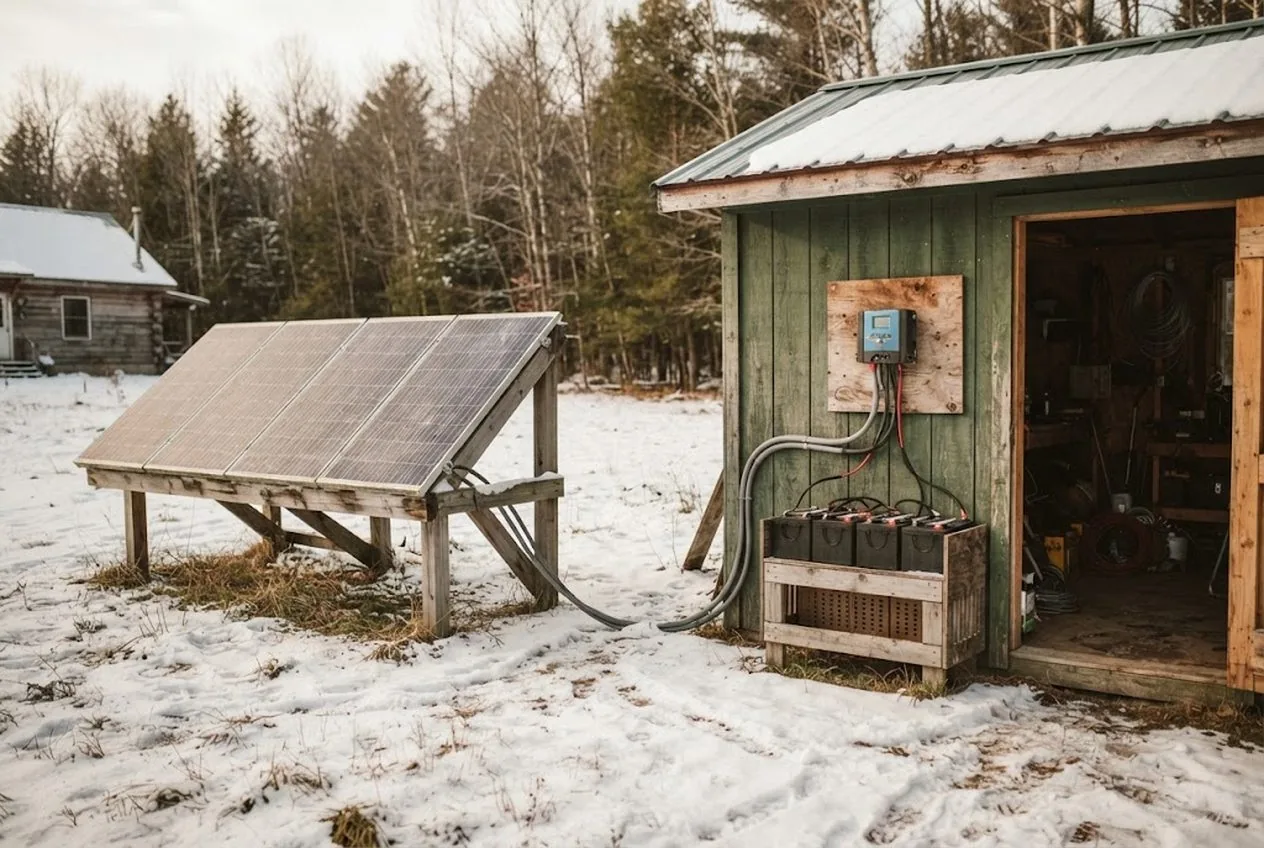
Every off-grid solar setup that fails does it in the same season. It runs beautifully all summer, the batteries sit full by noon, and then the days shorten, the clouds roll in, and by January the lights are flickering and the inverter is beeping a low-battery alarm at breakfast. The panels didn’t break. The system was sized for summer sun and asked to do a winter job.
Here’s the short version: you size a fall-and-winter solar setup around the few hours of weak daylight you actually get, not the panel’s sticker wattage. That means adding up your real loads, dividing by your local winter sun hours, then oversizing both the array and the battery bank so a run of dark, snowy days doesn’t leave you cold. This guide walks the whole calculation, step by step.
Why Winter Is the Hard Season for Solar
It surprises people, but cold weather isn’t the enemy — solar cells generally work best at low temperatures (U.S. Department of Energy). The problem is light. In winter the sun sits low on the horizon, the days are short, and clouds and snow eat into what little daylight remains. A spot can see far fewer peak-sun hours in December than in June.
That single number drives everything. A 200W panel rated to make 200 watts in full sun produces its rated output for only those few peak hours, so the same panel that banked plenty of energy in July can fall short in December against the very same load. Winter sizing, then, is really the art of squeezing enough watt-hours out of a handful of weak sun hours — and building in enough battery to ride through the days that give you almost nothing.
Step 1: Add Up Your Daily Loads in Watt-Hours
Solar sizing starts with demand, never with panels. Go through everything you’ll run and, for each, multiply its wattage by the hours per day you use it. That gives watt-hours (Wh), the unit that makes the whole calculation work.
A modest off-grid load list might look like this:
| Device | Watts | Hours/day | Watt-hours/day |
|---|---|---|---|
| LED lights (several) | 40 | 5 | 200 |
| Laptop | 50 | 4 | 200 |
| Phone charging | 15 | 3 | 45 |
| Wi-Fi router | 10 | 24 | 240 |
| Fridge (cycling) | 120 | ~8 effective | ~960 |
Add them up. In this example you’re near 1,645 Wh/day — and note the fridge alone is more than half of it. Winter has a way of quietly inflating this list: lights burn longer in the dark months, and any electric heating helper — a furnace blower, a well-pump cycle, a stock-tank heater — lands with a heavy watt-hour cost. Build your list for the season you’re actually sizing for, not a mild autumn afternoon.
Step 2: Find Your Winter Peak-Sun Hours
Now find how much sun your location really delivers in the dead of the season. “Peak-sun hours” is the number of hours per day equivalent to full-strength sun, and it’s published for nearly every region. Use the lowest realistic month you intend to run on solar — December or January for most of us.
The general pattern:
- Northern US / cloudy climates: the fewest winter peak-sun hours
- Middle latitudes: somewhat more
- Sunny Southwest: the most
If you’re unsure, size to the low end. Planning around three hours and getting four is a happy surprise; planning around five and getting three is a dead battery bank in the coldest week of the year.
Step 3: Size the Panel Array
Here’s where the two numbers meet. Divide your daily watt-hours by your winter peak-sun hours to get the raw panel wattage you need:
1,645 Wh ÷ 3 sun hours ≈ 550W of panel
Then add 20–30% on top for the losses no spec sheet mentions: dust and snow on the glass, charge-controller and wiring inefficiency, battery round-trip loss, and simple bad luck with the weather. That pushes our example to roughly 700W of panel to reliably cover 1,645 Wh through a three-sun-hour winter.
This is why a single rigid panel is best thought of as a building block. A 200W panel is a practical, widely available unit you can scale — run three or four of them to reach the array size your winter math demands.
Disclosure: the product links here are affiliate links, so we may earn a commission if you buy through them at no extra cost to you. The sizing figures here reflect long-standing off-grid and manufacturer guidance, not a single brand’s marketing.
For a full breakdown of how a 200W panel actually performs as the core of a cold-season system, see our Renogy 200W solar panel review.
Step 4: Size the Battery Bank
Panels make power only while the sun is up; the battery bank is what carries you through the night and, more importantly in winter, through the cloudy days that give you almost nothing (U.S. Department of Energy). Size it around days of autonomy — how long you need to run with little or no charging (U.S. Department of Energy).
The formula:
Daily watt-hours × days of autonomy ÷ usable depth of discharge = battery capacity needed
Take our 1,645 Wh/day and plan for 2 days of autonomy:
- Lead-acid (usable to ~50%): 1,645 × 2 ÷ 0.5 = 6,580 Wh of bank
- Lithium (LiFePO4) (usable to ~85%): 1,645 × 2 ÷ 0.85 ≈ 3,870 Wh of bank
Two winter cautions. First, cold temporarily robs lead-acid batteries of usable capacity — a bank that’s fine at 70°F can deliver noticeably less near freezing, so keep the batteries insulated and out of the hard cold, and never plan to draw them flat during a freeze. Second, don’t skimp on autonomy in a cloudy climate; a single-day bank leaves no cushion for the three-day overcast stretch winter loves to deliver.
Step 5: Match the Charge Controller and Wiring
The last piece ties the array to the bank: the charge controller, which regulates the panels’ output so it charges the batteries safely. In winter, the type matters.
- MPPT controllers actively track the panel’s best operating point and convert excess voltage into extra charging current — noticeably more harvest in cold, low-light conditions than a basic PWM controller. They also let you wire panels in series at higher voltage, which cuts losses over the long cable runs common in backyard and cabin setups.
- PWM controllers are cheaper and fine for a small, matched 12V panel-and-battery pairing, but they leave winter energy on the table.
For any real fall-and-winter system, MPPT earns its price back in the exact months you need every watt-hour. Size the controller for your array’s total current and your battery voltage (12V, 24V, or 48V), and size your cables for the current and distance so voltage drop doesn’t quietly steal output.
A Worked Example, Start to Finish
Putting the five steps together for our sample cabin:
- Loads: ~1,645 Wh/day.
- Winter sun: 3 peak-sun hours.
- Array: 1,645 ÷ 3 ≈ 550W, +30% ≈ 700W of panel (four 200W panels, or three plus headroom).
- Battery: 2 days autonomy → about 3,900 Wh of lithium or 6,600 Wh of lead-acid.
- Controller: an MPPT unit sized to the array’s current at your chosen bank voltage.
Change the loads and the numbers move, but the method never does. Cut the fridge and the whole system shrinks; add electric heat and it grows fast. The discipline is always the same: size to winter’s demand and winter’s weak sun, then add margin.
Don’t Forget the Backup
Even a well-sized winter array can fall behind during a week of solid overcast and snow. That’s not a design failure — it’s why nearly every serious off-grid setup in a cloudy climate keeps a generator on hand to top the batteries when the sun simply doesn’t show. Sizing the panels for the single darkest week of the decade is wildly expensive; a small backup that covers those rare stretches is cheap insurance (U.S. Department of Energy). We break down that decision in solar generator vs gas generator for winter backup.
The Bottom Line
Winter is the season that exposes an undersized solar setup, and it does it with math you can run at the kitchen table. Total your watt-hours, divide by your honest winter sun hours, oversize the array by a third, build a battery bank with two to three days of autonomy, and tie it together with an MPPT controller. Do that, and the darkest, shortest days of the year stop being the moment your system fails — and become just another stretch it was built to carry.
Frequently Asked Questions
- How many watts of solar do I need for winter?
- Start from your loads, not a panel count. Add up the watt-hours you use in a day, then divide by your winter peak-sun hours — often only a few in much of the country — to get the wattage of panel array you need, and add 20–30% on top for cold, cloudy stretches. A cabin running lights, a laptop, and phone charging might need 300–400W of panel in winter; add a fridge and you're quickly into 600W or more. The short days are what make winter demanding, not the cold itself.
- Do solar panels work in the cold?
- Yes, and the panels themselves actually produce slightly more efficiently in cold air than in summer heat. The winter problem is not temperature but daylight: the sun is lower, the days are short, and clouds and snow cut your production hours. That's why winter sizing is all about squeezing enough energy out of very few sun hours, and why you oversize the array and the battery bank rather than the panel's rated wattage alone.
- How big should my battery bank be for winter?
- Size the bank to carry your loads through the longest stretch you expect without a good charge — usually 2–3 days of autonomy for a fall-and-winter setup. Take your daily watt-hours, multiply by the days of autonomy, then divide by the usable depth of discharge (about 50% for lead-acid, 80–90% for lithium). Cold also temporarily cuts usable lead-acid capacity, so keep the bank insulated and don't plan to draw it flat in a freeze.
- PWM or MPPT charge controller for winter?
- MPPT, if the budget allows. An MPPT controller harvests noticeably more energy from a panel in cold, low-light conditions than a basic PWM controller, precisely when every watt-hour counts. It also lets you wire panels in series at higher voltage, which reduces losses on long winter cable runs. For a small, matched 12V panel-and-battery setup a PWM controller works, but for a real fall-and-winter system MPPT is worth it.
- Should I add a generator as backup for winter solar?
- For most off-grid setups in a cloudy climate, yes. Even a well-sized array can fall behind during a week of overcast, snowy weather, and a small inverter generator or a fuel-based backup lets you top the batteries off rather than run them dangerously low. Think of winter solar as your primary source and a generator as the insurance that covers the worst stretches — the pairing is far cheaper than sizing the array for the darkest possible week.
Sources & references
Before you go
The Renter's Homestead Pack
Self-reliance projects for the yard you don't own — container yields, a raised bed built to move with you, balcony preservation basics, and the landlord questions to ask first.
Free guide
The Renter's Homestead Pack
Self-reliance projects for the yard you don't own — container yields, a raised bed built to move with you, balcony preservation basics, and the landlord questions to ask first.