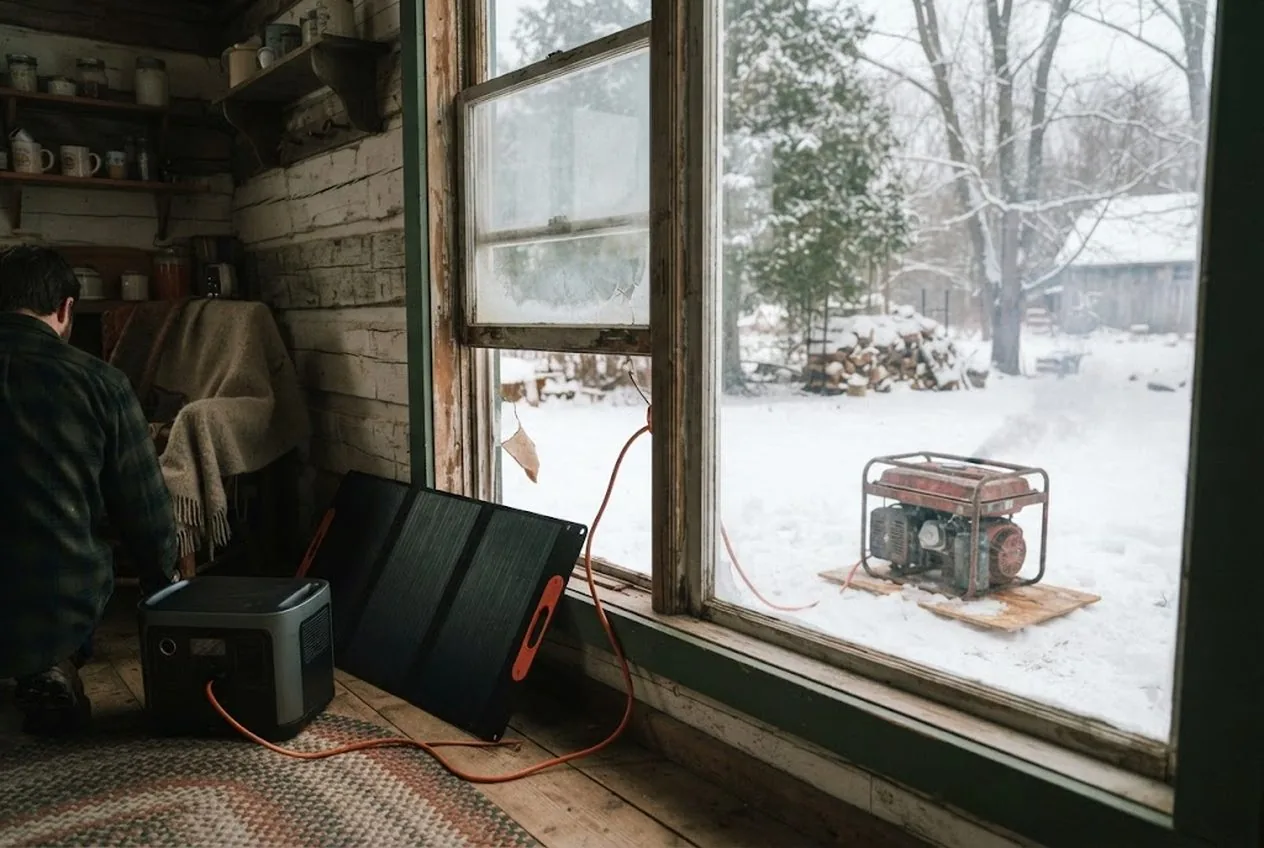
When the grid drops in the dead of winter, the question isn’t academic anymore. The furnace won’t circulate heat, the fridge is warming, and the pipes are one cold night from bursting. Two very different machines promise to bridge the gap: the solar generator — a battery power station recharged by panels — and the old-reliable gas generator. They’re often pitched as rivals, but in winter they’re better understood as tools for different jobs. Here’s how each actually performs when it’s cold, and which belongs in your plan.
Short answer: a solar generator wins on safety, silence, and hands-off reliability for indoor essentials, while a gas generator wins on raw sustained power and unlimited runtime on fuel for heavy loads and long outages. In a cold climate, many households are best served by owning both — and if you own one, the winter safety rules are non-negotiable. Below, the honest comparison.
Disclosure up front: this comparison reflects manufacturer specs, independent reviews, and long-standing safety guidance rather than a side-by-side bench test, and the product links here are affiliate links. With that said, here’s how they compare.
Solar vs Gas Generator: Side-by-Side
| Solar Generator (battery) | Gas Generator | |
|---|---|---|
| Power source | Stored battery, recharged by panels | Gasoline (or propane/dual-fuel) |
| Sustained output | Limited by battery capacity | High — runs as long as you have fuel |
| Runtime | Hours to a day per charge | Indefinite with refueling |
| Safe indoors? | Yes — no fumes | No — carbon monoxide, outdoors only |
| Noise | Silent | Loud |
| Winter recharge | Slow — short, cloudy days | Refuel anytime |
| Cold starting | Flip a switch | Can be hard to start in cold |
| Maintenance | Minimal | Oil, fuel, plugs, storage |
| Best winter role | Quiet indoor essentials | Heavy loads, multi-day outages |
Two rows decide most of it: safety (which is a hard line, not a preference) and sustained power (where gas simply does more). Everything else follows from those.
The Safety Line You Cannot Cross
Before anything else, understand the one rule that matters most in winter: a gas generator must run outdoors, always. It produces carbon monoxide — invisible, odorless, and deadly — and most generator incidents reported to the U.S. Consumer Product Safety Commission involve CO poisoning from generators used indoors or in partially enclosed spaces, and CPSC warns never to run one in a home or garage, even with doors and windows open (CPSC). It’s a real temptation in cold-weather outages, when people want to bring the machine in from the snow. Run a gas generator outdoors, at least 20 feet from windows, doors, and attached garages, and keep a CO alarm inside the house (Ready.gov).
This is exactly where a solar generator’s biggest winter advantage lives: it emits nothing, so it’s safe to run right beside you indoors, keeping the fridge and lights going in the warm part of the house while a storm rages outside. For anyone who’s nervous about generator safety — and everyone should be — that alone is a powerful reason a battery unit anchors the indoor side of a winter plan.
Where Gas Wins: Sustained Power and Runtime
Give the gas generator its due, because in one dimension it’s unmatched. A mid-size gas generator delivers far more sustained power than a portable battery unit and runs as long as you keep feeding it fuel — through days of outage if you’ve stored enough. That makes it the right tool for the heavy stuff: a well pump, a whole-home load through a transfer switch, or the high-draw appliances a battery simply can’t carry for long.
The catches are real, though. It’s loud, it needs fuel you have to store and rotate (and that stations may not sell if their pumps are down), it demands maintenance — oil, spark plugs, fuel stabilizer — and it can be stubborn to start in the cold, when fuel and oil thicken. Cold-weather reliability is a discipline: fresh stabilized fuel, winter-weight oil, and periodic test starts so the machine is actually ready when you need it.
For the DIY-minded, the heart of a battery-based backup is a good inverter that turns stored DC into clean household AC — the same component that lets you build power capacity around a battery bank rather than an engine.
Where Solar Wins: Silence, Safety, and Set-and-Forget
A solar generator’s strengths are the mirror image of the gas unit’s weaknesses. It’s silent, so it won’t keep the house awake or announce to the neighborhood that you have power. It’s fume-free and safe indoors. It needs no fuel to store and almost no maintenance — no oil, no plugs, no stale-gas headaches. And it starts with a switch, every time, no matter how cold, which for hands-off winter reliability is worth a great deal.
Its honest limit is the flip side: battery capacity caps how much you can run, and winter recharging is slow. Short, cloudy days mean panels may not refill the battery the way they do in summer (U.S. Department of Energy), so you often live on the stored charge and top up from the wall (or a brief generator run) when you can. That’s why sizing matters so much — our guide on how to size a solar setup for fall and winter shows why winter demands far more panel and battery than the same loads need in July, and our Renogy 200W panel review covers the workhorse panel most of those winter arrays are built from.
A small solar generator is the entry point: enough to keep phones, lights, a radio, and small devices alive quietly and safely, and a sensible first purchase before you scale up.
Matching the Tool to the Winter Load
What you need to run should drive the choice more than brand loyalty:
| Winter need | Solar generator | Gas generator |
|---|---|---|
| Phones, lights, radio | Ideal — silent, indoors | Overkill, and loud |
| Fridge overnight | Yes, with a 1,000Wh+ unit | Yes, easily |
| Furnace blower (gas furnace) | Yes, intermittently | Yes, sustained |
| Well pump | Usually too much | Yes |
| Whole-home / electric heat | No | Yes, with proper setup |
| Multi-day outage | Only if you can recharge | Yes, with stored fuel |
The pattern is clear: the solar generator owns the quiet indoor essentials, and the gas generator owns the heavy, sustained, multi-day loads. They overlap in the middle — a fridge, a furnace blower — but push to the edges and each becomes the obvious answer.
So Which Should You Buy?
The right pick depends less on brand loyalty than on which of these four situations matches you:
Best Overall
For most winter-resilience-minded households, the answer is both. A portable solar generator covers the quiet, safe, indoor essentials — phones, lights, a fridge, a furnace blower — while a gas generator, run outdoors with a CO alarm inside, handles the heavy and multi-day loads a battery can’t carry for long. Owning both also covers solar’s one real weakness: on a sunless stretch, you can recharge the battery unit from the gas generator instead of waiting on the panels.
Best Home Backup
If your priority is keeping a whole house running through a multi-day outage — a well pump, a furnace blower, and more — a gas generator is still the better-suited machine. It delivers far more sustained power than any portable battery unit and runs as long as you keep it fed with fuel. The trade-off is real: it must run outdoors, at least 20 feet from windows, doors, and attached garages, with a CO alarm inside the house, and it needs stored, rotated fuel plus periodic maintenance to start reliably in the cold.
Best for RV/Van Life
In a vehicle or any enclosed space, the calculus tilts hard toward solar. The same traits that make a solar generator the safer indoor choice at home — silent operation, no exhaust to vent, nothing to start in the cold — matter even more in the tight quarters of an RV or a van, where a gas generator’s carbon-monoxide risk is concentrated in far less air. A compact unit like the 300W Portable Solar Generator can run phones, lights, and small devices safely right beside you, with no fuel to store and no fumes to manage on the road.
Best Budget Pick
If you’re starting small and want the most affordable way into safe backup power, this is it. The 300W Portable Solar Generator is the entry point of this lineup — a compact battery station for phones, lights, a weather radio, and small devices, safe to run indoors with no fuel to store and almost no maintenance. It won’t carry a fridge or a furnace blower, but as a low-cost first layer of backup you can scale up later with a battery bank and a pure sine wave inverter, it’s a sensible place to start.
Building a Complete Winter Plan
Whichever machine you choose, it’s one layer of a plan, not the whole thing. Pair your backup power with a strategy to keep food cold without power and a look at how a battery unit stacks up in the cold in our Bluetti AC180 vs EcoFlow winter blackout comparison.
Get the safety right, match the machine to the load, and a winter outage stops being a crisis and becomes a problem you’ve already solved.
Frequently Asked Questions
- Does a solar generator work in winter?
- Yes, but with a caveat. A solar generator — a battery power station charged by panels — runs your loads fine in winter and is silent and safe indoors. The limit is recharging: short, cloudy days mean panels may not refill the battery, so in deep winter you often rely on the stored charge and top up from the wall or another source when you can. Sized right and kept warm, a solar generator is excellent winter backup for essentials; it just can't count on the sun the way it does in summer.
- Is a gas generator or solar generator better for a winter power outage?
- They solve different problems. A gas generator delivers far more sustained power and runs as long as you have fuel, which suits high-draw or whole-home loads and multi-day outages — but it must run outdoors because of carbon monoxide, it's loud, and it needs fuel you have to store and refuel. A solar generator is silent, fume-free, safe indoors, and maintenance-free, but is limited by battery capacity and slow winter recharging. Many households keep both: the solar unit for quiet indoor essentials, the gas generator for heavy loads.
- Can you run a gas generator indoors in winter?
- Never. A gas generator produces carbon monoxide, an invisible, odorless gas that kills, and running one indoors or in a garage — even with doors and windows open — is how most generator incidents reported to the U.S. Consumer Product Safety Commission happen. Always run a gas generator outdoors, at least 20 feet from windows, doors, and attached garages, and use a carbon monoxide alarm inside. The fact that a solar generator is safe to run indoors is one of its biggest cold-weather advantages.
- Do gas generators start in cold weather?
- They can be hard to start in the cold. Fuel and oil thicken, and a small engine may need several pulls or struggle below freezing; stale or untreated fuel makes it worse. Cold-weather reliability means using fresh fuel with stabilizer, the right winter-weight oil, and starting the generator periodically to keep it ready. A solar generator has no engine to start — you flip a switch — which is part of why it's the more dependable choice for hands-off winter backup.
- What size backup do I need to keep pipes from freezing?
- The key winter load is usually the furnace blower, which circulates heat from a gas furnace and typically draws several hundred watts running. A 1,000Wh-class solar generator can run that blower intermittently for hours; a mid-size gas generator runs it plus a fridge and more, indefinitely on fuel. Whole-home electric heat — a heat pump or electric furnace — needs thousands of watts and a large gas generator or transfer setup, far beyond a portable solar unit.
Sources & references
Before you go
The Renter's Homestead Pack
Self-reliance projects for the yard you don't own — container yields, a raised bed built to move with you, balcony preservation basics, and the landlord questions to ask first.
Free guide
The Renter's Homestead Pack
Self-reliance projects for the yard you don't own — container yields, a raised bed built to move with you, balcony preservation basics, and the landlord questions to ask first.