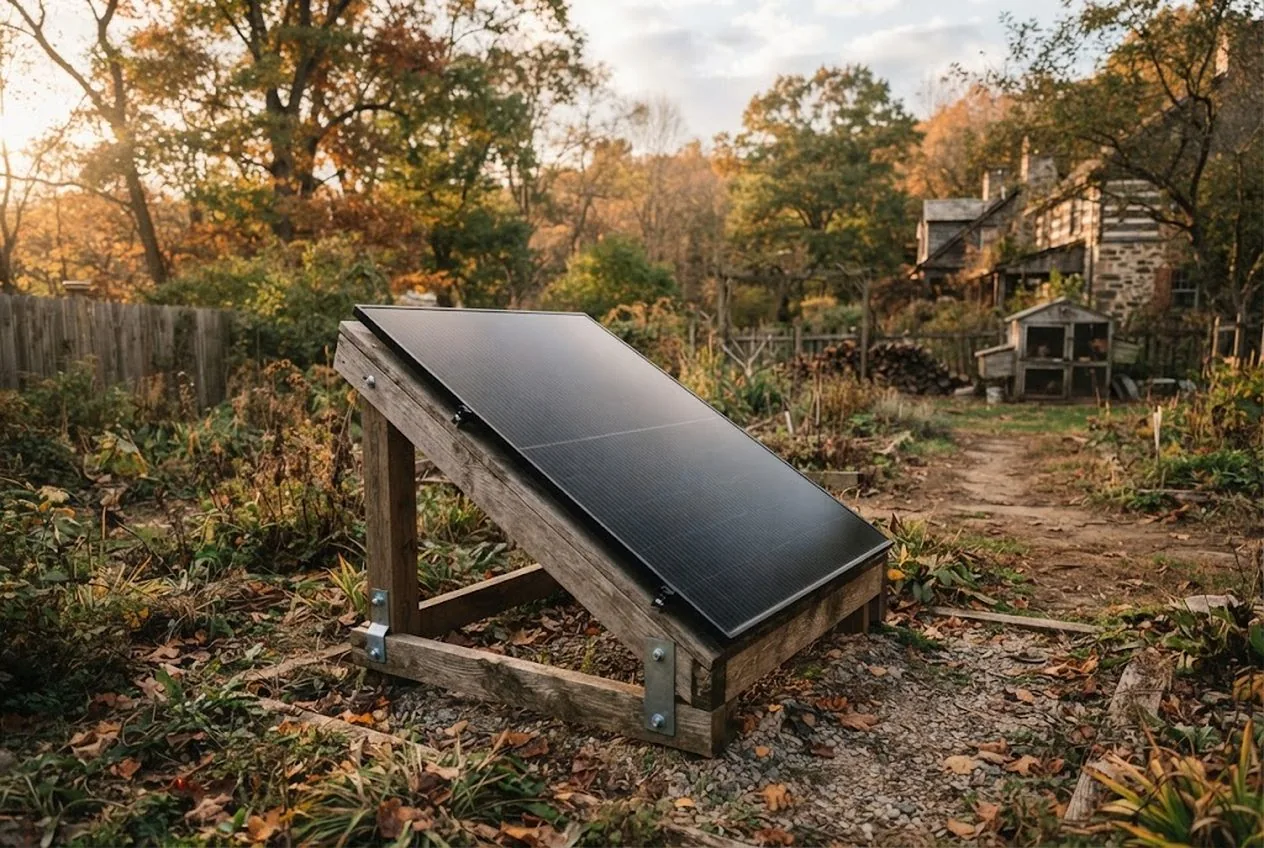
If you’ve priced out an off-grid solar setup, you’ve met the Renogy 200W panel, a familiar rigid building block in backyard and cabin systems. But “popular” and “right for a fall-and-winter setup” aren’t the same claim, so this review answers the practical question: what can a Renogy 200W panel actually do as the cold season closes in, and is it the panel to build your system on?
This is a single-product review of the standard rigid Renogy 200W monocrystalline panel — its real-world winter output, build quality, and honest limits. If you’re still working out how many watts your setup needs, start with our guide to sizing a solar setup for fall and winter; this review assumes you’ve decided a 200W-class panel is a building block you’re considering.
Short answer: the Renogy 200W is a well-built, dependable monocrystalline panel that makes an excellent module for a fall-and-winter array — provided you treat it as one brick in a bigger wall, pair it with an MPPT controller, and mount it well for the low winter sun. It won’t single-handedly power off-grid living in December, and it was never meant to.
Disclosure: the product links here are affiliate links, so we may earn a commission if you buy through them at no extra cost to you. This assessment is built from manufacturer specifications, independent 2026 reviews, and the cited sources — not a multi-year test of this exact panel on our own roof.
What a 200W Panel Really Produces
Let’s ground the whole review in one honest number. A 200W panel makes 200 watts only in full, direct, midday sun — its rated peak. What it makes across a real day is your peak-sun hours times the wattage, minus losses:
- Good fall sun (4–5 peak-sun hours): roughly 700–900 watt-hours/day
- Short, cloudy winter day (2–3 hours): often just 350–550 watt-hours/day
That daily harvest is the number that matters, and it’s why a single panel is a building block, not a power plant. Around 800 Wh on a decent day keeps lights, a laptop, phones, and a modest fridge topped up through a battery. Halve that in deep winter and you can see immediately why a genuinely off-grid winter load usually needs several of these panels working together.
The panel isn’t underperforming when its winter output drops — it’s obeying physics. Understanding that up front is the difference between a satisfied owner and a frustrated one.
Build Quality: Why Renogy Became the Default
Renogy earned its ubiquity honestly. The current 200W rigid panel uses N-type cells (Renogy), a higher-efficiency monocrystalline cell type. The build is what you want in a component you’ll bolt down and leave through years of weather: a rigid, framed panel meant for a fixed mount.
That durability is the quiet case for the panel. A solar array lives outdoors through hail, snow load, wind, and UV for a decade or more, and the failure that hurts is the one that shows up in year three. Renogy’s track record and easy-to-find replacements and mounting hardware are a real advantage over no-name panels whose long-term behavior — and warranty support — is a gamble.
Living With It: Mounting for Winter Sun
Here’s where you make or lose a big share of your winter output, and it’s entirely in your control. The standard Renogy 200W is a rigid, framed panel meant for a fixed mount — a roof, a ground rack, or a pole. That permanence is a feature for a set-and-forget backyard array, but it puts the burden on you to mount it right.
Two winter moves pay off enormously:
- Steep tilt. The winter sun sits low, so a steep panel angle catches it far more directly than a shallow summer tilt. A steeper angle also helps snow slide off rather than sit on the glass and shut production to zero.
- Clear the snow. Even the best panel makes nothing under a blanket of snow. An accessible mount you can sweep, plus that steep tilt, keeps a fall-and-winter array earning.
This is a common mistake with a panel this good: leaving it at a summer tilt and letting snow sit, then blaming the panel for weak winter numbers.
What You Need Alongside It
A panel is one part of three. To turn the Renogy 200W into usable power you also need a charge controller (an MPPT unit pulls more from it in cold, low light than a basic PWM) and a battery bank to store what it makes for the night and the cloudy days (U.S. Department of Energy). Renogy sells the bare panel as well as kits that bundle a controller, cables, and hardware (Renogy) — the kit is simpler if you’re starting from zero, while the standalone panel lets you match it to a controller and bank you already own.
If part of your goal is portability — power you set out and stow rather than bolt down — the rigid 200W is the wrong shape, and a folding panel fills that role. The battery-bank side of the equation is easiest to solve with a power station; our Bluetti AC180 vs EcoFlow winter comparison covers the two units most people pair with panels like this.
Pros and Cons
Pros
- High-efficiency monocrystalline (N-type) cells
- Durable rigid, framed build for a fixed mount
- Proven, ubiquitous brand with easy-to-find mounts and replacements
- Scales cleanly — a natural 200W module to wire in parallel or series
- Fairly priced for the build quality and reliability
Cons
- A single panel makes a modest winter harvest — real loads need several
- Rigid and fixed-mount, not portable
- Sold bare — you still need a charge controller and battery bank
- Winter output depends heavily on tilt and keeping snow cleared
Who Should Buy It — and Who Shouldn’t
Buy it if you’re building or expanding a fixed off-grid or backup array and want a proven, scalable rigid panel you can trust for a decade. In that role the Renogy 200W is close to the default answer: reliable, efficient, and easy to add to. Start with one for a small cabin or backup load, and add matching panels as your winter math demands.
Think twice if you want a single panel to power off-grid living through winter — that’s more than any one 200W panel can do, and you’ll be happier sizing a proper multi-panel array from the start. And if you need portability, choose a folding panel instead of this rigid unit.
The Bottom Line
The Renogy 200W does exactly what a great building-block panel should: it’s efficient, built to survive years outdoors, and it scales cleanly into whatever size array your loads require. Its only real limitation is one of expectations — one panel is a module, not a system, and winter’s short days shrink what any single panel returns. Mount it steep, keep the snow off, run it through an MPPT controller, and expand the array to match your winter watt-hours, and it earns its place as the backbone of a fall-and-winter setup.
A panel is only ever part of the plan, though. Once you know how many of these you need, weigh your cold-season strategy against the alternatives in solar generator vs gas generator for winter backup.
Frequently Asked Questions
- What can a Renogy 200W solar panel actually run?
- A 200W panel doesn't run appliances directly — it charges a battery bank that does. In good sun it makes roughly 800–1,000 watt-hours a day, enough to keep lights, a laptop, phones, and a small fridge topped up through a charge controller and battery. In short winter sun that daily harvest can fall by half or more, which is why a single 200W panel suits a modest cabin or backup setup, and larger loads need several panels wired together.
- Is one 200W panel enough for off-grid living in winter?
- For a genuinely off-grid winter, usually not on its own. One 200W panel is an excellent building block, but winter's short, cloudy days mean most real loads need 400–800W or more of total array. The smart approach is to treat the 200W panel as a module: start with one for a small load, and add matching panels as your needs and your winter sun hours demand. Size the array to your watt-hours divided by your winter peak-sun hours.
- Does the Renogy 200W panel come with a charge controller?
- The bare panel is typically sold on its own; Renogy also offers kits that bundle a charge controller, cables, and mounting hardware. You need a charge controller between any panel and your battery — an MPPT controller pulls more energy in cold, low winter light than a basic PWM unit. If you're starting from nothing, a kit can be simpler; if you're expanding an existing system, the standalone panel lets you match it to the controller you already have.
- Is the Renogy 200W a rigid or portable panel?
- The standard Renogy 200W is a rigid, framed monocrystalline panel meant to be mounted on a roof, ground rack, or fixed frame — it's a permanent-install building block, not a fold-up unit you carry. If you want something to set out and stow, Renogy's portable and 100W folding panels serve that role. For a fixed backyard or cabin array you'll leave in place through the seasons, the rigid 200W is the right form factor.
- Do Renogy panels work when it's cold or snowy?
- Yes — solar cells generally work best at low temperatures, so the cold itself isn't the problem. The winter limiter is daylight, not cold: short days and low sun cut your production hours, and snow on the glass stops output entirely until it's cleared or slides off. Mounting the panel at a steep winter tilt helps snow shed and catches the low sun more directly, meaningfully improving cold-season harvest.
Sources & references
Before you go
The Renter's Homestead Pack
Self-reliance projects for the yard you don't own — container yields, a raised bed built to move with you, balcony preservation basics, and the landlord questions to ask first.
Free guide
The Renter's Homestead Pack
Self-reliance projects for the yard you don't own — container yields, a raised bed built to move with you, balcony preservation basics, and the landlord questions to ask first.