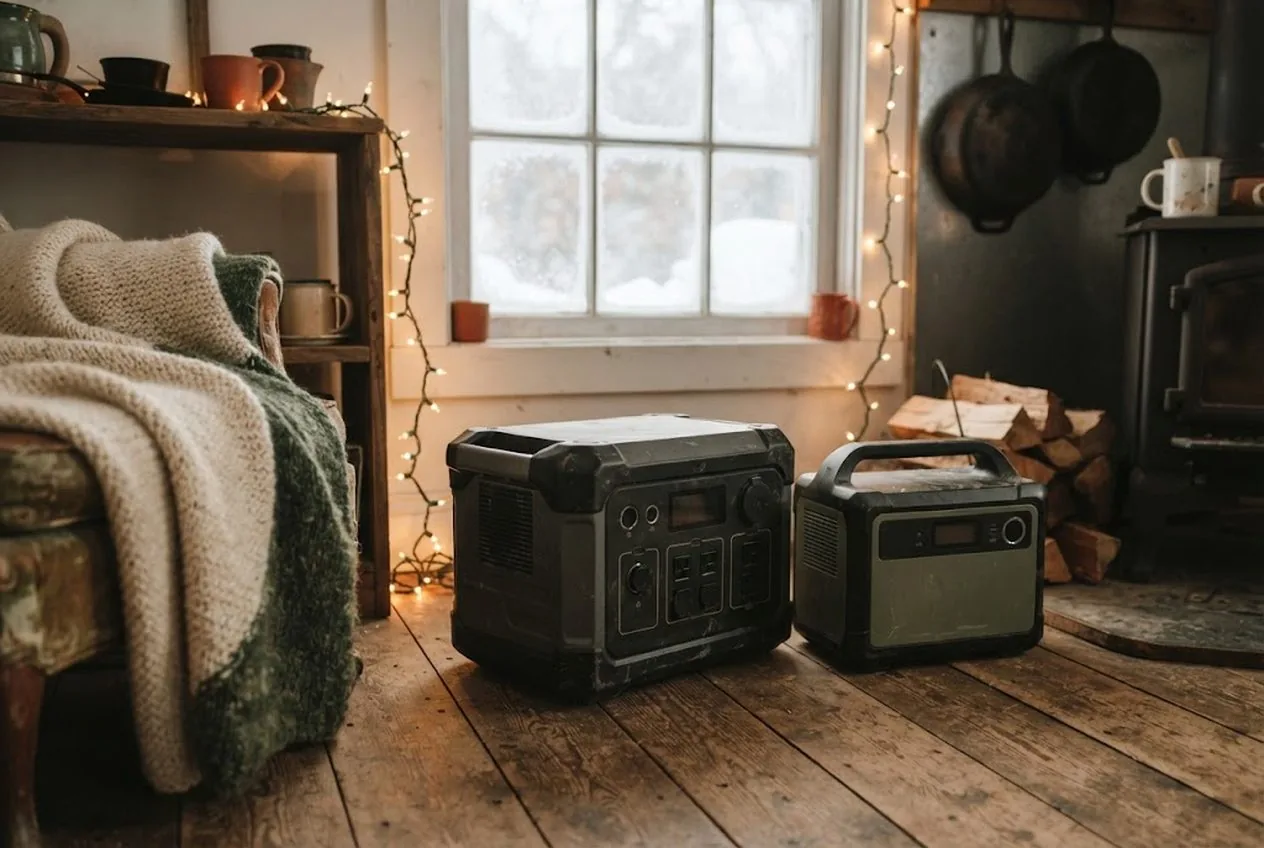
A winter blackout is a different animal from a summer one. In July, a power station’s job is to keep the fridge cold and a fan running. In January, the stakes rise: you want to keep the furnace blower turning so the pipes don’t freeze, the fridge cycling, and phones alive to call for help — all while the short, cloudy days give your solar panels almost nothing to work with, and the cold itself is quietly draining the battery. Two units dominate this conversation: the Bluetti AC180 and the comparable class of EcoFlow power station. Here’s how they actually stack up when it’s cold.
Short answer: the Bluetti AC180 is the durability pick, with LiFePO4 chemistry rated for 3,500+ cycles, making it a strong dedicated winter-and-emergency unit; a same-class EcoFlow wins on recharge speed and everyday versatility. Both run the winter essentials. Below, I compare the two on the things that actually matter in a freeze.
Disclosure up front: this comparison draws on manufacturer specs, independent 2026 reviews, and real-world runtime reports rather than a bench test of every model, and the product links here are affiliate links. With that said, here’s how they compare.
Bluetti AC180 vs EcoFlow: Side-by-Side
| Bluetti AC180 | EcoFlow (same class) | |
|---|---|---|
| Capacity class | ~1,152Wh | ~1,024Wh (model-dependent) |
| Battery chemistry | LiFePO4 | LiFePO4 on current models (e.g., DELTA 3); NMC on some older units |
| AC output | 1,800W (2,700W surge) | ~1,800W (surge varies) |
| Inverter | Pure sine wave | Pure sine wave |
| Cold limits | Storage rated -4°F to 104°F | Check the specific model |
| Recharge speed | Fast (0–80% in ~45 min) | Very fast (DELTA 3: full in ~56 min) |
| Solar input | Up to 500W | Up to 500W (DELTA 3) |
| Best for | Winter & emergency durability | Fast recharge & versatility |
| Weight | ~35 lb | ~25–30 lb |
The two most decisive rows in winter are battery chemistry and recharge speed — and they point in different directions, which is the whole reason this is a real choice rather than a blowout. (Specs: BLUETTI; EcoFlow.)
The Cold-Weather Question: Battery Chemistry
Cold is hard on batteries, and this is where the Bluetti AC180 makes its strongest case. It uses LiFePO4 (lithium iron phosphate), a chemistry that’s more thermally stable than the older NMC lithium some units carry, and the AC180 is rated for 3,500+ cycles to 80% capacity and for storage down to -4°F (BLUETTI). For a unit you may store in a cold mudroom or garage between emergencies and lean on hard when the temperature drops, that durability isn’t a spec-sheet nicety — it’s the difference between a device that’s ready every winter for years and one that quietly degrades.
There’s a catch that applies to both brands, though, and it’s the mistake people make most: lithium batteries generally won’t accept a charge below freezing without built-in heating, because charging a frozen cell damages it. And in the cold, any lithium battery delivers less usable capacity than it does at room temperature. The practical rule for either unit is simple — keep the power station indoors at room temperature during a winter outage. A warm battery gives you its full rated watt-hours and recharges normally; a frozen one gives you a fraction and may refuse to charge at all.
Can Either Run What Matters in a Freeze?
The winter loads that count aren’t glamorous — they’re the ones that keep a house safe and livable. Here’s roughly what a ~1,000–1,150Wh unit does with them:
| Winter load | Typical draw | Rough runtime |
|---|---|---|
| Furnace blower (gas furnace) | Several hundred watts (surge higher) | A few hours to overnight, intermittent |
| Full-size refrigerator | 100–200W (cycling) | 12–20 hrs |
| LED lights | 30–60W total | 20+ hrs |
| Phone / radio charging | ~15Wh each | 50+ charges |
| Electric furnace / heat pump | 3,000W+ | Not possible — too large |
The headline is that both units comfortably run the gas-furnace blower, and that’s the one that matters most in a freeze — keeping heat circulating so your pipes don’t burst, even though the furnace burns gas for the actual heat. Their pure sine wave inverters are also non-negotiable here: furnace control boards and modern fridge compressors need clean power, and a cheap modified-sine unit can damage or refuse to run them (U.S. Department of Energy).
The hard limit for both brands is whole-house electric heat. An electric-resistance furnace or a heat pump pulls thousands of watts continuously, far beyond either unit. Neither a Bluetti nor an EcoFlow is a substitute for that — they’re built to carry the essentials, not to heat a house electrically.
The Recharge Question: EcoFlow’s Home Turf
If the Bluetti is the durability pick, EcoFlow owns recharge speed — its signature feature. In a winter blackout, that matters more than it sounds, because your recharging window is brutal: a short day, weak low-angle sun, and often clouds or snow. When you do get a break — an hour of grid power flickering back, a generator run, or a rare bright afternoon — a faster charger banks more energy in that narrow window.
That said, temper expectations for solar in deep winter. Neither unit will fully refill from panels alone on a solidly overcast day; a 100W folding panel helps, but winter often means leaning on a wall or generator top-up whenever you can get one. If off-grid solar recharging is central to your plan, size it deliberately — our guide on how to size a solar setup for fall and winter shows why winter demands far more panel than summer.
Which Should You Buy?
The decision comes down to a single question: is this a dedicated emergency unit, or an everyday one?
- Choose the Bluetti AC180 if your priority is a rock-solid winter and emergency power station you keep charged and ready. Its LiFePO4 chemistry is rated for 3,500+ cycles and storage down to -4°F, which gives you confidence that the unit sitting in the closet since last winter will perform when the grid drops in a freeze.
- Choose an EcoFlow if you’ll use the unit year-round and value fast recharging above all — someone who camps, runs power tools off-grid, and wants the same battery to also cover blackouts. Confirm the specific model’s chemistry; current models like the DELTA 3 use LiFePO4.
For most preppers who want insurance — a unit bought specifically for the winter the power goes out — the Bluetti’s durability makes it the safer answer. For someone who wants one battery to do everything, the EcoFlow’s speed and flexibility win.
Beyond a Single Battery
A power station is outage insurance for the essentials, not a whole-home solution. If a multi-day winter outage is a real risk where you live, a portable unit is one layer — pair it with a plan to keep food cold without power and a broader winter backup strategy that weighs solar against a gas generator for the stretches when battery alone won’t carry you. (Summer has its own version of this problem — our ranking of portable power setups for a summer blackout covers the heat-wave side of the same decision.)
The Verdict
- Best dedicated winter-emergency unit: the Bluetti AC180 — LiFePO4, rated for 3,500+ cycles, built to sit ready for a freeze.
- Best for recharge speed and versatility: an EcoFlow of the same class — the everyday all-rounder that also covers outages.
Whichever you pick, keep it warm during the outage, feed it clean pure sine power to the loads that matter, and you’ve turned a winter blackout from a pipe-freezing emergency into a manageable inconvenience.
A Newer Option for Extreme Cold: Sodium-Ion Power Stations
Neither the Bluetti AC180 nor a same-class EcoFlow uses this chemistry yet, but it’s worth knowing about if extreme cold is your main concern: a handful of newer power stations have started using sodium-ion battery cells instead of lithium. Sodium-ion chemistry is promoted as more cold-tolerant than lithium, and some of these newer units are marketed for charging and discharging in colder conditions than standard lithium batteries can handle without a warm-up period. The tradeoff is that sodium-ion units are generally heavier and lower in energy density for their size, and the category is too new for long track records on reliability. If a unit needs to live in an unheated cabin, garage, or vehicle through hard winters, sodium-ion is a category worth watching going forward — though for most people, keeping a proven LiFePO4 unit like the AC180 warm and indoors is still the simpler, better-tested approach.
Frequently Asked Questions
- Can a Bluetti AC180 or EcoFlow run a furnace blower during a winter blackout?
- Often yes, but check the numbers. A gas-furnace blower typically draws several hundred watts running with a higher startup surge, which is within the Bluetti AC180's 1,800W (2,700W surge) and a comparable EcoFlow's output. Both have pure sine wave inverters that furnace electronics need. On roughly 1,000–1,150Wh of capacity, expect a few hours to overnight of intermittent blower runtime — enough to keep a house from freezing while you recharge. An electric-resistance furnace or heat pump, though, is far too large for either unit.
- Do these power stations lose capacity in the cold?
- The batteries do, temporarily. Lithium cells deliver less usable capacity in the cold, and — more important — most units will not accept a charge below freezing without built-in heating, to protect the battery. The Bluetti AC180's LiFePO4 chemistry is more thermally stable than older NMC lithium, and the unit is rated for storage down to -4°F. For either brand, keep the unit indoors at room temperature during a winter outage; a warm battery gives you its full rated capacity and can recharge normally.
- Which recharges faster in weak winter sun?
- EcoFlow generally leads on wall recharge speed: the DELTA 3 is rated for a full AC charge in about 56 minutes, while the Bluetti AC180 reaches 80% in about 45 minutes and 100% in roughly 1.3–1.8 hours. On solar, both accept up to 500W, so neither has a clear edge when a short, cloudy winter day gives you only a few usable sun hours. That said, in deep winter neither will fully refill from solar alone on an overcast day — both benefit from a wall or generator top-up whenever grid power or a backup source is briefly available.
- Is the Bluetti AC180 or EcoFlow better for a winter blackout?
- For a dedicated winter-and-emergency unit, the Bluetti AC180's LiFePO4 chemistry (rated for 3,500+ cycles) is a strong fit, though current EcoFlow models such as the DELTA 3 also use LiFePO4. For fast recharging and all-round versatility beyond blackouts — camping, job sites, frequent use — an EcoFlow of the same class is the stronger pick. Both run the winter essentials of a fridge, furnace blower, lights, and phones on a pure sine wave inverter; the decision comes down to whether you prioritize cold-weather durability or charging speed and flexibility.
Sources & references
Before you go
The Renter's Homestead Pack
Self-reliance projects for the yard you don't own — container yields, a raised bed built to move with you, balcony preservation basics, and the landlord questions to ask first.
Free guide
The Renter's Homestead Pack
Self-reliance projects for the yard you don't own — container yields, a raised bed built to move with you, balcony preservation basics, and the landlord questions to ask first.