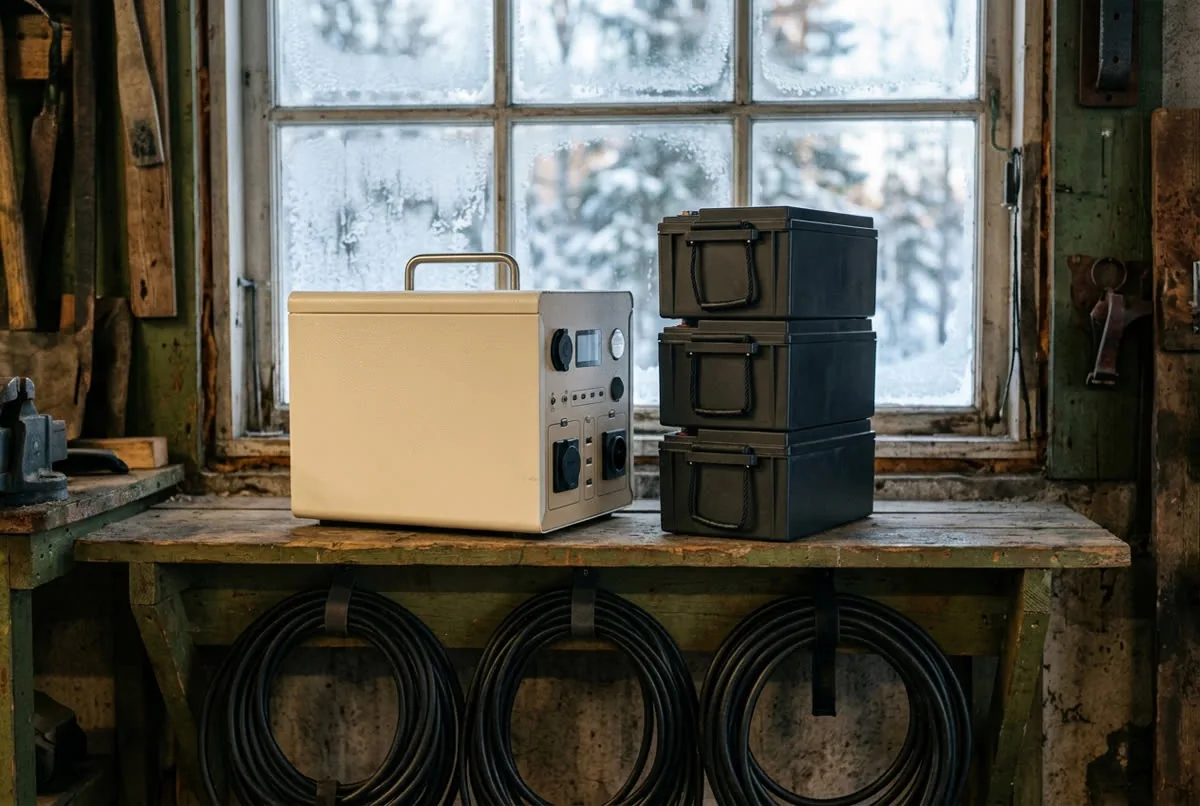
Every autumn the same instruction circulates: winterize your batteries before the first freeze. It is sound advice bolted to a date that does not exist. There is no national first freeze, the date you actually need is specific to your address, and for most of the country it has been drifting later for fifty years.
Start there, because the calendar decides everything else. The normal first 32°F reading lands in the last ten days of September across the upper Midwest, around October 1–10 in the Twin Cities, October 19 at Chicago O’Hare, November 12 in Memphis and November 13 in Atlanta (NWS Twin Cities, NWS Chicago, NWS Memphis, NWS Peachtree City). Coastal California and low-elevation southern Arizona often wait until December, and parts of Florida may not freeze at all in a given year (NOAA NCEI).
Short answer: winterizing a battery bank is not really about cold. It is about charge state and where the battery sits. Two rules carry most of the weight. A lithium iron phosphate battery must not be charged below 32°F, because charging a frozen lithium cell plates metallic lithium on the anode and causes permanent damage. A lead-acid battery must be stored fully charged, because a run-down one freezes at temperatures an ordinary cold snap reaches. Everything else in this guide is housekeeping around those two facts.
Disclosure: the product links here are affiliate links, so we may earn a commission if you buy through them at no extra cost to you. The temperature limits, freeze points and capacity figures below come from Battery University, Battery Council International, published Rolls deep-cycle documentation, Battle Born’s and Bluetti’s own product guidance, NOAA and National Weather Service climate normals, and a Consumer Product Safety Commission recall notice — not from a bench test of any product in this article, and not from brand marketing.
Almost nothing lost to winter storage is killed by the cold itself — it is killed by the condition it went into storage in.
Find Your Own Freeze Date, Then Stop Reading Calendars
The regional spread is wide enough that a single national deadline is useless. Here is the shape of it:
| Region | Normal first 32°F |
|---|---|
| Upper Midwest (St. Cloud, Eau Claire) | Sept 21–30 |
| Twin Cities, MN | Oct 1–10 |
| Denver, CO | Oct 7 (NWS Boulder) |
| Chicago O’Hare, IL | Oct 19 |
| Northeast Georgia | mid-October |
| Memphis, TN | Nov 12 |
| Atlanta, GA | Nov 13 |
| Coastal CA, southern AZ | December or later |
There is a second correction worth making, because it cuts against the urgency the topic usually gets sold with. Climate Central analyzed 204 US weather stations against NOAA records from 1970 to 2024 and found the first freeze now arrives later in 88% of the cities studied — 179 of 204 — by an average of 12 days, with 70 cities shifting by at least two weeks (Climate Central, October 2025). Reno, Bend and Toledo have moved by four to six weeks.
So the honest framing is not hurry, it is coming any day. It is: look up your own median date, subtract two weeks, and put that on the calendar. For a northern-tier reader in early October that genuinely is now. For a reader in Atlanta or Sacramento it is not, and pretending otherwise would just get the job done badly and early.
The One Rule Worth More Than the Rest: Never Charge a Frozen Lithium Battery
This is the rule that turns an inconvenience into a replacement invoice.
Battery University’s charging guidance for lithium-ion is blunt: the permissible charge range is 0°C to 45°C (32°F to 113°F), and “no charge permitted below freezing” (Battery University BU-410). The mechanism matters, because it explains why this is not a soft limit. Charging a sub-freezing lithium cell causes “plating of metallic lithium… on the anode,” which Battery University describes as leading to “a permanent degradation in performance and safety.” Permanent. It does not cycle back out. And the plated cell is more fragile afterwards, not just weaker.
The trap is that charging and discharging have different limits, and the discharge limit is the generous one. A battery that runs your lights happily at 10°F is not thereby safe to charge at 10°F.
Two hedges belong on that chart, and leaving them off would be the dishonest version.
Brands do not all latch at exactly 32°F. Battle Born states its battery management system blocks charging in the mid-20s Fahrenheit, not at 32°F (Battle Born). Treat 32°F as the number you design around, and treat any margin below it as your manufacturer’s mercy rather than your plan.
Lead-acid genuinely is different here, and better. Battery University gives lead-acid a permissible charge range of -20°C to 50°C (-4°F to 122°F) at 0.3C or less. An old flooded bank can take a charge in weather that would ruin a lithium one. That is one of the few arguments left in lead-acid’s favour, and it is a real one.
Lead-Acid’s Opposite Problem: It Freezes When It Is Empty
Lead-acid does not care much about charging in the cold. It cares enormously about what state you leave it in, because the electrolyte’s freezing point moves with state of charge.
Battery University spells out the mechanism: with lead acid “there is the danger of the electrolyte freezing, which can crack the enclosure,” and it “freezes quicker with a low charge when the specific gravity is more like water than when fully charged” (Battery University BU-502). Under the Battery Council International standard, specific gravity falls from 1.265 at full charge to about 1.155 at 25% charge (Battery University BU-903).
Push it further down and the freeze point keeps climbing toward the temperature of plain water. The practical rule to carry away: a deeply discharged lead-acid battery can freeze in an ordinary cold snap — which is not an Arctic event, it is a normal Tuesday in February across most of the country. A frozen battery can split its case, and a split case is not a repair.
Battery University adds the corollary for anyone with a flat battery in the yard right now: batteries “freeze more easily if kept in discharged state,” so charge lead acid before storing it (Battery University BU-702).
What Cold Actually Costs You in Usable Power
Separate from freezing, cold quietly shrinks what the bank will deliver. This is where a lot of winter blackout plans fall over — the arithmetic was done at room temperature.
Rolls publishes a temperature derating table for flooded lead-acid that puts numbers on it: against an 80°F rating, capacity drops to roughly 75% at freezing and to about 46% at 0°F (Rolls Battery). Battery University corroborates the cold end independently, noting a battery delivering 100% at 80°F “will typically deliver only 50 percent at –18°C (0°F)” (Battery University BU-502).
Call it a quarter of your capacity gone at freezing, half of it gone at 0°F, and size accordingly. If you already worked through sizing a solar setup for fall and winter, this is the correction that belongs on top of it.
For lithium, we will hedge rather than hand you a number. The cold-capacity percentages circulating for LiFePO4 come overwhelmingly from vendor blogs and calculator sites, they contradict each other by wide margins, and we could not trace any of them to a datasheet or an independent test — so we are not going to launder them into a table. What is well established, and is the more useful fact anyway: lithium’s cold capacity loss is temporary and returns when the pack warms up. Lead-acid left frozen at low charge does not get a second chance. That asymmetry, not a percentage, is the thing to plan around.
The Winterizing Sequence, In Order
Eight steps. Most take minutes; the order matters more than the effort.
1. Look up your own median first-freeze date and subtract two weeks. That is your deadline. Use the NWS pages linked above rather than a national round number.
2. Confirm what chemistry you actually own. Lithium iron phosphate and lead-acid want opposite things in storage, and “solar generator” tells you nothing. The label or the manual will say. If your unit is a sealed power station, it is almost certainly LiFePO4 and the 32°F charge floor applies.
3. Decide where it will spend the winter before you touch the charge state. Conditioned indoor space, an unheated garage, and an outbuilding are three different problems. Battle Born gives a safe storage range of -15°F to 140°F and advises removing batteries to a warmer location if temperatures are expected to drop below -10°F (Battle Born winterization guidance). Below-zero storage also risks cracking the plastic housing.
4. Set the charge state to match that decision. Lead-acid: full, no exceptions — this is the freeze protection from the previous section, not merely good practice. Lithium: see the next section, where the manufacturers disagree.
5. Disconnect it from the system. Parasitic draw is what turns a properly charged bank into a discharged one by February. Pull the positive main cable or open the disconnect switch. On heated lithium models, disconnect the heat-enable wire as well unless you intend to keep it powered.
6. Verify the low-temperature charge cutoff before the panels are still making power. This is the step people skip. If a solar array is left connected through a cold snap, the only thing standing between a sunny 25°F morning and a plated anode is a charge controller or BMS that refuses the charge. Confirm yours has low-temperature protection and that it is enabled — do not assume it.
7. Put a thermometer where the battery actually is. Not in the house, not on the porch — inside the cabinet or on the case. An unheated garage runs colder than the forecast, and a shed colder still. This is the cheapest step here and the one that turns the 32°F rule from theory into something you can act on.
8. Put one calendar reminder on the far side of winter. Lead-acid needs a top-up when it falls to about 70% state of charge — around 12.42V on a 12V battery (Battery University BU-702); sitting below that induces sulfation on the plates. Lithium’s schedule depends on which guidance you follow, below.
While you are working through the outdoor list, winterizing a rain barrel is the same weekend’s job and fails the same way — water left in a container that freezes.
Winter Storage Charge Level: Where the Manufacturers Genuinely Disagree
Most guides state a lithium storage charge level as settled fact. It is not, and the disagreement is wide enough that we would rather show it than pick a side for you.
| Source | LiFePO4 storage charge | Top-up interval |
|---|---|---|
| Battle Born | Fully charged | None; no trickle charging |
| Bluetti (EB3A guidance) | 40–60% | Recharge every 3–6 months |
| Battery University (Li-ion) | 40–50% | Keep above 2.5V per cell |
Both camps have a real argument. Battery University quantifies the low-charge case: after a year at 25°C, a lithium-ion (Li-cobalt) cell retains about 96% of capacity stored at 40% charge, against 80% stored full — calendar aging is worse at a high state of charge (Battery University BU-702). Battle Born’s case is that a seasonal three-to-six-month window is short enough for that penalty to be minor, and that its own packs self-discharge only 2–3% per month (Battle Born), so a full pack will still be comfortably charged in spring without anyone touching it.
The defensible move is to follow the manual for the battery you own, and if there is no manual, take the middle: store around 50%, check it once mid-winter. What you should not do is apply lead-acid’s “always store full” reflex to lithium without checking, or the reverse.
Lead-acid has no such ambiguity. Store it full. The freeze-point physics and the sulfation risk both point the same way, which is a rare mercy.
Check for a Recall Before You Shut the Lid
One piece of housekeeping worth folding into the same afternoon, because a stored unit is a unit nobody looks at for months.
On August 20, 2026, Goal Zero recalled approximately 46,200 YETI 3000X power stations after four reports of fires, overheating or smoking traced to a circuit board that can overheat. The CPSC notice tells owners to stop using the units immediately; the remedy is a free firmware update delivered through the Goal Zero app (CPSC recall notice).
The recall has nothing to do with cold — the notice does not cite temperature or storage as a factor. It is here because the moment before you put a lithium unit away for four months is the right moment to check whether the manufacturer has published anything about it, and applying a firmware fix is much easier before the thing is buried behind the snowblower.
Who Should Skip Most of This
This is the section where the honest answer costs us clicks, so here it is.
Skip it if your battery lives in conditioned space. A power station stored in a heated basement or a closet has no winterizing problem. Charge it to whatever the manual says, unplug it from the loads, and stop. Everything above is about batteries that live somewhere cold.
Skip most of it if your median first freeze is in December or never. If you are in coastal California, the low desert or much of Florida, the freeze-driven half of this guide does not apply to you in a normal year. The capacity-derating arithmetic still does on a cold snap, and the recall check still does. The rest is somebody else’s climate.
Renters, work within what you have. If the only cold storage available is a shared garage or a balcony box, the honest sequence shrinks to three things: bring the battery indoors if you can, keep lead-acid fully charged if you cannot, and never let a connected array charge a lithium pack that has been sitting below freezing. A thermometer in the box costs little and travels with you.
Skip the deep dive if you own one small power station and one panel. Charge it, disconnect it, put it somewhere above freezing, and check it at the solstice. The multi-step version earns its keep on a real bank, not on a unit you can carry in one hand.
If you are still choosing hardware rather than storing it, our comparison of Bluetti and EcoFlow for winter blackouts and the solar generator versus gas generator trade-off both cover the cold-weather angle before you buy.
The Bottom Line
Cold weather does not usually kill a battery bank. Two avoidable mistakes do: charging a lithium pack below 32°F, which plates the anode permanently, and leaving a lead-acid battery discharged, which lets the electrolyte freeze at temperatures a normal winter reaches. Fix those two and you have done most of the job.
The rest is a short sequence with a real deadline attached — your own median first-freeze date, not a national one, minus two weeks. Look it up, pick where the bank will live, set the charge state to match, disconnect the loads, confirm the low-temperature cutoff, and put a thermometer where the battery actually is. Then check on it once in the middle of winter. A battery bank is one layer of a plan, and it works the way the rest of a blackout kit works: not because you bought the right thing, but because you put it away in the right condition and knew what you would run before the power went out.
Frequently Asked Questions
- Can you charge a lithium battery below freezing?
- No. Battery University gives lithium-ion a permissible charge range of 32F to 113F and states plainly that no charge is permitted below freezing. Charging a sub-freezing cell plates metallic lithium on the anode, which causes permanent degradation in performance and safety rather than a temporary loss. Discharging is different and far more forgiving, with many LiFePO4 packs rated down to about -4F, so a battery that runs your lights in the cold is not thereby safe to charge in the cold. Some brands' battery management systems do not block charging until the mid-20s Fahrenheit, but treat 32F as the number you design around.
- What state of charge should I store a battery bank at over winter?
- It depends on chemistry, and for lithium the manufacturers genuinely disagree. Lead-acid is unambiguous: store it fully charged, because a discharged lead-acid battery freezes at temperatures an ordinary cold snap reaches, and low charge also causes sulfation. For LiFePO4, Battle Born advises storing fully charged with no trickle charging, while Bluetti advises 40 to 60 percent with a recharge every three to six months and Battery University suggests 40 to 50 percent for lithium-ion generally. Follow the manual for the battery you own; if there is none, store around 50 percent and check it once mid-winter.
- Will a battery freeze in an unheated garage?
- A fully charged lead-acid battery is far less likely to. Battery University notes that lead acid freezes more readily at a low charge, when the electrolyte is more like water, so a run-down one is the real risk, and a deeply discharged battery can freeze in the kind of cold snap most of the country gets in a normal winter. A frozen battery can split its case, and that is not repairable. Battle Born gives a safe storage range of -15F to 140F for its lithium packs and advises moving them somewhere warmer if temperatures below -10F are expected.
- How much capacity does a battery lose in cold weather?
- For flooded lead-acid, Rolls publishes a derating table showing capacity falling to roughly 75 percent at freezing and about 46 percent at 0F against an 80F rating, and Battery University independently notes that a battery delivering 100 percent at 80F will typically deliver only 50 percent at 0F. Plan on losing about a quarter of your capacity at freezing and about half at 0F. For lithium the published percentages vary too widely between vendor sources to quote responsibly, but the important difference is that lithium's cold capacity loss is temporary and returns when the pack warms up.
Sources & references
- Battery University, BU-410: Charging at high and low temperatures (opens in new tab)
- Battery University, BU-502: Discharging at high and low temperatures (opens in new tab)
- Battery University, BU-702: How to store batteries (opens in new tab)
- Battle Born Batteries, How to winterize your batteries (opens in new tab)
- Rolls Battery, Temperature vs capacity for flooded lead-acid batteries (opens in new tab)
- Climate Central, Later first freeze in 179 US cities (opens in new tab)
- NOAA NCEI, When to expect your first fall freeze (opens in new tab)
- CPSC, Goal Zero recalls YETI 3000X power stations (opens in new tab)
Before you go
The Renter's Homestead Pack
Self-reliance projects for the yard you don't own — container yields, a raised bed built to move with you, balcony preservation basics, and the landlord questions to ask first.
Free guide
The Renter's Homestead Pack
Self-reliance projects for the yard you don't own — container yields, a raised bed built to move with you, balcony preservation basics, and the landlord questions to ask first.