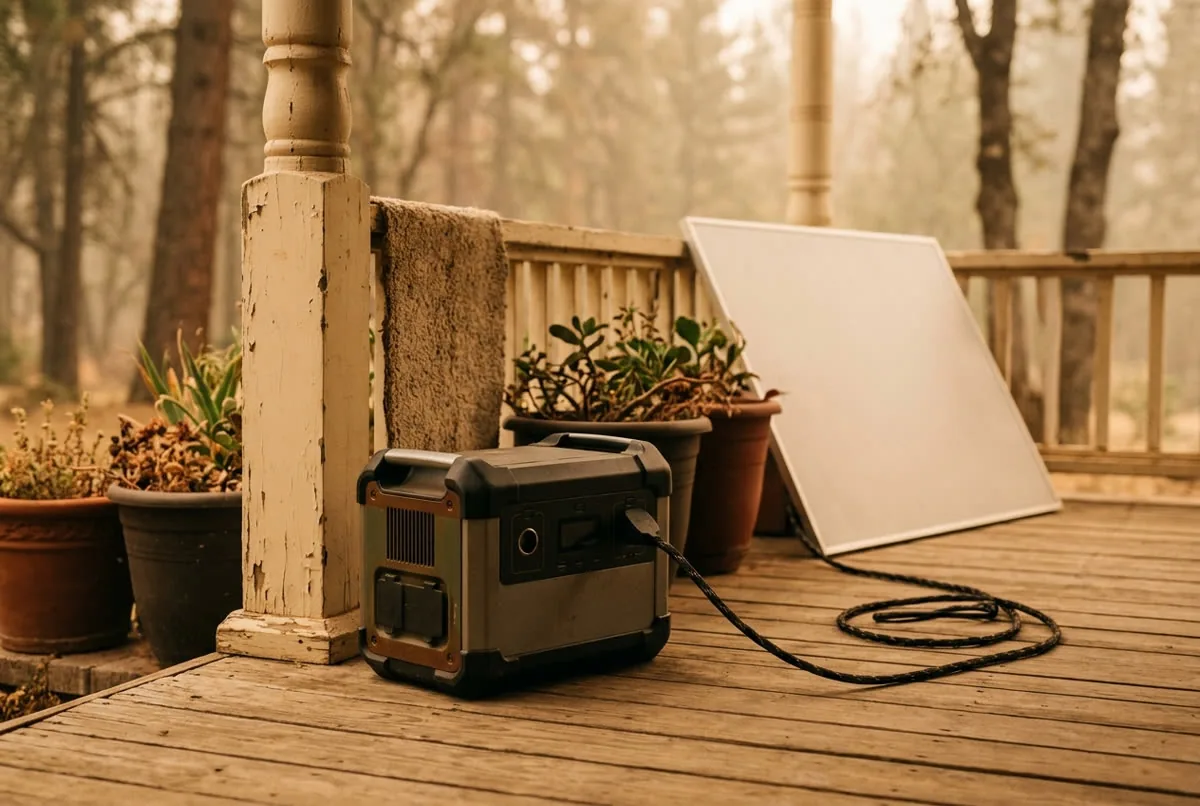
The public image of a California power shutoff was set in a single week. In October 2019, PG&E cut power to roughly 750,000 customer accounts across northern and central California in two waves, an outage the utility said could reach as many as two million people (NBC News, October 2019). The phrase public safety power shutoff entered the language attached to a picture of half a state going dark at once.
That is not what a shutoff looks like today. When Southern California Edison de-energized lines ahead of a Santa Ana wind event on October 28, 2025, the post-event report it filed with state regulators counted 2,640 customers (CPUC PSPS post-event reports). Same tool, same fire logic, a fraction of the footprint. The reputation has not caught up with the reality, and that gap is the most useful thing to understand before you spend a dollar on backup power.
Short answer: a Public Safety Power Shutoff (PSPS) is a planned, announced outage a utility calls when wind, low humidity and dry fuel make its own lines a fire risk. You typically get 48 to 24 hours of warning, the outage is targeted at specific circuits rather than whole regions, and PG&E’s stated goal is to restore power within 24 hours after the weather passes. That short, announced, hot-and-dry shape is what makes PSPS backup a different problem from hurricane or winter-storm backup — and it means a modest battery does more here than it would anywhere else.
Disclosure: the product links here are affiliate links, so we may earn a commission if you buy through them at no extra cost to you. The numbers below come from utility filings with the California Public Utilities Commission, PG&E’s own published PSPS guide, the National Interagency Fire Center’s seasonal outlook, and federal food-safety and carbon-monoxide guidance — not from a bench test of any product in this article, and not from brand marketing.
What a Public Safety Power Shutoff Actually Is
A PSPS is a utility deliberately switching off healthy power lines because the weather has made those lines dangerous. The California Public Utilities Commission puts it plainly: “Utilities may temporarily turn off power to specific areas to reduce the risk of fires caused by electric infrastructure” (CPUC).
The authority is not new. The CPUC ruled in 2012 that Public Utilities Code sections 451 and 399.2(a) give the state’s electric investor-owned utilities the power to shut off electricity to protect public safety. Six utilities run PSPS programs today: Pacific Gas and Electric, Southern California Edison, San Diego Gas & Electric, Liberty Utilities, Bear Valley Electric Service and PacifiCorp.
What triggers one is a combination, not a single number. PG&E lists the factors it weighs as “humidity levels, forecast winds, dry vegetation, Red Flag Warnings and other real-time observations,” and describes the shutoff itself as “a last-resort measure to help prevent wildfires during severe weather” (PG&E, Your Guide to Public Safety Power Shutoffs).
The part that matters for planning is the clock. PG&E’s published notification timeline runs in stages:
| Stage | Timing |
|---|---|
| PSPS Watch | 48–24 hours before power is turned off |
| PSPS Warning | 4–1 hours before power is turned off |
| Shutoff notice | When power is turned off |
| Restoration updates | After severe weather has passed, daily until power returns |
Then the reverse: crews cannot simply flip the switch when the wind drops. A weather “all-clear” is issued, patrols inspect the de-energized lines for damage, and only then does power come back. PG&E states the target directly — “our goal is to restore power within 24 hours after severe weather conditions have passed.” Treat that as a goal, not a guarantee; terrain, damage found on patrol and daylight all move it.
The Number That Should Shape Your Whole Plan
Put the utility’s restoration goal next to federal food-safety guidance and something useful falls out.
If the doors stay shut, the FDA says a refrigerator holds safe temperatures for about 4 hours, a half-full freezer for 24 hours, and a full freezer for 48 hours.
Read that chart honestly and the conclusion is deflationary: for a typical PSPS, a full freezer with the door shut is already better backup than most of what people buy. The battery is not there to save your frozen peas. It is there for the things a closed door cannot do — light, phones, a weather radio, a well pump, a CPAP or a furnace fan — and sizing it against that shorter list is what keeps the cost sane.
Why Fall 2026 Is a Quieter Forecast Than You Might Expect
It would be easy to sell this article on a bad fire outlook. The current data does not support that, and saying so is more useful than the alternative.
The National Interagency Fire Center’s outlook issued October 1, 2026 says significant fire potential “is projected to be normal from October through January in northern California.” For central and southern California it keeps October near normal, and “near-normal significant potential is indicated for all areas by November through January” (NIFC, National Significant Wildland Fire Potential Outlook).
The driver is a very strong El Niño. NIFC’s forecasters say it and climate models “favor above-normal precipitation this fall and winter,” and that the expected pattern “typically results in a below normal number of Santa Ana wind events, even if a couple occur early in the season.” Fewer offshore wind events means fewer PSPS triggers.
So the case for backup power this particular autumn is not that something dramatic is coming. It is that a PSPS is a recurring structural feature of living on certain circuits, independent of any one season’s forecast. The state has effectively conceded the point: California’s Self-Generation Incentive Program has prioritized battery rebates for communities that have experienced two or more PSPS events, alongside those in high fire-threat areas and low-income and medically vulnerable customers (CPUC SGIP fact sheet). A program does not write “two or more” into its eligibility rules for a once-in-a-decade event.
Why PSPS Prep Is Not Hurricane Prep or Winter Prep
Backyard Freedom Lab has covered blackout prep for hurricanes, heat waves and winter storms. The gear overlaps. The problem does not.
| PSPS | Hurricane | Winter storm | |
|---|---|---|---|
| Warning | 48–24 hrs, then 4–1 hrs | Days | Hours to days |
| Typical duration | Under 24 hrs after all-clear is the goal | Days to weeks | Hours to days |
| Ambient conditions | Hot, bone-dry, windy | Warm, wet, humid | Freezing |
| Air quality | Often smoky; filtration draws power | Normal to poor | Normal |
| Water risk | Well pumps stop; no flood risk | Flooding, contamination | Frozen pipes |
| Generators | Constrained by extreme fire risk | Widely used, flood-sited | Widely used |
| Repeat events | Can recur several times in one season | Once or twice a season | Several per winter |
Four differences do real work here.
The notice is generous, and the outage is short. You are prepping for a day, not a fortnight. That single fact shrinks the sensible battery from something that costs thousands to something that often costs hundreds.
The weather is hot, dry and windy — which is exactly when a generator is riskiest. This is the hard line, and it does not bend: never run a generator inside a home or garage, “even if doors and windows are open,” and keep it outside more than 20 feet from the house, doors and windows, with a working carbon monoxide alarm indoors (CDC). During a PSPS you have the added problem that the conditions triggering the shutoff are the same conditions that make a hot exhaust and stored fuel a poor idea in dry grass. A battery has neither exhaust nor fuel, which is most of why it wins this particular scenario. If you are weighing the two, our head-to-head on solar generator vs. gas generator for winter backup lays out the same trade-offs in a colder setting.
The air is often bad, and clean air costs watts. A portable air cleaner running through a smoke event is a continuous load a hurricane kit never budgets for. It is small, but it is constant, and it competes with the fridge.
It can happen again next week. Hurricane prep is annual. PSPS prep may get used three times in one autumn, which changes the calculation toward something you can recharge and reuse without effort rather than something you consume. Our hurricane season power outage checklist covers the longer-duration version of the same kit.
The Recharge Problem Nobody Budgets For
Here is the wrinkle specific to fire-season backup, and it is the reason a solar panel is not a blank cheque.
Smoke dims the sun that is supposed to refill your battery. A study led by the National Center for Atmospheric Research and published in Environmental Research Letters found that smoke from the September 2020 California wildfires cut the state’s solar energy production by 10% to 30% between noon and 4 p.m., measured against the same hours in prior years (NCAR/UCAR). On the smokiest days, output ran an average of 27% below forecast.
The practical read: a panel that comfortably refills a battery on a clear October day may need most of a smoky one to do the same job. Plan the array with margin, or plan to ride the outage on stored capacity alone and treat solar as a bonus. Our own rough rule, and we will label it an estimate rather than dress it up as measurement, is to assume a smoke day gives you something closer to two-thirds of a clear day and size accordingly.
What a Battery Setup Actually Covers
Work from loads, not from the sticker wattage on the box. For a 24-hour PSPS the honest list is short:
- Lights and phone charging. Trivial. Any unit handles it.
- Router and a weather radio. Small and worth having; PSPS updates arrive by call, text and email.
- A refrigerator, if you insist. A full-size fridge is the load that drives sizing, and per the chart above it is also the load a closed door mostly solves for a one-day outage.
- A portable air cleaner. Modest but continuous during smoke.
- A well pump. This is the real constraint for rural households, and it is not modest. Deep-well pumps draw heavily on startup and are the load most likely to exceed a mid-size battery’s inverter. If you are on a well, size for the pump or plan around it entirely — a stored-water buffer is usually the cheaper answer, and our guide to storing emergency water at home covers the arithmetic.
Two limits are worth stating flatly rather than burying.
Nothing here touches your main electrical panel. Low-voltage DC wiring and plug-in battery units are homeowner territory. Anything involving a transfer switch, a panel tie-in, a breaker or grid export is a licensed electrician’s job and a permit question, and it stays that way regardless of what a guide promises.
A battery will not run central air conditioning, an electric range, an electric water heater or a well pump at depth for long. Those are the loads that push a system from hundreds of dollars into five figures. Ranges here are wide and depend on your equipment; price your own list rather than trusting a marketing figure.
Who Should Not Build a PSPS Battery Setup
This is where the honest answer costs us money, so here it is.
Skip it if you rent, or if your outage risk is low. Circuit-level shutoffs are targeted. Check your address against your utility’s PSPS map before buying anything. If you have never been in scope, a good headlamp and a full freezer may genuinely be the whole answer.
Skip it if someone in the house depends on powered medical equipment. That is not a battery-sizing problem, it is a care-planning one. Enroll in your utility’s Medical Baseline Program — PG&E makes repeated notification attempts and will attempt in-person contact for customers who do not respond — and work out the equipment plan with the treating clinician and the device manufacturer, not with a blog.
Check the rebate before you pay retail. California’s SGIP has offered substantially higher rebates through its Equity and Equity Resiliency categories for qualifying households, including those who have been through two or more PSPS events, though the CPUC’s program page now lists Equity Resiliency as available only through 2025 (CPUC SGIP). Budget availability changes year to year, so confirm current status with the program administrator rather than assuming what you read is still true.
Skip the DIY route if you want plug-and-play. A commercial power station you charge and forget is a legitimate choice, and it is the right one for most households.
The Bottom Line
A Public Safety Power Shutoff is the most predictable outage you will ever face: announced up to two days ahead, aimed at specific circuits, and targeted for restoration within a day of the wind dropping. Prepare for that outage rather than the 2019 headline, and the shopping list gets shorter and cheaper — a modest battery, a panel with margin for smoke, a closed freezer door, and a generator kept outside and 20 feet away if you keep one at all.
A battery is one layer of a plan, not the plan. It pairs with stored water for the days a well pump has no power, and with the same discipline that makes any backup work: charge it, load-test it once a season, and know before the wind picks up which three things you actually intend to run.
Sources & references
- CPUC, Public Safety Power Shutoffs (opens in new tab)
- CPUC, Utility PSPS post-event and post-season reports (opens in new tab)
- PG&E, Your guide to Public Safety Power Shutoffs (opens in new tab)
- FDA, Food and water safety during power outages and floods (opens in new tab)
- CDC, Generator safety fact sheet (opens in new tab)
- NIFC, National Significant Wildland Fire Potential Outlook (opens in new tab)
- NCAR/UCAR, California wildfire smoke dimmed solar energy in 2020 (opens in new tab)
- CPUC, Self-Generation Incentive Program fact sheet (opens in new tab)
Before you go
The Renter's Homestead Pack
Self-reliance projects for the yard you don't own — container yields, a raised bed built to move with you, balcony preservation basics, and the landlord questions to ask first.
Free guide
The Renter's Homestead Pack
Self-reliance projects for the yard you don't own — container yields, a raised bed built to move with you, balcony preservation basics, and the landlord questions to ask first.