What’s the short answer?
- Bubble-test every propane connection before first use each season and after every reconnect.
- Confirm your cylinder has an OPD valve, a triangular handwheel stamped "OPD", before you rely on it this winter.
- Check the manufacture date stamp against the 12-year requalification window before the fill station does.
- Never relight or reopen a propane system yourself after an outage, suspected leak, or service work; call a qualified professional.
- Keep appliance vents clear of snow and ice all season, and call a qualified professional if you see evidence of a blockage.
Cold snaps expose weak links in a propane setup fast: a slow leak that never mattered in August suddenly fills a closed-up shed with gas, or an old cylinder gets rejected at the fill station right when you need it full. If your propane tank and appliances have sat untouched since last spring, the pre-season check is the difference between a five-minute soap test and a service call in the middle of a cold front. Check the setup the same way each fall, tank valve to appliance vent, because skipping a step is how the easy problems turn into the expensive ones.
The short answer: Before you fire up any propane appliance for the season, bubble-test every connection for leaks, confirm your cylinder has an OPD valve and is within its requalification window, and never re-light a system yourself after an outage or refill; call a qualified professional instead.
How Do I Check My Propane Tank and Lines for Leaks Before Winter?
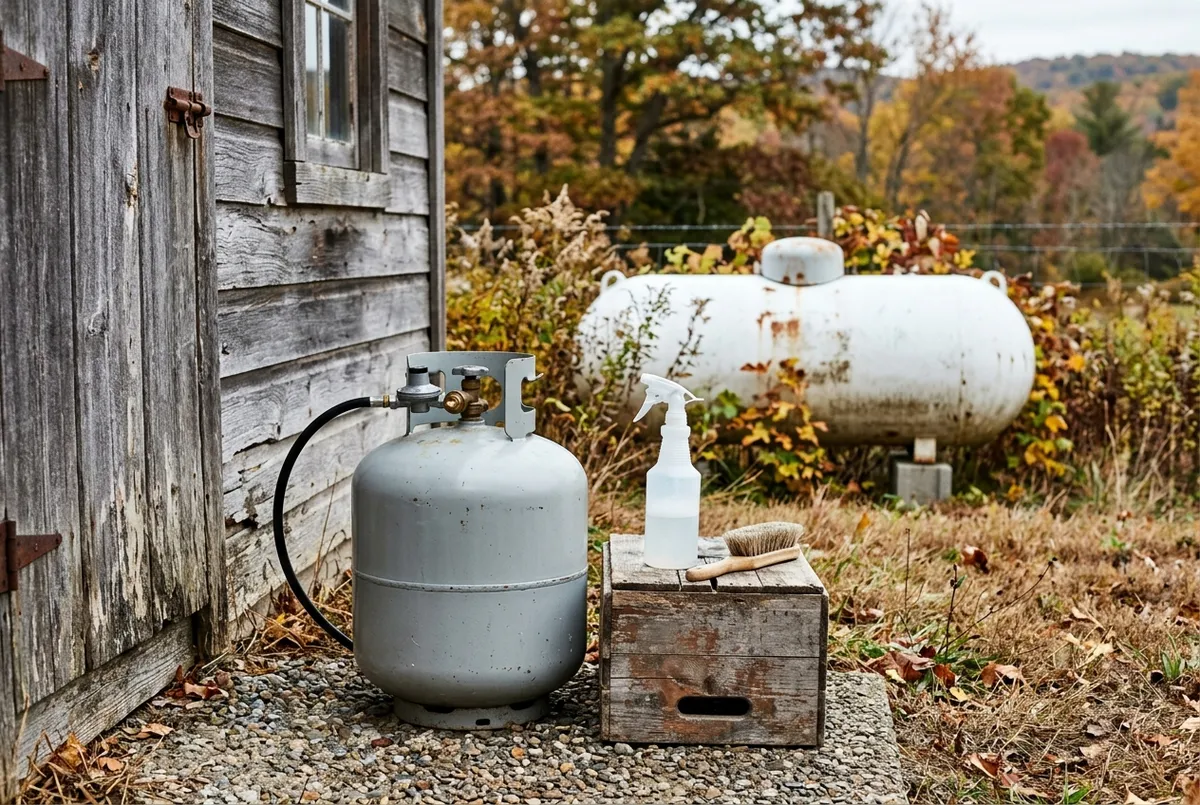
Run a bubble test before the first use of the season, and again every time you reconnect a cylinder to an appliance. Apply leak detector solution or thick soapy water to the valve area, slowly open the valve, and watch the connection point for bubbles. If bubbles appear, close the valve, tighten the connection, and test again; if bubbles still appear, close the valve and call your propane retailer (PERC, accessed 2026).
What the Test Actually Catches
The bubble test targets the connection points, not the tank body: the valve threads, the regulator seat, and the hose fitting are where a winter’s worth of temperature swings and outdoor storage tend to loosen a seal. A tank that passed this test in spring can still fail it in October if the fitting corroded, the O-ring dried out, or the connection got jarred during storage. That’s why a seasonal pass from months ago doesn’t carry over; the test is checking the current state of the connection, not a permanent property of the tank.
Tools You Actually Need
A bubble test doesn’t require anything specialized. A commercial leak-detector solution works, and so does a mix of dish soap and water thick enough to hold a bubble rather than run off the fitting. Either way, the process is the same: coat the joint, open the valve slowly, and watch closely for bubbles before you decide it’s clean. A quick spray-and-glance isn’t the same test; a slow leak can take longer than a few seconds to show a visible bubble.
When to Repeat It
Treat every reconnection as a fresh test, not just the seasonal one. Swap in a new or refilled cylinder, move the tank, or reattach a hose after maintenance, and the bubble test runs again before you turn anything on. If you’re running more than one propane appliance this winter, each connection point gets its own pass; a clean test on the grill’s regulator says nothing about the heater’s fitting three feet away.
What Is an OPD Valve, and How Do I Know if My Tank Has One?
An Overfill Prevention Device, or OPD, is a valve that stops a cylinder from being filled past a safe level. It’s a safety feature required by law, and most cylinders with one have a triangular handwheel marked “OPD”. If your cylinder doesn’t have an OPD, or you’re not sure, PERC says not to use it; exchange it at a propane retailer or buy a new cylinder (PERC, accessed 2026).
NFPA 58, the LP-Gas code that many states have adopted as state law, requires an OPD on all 4- to 40-pound propane cylinders that were manufactured after September 30, 1998, requalified after that date, or refilled on or after April 1, 2002 (PHMSA). In practice, that covers almost every grill-sized cylinder still in circulation. If yours predates that window and hasn’t been refilled since, check the handwheel before you assume it’s compliant.
Checking a Cylinder You Didn’t Buy New
Hand-me-down cylinders, ones picked up secondhand, or tanks that have been sitting in a shed for years are the ones most likely to be missing an OPD. Look at the handwheel before you haul it to a fill station: a triangular wheel marked “OPD” is the usual sign one is fitted, and if there’s no OPD or you can’t tell, don’t use the cylinder until a propane retailer has exchanged it.
How Often Does a Propane Cylinder Need to Be Recertified?
A propane cylinder has to be requalified for continued use within 12 years of its manufacture date. If that requalification is done by visual inspection, it’s good for another 5 years before it needs to be checked again; other test methods carry longer intervals (US DOT/PHMSA, 2023). The manufacture date is marked on the cylinder as a month and year, and a cylinder older than 12 years should also carry a requalification date stamp or sticker; those dates decide whether it can be refilled.
Why This Matters Going Into Heating Season
A cylinder that’s aged out of its requalification window won’t get refilled, full stop, no matter how good it looks. Finding that out at the fill station on a cold morning is a bad time to discover it. Check the collar stamp against the 12-year window before the season starts, not after your primary heat source runs dry. If the stamp is worn or hard to read, that’s worth resolving with the fill station directly rather than guessing at the date.
The rules behind all of this sit inside NFPA 58, Liquefied Petroleum Gas Code, the national code covering safety requirements for LP-gas system installations, storage, and transportation. The most recent edition is the 2024 edition (NFPA, 2024), and many states have adopted NFPA 58 as state law, though the edition in force varies by state.
Is It Safe to Turn My Propane Tank Back on Myself After It Runs Out?
No. If a propane tank runs out of gas or gas service is interrupted, PERC says to have your propane retailer or a qualified professional perform a leak check, restore gas service, and, if needed, light your pilot lights. That’s not a step a homeowner should do themselves (PERC, accessed 2026).
This is one of the more common shortcuts people take, and it’s worth being direct about: relighting a pilot or reopening a valve yourself after an outage skips the exact check that catches a leak introduced during the interruption itself, whether that’s a loose fitting from a refill or a line that shifted while the system sat empty. The requirement exists because an empty or recently serviced system is precisely when a fresh leak is most likely to be present and least likely to be caught before you strike a match near it.
What Counts as an “Interruption”
It’s not just a completely empty tank. PERC also lists any service or changes to the gas system, such as tanks, cylinders, pipes, or appliance connectors, as work for a qualified professional, and it calls a propane gas leak an emergency. If you’re not sure whether your situation qualifies, treat it as though it does.
Why Is Snow or Ice on a Propane Vent Dangerous?
Winter weather adds a hazard that summer storage doesn’t: snow, ice, and even nests can block the vents on a propane appliance. Keep the area around appliance vents clear of snow and ice through the season, and if you see evidence of a blockage, call a qualified professional rather than forcing it open (PERC, accessed 2026).
A blocked vent interferes with how the appliance is designed to draw air in and exhaust combustion byproducts out. Combustion appliances rely on that airflow to work correctly, so a vent packed with ice isn’t just an efficiency problem, it changes how the appliance is meant to function. If a heavy snowfall or ice storm buries a vent and you’re not confident you can clear it without damaging it, that’s the situation the “call a professional” guidance is written for.
Building a Habit Out of It
Vent checks are easy to forget precisely because they’re outside, in the cold, away from the parts of the system you think about first. Pair the vent check with something you’re already doing outdoors this winter, clearing a walkway, checking the mailbox, refilling a bird feeder, so it becomes a habit rather than a separate errand you have to remember on its own.
Building the Checklist Into Your Routine
None of these checks take long individually, but they only work if they happen before the first cold night, not during it. In order, that’s:
- Bubble-test every connection point on the tank and appliance
- Confirm the OPD handwheel and its markings
- Check the manufacture date stamp against the 12-year requalification window
- Walk the perimeter of both tank and vents and clear anything winter has piled up
- Call a qualified professional for any leak, expired cylinder, or blockage you can’t fix yourself
If any of it turns up a leak, an expired cylinder, or a blocked vent you can’t clear, that’s the professional’s job, not a shortcut to work around.
It’s also worth thinking about what happens if a professional visit means a stretch without your primary heat source while a technician gets to your system. A backup power source to keep essentials running bridges that gap without touching the propane system itself; our comparison of 300W and 1000W portable solar generators walks through how much backup power a household actually needs. And if you’re using downtime this season to get ahead on other projects, our roundup of backyard homestead projects for slow winter weeks is a reasonable next stop.
Next step: pull out your propane cylinder before the first hard freeze, run through these five checks in order, and fix or call in whatever fails before you rely on it for heat.
Frequently Asked Questions
- How often do I need to bubble-test my propane tank for leaks?
- Before the first use of the season, and again every time you reconnect a cylinder to an appliance (PERC, Safety Guide for Propane Users).
- What is an OPD valve?
- An Overfill Prevention Device, a safety feature required by law; most cylinders with one have a triangular handwheel marked "OPD" (PERC, Safety Guide for Propane Users).
- How often does a propane cylinder need to be recertified?
- Within 12 years of its manufacture date; if it is requalified by visual inspection, it's good for another 5 years before it needs to be checked again, and other test methods allow longer intervals (US DOT/PHMSA).
- Can I turn my propane tank back on myself after it runs out?
- No. If the tank runs out of gas or service is interrupted, PERC says to have your propane retailer or a qualified professional perform a leak check, restore gas service, and, if needed, light your pilot lights (PERC, Safety Guide for Propane Users).
- Why is snow or ice on a propane vent dangerous?
- It can block the vent the appliance relies on for airflow, and ventilation problems can cause high carbon monoxide levels in the home; keep vents clear and call a qualified professional if you see evidence of a blockage (PERC, Safety Guide for Propane Users).
Sources & references
- PERC - Safety Guide for Portable Propane Cylinders (opens in new tab)
- PERC - Safety Guide for Propane Users (opens in new tab)
- US DOT/PHMSA - Overfilling Prevention Device (OPD) Advisory (opens in new tab)
- US DOT/PHMSA - Is Your Cylinder Safe to Fill? (opens in new tab)
- NFPA - NFPA 58, Liquefied Petroleum Gas Code (opens in new tab)
Before you go
The Renter's Homestead Pack
Self-reliance projects for the yard you don't own — container yields, a raised bed built to move with you, balcony preservation basics, and the landlord questions to ask first.
Free guide
The Renter's Homestead Pack
Self-reliance projects for the yard you don't own — container yields, a raised bed built to move with you, balcony preservation basics, and the landlord questions to ask first.