What’s the short answer?
- Wattage (300W, 1000W) measures continuous power output, not battery size; battery capacity is a separate watt-hour spec.
- A 300W-class station is built for phones, lights, fans, and small electronics, not compressors or heating elements.
- A refrigerator runs about 700W and a sump pump about 1,050W, both above a 300W station's rated output before their starting surge is even counted.
- Motor-driven appliances draw a short surge above their running wattage when they cycle on, which is what actually determines whether a small station can start them.
- A 280Wh battery can run a 40W device for roughly six to seven hours before recharging, before efficiency losses.
You’re standing in front of two solar generator listings, one rated 300W and one rated 1000W, and the price gap between them is real money. Before you decide which one earns a spot in the shed, it helps to know what those numbers actually promise, because “300W” and “1000W” don’t mean what most shoppers assume. The rated wattage on the box is a ceiling on what the unit can push out at one moment, quoted as if it were the whole story, when the appliance you actually plan to run is the part that decides whether that ceiling is high enough.
The short answer: A 300W-class power station is sized for phones, lights, fans, and small electronics, not appliances with a compressor or motor. A 1000W-class unit (or larger) is what you need if a refrigerator, sump pump, or window AC unit has to run, because those loads draw a short power surge well above their steady wattage when they switch on.
What “300W” and “1000W” Actually Measure
The wattage in a power station’s name describes continuous AC output, meaning how much power it can deliver to a device at any given moment. It says nothing about how long that power lasts. That’s a separate spec, measured in watt-hours (Wh), which is stored energy in the battery.
It’s an easy mix-up. A shopper sees “1000W” and assumes it means a bigger battery, when it may just mean the inverter can push more wattage at once, sometimes without a proportionally bigger battery behind it. Checking both numbers, the wattage rating and the watt-hour capacity, before buying is the only way to know what a unit can actually do for a weekend without grid power.
The 300W unit named in this guide is a useful reference point: 300W rated output with a 550W starting wattage buffer, paired with a 280Wh lithium battery and a bundled 40W folding solar panel (Amazon product listing, 2026; the 300W output and 280Wh battery also appear on the manufacturer’s site). That pairing, modest wattage with a modest battery, is typical of the 300W class. Bigger units in the 1000W-plus range generally pair higher wattage with a proportionally larger battery, though it’s worth checking both specs on any listing rather than assuming.
What a 300W Power Station Can Realistically Run
Phones, tablets, laptops, LED lanterns, a box fan, a small speaker, a CPAP machine without a heated humidifier, a router. These are the loads a 300W-class station is built for: low, steady draws with no compressor or heating element involved.
The manufacturer’s product listing for the 300W unit is direct about the boundary: it warns that appliances over 300W may damage the unit, especially devices with a heating element or a built-in compressor, naming coffee makers, hair dryers, and water pumps specifically (Amazon product listing, 2026). That’s not a conservative suggestion, it’s a hard ceiling on what the inverter is built to handle.
A window fan and a mini fridge look similar on paper, both are small appliances, but they behave very differently on a 300W station. A fan is a steady, low-watt draw the whole time it runs. A mini fridge has a compressor, and compressors don’t draw a flat wattage, they cycle on and off, and every time they switch on they pull more than their steady running number for a moment. That distinction, steady draw versus cycling compressor, is the real dividing line for what belongs on a small power station.
What Comes in the Box (and What Doesn’t)
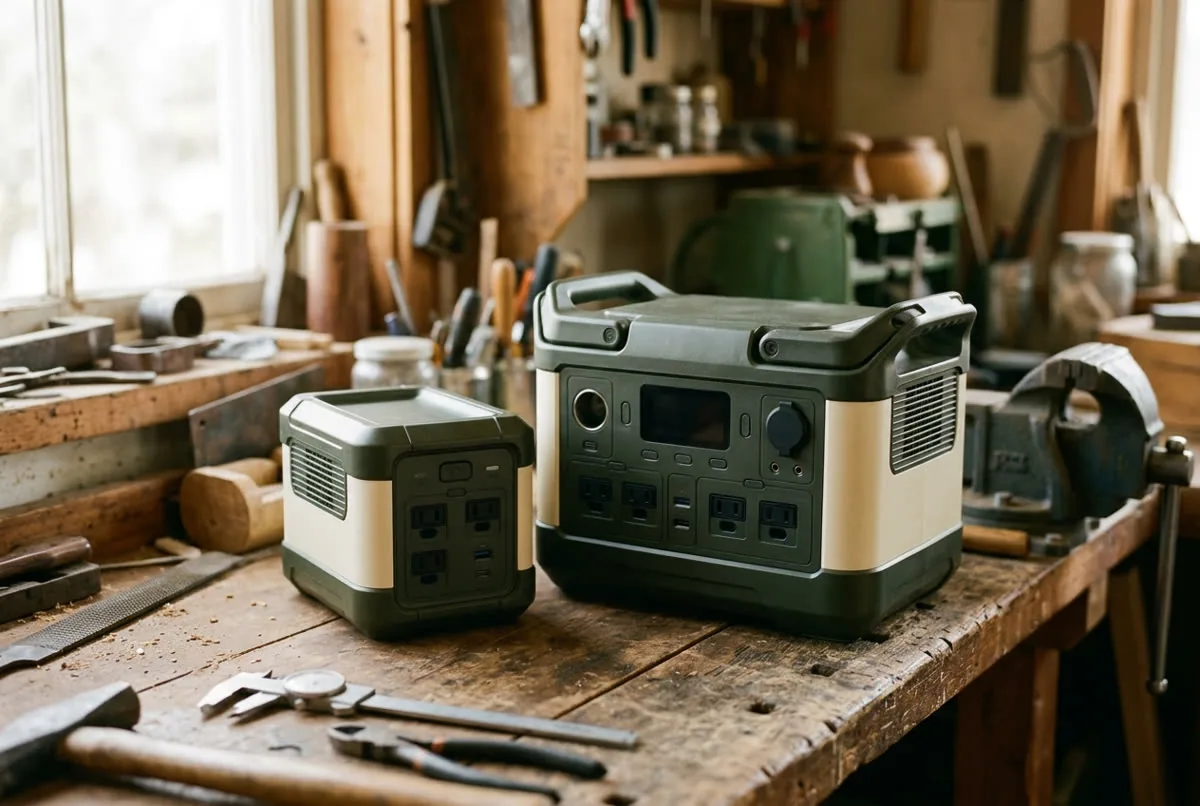
The named 300W unit ships as a small system rather than a single box: the 300W station itself with its 280Wh battery, a 40W folding solar panel to recharge it, and a smaller separate 100W power pack included alongside it (Amazon product listing, 2026). That bundling matters for the price comparison against a 1000W unit sold on its own, since part of what you’re paying for is a second, smaller battery for splitting loads (a phone on the 100W pack, a fan on the 300W station) rather than a single larger unit doing everything.
What isn’t in the box is anything that turns this into a whole-home backup. There’s no transfer switch, no wiring into household circuits, and no path to running anything through your home’s outlets or breaker panel. Any question about connecting a power station to household wiring, rather than plugging devices directly into it, belongs with a licensed electrician and your local code official, not with the wattage math in this guide.
Why a Refrigerator or Sump Pump Needs More Than 300W
This is where the math against a 300W unit gets unforgiving. Home Depot’s published wattage worksheet lists a refrigerator or freezer at roughly 700W running, plus about 2,200W of additional starting watts (Home Depot, “Wattage Worksheet”). A half-horsepower sump pump runs at about 1,050W, also with about 2,200W of additional starting watts (Home Depot, “Wattage Worksheet,” 2021-04-02). A half-horsepower furnace fan runs around 800W, and a window AC unit around 1,200W running (Home Depot, “Wattage Worksheet,” 2021-04-02).
Every one of those numbers is already above what a 300W station is rated to deliver on a running basis, before the starting surge is even counted. A 700W running refrigerator alone exceeds a 300W-rated station’s continuous output, which is the arithmetic reason this class of unit is built for phones, lights, and small electronics rather than appliances with a compressor or motor (derived from Home Depot’s wattage worksheet, 2021-04-02).
The Surge Problem
Consumer Reports’ generator-sizing guidance points at the mechanism behind those inflated numbers: motor-driven appliances like refrigerators, sump pumps, and window AC units draw a short surge well above their steady running wattage the instant they cycle on, and that surge, not the running number, is what determines whether a small power station can start them at all (Consumer Reports, “How to Choose the Right Size Generator”). A station can be rated well above an appliance’s running wattage and still fail to start it, if the surge outpaces the unit’s starting-wattage ceiling.
That’s the practical answer to whether a sump pump belongs on a small solar generator during an outage: on a 300W-class unit, no, the starting surge alone, about 2,200W, is roughly four to seven times what the unit is rated to deliver. A heat-wave blackout kit built around a window AC unit runs into the same wall, since a 1,200W running load with its own starting surge is well outside a 300W station’s range.
How Long Will a 300W Station Actually Last?
Runtime comes down to a simple formula: device wattage multiplied by hours of use equals watt-hours needed, and a station’s battery capacity in watt-hours is the budget you’re spending against, minus some loss to inverter efficiency (general electrical sizing arithmetic, using the manufacturer’s capacity figure from the Amazon product listing, 2026).
Applied to the 280Wh battery in the named 300W unit, a 40W device (a laptop charging, a router, a string of LED lights) could run for roughly six to seven hours before the battery needs recharging, before accounting for the efficiency losses every inverter has (Amazon product listing, 2026). A phone charger, which draws less, would stretch that runtime further; a box fan, which typically draws more, would shorten it. The unit’s bundled 40W solar panel is there to slow that drain during daylight, though actual recharge speed depends on sun conditions the spec sheet doesn’t quantify.
This is also the answer to “how many watt-hours do I need for a weekend without power”: add up the wattage of what you actually plan to run, multiply each by the hours you’ll run it, and total the watt-hours. A phone and a lantern for a weekend might total under 100Wh. A CPAP running overnight for two nights could be several hundred watt-hours on its own. The math is unforgiving in both directions, it will tell you honestly whether 280Wh is plenty or nowhere close.
Is a 300W or 1000W Power Station Right for Your Household?
The honest split comes down to what’s actually plugged in during an outage, not what feels like a safer number to buy. If the list is phones, a router, a lantern, a fan, and maybe a laptop, a 300W-class station covers it, and the lower price is money saved rather than money risked. If the list includes a refrigerator, a sump pump, a window AC unit, or a CPAP with a heated humidifier, the wattage worksheet numbers above make the case for a 1000W-class unit or larger on their own, since even the running wattage of those appliances clears what a 300W station is rated to deliver.
Reading the listing for the unit itself is worth ten minutes before buying. Two numbers, running wattage and battery watt-hours, tell you almost everything: whether it can carry the load at all, and for how long. A comparison of two mid-size power stations or a broader look at budget solar setups can help calibrate what’s typical at each price point, but the worksheet math for your own household’s appliances is the number that actually decides the purchase.
For a household that splits the difference, some higher-draw appliances and some pure small-electronics use, buying two smaller units, or a 300W unit alongside a battery-only backup, can sometimes make more sense than a single mid-size station. That’s a household-by-household call the wattage worksheet numbers above are built to help answer, not a rule.
Renters and smaller-yard households tend to land on the 300W side of this split by default, simply because there’s less to power in the first place: no well pump, no furnace fan, sometimes no full-size fridge separate from what came with the unit. A 300W station with its bundled solar panel can be enough to cover a weekend of phones, a fan, and a lantern without ever touching the higher-wattage math above. The same worksheet numbers apply either way, they just resolve differently depending on what’s actually plugged into the wall in a given household.
Before your next power-station purchase, run your own list of what needs to stay on through an outage against the running and starting wattage figures for each appliance, then check that total against the battery watt-hours and rated output on the listing you’re considering. That ten-minute exercise, done before checkout, is what separates a station that quietly does its job from one that trips the moment the fridge compressor kicks on.
Frequently Asked Questions
- Is a 300W solar generator enough to run a mini fridge or window fan?
- A window fan, yes, it's a steady low-watt draw. A mini fridge is riskier because compressors cycle on and off and pull a surge each time they start; the product listing for the named 300W unit warns that running appliances over 300W may damage it, especially devices with a heating element or a built-in compressor.
- What's the real difference between a 300W and a 1000W power station?
- The wattage number is continuous AC output, how much power the unit can deliver at once, not battery size. Battery capacity is measured separately in watt-hours. A 1000W-rated unit can generally handle bigger, motor-driven loads that a 300W unit is not built for, but it's worth checking the watt-hour rating on any listing too, since that's what determines runtime.
- How long will a 300W power station run my phone or laptop?
- Using the named 300W unit's 280Wh battery as a reference, a 40W device like a laptop or router could run for roughly six to seven hours before recharging, before accounting for inverter efficiency losses. A phone charger, which draws less, would stretch that runtime further.
- Can I run a sump pump on a small solar generator during an outage?
- Not on a 300W-class unit. Home Depot's wattage worksheet lists a half-horsepower sump pump at roughly 1,050W running plus about 2,200W of additional starting watts, well above what a 300W-rated station is built to deliver.
- How many watt-hours do I actually need for a weekend without power?
- Add up the wattage of each device you plan to run and multiply by the hours you'll use it; the total is your watt-hour budget. Small electronics like a phone and a lantern for a weekend can total under 100Wh, while something like a CPAP running overnight can require several hundred watt-hours on its own.
Sources & references
Before you go
The Renter's Homestead Pack
Self-reliance projects for the yard you don't own — container yields, a raised bed built to move with you, balcony preservation basics, and the landlord questions to ask first.
Free guide
The Renter's Homestead Pack
Self-reliance projects for the yard you don't own — container yields, a raised bed built to move with you, balcony preservation basics, and the landlord questions to ask first.