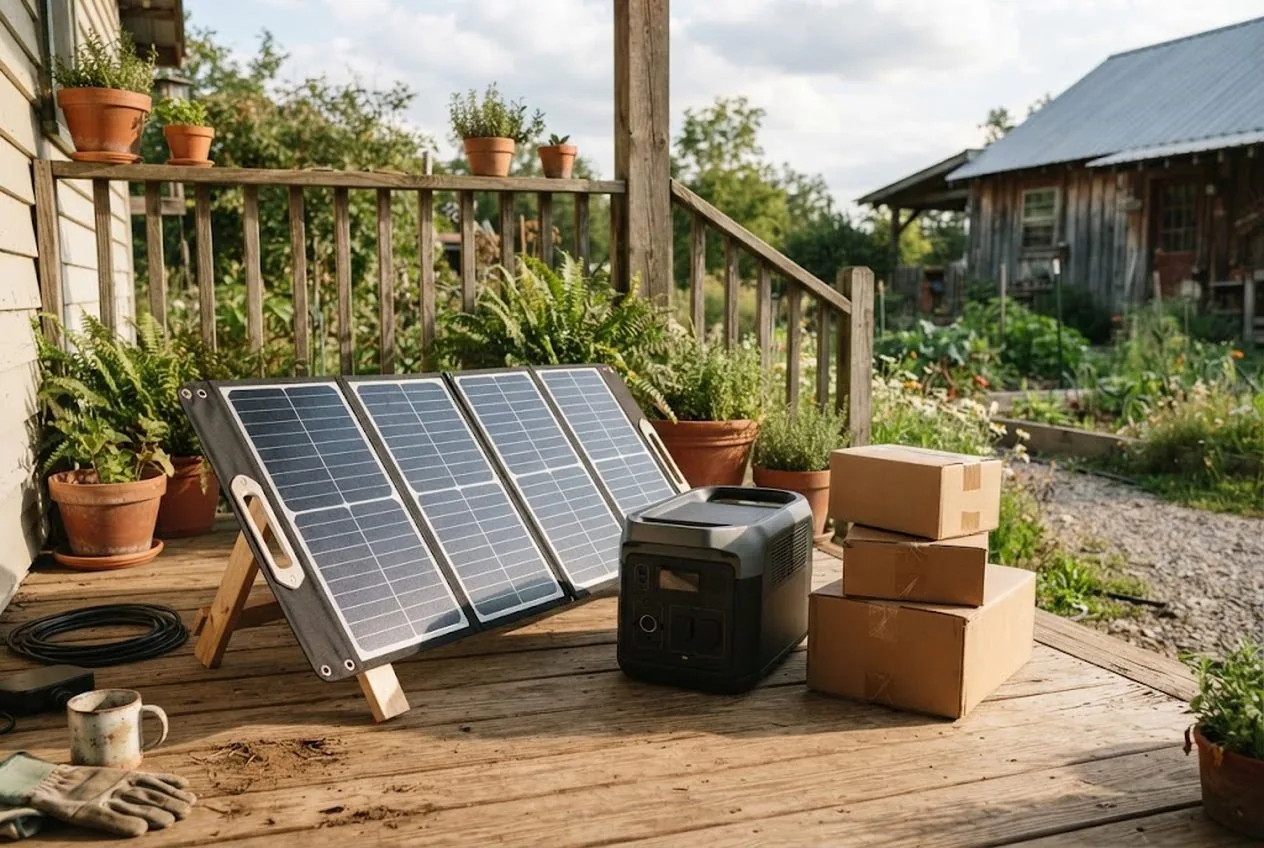
Another countdown clock is coming to your inbox. Amazon has confirmed it is running Prime Big Deal Days again on October 6 and 7 (NBC News), and by the last week of September every portable power brand will be running the same play: a big red percentage, a ticking timer, and a page telling you this is the year to finally buy backup power. Some of that will be a real deal. A lot of it will be a badge stapled to a price nobody was ever going to pay.
Short answer: the solar generator category — portable power stations plus the panels that recharge them — shows up in October Prime sales with discounts that vary widely by brand, model, and size. The move that actually saves you money isn’t picking a brand; it’s sizing the unit to your real loads first, then shopping that spec across whichever brand happens to be cheapest that week.
Disclosure: the product links here are affiliate links, so we may earn a commission if you buy through them at no extra cost to you. This roundup is built from manufacturer specifications and public deal-recap coverage — not a confirmed markdown calendar from Amazon or any brand, and not a claim that any specific unit will hit a specific price this October.
First, Separate the Calendar From the Hype
Prime Big Deal Days is a real, confirmed event — Amazon’s second major sale of the year, running October 6 to 7, timed to catch holiday and cold-weather shopping. What isn’t confirmed is which models get marked down. Every brand’s own “coming soon” page you’ll see between now and then is marketing, not a price guarantee.
Here’s what is a reasonably solid pattern rather than hype: portable power stations and solar panels have shown up in past October sales. Treat that as a pattern, not a promise — the actual discount on any one model this October depends on that model’s age, inventory, and how aggressively that specific brand wants to move it. A unit that launched eight months ago behaves differently than one about to be replaced by a new generation.
The 4 Solar Generator Deals Worth Watching, at a Glance
- The cold-weather workhorse — a LiFePO4 power station like the Bluetti AC180, for households prioritizing long battery life
- The all-rounder — an EcoFlow-class ~1,000Wh station, for households that want fast recharging and broad everyday versatility beyond just outages
- The budget entry — a 300W-class portable solar generator, for phones, lights, a router, and small electronics rather than a refrigerator
- The panel that makes any of them worth owning — a 200W folding or rigid solar panel, since a power station with no way to recharge it is just a battery that runs out
1. The Cold-Weather Workhorse — LiFePO4 Power Stations
If your household is buying backup power with winter specifically in mind — heating-season outages, a well pump, a furnace blower — battery chemistry matters more than the size of the discount badge. LiFePO4 (lithium iron phosphate) units like the Bluetti AC180 are rated for thousands of charge cycles (3,500+ to 80% capacity for the AC180 (BLUETTI)), which is the difference between a unit that’s still reliable in five winters and one that’s quietly lost capacity. We compare this class directly against a same-size EcoFlow in our Bluetti AC180 vs. EcoFlow winter blackout guide if cold tolerance is your deciding factor.
2. The All-Rounder — EcoFlow-Class ~1,000Wh Stations
If you want one unit that does double duty — camping and job-site use most of the year, blackout backup the rest — an EcoFlow-class station in the same capacity range is the comparable alternative; compare rated cycles, recharge times, and solar input on each spec sheet. Solar input matters most on the short, cloudy days this sale season leads into, when a fast charger banks more energy in a narrow sunny window. Our best power stations for a blackout comparison breaks down the same trade-off with a full runtime table.
3. The Budget Entry — 300W-Class Solar Generators
Not every household needs to run a refrigerator off battery power, and this is where the discount-percentage trap does the most damage: a bigger badge on a bigger unit isn’t a better deal if you only needed to keep a phone, a router, and a couple of lamps alive. A 300Wh-class unit is a fraction of the price of the two above and covers exactly that shorter list, with no illusions about running anything that cycles a compressor.
4. The Panel That Makes Any of Them Worth Owning
A power station with no way to recharge it during a multi-day outage is a battery that runs down and stays down. A 200W panel is a practical building block — enough to meaningfully top off a 1,000Wh-class station over a sunny day, and small enough to store flat in a closet the other 360 days a year. If you’re buying a new station this sale season and don’t already own a panel, price the two together rather than treating the panel as an optional add-on later.
What a Big “Percent Off” Badge Actually Gets You
The headline percentage on a deals page is doing a job, and the job isn’t informing you — it’s getting you to stop comparing. Here’s how the categories compare. Discounts vary by model and by year, so treat any badge as a starting point, not a price promised for any specific model this year.
| Category | Typical full price range | Past-event discount range seen (estimate) | What that buys |
|---|---|---|---|
| Budget 300W-class solar generator | Varies by brand | Varies; check price history | Phones, lights, router, small electronics |
| Mid-size ~1,000Wh station (EcoFlow-class) | Varies by model | Varies; check price history | Fridge, fans, phones, medical devices overnight |
| LiFePO4 ~1,150Wh station (Bluetti-class) | Varies by model | Varies; check price history | Same loads, 3,500+ rated cycles on the AC180 |
| 200W solar panel | Varies by brand | Varies; check price history | Daytime recharge for any station above |
The panel row is the one worth sitting with. Solar panels are commodity hardware with thin brand differentiation, so there’s less brand-loyalty premium to protect. A station’s discount, by contrast, often tracks how close that model is to being replaced by a newer generation, which you can’t see from the deals page alone.
Buy the Size You Need, Not the Percentage Off
The actual decision that saves or wastes money here happens before the sale starts, not during it. Add up what you need to run — a fridge and a furnace blower call for a very different unit than a phone and a lamp — and shop that capacity class across brands, rather than starting from “which brand has the biggest badge this week.” Our portable power for a summer blackout roundup walks through that sizing math load by load, and it applies just as much to a fall sale as it did to a July one.
It’s also worth checking a unit’s own price history before trusting any percentage-off claim — a “50% off” badge means little if the “before” price was inflated for the occasion, which federal pricing guides call a false bargain (FTC Guides Against Deceptive Pricing, eCFR). That habit costs five minutes and catches many of the bad deals in this category before you click buy.
The Bottom Line
A solar generator is a bridge, not a plan — it buys you hours to days during an outage, not a rebuilt grid. Prime Big Deal Days is a genuinely good time to close that gap for less money than usual, but only for the size and chemistry your household actually needs. Decide that first. Then let the brands compete for your business in early October, instead of the other way around.
Frequently Asked Questions
- When is Prime Big Deal Days 2026?
- Amazon has set Prime Big Deal Days 2026 for October 6 and 7, a 48-hour sale for Prime members. Check Amazon's own deals page for the live deals, and don't buy on a rumor of a discount.
- Do solar generators actually get discounted during Prime Big Deal Days?
- Portable power stations and solar panels have appeared in past October Prime sales, but discounts vary widely by model and year, and nothing guarantees a cut on any specific model this year. Always check the unit's own price history before treating a percentage-off badge as real.
- Which brand should I wait for — Jackery, EcoFlow, Anker, or Bluetti?
- Any of the four may run October sale discounts, so brand loyalty matters less than matching the unit's capacity and battery chemistry to your actual loads. A LiFePO4 unit like the Bluetti AC180 is rated for long battery life; budget solar generators from any brand trade capacity for price. Pick the spec, then shop that spec across brands during the event.
- Should I buy a solar generator before the event or wait?
- If you have zero backup power and winter is close, don't wait on a maybe-discount — buy the size you need now and treat any sale price as a bonus. If you already have some backup and are shopping to upgrade or add capacity, waiting for the October 6 to 7 event is reasonable.
- Is a cheap 300W solar generator ever a smarter buy than a name-brand 1,000Wh unit?
- Yes, for the right household. A 300Wh-class unit can't run a refrigerator, but it covers phones, a router, and lights through a short outage — often the actual list of things people lose sleep over. Buying more capacity than your loads require just because the percentage-off badge is bigger is a common overspend in this category.
Sources & references
Before you go
The Renter's Homestead Pack
Self-reliance projects for the yard you don't own — container yields, a raised bed built to move with you, balcony preservation basics, and the landlord questions to ask first.
Free guide
The Renter's Homestead Pack
Self-reliance projects for the yard you don't own — container yields, a raised bed built to move with you, balcony preservation basics, and the landlord questions to ask first.