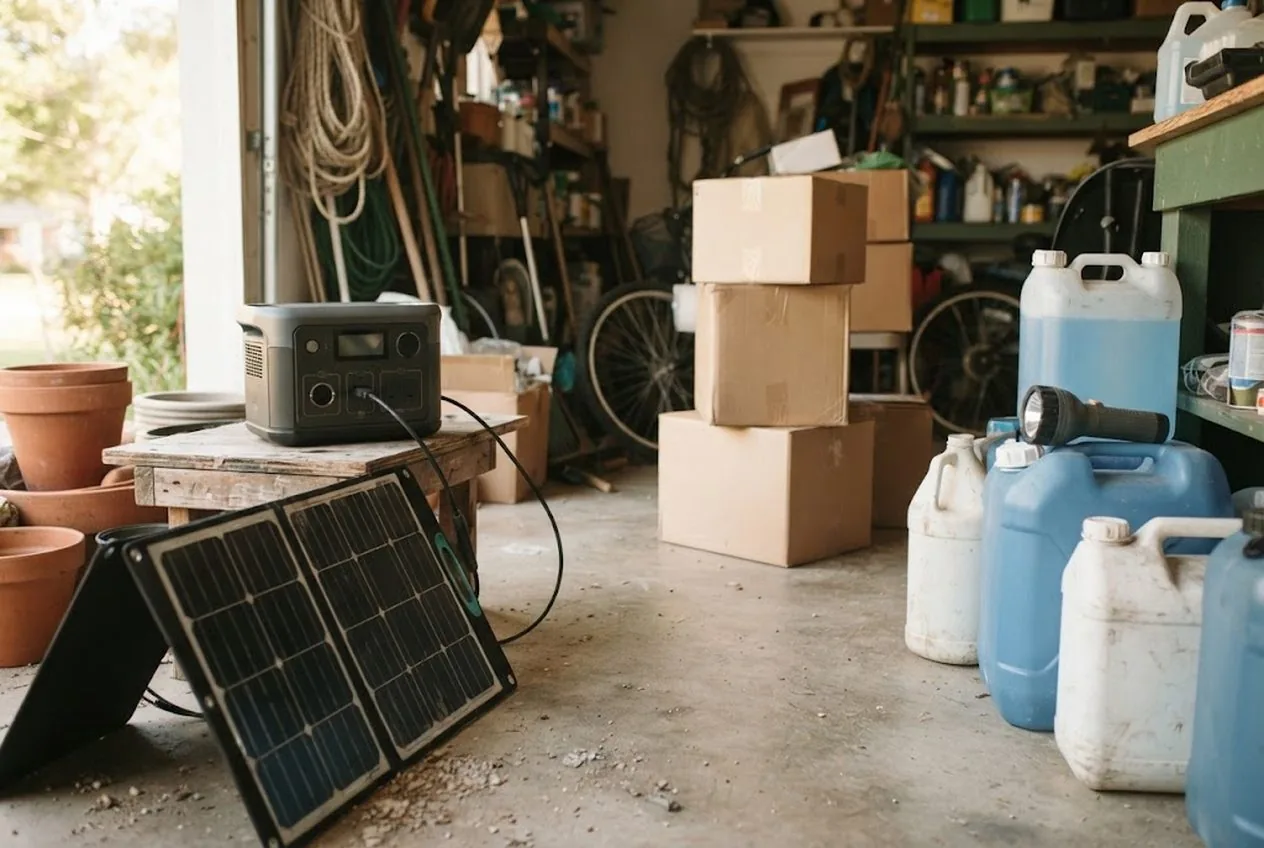
Every year, the pattern repeats on schedule. Atlantic hurricane season runs June through November, but the real climb happens through August and peaks around early-to-mid September (NOAA National Hurricane Center) — and that’s exactly when a solar generator becomes the hardest thing to buy in a threatened region. In the storm’s path, inventory that sat steady on shelves for weeks can sell through in a short window the moment a storm gets a name and a cone shows up on the map. Whatever you were planning to buy is now a scavenger hunt across three counties.
Most solar-generator advice, including a fair amount of it on this site, is written for winter: sizing an array against short days, keeping a battery bank from getting cold-soaked. Hurricane prep is a different job — you’re not designing a system from scratch, you’re pressure-testing the unit you already own, or buying the right one, in the calm window before a storm exists on paper.
Short answer: get the unit ready before a name appears in the forecast, not after. Add up the handful of loads that actually matter — fridge, phones, a fan, a medical device — charge the battery to full and confirm it holds that charge and performs under a real load, test the solar panel’s recharge path in direct sun, and buy or upgrade now if what you own falls short. Do the testing in the quiet part of the season, and the week a storm actually threatens becomes a non-event instead of a scramble.
The gear is rarely the failure point in a storm kit — the timing is. A power station that’s sat fine in a closet all summer can still surprise you with a battery that won’t hold a charge or a panel cable that’s corroded, and the worst time to discover either one is the day the power actually goes out.
Disclosure: the product links here are affiliate links, so we may earn a commission if you buy through them at no extra cost to you. The testing steps below follow manufacturer guidance and FEMA (Ready.gov) and Red Cross (American Red Cross) power-outage preparedness recommendations, not any brand’s marketing.
Why Prepping It Now Actually Works
A solar generator’s biggest advantage over a gas generator is also the thing that lets it sit forgotten: it has no engine to seize, no carburetor to gum up, no fuel to go stale. That’s real, but it isn’t a reason to skip testing. Lithium batteries self-discharge slowly even in storage, connectors corrode in a humid garage, and a unit that reads “100%” on a shelf may not deliver its rated output once you actually put a load on it. The only way to know is to test it, and the only good time to test it is before you need it.
The sell-out dynamic compounds the problem. Solar and battery-based backup appeals to plenty of homeowners as an alternative to gas generators, thanks to quiet, fumes-free operation a combustion engine can’t match. That’s a reasonable move — solar generator vs. gas generator for winter backup walks the trade-offs — but more buyers chasing the same regional shelf space is exactly what empties it fast once a storm gets a name. The fix isn’t outrunning the crowd during a watch; it’s not being in the crowd at all.
Indoor safety is the other half of the case. A battery-based unit produces no exhaust, so it’s safe to run right beside you inside during a storm, when going outside isn’t an option. A gas generator must always run outdoors, more than 20 feet from windows, doors, and vents, with a carbon monoxide alarm inside the house (CDC) — that line doesn’t bend for a hurricane, and it’s the single most dangerous mistake in any storm-power setup.
What You’ll Need
- An entry-level, budget-friendly unit — something like the 300W Portable Solar Generator (Amazon) if your must-run list is phones, lights, and a weather radio, not a fridge.
- A larger LiFePO4 power station — a unit like the Bluetti AC180 (Amazon) (BLUETTI specs) if a fridge, a CPAP, or a box fan is non-negotiable during a multi-day outage.
- A folding solar panel — something like the Renogy 100W Portable Solar Panel (Amazon) so recharging doesn’t depend on a wall outlet that may not have power.
- A notepad or your phone’s notes app, to run the wattage math in Step 1.
- Any device-specific cables or adapters your must-run list needs — check now, not mid-outage.
Step 1: Add Up What You Actually Need to Power
Skip the temptation to size for the whole house. List the short set of loads that actually matter in a hurricane outage — a fridge cycling, phones, a box fan, a CPAP, a router to keep a cell signal — and multiply each one’s wattage by the hours per day you’d run it to get a watt-hour total (American Red Cross recommends taking an inventory of your electrical needs first). That number, not a marketing spec, tells you whether the unit you own is enough.
This is the same math our guide to sizing a solar setup for fall and winter walks in more depth, but a hurricane version is shorter on purpose: you’re planning for a handful of days, not a whole season, so the goal is certainty about your must-run list, not a maximal build.
Step 2: Buy or Upgrade Before the Forecast Cone Appears
If Step 1’s math outruns what you already own, this is the step that matters. Buy or upgrade during the calm build-up to peak season — midsummer at the latest — while regional stock is full and prices haven’t been squeezed by a cone-driven rush.
If your list is lighter — phones, a lamp, a radio — a smaller, cheaper unit is a reasonable entry point instead of overbuying capacity you’ll never use.
Step 3: Charge It to Full and Run a Real Load Test
Charge the battery to 100%, then check the next morning whether it’s still reading full. A real overnight drop — more than the spec sheet’s expected standby loss — is an early sign of a degrading cell, and it’s far better to learn that now than during a blackout.
Then run an actual load test, not just a percentage check. Plug in a lamp, a fan, or the fridge itself for a couple of hours and watch whether the runtime holds up against what the unit promises. A power station that can’t sustain its stated output under a real device isn’t ready, no matter what the gauge says.
Step 4: Test the Solar Panel’s Recharge Path in Full Sun
Unfold the panel outdoors, in direct midday sun, and confirm the unit shows active charging current — not just a connection light. This is the piece that keeps producing power once the battery’s stored charge is gone, especially during the clear breaks between storm bands.
Step 5: Check Cables, Ports, and the App Connection
Inspect every port and connector for corrosion or grit from off-season storage in a humid garage or shed. Confirm the inverter’s outlet types match your must-run devices — a compressor or a CPAP wants a pure sine wave output, not a modified one — and test any companion app now. Treat the app as a convenience, not a dependency; the hardware needs to work with or without it.
Step 6: Stage It With the Rest of Your Storm Kit
Once it’s tested, store the unit, its panel, and its cables together in one stable, dry interior spot — not a hot attic, where heat degrades batteries faster, and not a garage that could flood. Keep it beside the rest of your storm supplies so the kit is a single grab if you need to evacuate. Our hurricane-season blackout kit lays out the full power-and-water stack this unit fits into.
Troubleshooting Common Solar Generator Problems Before a Storm
- It won’t hold a full charge overnight. A real, repeated drop points to a degrading cell. Contact the manufacturer’s warranty support in the off-season, not the week a storm is bearing down.
- The panel shows connected but not charging. Check the cable orientation and clean the contacts, and make sure it’s in direct sun rather than shade or through a window.
- Output cuts out under a real load. The unit’s continuous wattage rating may sit below your device’s startup draw — compressors and motors spike hard before settling. Recheck the spec sheet against your Step 1 math.
- The app won’t pair. Most units run fine without it. Treat a software hiccup as a shrug, not a reason to skip the hardware test.
The Bottom Line
A solar generator is one layer of a hurricane plan, not the whole thing — it doesn’t replace stored water or a family plan for where you’ll be when a storm makes landfall. But it’s the layer that’s easiest to get wrong through neglect, because it sits quietly in a closet until the one week a year it has to work. Run the math, charge it, load-test it, prove out the panel, and buy now if you’re short — and the moment a storm finally gets a name, you’ll already be done. For a closer look at a panel that pairs well with this checklist, see our Renogy 200W solar panel review, and for the gas-versus-battery question, our head-to-head on solar generator vs. gas generator for winter backup — the same trade-offs apply whether the threat is a cold snap or a coastline.
Frequently Asked Questions
- When should I get my solar generator ready for hurricane season?
- During the calm run-up to peak season, not after a storm is already on the map. The Atlantic season officially runs June through November, but activity climbs through August and climaxes around early-to-mid September. Run the checklist in that build-up window — charge, load-test, and check the panel — so the unit is proven out before a name ever appears in the forecast.
- Why do solar generators sell out before a hurricane?
- Regional demand spikes hard the moment a storm is named and a cone shows up on the map, and inventory in the threatened area that sat steady for weeks can sell through in a short window once that happens. It's an availability problem, not a manufacturing one — the fix is buying or upgrading during the quiet part of the season, while shelves and warehouses are still full, instead of waiting to see which way the storm turns.
- Is a solar generator safer than a gas generator during a hurricane?
- For indoor use, yes, and it's the main reason to own one. A battery-based solar generator produces no exhaust, so it can run inside during a storm when going outdoors isn't safe. A gas generator must always run outdoors, more than 20 feet from windows, doors, and vents, with a carbon monoxide alarm inside the house — the CDC warns never to run one inside a home or garage, even with doors and windows open. That hard line doesn't move for weather.
- Will a solar generator run my refrigerator through a multi-day outage?
- A larger LiFePO4 unit in the roughly 1,000Wh class can typically carry a full-size fridge's compressor cycling for many hours on a single charge, depending on the fridge, and pairing it with a solar panel extends that between storm bands. A compact, budget-friendly unit generally can't — it's built for phones, lights, and a radio, not a compressor. Run the wattage math in Step 1 before you assume either way.
Sources & references
- NOAA National Hurricane Center, Tropical Cyclone Climatology (opens in new tab)
- CDC, Carbon Monoxide Poisoning Basics (opens in new tab)
- Ready.gov (FEMA), Power Outages (opens in new tab)
- American Red Cross, Power Outage Safety (opens in new tab)
- BLUETTI, AC180 Portable Power Station specs (opens in new tab)
Before you go
The Renter's Homestead Pack
Self-reliance projects for the yard you don't own — container yields, a raised bed built to move with you, balcony preservation basics, and the landlord questions to ask first.
Free guide
The Renter's Homestead Pack
Self-reliance projects for the yard you don't own — container yields, a raised bed built to move with you, balcony preservation basics, and the landlord questions to ask first.