What’s the short answer?
- Run portable generators outside only, at least 20 feet from your house, doors, and windows.
- An open garage door does not make indoor or garage generator use safe; CO still builds to deadly levels.
- Point exhaust away from your house and any nearby buildings, and keep the unit far from doors, windows, and vents that could let CO indoors.
- Deadly CO levels can build within minutes and linger for hours after the generator shuts off.
- Install battery-backup CO detectors near every sleeping area regardless of generator placement.
- In rain, use an open canopy-like structure outside the 20-foot line, not an attached covered porch.
A storm knocks out the power, and the generator bought for exactly this moment is sitting in the garage. The instructions say “well-ventilated area,” but the rain is picking up again, and the only dry spot within reach is a few feet from the back door. Every storm season, this exact set of trade-offs is where people make the decision that turns a power outage into a poisoning case.
The short answer: Run a portable generator outside only, at least 20 feet from your house, garage, doors, and windows, with the exhaust pointed away from any building opening. Never run one indoors or in a garage, even with doors and windows open (CDC.gov).
How Far From the House Does a Generator Actually Need to Be?
CDC’s generator safety guidance is specific about the number: portable generators should be used only outdoors, more than 20 feet away from your home, doors, and windows (CDC.gov). That distance is a minimum, not a target to round down from when the extension cord is a little short.
The same guidance is unambiguous about the placement most people default to when the weather turns bad: never run a generator inside a home or garage, even with the doors and windows open (CDC.gov). That rules out the covered spot by the back steps, the space under a deck, and the three-sided lean-to against the shed wall, unless those spots happen to clear 20 feet from every door and window on the house.
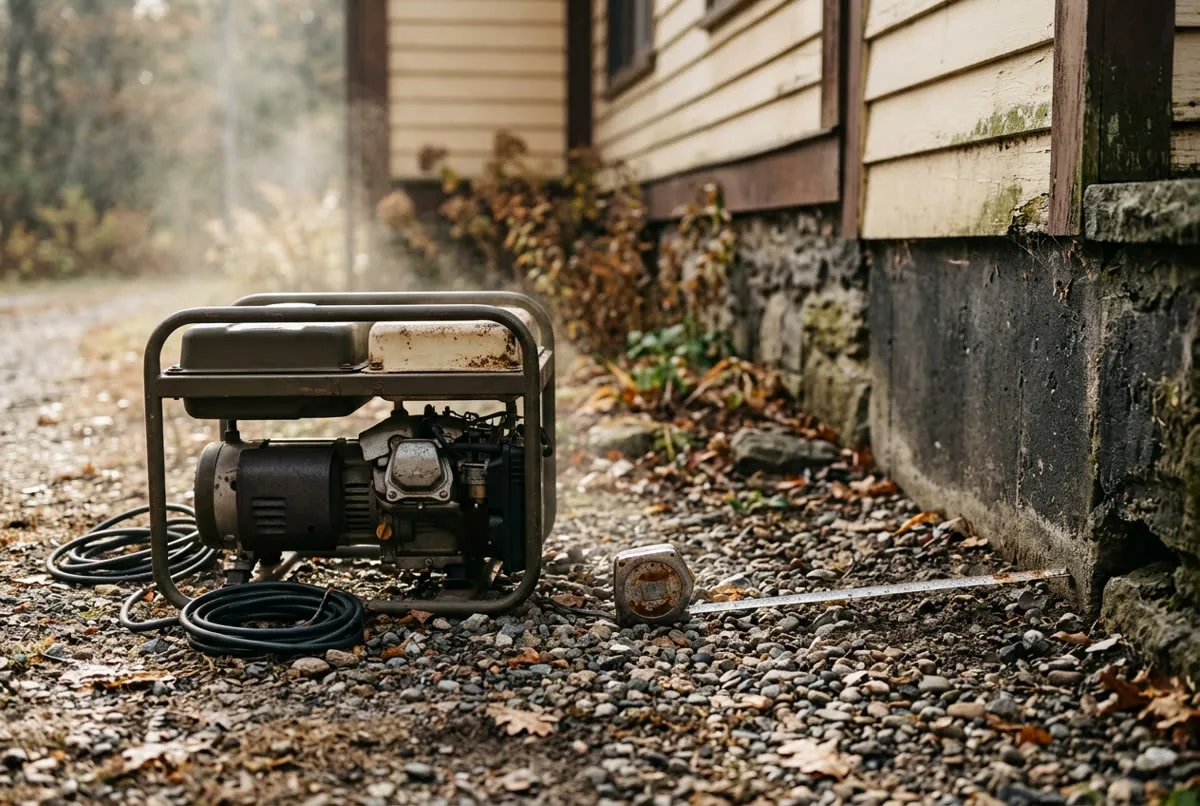
Before the next outage, not during it, is the time to walk the property with a tape measure and mark where a generator can actually sit. Most yards have one or two spots that work; figuring out which ones in daylight, with no storm pressure, is the whole exercise.
Why an Open Garage Door Doesn’t Change the Math
This is the mistake that shows up again and again in poisoning cases: someone runs the generator in the garage with the big door up, reasoning that the airflow makes it safe enough. CPSC’s generator safety alert closes that loophole directly, stating that generators should never be used inside homes, garages, crawlspaces, or sheds, even with fans running or doors and windows open, because deadly carbon monoxide levels can build up in these spaces within minutes and linger for hours after the generator shuts off (CPSC.gov).
An open garage door doesn’t create the kind of airflow that clears carbon monoxide from an enclosed space. It creates the impression of airflow, which is worse than no airflow at all, because it removes the instinct to move the generator somewhere genuinely open. CO is invisible and odorless, so there’s no sensory warning telling anyone in the house that the air has already turned dangerous. The garage door being up is not a safety measure; it’s a detail that has no bearing on the outcome.
Where the Exhaust Points Matters as Much as the Distance
Twenty feet of clearance is necessary, but CPSC is clear that distance alone isn’t the whole safety picture. The agency also instructs locating the unit far from doors, windows, and vents that could allow carbon monoxide to come indoors, and pointing the exhaust away from any nearby buildings (CPSC.gov).
In practice, that means checking which way the wind is blowing before positioning the unit, not just where the tape measure lands. A generator set up 25 feet out but exhaling straight toward an open kitchen window, on a day the wind happens to be blowing toward the house, still carries real risk despite technically clearing the distance rule. The two checks, distance and exhaust direction, work together; neither one covers for the other.
Small Lots, Attached Garages, and Close Neighbors: When 20 Feet Is Hard to Find
A 20-foot radius is easy to picture on a rural half-acre and much harder to picture on a narrow suburban lot or a rented townhouse with a shared driveway. CPSC’s exhaust guidance doesn’t only cover a homeowner’s own doors and windows; it applies to nearby buildings generally, which means a generator placed 20 feet from the renter’s own back door but 8 feet from a neighbor’s kitchen window hasn’t actually solved the problem, just relocated it (CPSC.gov).
On a lot where no single spot clears 20 feet from every structure, an attached garage, a neighbor’s wall, a shared fence line with windows on the other side, the honest answer is that a portable fuel generator may not have a safe placement option on that property at all. That’s a real constraint, not a reason to compromise on the distance. It’s also the strongest case for shifting part of the load, medical equipment, a refrigerator, a few lights, onto a battery-based power station instead, since it removes the exhaust question from the equation for whatever circuits it covers.
How Fast Carbon Monoxide Actually Becomes Dangerous
The instinct to “just run it for a few minutes” in a marginal spot doesn’t hold up against the numbers. CPSC’s alert states that CO levels in an enclosed or semi-enclosed space near a running generator, a garage, crawlspace, or shed, can reach deadly concentrations within minutes (CPSC.gov). The same guidance notes the gas lingers for hours after the generator is turned off, so the false sense of safety doesn’t end when the engine does.
That combination, a fast buildup and a slow clearance, is why the placement rules function as hard limits rather than best-practice suggestions. There isn’t a version of “run it inside for a short stretch” that the science supports. By the time symptoms like headache or dizziness show up, the exposure that caused them already happened.
A CO Detector Is a Backup, Not a Placement Plan
Even with a generator placed correctly outside, CDC recommends installing battery-operated or battery-backup carbon monoxide detectors near every sleeping area in the home and testing them regularly (CDC.gov). That instruction stands regardless of where the generator sits, because a detector is designed to catch the exact scenario the placement rules exist to prevent in the first place: exhaust that reaches the house anyway, whether from wind, a neighbor’s unit, or a mistake made under pressure.
A detector doesn’t replace correct placement, and correct placement doesn’t make a detector optional. They cover different failure points, and treating either one as sufficient on its own is how the same mistake shows up in different houses every storm season. CPSC advises testing CO alarm batteries monthly (CPSC.gov), not just once when the unit is first installed, since a detector that’s silently dead by the time it’s needed offers no more protection than no detector at all.
If a whole-home outage plan is on the table, it’s worth comparing a fuel generator against a battery-based power station for at least part of the load, since a battery unit produces no combustion exhaust and removes the placement question entirely for whatever it’s running. That doesn’t mean retiring the fuel generator; it means deciding, ahead of the next outage, which circuits genuinely need the higher output of a fuel unit and which ones, a phone charger, a CPAP machine, a few lights, could run on stored power instead, without the clearance math attached.
Running a Generator in the Rain Without Trading One Risk for Another
Wet weather adds a second hazard, electrocution, that pushes some people toward covering the generator or moving it somewhere more sheltered. CPSC’s answer isn’t to bring the unit closer to the house; it’s to operate it under an open, canopy-like structure on a dry surface, not indoors and not near a building opening (CPSC.gov).
A detached carport, an open-sided gazebo, or a simple pop-up canopy set up outside the 20-foot line does the job. A generator tucked under an attached covered porch a few feet from the back door does not, since that spot is still “near a building opening” by CPSC’s own definition, whatever the roof overhead is doing about the rain. When the two hazards, wet electrical connections and CO buildup, seem to be pulling toward the same compromise spot, the fix is a better outdoor structure, not a location closer to the house.
The Numbers Behind the Warning Label
Every portable generator manufactured or imported since May 14, 2007, has carried a required carbon monoxide danger label (CPSC.gov), and the warning reflects a real toll rather than a regulatory formality. CPSC estimates that an average of about 100 consumers die in the U.S. each year from CO poisoning from portable generators (CPSC), and a 2022 CPSC report found that since 2008, portable generators accounted for 43 percent of all CO deaths related to consumer products under its jurisdiction (CPSC, 2022-02-23).
That share, close to half of all product-linked CO deaths coming from a single category of device, is what makes clearance distance a hard rule instead of a suggestion on a sticker most people never read. The label has been there since 2007. The behavior it’s warning against hasn’t stopped being common.
Before the next outage, walk the property with a tape measure and mark the actual 20-foot line from every door and window on the side of the house a generator would normally sit. Check which direction the prevailing wind runs from that spot, confirm the CO detectors near every sleeping area have working batteries, and work through a hurricane season power outage checklist and a generator maintenance guide now, so placement isn’t the only decision left for the middle of a storm.
Frequently Asked Questions
- How far away from my house does a generator actually need to be?
- More than 20 feet from your home, doors, and windows, per CDC guidance, and CPSC adds that the exhaust should point away from any nearby buildings (CDC.gov; CPSC.gov).
- Can I run a generator in my garage with the door open?
- No. Both CDC and CPSC state generators should never run inside a home or garage, even with doors and windows open, because CO can reach deadly levels within minutes (CDC.gov; CPSC.gov).
- Do I still need a CO detector if my generator is outside?
- Yes. CDC recommends battery-operated or battery-backup CO detectors near every sleeping area regardless of where the generator is placed outdoors (CDC.gov).
- Is it safe to run a generator on a covered porch during rain?
- Only if that structure is open and canopy-like, sits outside the 20-foot line, and isn't near a door, window, or vent. CPSC advises against running a generator indoors or near any building opening, even in rain (CPSC.gov).
- How fast can carbon monoxide from a generator become dangerous?
- CPSC states deadly CO levels can build up in enclosed or semi-enclosed spaces within minutes of a generator running, and the gas can linger for hours after the generator shuts off (CPSC.gov).
Sources & references
Before you go
The Renter's Homestead Pack
Self-reliance projects for the yard you don't own — container yields, a raised bed built to move with you, balcony preservation basics, and the landlord questions to ask first.
Free guide
The Renter's Homestead Pack
Self-reliance projects for the yard you don't own — container yields, a raised bed built to move with you, balcony preservation basics, and the landlord questions to ask first.