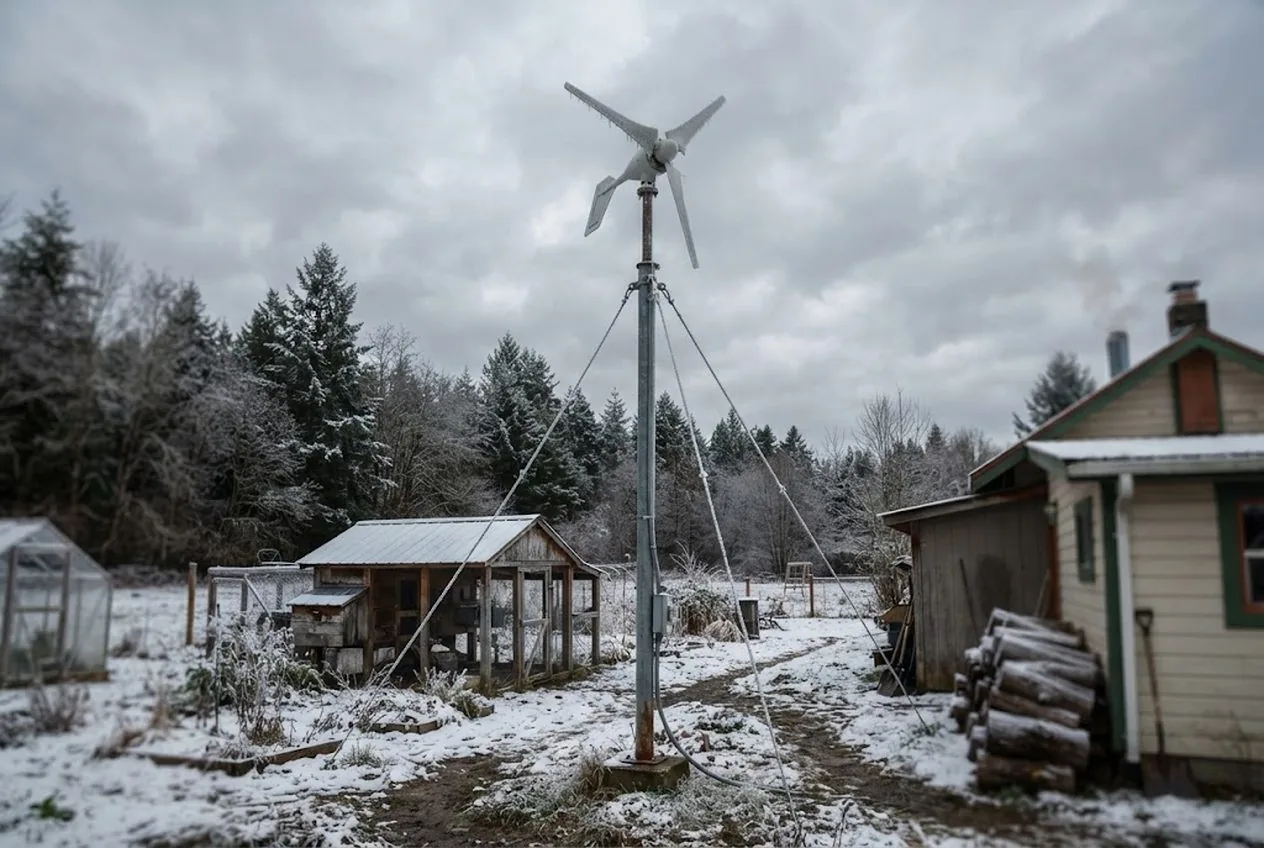
The pitch is seductive, and it’s everywhere: bolt a small turbine to a pole, let the winter storms spin it, and generate power at night when your solar panels are asleep. For a prepper eyeing off-grid resilience through the dark months, wind sounds like the perfect partner to solar. So it’s worth answering the question honestly, without the marketing gloss: do backyard wind turbines actually work in winter?
The honest answer is sometimes, in the right place, as a supplement — and rarely, disappointingly, as a standalone source in the average yard. Winter is genuinely wind’s best season, but a small turbine’s real output is governed by physics and site conditions that most backyards fail. This piece lays out the reality so you can decide clearly whether a turbine belongs in your setup — and it will save some readers a costly, spinning ornament.
The One Law That Governs Everything: Wind Speed Cubed
Start with the physics, because it explains every disappointment and every success. A wind turbine’s power output rises with the cube of wind speed (U.S. Department of Energy). Double the wind, and the available power goes up roughly eight-fold. Halve it, and power collapses to an eighth.
That single relationship is why site matters more than the turbine you buy (U.S. Department of Energy). A “400W” turbine reaches 400 watts only in strong, steady wind that backyard-height air rarely delivers, and as the wind drops — which it does constantly near the ground — output plummets far faster than intuition suggests. A yard with a 9–10 mph average is roughly the floor where small wind starts to justify itself (U.S. Department of Energy); below that, the cube law quietly starves the machine no matter how good it is.
This is the core of the marketing trap: the rated wattage is a peak in ideal wind, and it gets quoted as if it were a daily reality. It almost never is.
Why Most Backyards Are Bad Wind Sites
Wind near the ground, surrounded by houses, fences, and trees, is slow, gusty, and turbulent — the three things a turbine likes least (U.S. Department of Energy). Smooth, strong, steady wind lives well above the obstructions, which is why commercial turbines sit on tall towers in open country. A turbine on a short backyard pole is fishing in exactly the wrong part of the air column.
The honest markers of a genuinely good site are:
- Open exposure — no buildings or tree lines upwind for a good distance.
- Real height — a tower tall enough to clear nearby obstructions (a common rule of thumb puts the bottom of the blades at least 30 feet above anything within 300 feet), which is a bigger install than most people picture (U.S. Department of Energy).
- A good measured average — ideally verified with an anemometer over time, not guessed from “it feels breezy.”
Most suburban and wooded backyards fail two or three of these. A rural, open, windy homestead can pass — and that’s precisely the setting where small wind earns its keep.
Winter’s Real Trade-Off: More Wind, But Ice
Now the seasonal question. Winter genuinely favors wind in two ways: storms bring stronger, more frequent wind, and a turbine generates at night, exactly when solar produces nothing (U.S. Department of Energy). On a windy site, those are real advantages that dovetail with solar’s winter weakness.
But winter also brings the small turbine’s true enemy: ice. Ice on the blades disrupts their aerodynamics and adds weight, slowing or stopping generation and stressing the machine; heavy riming or freezing rain can halt it entirely until it clears. Most small turbines have no de-icing — they simply ride it out. So the same season that brings the wind also brings the conditions most likely to shut the turbine down, which makes winter output less dependable than the rated numbers imply.
Disclosure: the product links here are affiliate links, so we may earn a commission if you buy through them at no extra cost to you. The figures and cautions here reflect long-standing small-wind and off-grid guidance, not a single brand’s marketing claims.
The Honest Verdict on Small Wind
Pros
- Generates at night and in storms, when solar makes little or nothing
- Winter brings stronger, more frequent wind on a good site
- Complements solar in a hybrid system, filling seasonal and daily gaps
- Genuinely useful on open, windy, rural sites with a tall tower
Cons
- Output scales with wind speed cubed — low-wind yards produce very little
- Rated wattage is a peak, not a daily reality; real output is often a fraction
- Most backyards have slow, gusty, turbulent, obstructed wind
- Ice and freezing rain can slow or stop it in winter
- Moving parts mean maintenance; a proper tower is a real install
Where a Turbine Does Make Sense: Hybrid With Solar
None of this means small wind is worthless — it means it’s a supplement, not a savior. The strongest real-world case is a solar-and-wind hybrid on a site that actually has wind: solar carries the primary load, and the turbine adds generation at night and during the winter storms when the sun is scarce and the wind is up. The two sources cover for each other’s gaps across the day and the season.
What makes the hybrid practical is that both feed the same battery bank. A turbine’s output is erratic and gusty, so a battery is essential to store what it makes and deliver steady power when it doesn’t (U.S. Department of Energy). Wind and solar can share one deep-cycle bank through their respective charge controllers — the turbine usually needs a wind or hybrid controller with a dump load to safely absorb sudden gusts.
Before You Buy: A Reality Check
If you’re weighing a turbine, run this honest checklist first:
- Do you have real wind? Is your site open and exposed, with a good year-round average — ideally measured, not assumed (U.S. Department of Energy)? Below ~9–10 mph average, reconsider.
- Can you put it up high enough? A turbine on a short pole among obstructions will underperform badly. A proper tower is part of the cost and the project.
- Would that money make more power as solar? In most backyards, the same budget spent on panels and batteries produces more, more predictably, with less maintenance — our Renogy 200W panel review shows what one workhorse panel actually delivers in winter light. That’s not a knock on wind — it’s the cube law and site reality talking.
For most readers in most yards, the answer to that third question is yes, which is why we point people to solar first — see how to size a solar setup for fall and winter to plan the more dependable path, and solar generator vs gas generator for winter backup for the backup layer that covers the sunless, windless stretches.
The Bottom Line
Do backyard wind turbines work in winter? On an open, genuinely windy site with a tall tower and a battery bank to smooth the gusts, a small turbine adds real value as a supplement to solar — generating at night and in the storms when panels can’t. In the average sheltered, low-wind backyard, the cube law and turbulent ground wind mean a rated “400W” turbine produces a disappointing fraction of the dream, and ice can stop it when you need it most. Judge your site honestly before you judge the machine: wind rewards the right location richly and the wrong one hardly at all, and for most yards, solar is still the surer road to winter power.
Frequently Asked Questions
- Do backyard wind turbines actually work in winter?
- Sometimes, in the right location — but far less than the marketing suggests. Winter storms bring stronger wind, which favors a turbine, and it generates at night when solar makes nothing. But most backyard sites have weak, gusty, turbulent wind near the ground, and a small turbine's output climbs steeply only with wind speed, so a low-average-wind yard produces very little. Icing on the blades can also stop it entirely. A small wind turbine works best as a supplement to solar in a genuinely windy, open location, not as a standalone winter power source.
- How much power does a small wind turbine really produce?
- Much less than its rated wattage in most yards. A '400W' turbine hits 400 watts only in strong, steady wind rarely seen at backyard height, and output falls off dramatically as wind drops because power scales with the cube of wind speed. In a typical low-wind residential site, real daily production is often a small fraction of the rating. Honest expectations start with your site's average wind speed — below about 9–10 mph average, a small turbine rarely justifies itself.
- Is solar or wind better for a backyard off-grid setup?
- For most backyards, solar. It's more predictable, has no moving parts, needs little maintenance, and performs consistently where sun is available. Wind only makes sense on genuinely windy, open sites with good year-round average wind speed. The strongest case is a hybrid: solar as the primary source, with a small turbine adding winter and nighttime generation when storms bring wind and the sun is scarce. Wind complements solar; it rarely beats it as a standalone choice.
- What happens to a wind turbine in ice and snow?
- Ice is a small turbine's real winter enemy. Ice on the blades disrupts their aerodynamics and adds weight, which can slow or stop generation and stress the unit; heavy riming may halt it entirely until it clears. Freezing rain is worse than snow. Most small turbines have no de-icing and simply ride it out, which is one more reason winter wind output is less dependable than the rated numbers imply, and why battery storage matters to bridge the gaps.
- Do I need a battery bank for a wind turbine?
- Yes, for any practical off-grid use. Wind is intermittent and gusty, so a turbine's output is erratic — a battery bank stores what it makes when the wind blows and delivers steady power when it doesn't. The turbine also needs a charge controller (often a specific wind or hybrid controller with a dump load to handle gusts safely). In a hybrid setup, wind and solar can share the same deep-cycle battery bank, which is part of what makes combining them efficient.
Sources & references
Before you go
The Renter's Homestead Pack
Self-reliance projects for the yard you don't own — container yields, a raised bed built to move with you, balcony preservation basics, and the landlord questions to ask first.
Free guide
The Renter's Homestead Pack
Self-reliance projects for the yard you don't own — container yields, a raised bed built to move with you, balcony preservation basics, and the landlord questions to ask first.