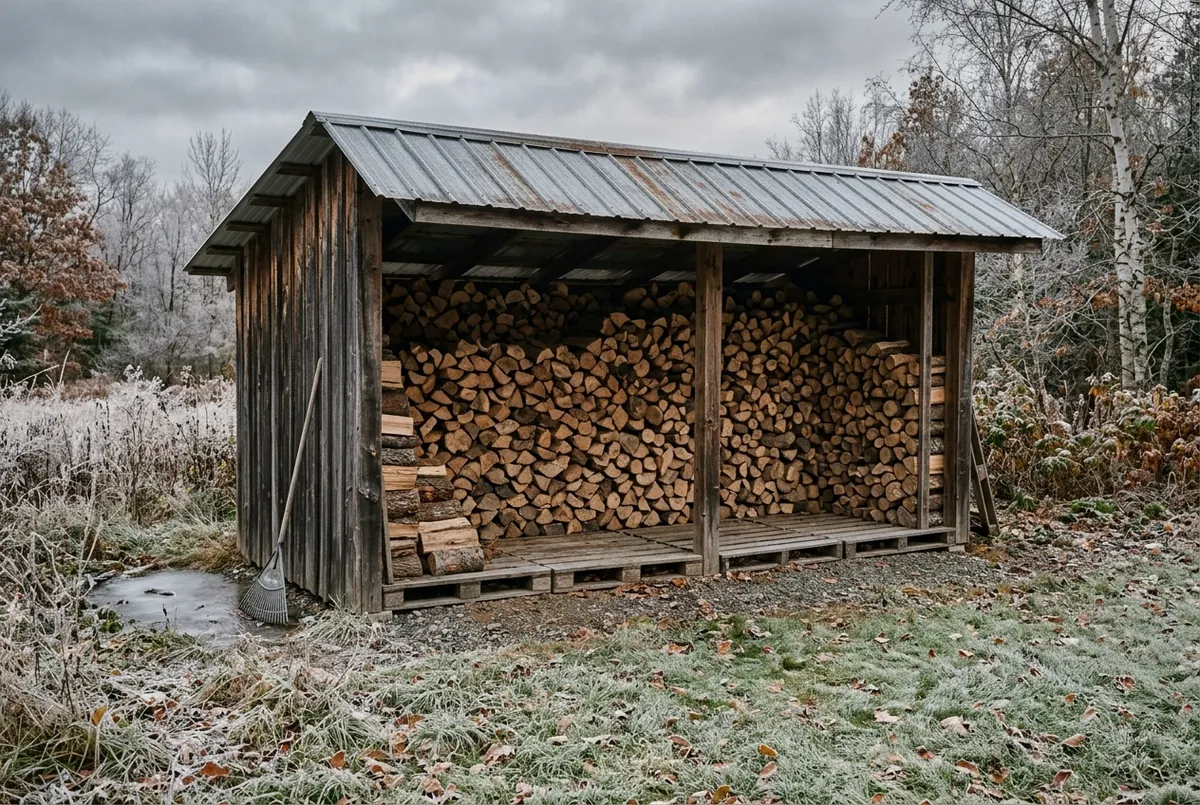
You have a stack of split wood somewhere in the yard, maybe under a tarp, maybe leaning against the fence, and the first cold nights are already here. The wood you cut this fall will not be ready to burn this winter, but a good shed built now means next year’s wood will be.
The short answer: A firewood shed that dries wood is a roof over a raised, open-sided rack. Keep the wood off the ground, cover only the top, and let air move through all four sides. Penn State Extension says wood generally dries to about 20% moisture in 6-12 months, and the EPA advises at least 12 months for hardwood. Build the shed this fall, fill it with freshly split wood, and burn last year’s seasoned stock this winter.
Can you still burn wood this winter?
It depends on what is already stacked. Wood generally dries to about 20% moisture in 6-12 months, and Penn State Extension suggests cutting by April and having it split and stacked by May (Penn State Extension). Mid-autumn is late for that schedule, particularly for hardwood.
Species matters a great deal:
- Depending on species, cut and split wood needs roughly 6-8 months of drying time (UNH Cooperative Extension).
- The EPA advises storing freshly cut wood for a minimum of 6 months for softwood and 12 months for hardwood (EPA Burn Wise).
- Cherry and hackberry cut in the wet season can be ready in 6-7 months, while dense black locust and hickory take longer (University of Maryland Extension).
- Commercial compilations put oak at roughly 24-36 months and softwoods from about 3 to 18 months depending on species (Firewoodcalc). The spread is wide, which is a good reason to measure rather than guess.
The practical split is simple. Wood that was cut and stacked last year is the wood to burn this winter. Wood you are cutting or buying now goes into the new shed for next winter.
Check with a meter, not the calendar
Wood burns best below 20% moisture, and the EPA recommends testing with a moisture meter (EPA Burn Wise). Penn State puts the seasoned target at about the same 20% mark. The calendar only estimates; the meter reads the actual piece in your hand. If a split reads above 20%, leave it in the shed longer. A pocket meter is a small cost compared with the price of a cord.
The stove side of this is covered elsewhere on Backyard Freedom Lab, including creosote and chimney care. The one line to carry over: burn only dry wood.
How much wood does the shed need to hold?
Start with the unit. A cord is 128 cubic feet of wood “ranked and well stowed.” The standard stack is 4 ft x 4 ft x 8 ft, but any shape totalling 128 cubic feet counts (NIST, 2025-12-16).
From that figure, the floor space follows. Dividing 128 cubic feet by the stack height gives about 32 square feet per cord at 4 ft and about 21 square feet at 6 ft. One plan site allows roughly 20% extra for airflow gaps and walking room (ShedCalculator, 2026-10-14). That is arithmetic derived from the cord definition rather than a measured result, but it is a useful starting point.
Because you are seasoning wood, think in two cords at minimum: one drying for next year and one ready to burn. If you burn several cords a winter, the shed has to hold the drying stock for the next season as well.
Example sizes from commercial plan sources, which are indicative rather than authoritative:
- 4x8 ft: about 1 cord
- 6x10 ft: about 2-2.5 cords
- 8x12 ft: about 3.5 cords
- 8x16 ft: about 4.5-5 cords
Another plan set lists an 8x10 shed at about 2 cords (Craftcamp). The two sources do not match exactly, so treat any size chart as a rough guide and do your own stack math before cutting lumber.
Where should the shed go?
Three questions decide the spot: sun and wind, rain direction, and distance from the house.
Sun and wind. Extension guidance calls for an open, sunny spot with airflow on all sides (UNH Cooperative Extension, 2018-02). A sunny, breezy location dries wood faster than a sheltered corner.
Rain direction. Point the open face away from the prevailing wind and storm direction (ShedCalculator, 2026-10-14). Slatted side boards then keep sideways rain out while still letting air through.
Distance from the house. Ohio State University Extension notes that some experts recommend stacking firewood 20-30 feet from the house, and that all agree the wood should be elevated with room for airflow (Ohio State University Extension, 2020-05-08). The stated concern there is termites. Check your local fire guidance, because no code source found for this article sets a specific wood pile distance from structures.
What are the design rules that make wood dry?
Extension and plan sources broadly agree on four principles. A shed that breaks any of them is just a storage box.
1. Keep wood off the soil
Wet ground feeds moisture into the bottom of the stack. Published plans use one of three bases:
- a raised slatted floor
- pallets on compacted gravel
- a gravel pad with treated sleepers
One plan site quotes a raised floor at least 6-8 inches off the ground (Engineer Fix). That figure comes from a commercial plan site, not an extension service.
2. Cover the top, and only the top
The EPA’s guidance is to store wood outdoors, off the ground, with only the top covered, because covering the sides traps in moisture (EPA Burn Wise). A tarp wrapped down the sides keeps rain out and also keeps moisture in.
3. Open the sides
Plans commonly use slatted or open sides, with boards set about 1/2 to 1 inch apart so air passes through (DIY Shed Plans). Another source recommends gaps of 1 inch or more on side and back boards, with a few inches between rows and the back wall (ShedCalculator, 2026-10-14).
4. Split the wood before you store it
Splitting is critical, and it speeds drying noticeably (UNH Cooperative Extension, 2018-02). The EPA makes the same point: split before storage (EPA Burn Wise). An unsplit round has bark on every side, and the moisture has nowhere to go.
What roof works best?
The single-slope lean-to is the most common roof on firewood sheds. One plan site suggests an overhang of at least 12-18 inches on the open side (ShedCalculator, 2026-10-14). One plan site recommends a minimum 4/12 pitch (Engineer Fix).
Neither the pitch nor the overhang figures came from an extension service, so treat them as common practice rather than a standard. A steeper pitch and a longer overhang both shed water better; the trade-off is cost and height.
What does a firewood shed cost?
Prices depend on size, materials and whether you salvage lumber. Published ranges, all from commercial or plan sources:
- Materials for a DIY 4x8 woodshed: $300-$800. For an 8x12: $800-$2,500 (ShedCalculator, 2026-10-14).
- Kits: $500-$4,000 or more. Contractor-built: $2,000-$6,000 or more (same source).
- A metal rack with a cover: $75-$300 (same source).
- A one-cord lean-to from salvaged lumber: about $80-$250 in materials. The same plan bought all new comes to about $634, from a single plan and indicative only (Plan Your Homestead).
These are materials figures from plan sites, not quotes, and local lumber prices move. If the budget is tight, the metal rack with a cover or a salvaged-lumber lean-to is the cheaper path, and both follow the same drying rules: raised base, covered top, open sides.
A plan set with a printed cut list is one option. Two small purchases tend to matter more than people expect: a moisture meter, and exterior-rated fasteners, since screws in a rain-exposed frame will rust out if they are not rated for outdoor use. Judge any plan set by whether it shows a full materials list and dimensions. Treat any sales page claim about speed or savings as the seller’s claim, not an independent result.
Do you need a permit?
Possibly, and the rules are local. Sheds around 120 square feet or less often need no building permit but still must meet zoning setbacks, and thresholds vary by place. In Westford, Massachusetts, sheds of 120 square feet or less need no building permit and get reduced side and rear setbacks, while any shed may need Conservation Commission approval (Town of Westford, MA). That is one town’s example of local variation, not a national rule.
Call your local code official before you buy lumber. Ask about permit thresholds, setbacks from the property line, and any limit on structures near wetlands or in a historic district. A 4x8 or 6x10 shed will often fall under a threshold, but only the local office can say.
Wiring is out of scope here. If you want lighting or power in the shed, hire a licensed electrician and check with the local code official. A firewood shed does not need either to do its job.
A simple build and fill timeline
- This week: Check local rules, choose the spot, and mark out the footprint using the cord math above.
- Within a few weekends: Build the base, the frame, the roof, and the slatted sides.
- As wood arrives: Split first, then stack loosely with space between rows and between the stack and the back wall.
- Through next spring and summer: Leave the wood alone. Penn State’s schedule of cut by April and stacked by May is the one to match in future years.
- Before burning: Test with a moisture meter. Burn only wood that reads below 20%.
Will wood dry over the winter?
Drying slows in cold weather, and the stacking date changes how long it takes. A USDA Forest Service report estimates air drying times to 20% moisture content for nominal 1-inch-thick northern red oak lumber in Madison, Wisconsin: 144 days if stacked January 1, 82 days if stacked April 1, 62 days if stacked June 1, and 184 days if stacked October 1 (USDA Forest Service, Forest Products Laboratory, 2000-11).
The report explains the pattern. Material stacked in late summer or early fall is exposed to winter temperatures, when drying may almost stop. Material stacked in spring may dry in a relatively short time, because a large share of the drying falls in the warm spring and summer months. It also cites an Upper Midwest calendar with five effective air drying days in December, January and February, rising to as many as 30 days in June through August.
Those figures describe lumber, not split firewood, so read them as a pattern rather than a schedule for your stack. For wood stacked in a shed this fall, the pattern points to a slow first winter. It is consistent with the Penn State schedule above, which has wood cut by April and stacked by May.
Next step
Pick the footprint first. Work out how many cords you burn in a winter, double it so one cord can season while another is in use, and use the 32 or 21 square foot figures above to size the floor. Then call the local code official and ask about permits and setbacks. Once you have the dimensions, compare them against a plan set or a simple rack-and-roof kit and make sure the design has the four features that matter: raised base, covered top, open sides and room to stack split wood. If you are weighing other fall projects, the guide to hot versus cold composting and the walkthrough on building a root cellar cover two more structures that reward a start before the ground freezes.
Frequently Asked Questions
- How long does firewood take to dry in a shed?
- Wood generally dries to about 20% moisture in 6-12 months, according to Penn State Extension. The EPA advises a minimum of 6 months for softwood and 12 months for hardwood.
- Should I cover firewood with a tarp?
- Cover only the top. The EPA says covering the sides traps in moisture, so the sides should stay open to let air move through.
- How much wood does one cord equal?
- A cord is 128 cubic feet of wood, ranked and well stowed. The standard stack is 4 ft x 4 ft x 8 ft, per NIST Handbook 133.
- Do I need a permit for a firewood shed?
- It depends on your locality. Sheds around 120 square feet or less often need no building permit but must still meet zoning setbacks. Check with your local code official.
Sources & references
- Penn State Extension (opens in new tab)
- UNH Cooperative Extension (opens in new tab)
- University of Maryland Extension (opens in new tab)
- Firewoodcalc (opens in new tab)
- EPA Burn Wise (opens in new tab)
- NIST (opens in new tab)
- ShedCalculator (opens in new tab)
- Craftcamp (opens in new tab)
- UNH Cooperative Extension (Drying Firewood) (opens in new tab)
- Ohio State University Extension (opens in new tab)
- DIY Shed Plans (opens in new tab)
- EPA Burn Wise (Health and Safety Awareness Kit) (opens in new tab)
- Engineer Fix (opens in new tab)
- Plan Your Homestead (opens in new tab)
- Town of Westford, MA (opens in new tab)
- USDA Forest Products Laboratory, Air Drying Time Estimates (opens in new tab)
Before you go
The Renter's Homestead Pack
Self-reliance projects for the yard you don't own — container yields, a raised bed built to move with you, balcony preservation basics, and the landlord questions to ask first.
Free guide
The Renter's Homestead Pack
Self-reliance projects for the yard you don't own — container yields, a raised bed built to move with you, balcony preservation basics, and the landlord questions to ask first.