Your cart will not be the problem on November 27. The problem is that you will walk into the sale with no number in your head. Every banner says “up to 60% off,” and you have nothing to hold it against.
So spend the weeks before Black Friday on a boring job: write down what you need, then write down what each item costs on a normal day. That list is the whole advantage. Anyone can click “add to cart.” Few people know the price was already fair last week.
The short answer: Black Friday 2026 lands on November 27. Before then, list the gear that official kit checklists treat as the basics, log each item’s regular price, and re-check those prices on set dates. A deal is only a deal if it beats a number you wrote down yourself.
Why Your Own Price Log Beats the “Was” Price
A crossed-out price feels like proof. It is only a claim.
The FTC’s Guides Against Deceptive Pricing say a “former price” is a legitimate basis for a price comparison only when it is the actual, bona fide price at which the article was offered to the public on a regular basis for a reasonably substantial period of time (eCFR, 16 CFR Part 233, accessed Oct. 30, 2026). The same text says a former price is fictitious if it was an artificially inflated number set up to make a later reduction look large, and in that case the “bargain” is a false one (Cornell LII, 16 CFR 233.1, accessed Oct. 30, 2026).
That is a rule for sellers, not a tool for you. Nothing on the product page tells you which kind of “was” price you are looking at. What you can do is take the question off the table by keeping your own record. If your log says a power bank sat at $48 for three weeks, a “$90 now $59” banner stops being impressive in about two seconds.
Build the Need List From Official Checklists, Not Ads
Deal feeds decide what you want. Official kit lists decide what you need. Start with the second one.
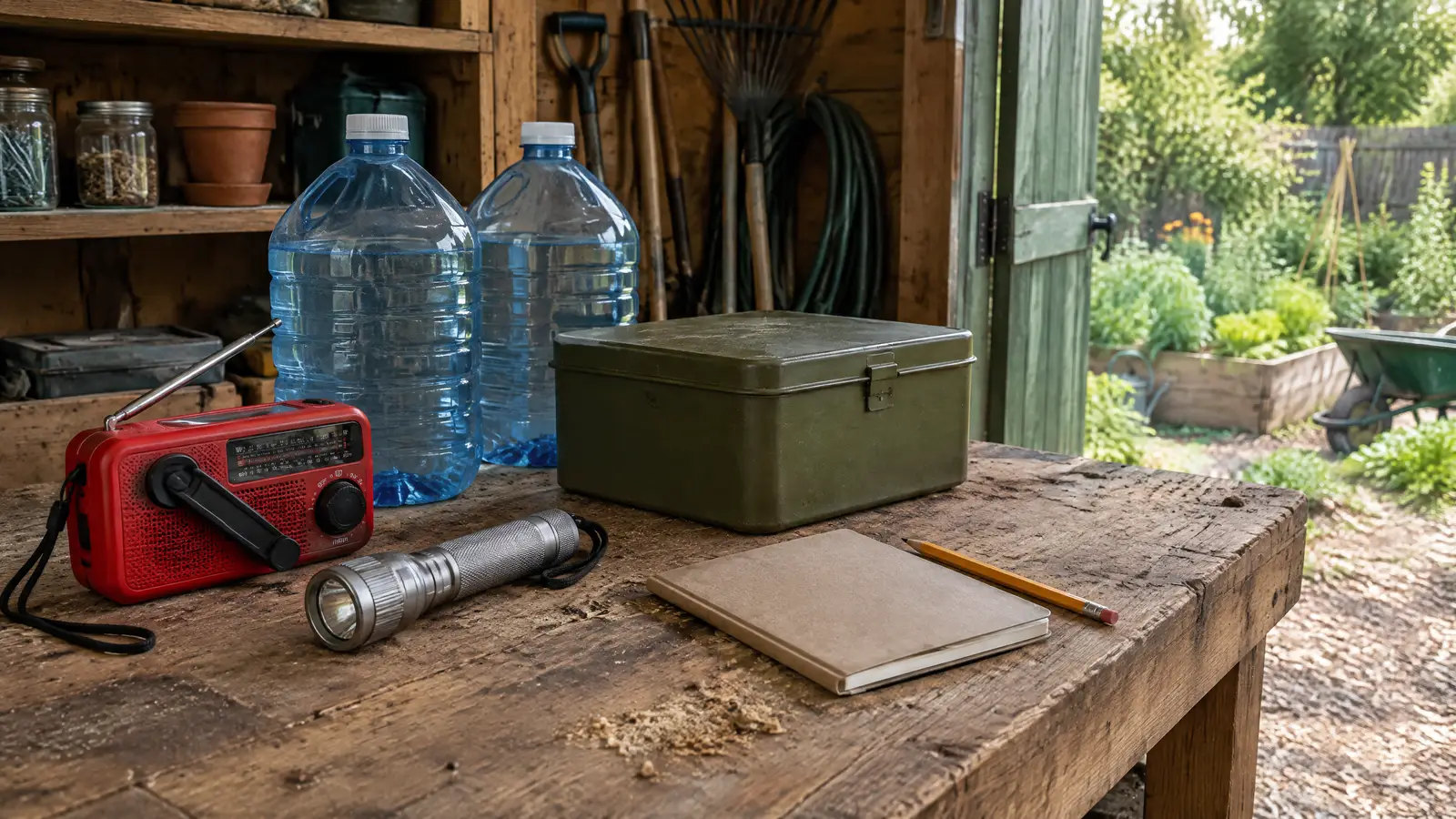
Ready.gov’s basic kit lists water at one gallon per person per day for several days, for drinking and sanitation, a several-day supply of non-perishable food, a battery-powered or hand crank radio with a NOAA Weather Radio, a flashlight, a first aid kit, extra batteries and a whistle, plus sanitation and shelter-in-place basics (Ready.gov, accessed Oct. 30, 2026). The American Red Cross checklist agrees on the water figure and pins it to a three-day supply, one gallon per person per day, with food that needs no refrigeration or cooking (American Red Cross, accessed Oct. 30, 2026).
Put that on paper for your own household. The math is short:
| Item | Official baseline | Your number |
|---|---|---|
| Drinking and sanitation water | 1 gallon per person per day, 3 days | People × 3 = gallons |
| Food | Non-perishable, no cooking needed | Meals × people × days |
| Light | Flashlight plus spare batteries | One per adult, one spare set |
| Radio | Battery or hand-crank, NOAA alert | One per household |
| First aid | A stocked kit | One at home, one in the car |
A household of four lands on 12 gallons for three days. A household of two lands on 6.
Be honest about what you already own. Cross off the flashlight in the junk drawer if it works. The goal is a shorter list, because a shorter list means a smaller number to defend on sale day.
What to Write Down for Every Item
For each line, keep five fields. A spreadsheet works. So does an index card.
- Exact model name. Not “weather radio.” The model, so you compare the same thing every time.
- Regular price and date. What it costs today, not what the page says it “used to” cost.
- Seller. Same product, different seller, different price. Note which one.
- Shipping and return terms. A low sticker price with a restocking fee is not low.
- Your walk-away price. The number at which you would buy without thinking twice.
That last field does the work. Setting it now, while nothing is flashing at you, is the difference between a plan and a reaction.
If a big-ticket item such as a power station is on your shortlist, log it the same way. An early October price is worth writing down, but the number you wrote down is what tells you whether a later sale was a deal.
Spend in This Order
Not every line on the list deserves the same attention. A sensible order, from the official lists outward:
- Drinking and sanitation water. Storage and treatment come first. It is the one item on the list you cannot improvise on day two.
- Light and power for light. Flashlights and batteries cost little and fail in a drawer.
- A way to get alerts. A hand-crank weather radio does not need a working grid or a charged phone.
- A first aid kit. Check what is in it. A kit with a handful of bandages is a container, not a kit.
- Everything bigger. Power stations, solar panels and generators come last, because they cost the most and have the most model-to-model variation.
Notice what that order does to your Black Friday. The cheap, boring items at the top are the ones where a few dollars of discount hardly matter and having the thing early matters a lot. The expensive items at the bottom are where the log pays for itself.
Two starting points that fit the top of the list are an emergency first aid kit and a hand-crank weather radio, both linked at the end of this article. We picked them because both appear on the official kit lists above and neither needs a technical deep dive before you can compare them. Our hand-crank weather radio review goes through what to check before buying one.
A Four-Step Check-In Schedule
You do not need to watch prices every day. Four check-ins are enough.
- Start now. Finish the need list. Log the regular price for each item. Set your walk-away prices.
- A week later. Re-check every item. Note anything that moved more than a few dollars and in which direction.
- Saturday, November 21. Re-check again. If a retailer is already calling something an early sale, your log tells you whether the price beats your last check.
- Friday, November 27. Compare live prices to your walk-away number. If it is under, buy. If not, close the tab. Cyber Monday is November 30 and gives you a second look. Both dates hang off Thanksgiving on Thursday, November 26 (U.S. Office of Personnel Management, accessed Oct. 30, 2026).
If a price drops below your walk-away number on any of these dates, you do not have to wait for the 27th. That is also the point.
Three Ways a Price Log Goes Wrong
A log is only as good as the entries. Three habits spoil it.
Comparing different things under one name. A “kit” from one seller may include extra pieces that another leaves out. A bundle price tells you nothing about the single item. Write down what is in the box, not just the product title, and compare like with like.
Logging only the sticker price. Shipping, handling and return terms change what you actually pay. Two listings at the same price are not the same deal if one ships free and the other adds a fee. Put the all-in number in the log.
Watching one seller. The same model can sit at different prices at different stores on the same day. If your item is sold in two or three places, log each one. Then your walk-away number reflects the market, not one store’s habit.
A single filled-in line looks like this, with made-up numbers to show the format: Hand-crank radio, model name, $30, Oct. 31, Seller A, free shipping, 30-day return, walk-away $24. Real entries need real figures from the listing in front of you.
What a Price Log Cannot Tell You
Three limits, so you do not oversell this to yourself.
First, a log shows you what an item cost, not whether it is any good. Quality still needs a source: independent testing, the manufacturer’s spec sheet, a review from someone with no stake in the sale.
Second, a log built over a few weeks is a short history. It will not show seasonal swings. If you see a model move twice in three weeks, treat that as a reason to look at one more data point, not as a pattern.
Third, a low price on something you do not need is still wasted money. Your list is the filter. Anything that was not on it before today needs a reason to be in the cart.
Make It Work for Your Household
The official lists are written for an average household. Yours is not average. A few quick adjustments:
- Pets. Water and food math changes. Add them to the headcount.
- Medication and infants. These do not live on a generic list. Plan them separately.
- Apartment storage. Twelve gallons is a lot of floor. Count the space before you count the bottles.
- Winter. Warmth and light matter more once the temperature drops. Add a blanket line to your sheet.
A printable version of the water math, plus the storage and filtering steps behind it, is in the free Emergency Water and Preparedness Checklist. It is a good thing to have open beside your price log.
The Rule Until Black Friday
Write the list. Price the list. Re-check on schedule. Buy only what falls under your own number.
That is all. No countdown timer on a retailer’s page is going to do that for you, and it is not supposed to.
Frequently Asked Questions
- When is Black Friday 2026?
- Black Friday 2026 falls on Friday, November 27, the day after Thanksgiving on Thursday, November 26. Cyber Monday follows on November 30.
- How much water should an emergency kit hold?
- Both Ready.gov and the American Red Cross give the same baseline: one gallon per person per day. Ready.gov calls it water for drinking and sanitation, for several days. The Red Cross checklist specifies a three-day supply. For a household of four, three days is 12 gallons.
- How do I know a Black Friday 'was' price is real?
- Under the FTC's pricing guide, a former price is a legitimate comparison only if it was the actual price the item was offered at on a regular basis for a reasonably substantial period. You cannot check that from the ad itself, so log the regular price yourself before the sale starts and compare against your own number.
- Should I buy prep gear in October or wait for Black Friday?
- It depends on the item. A first aid kit or a flashlight is cheap enough that the gap hardly matters, and having it sooner is the point of owning it. For a bigger purchase, record the regular price now, then check it again the week of the sale and decide against your own numbers.
Sources & references
- Ready.gov, Build A Kit (opens in new tab)
- American Red Cross, Emergency Kit Check List (opens in new tab)
- eCFR, 16 CFR Part 233, Guides Against Deceptive Pricing (opens in new tab)
- Cornell LII, 16 CFR 233.1 Former price comparisons (opens in new tab)
- U.S. Office of Personnel Management, Federal holidays (opens in new tab)
Before you go
The Renter's Homestead Pack
Self-reliance projects for the yard you don't own — container yields, a raised bed built to move with you, balcony preservation basics, and the landlord questions to ask first.
Free guide
The Renter's Homestead Pack
Self-reliance projects for the yard you don't own — container yields, a raised bed built to move with you, balcony preservation basics, and the landlord questions to ask first.