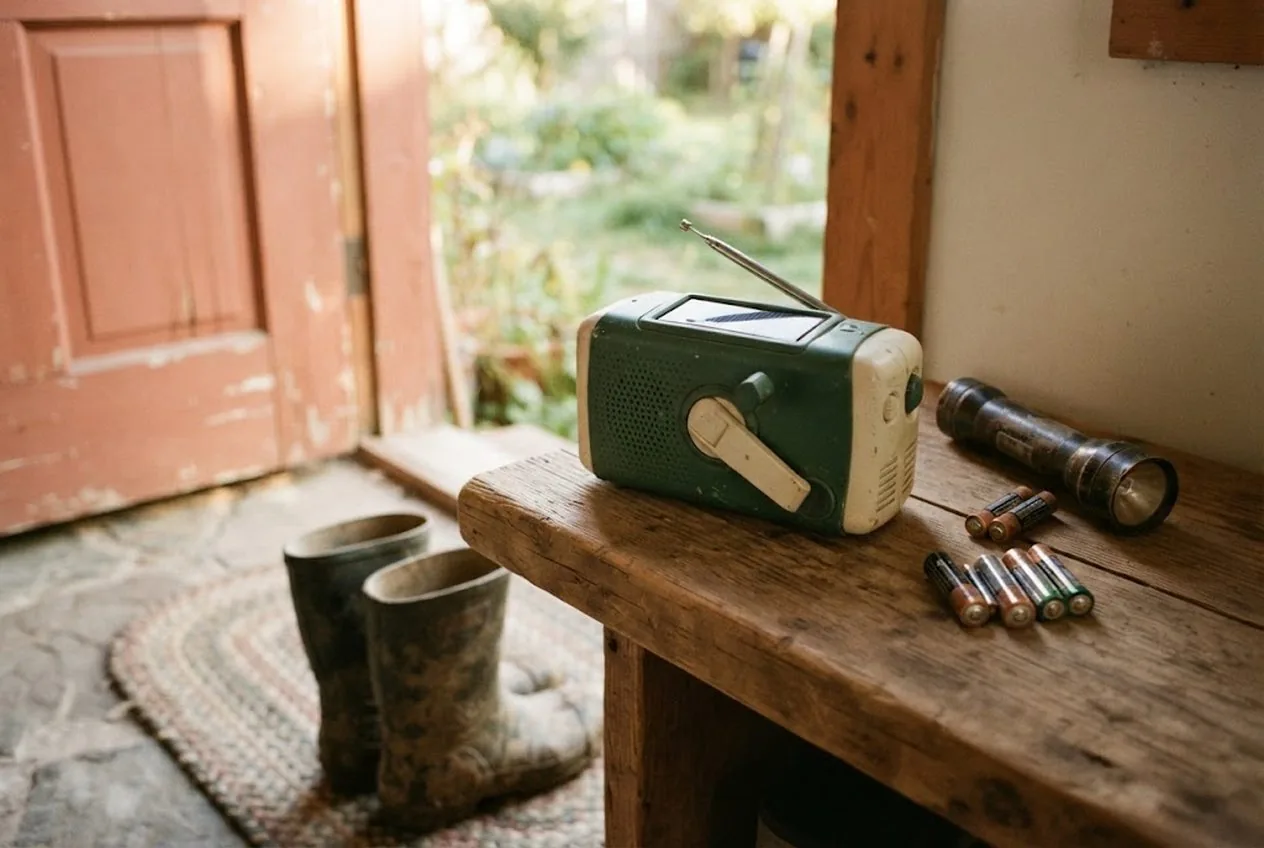
When the power goes and the cell network jams, the most valuable thing in a blackout isn’t light or even water — it’s information. Is the storm passing or building? Is the water safe? Is there an evacuation order? A hand-crank weather radio is the one device built to answer those questions when nothing else can, and it’s cheap enough that there’s no good reason not to own one. The fair question this review answers is whether the typical unit actually delivers: does it hold a charge, pull in the NOAA alerts, and earn its spot on the shelf by the door?
This is a single-product review of a standard hand-crank weather radio — the solar-and-crank emergency radios that combine AM/FM, the NOAA weather band, a flashlight, and a USB charging port in one palm-sized unit. If you’re assembling the wider outage kit, our guide to building a blackout kit room by room shows where this fits; here we’re focused on the radio itself.
Short answer: a good hand-crank weather radio is a genuine, high-value piece of blackout insurance — it does its core job (delivering emergency information without the grid) reliably, adds light and a phone top-up as bonuses, and costs little. Its limits are honest: the crank is a top-up, not a power plant, and the flashlight and charger are modest. For the price, it’s an easy recommendation for any household.
Disclosure: the product link here is an affiliate link, so we may earn a commission if you buy through it at no extra cost to you. This assessment is built from general product features and emergency-preparedness guidance (Ready.gov; American Red Cross), not a hands-on test of any specific model.
Why Information Is the Overlooked Essential
Blackout kits get built around the tangible needs — light, warmth, water, food — and those matter. But the thing that turns a bad outage into a dangerous one is usually a decision made in an information vacuum. Do you shelter or evacuate? Boil the tap water or trust it? Wait out the storm or move before the next band arrives? Without a way to hear official guidance, you’re guessing, and guessing in an emergency is how people get hurt.
That’s the gap a weather radio fills. The NOAA Weather Radio network is a chain of government transmitters broadcasting continuous local forecasts and, when it counts, emergency alerts — tornado warnings, flash-flood warnings, evacuation notices — as an “All Hazards” network of more than 1,000 transmitters (National Weather Service). It broadcasts independently of the cell network and the internet, which are exactly the systems that fail first in a major event. A weather radio is your direct line to that broadcast, and there’s no substitute for it once the network drops. It’s why the radio holds a fixed slot in our hurricane-season blackout kit alongside the power and water layers.
Does It Actually Hold a Charge and Pull In Alerts?
This is the part that separates a worthwhile unit from a drawer-filler, and the good ones get it right. A quality hand-crank weather radio has a decent internal rechargeable battery you top up from USB or the built-in solar panel ahead of time, so it’s ready to go the moment you need it. Reception on the NOAA band and AM/FM is clear on well-designed units — you’re pulling in the government transmitters and local stations without fuss, which is the entire job.
The crank is where expectations need calibrating. It’s a genuine, real feature — a short stretch of steady cranking buys you some radio time or a burst of flashlight, depending on the model — but it’s a top-up, not a generator. The smart way to run one is to keep the internal battery charged from solar or USB, and use the crank to extend runtime when an outage stretches past what the battery alone covers. Treated that way, the radio never truly runs out of power, which is precisely the reassurance you want from an emergency device.
The Bonus Features: Light and a Phone Top-Up
Most of these radios bundle two extras that punch above their price. The first is a built-in flashlight — modest, but genuinely useful as one more light source in a dark house, and it means the radio pulls double duty on the command shelf. The second is a USB output that can charge a phone. Set expectations here: hand-cranking produces a trickle, so you’re topping up enough for an emergency text or call, not filling the battery. But a solar- or USB-charged unit can pass along a meaningful bit of power, and “enough to send one message” can matter enormously when a phone is dead and you need to reach someone.
Neither extra is a reason to buy on its own — you buy the radio for the alerts — but together they make it a more versatile piece of kit than its size suggests.
Pros and Cons
Pros
- Delivers NOAA emergency alerts and AM/FM when the network is down — the core job, done reliably
- Multiple power paths (solar, USB, hand crank) mean it never runs out of power to run out of
- Built-in flashlight adds a genuinely useful second light source
- USB output can give a dead phone an emergency top-up
- Cheap, compact, and maintenance-free — easy to keep by the door
Cons
- The crank is a top-up, not a primary power source — charge it ahead of time
- Flashlight and phone charging are modest, not a substitute for dedicated gear
- Very cheap models have weak generators and poor reception — buy a quality unit
- Internal batteries degrade over years — check it twice a year and recharge
Who Should Buy One — and Who Shouldn’t
Buy it if you live anywhere weather or the grid can knock out power and communications — which is nearly everywhere. For the price of a couple of takeout meals, you get a dedicated, network-independent line to the emergency information that everything else in your outage plan depends on. It belongs in every household kit, and a second one in the car isn’t a bad idea.
Think twice only if you’re buying at the very bottom of the market. The ultra-cheap units with tiny generators and weak receivers are where these earn their “gimmick” reputation — poor reception and a crank that barely lights the flashlight. The fix isn’t to skip the category; it’s to spend a little more for a unit with real reception and a decent battery. Skimp on the radio and you’ve saved ten dollars on the one device whose whole value is reliability.
The Bottom Line
The hand-crank weather radio earns its 8/10 by doing its one critical job well — putting emergency information in your hands when the grid and network can’t. It holds a charge, pulls in the alerts, and never runs out of power thanks to its solar and crank backups, with a flashlight and phone top-up as worthwhile bonuses. Its limits are honest and minor: the crank tops up rather than powers, and the extras are modest. As cheap, grid-independent insurance, it’s one of the smartest small buys in home preparedness.
Keep it charged, keep it by the door, and fold it into the wider plan — our summer blackout prep checklist and room-by-room blackout kit guides show exactly where the radio sits in a household that’s ready before the lights go out.
Frequently Asked Questions
- Do hand-crank weather radios actually work, or are they a gimmick?
- The good ones genuinely work — the trick is buying one built around the crank and solar rather than one where they're an afterthought. A quality unit pulls in AM/FM and the NOAA weather band clearly, holds a charge in its internal battery, and gives you some listening time or a burst of light from a short stretch of cranking. The gimmicks are the ultra-cheap models with tiny, weak generators and throwaway batteries. Judge one on reception, battery capacity, and how much runtime a minute of cranking actually buys.
- How long do you have to crank a weather radio for it to work?
- It varies by model, so check the maker's stated runtime; on a decent unit, a short stretch of steady cranking buys some radio time or a burst of flashlight — enough to catch an alert or a forecast update. Cranking is best thought of as a top-up, not the primary power source: you charge the internal battery ahead of time from USB or solar, and use the crank to extend it when the outage runs long. In bright conditions the solar panel trickles the battery up on its own, so the crank becomes your backup to the backup.
- What's the difference between a weather radio and a normal radio?
- A weather radio receives the NOAA Weather Radio band — a network of government transmitters broadcasting continuous forecasts and, critically, emergency alerts for your area — in addition to standard AM/FM. That alert function is the whole point: when a warning is issued, it's the most direct, network-independent way to hear it. A normal radio only gives you commercial stations, which may or may not be broadcasting the local emergency information you need when the power and internet are down.
- Can a hand-crank radio charge a phone in an emergency?
- Most include a USB output that can charge a phone, but set your expectations: hand-cranking produces a trickle, so you're looking at a small top-up — enough for an emergency text or call, not a full charge. The bigger the internal battery, the more useful this is, since a solar- or USB-charged unit can pass along a meaningful bit of power. Treat it as genuine emergency insurance for a dead phone, not as your everyday charger.
- Is a hand-crank weather radio worth it if I already have a power station?
- Yes — they solve different problems. A power station keeps devices running, but a weather radio is your dedicated, always-available line to emergency alerts that doesn't depend on the cell network or internet staying up. It's cheap, it lives by the door, and it works even if the power station is flat or in use elsewhere. Most preppers keep both: the station for running things, the radio for knowing what's happening. The radio's job is information, and nothing else does it as reliably for the price.
Sources & references
Before you go
The Renter's Homestead Pack
Self-reliance projects for the yard you don't own — container yields, a raised bed built to move with you, balcony preservation basics, and the landlord questions to ask first.
Free guide
The Renter's Homestead Pack
Self-reliance projects for the yard you don't own — container yields, a raised bed built to move with you, balcony preservation basics, and the landlord questions to ask first.