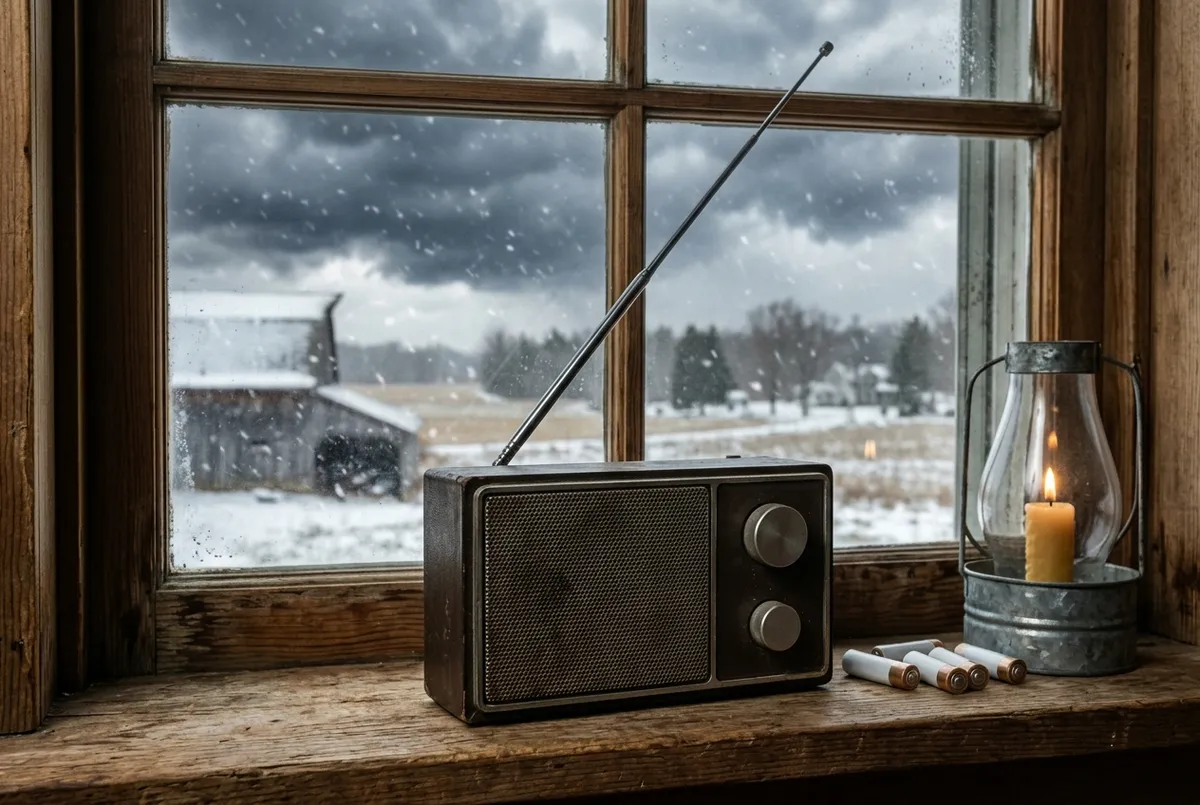
What’s the short answer?
- Public Alert certification (CTA-2009-C) requires a 1050 Hz tone alarm and SAME county-level alerting; if the box doesn't say Public Alert certified, don't assume it has either.
- NOAA Weather Radio broadcasts on seven dedicated VHF frequencies a standard AM/FM radio can't receive, over a network of more than 1,000 transmitters nationwide.
- A 2022 congressional report puts coverage at 95% of the U.S. population, so check your county before buying.
- Battery or hand-crank power, not a wall plug alone, is what keeps a weather radio working once a winter storm knocks out the power.
Winter storm warnings arrive with less notice than most households plan for, and the systems people lean on for that notice, a phone app, a push notification, a local news alert, all depend on a cell tower and household power staying up through the storm. A NOAA weather radio is built to keep working when those other channels don’t, but store shelves are full of units labeled “weather radio” that vary widely in what they actually receive and how they alert you.
The short answer: Buy a receiver labeled Public Alert certified (CTA-2009-C) with SAME programming, confirm your county falls inside NOAA’s broadcast coverage before you buy, and choose a battery or hand-crank powered model so it keeps working if the storm takes out the power.
Do You Need a NOAA Weather Radio If You Already Get Phone Alerts?
Phone-based weather alerts and NOAA Weather Radio All Hazards (NWR) cover different failure modes. A phone alert needs a working cell network and a charged battery; a battery or hand-crank NWR receiver needs neither, since it picks up the broadcast directly over dedicated frequencies instead of routing through a carrier’s network. NWR runs on more than 1,000 transmitters covering all 50 states, adjacent coastal waters, Puerto Rico, the U.S. Virgin Islands, and the U.S. Pacific Territories (National Weather Service), so for most households the two systems are complementary rather than either/or: phone alerts for everyday convenience, a dedicated receiver as the backup that doesn’t care whether the grid or the tower is still up. The House report on the NOAA Weather Radio Modernization Act makes the same point, saying NWR provides service where cellular coverage is limited and when cellular towers are out of commission (U.S. House Committee on Science, Space, and Technology).
What “Public Alert Certified” Means on the Box
“Public Alert” is a certification mark, CTA-2009-C, a technical standard the Consumer Technology Association developed jointly with the National Weather Service. A receiver carrying that certification is required to include a 1050 Hz tone alarm and SAME, Specific Area Message Encoding, for county-level alerting (National Weather Service). In practice, that certification is the fastest way to tell a real weather radio apart from a generic multi-band radio that happens to tune into the right frequencies but won’t sound an alarm or filter alerts by county. If the box doesn’t say Public Alert certified, don’t assume it has both features until the product listing confirms it. The NWS also points buyers to receivers carrying the NOAA Weather Radio All Hazards logo.
Why a Regular Battery-Powered Radio Won’t Pick Up NOAA Alerts
A common assumption is that any battery-powered radio, an old boombox or a camping AM/FM set, will pick up NOAA Weather Radio if you turn the dial far enough. A standard AM/FM radio won’t. NWR broadcasts on seven dedicated VHF frequencies, a band standard AM/FM tuners are not built to receive at all (National Weather Service). Reaching those frequencies requires a receiver built specifically for them, either a dedicated NWR unit or a multi-band radio that lists the weather band among the bands it covers (National Weather Service). This is worth checking before storm season rather than during it: a radio that “does everything” on the label but doesn’t specifically list NOAA or weather-band reception almost certainly can’t reach the broadcast at all.
What SAME Coding Does and Why It Matters
A single NWR transmitter often covers several counties at once, and without SAME programming, a receiver sounds its alarm for every warning broadcast on that transmitter, including ones for counties nowhere near you. SAME lets you program a receiver to your specific county or counties, so it alerts only for the areas you selected, cutting down on false alarms from warnings issued for someone else’s county on the same shared signal (National Weather Service). That is also the real difference between a SAME-capable model and an older “regular” weather radio: a non-SAME unit can only alert for everything on the transmitter, not for your specific area, so a household sharing a transmitter with several counties can get alarms for events nowhere near it.
Will a NOAA Weather Radio Work During a Power Outage?
Only if the unit itself doesn’t depend on household power to run. A model plugged into a wall outlet with no battery backup goes dark the moment the power does, which defeats the point of owning one for winter storm season. Look for a receiver that runs on batteries, has a hand crank, or ideally both, plus a battery-backup mode that keeps it alert-ready even while it’s normally running on AC power. Household electrical work, wiring a unit into an outlet or adding a dedicated circuit, is a job for a licensed electrician and your local code official, not something to improvise around a receiver. The simpler fix on the buyer’s side: pick a radio that doesn’t need the wall in the first place.
How to Check NOAA Weather Radio Coverage for Your County
Coverage is broad but not universal. A 2022 congressional report puts NOAA Weather Radio’s reach at 95% of the U.S. population (U.S. House Committee on Science, Space, and Technology, May 6, 2022). That still leaves gaps, especially in mountainous areas and places far from a transmitter (National Weather Service), so check your county against the NWS coverage listings before buying rather than assuming a national network means national coverage. A full-power NWR transmitter’s typical range is about 40 miles over level terrain (National Weather Service); the same FAQ notes that forests, deserts, hills and mountains tend to reduce reception, as can steel and concrete in cities, so a county near the edge of a coverage map is worth testing with a portable unit before committing to a permanent placement.
What to Look for When Buying
Frequency coverage, not just “weather band”
NWR broadcasts on seven dedicated VHF frequencies between 162.400 and 162.550 MHz, a range a standard AM/FM radio cannot pick up at all (National Weather Service). Confirm the listing states the unit covers all seven NWR frequencies, not just a couple.
Power source
Battery power, either alone or as backup, is the minimum bar for storm readiness; the NWS calls battery backup crucial since power outages often occur during storms (National Weather Service). Hand-crank models add a way to keep the unit running past the point the batteries die, without depending on a fresh supply of AA batteries you may not have on hand. A radio that also runs on household power, with batteries as backup, gives you the best of both without burning through batteries during normal, storm-free use.
SAME programming for your specific county
Confirm you can program the unit to your county’s SAME code, and check how many counties it can store if your household sits near a county line or you want alerts for a nearby workplace or a relative’s address in addition to your own.
Alarm type
The 1050 Hz tone alarm required by Public Alert certification activates the receiver even when its audio is turned off (National Weather Service), but if anyone in the household is hard of hearing, look for a model with an external device jack for a strobe light or bed shaker, which the NWS lists as a feature some receivers offer (National Weather Service).
Portability versus a fixed base unit
Antenna quality matters most near the edge of a transmitter’s range: the NWS says you may need a receiver with a good quality internal antenna, or an external antenna (National Weather Service). If reception where you live is solid, a smaller battery or crank-powered portable is easier to keep in a go-bag or move wherever the household ends up riding out the storm.
Display and channel storage
A backlit display that’s readable in a dark room matters more than it sounds, since alarms can go off overnight. Check how many SAME codes the unit can store and whether the county-selection menu is simple enough to set up once and forget, rather than a multi-step process you’ll dread repeating if you move or add a second address.
Where to Place a Weather Radio at Home
Reception depends on more than the transmitter’s range. Reception can vary from room to room, and steel, concrete, and other electronic equipment can weaken it, so a unit that works fine on a kitchen counter may struggle elsewhere in the house. The NWS suggests a spot near a window facing the station, away from other electronic equipment, on an upper level (National Weather Service). Extend the antenna fully, and reposition if reception is weak rather than assuming the radio itself is at fault, since moving even a few feet can change a weak signal to a strong one. For a household that spends stormy nights in a specific room, a bedroom nightstand or a hallway outside the bedrooms is a reasonable compromise between reception and being close enough to actually hear the alarm.
Testing and Maintaining Your Radio Before Storm Season
A weather radio that’s never been tested is a guess, not a plan. Every NWS office schedules a weekly test for each of its Weather Radio transmitters (National Weather Service); confirm the unit receives it, and that the volume and alarm are loud enough to wake someone from another room. Replace backup batteries on a schedule, not only when they die, since a dead battery is often discovered mid-outage rather than beforehand. If the unit runs on household power with battery backup, unplug it briefly once a season to confirm it switches over cleanly instead of assuming the backup mode works because the manual says it does.
Next Step
Once you’ve confirmed your county’s coverage and picked a Public Alert certified, SAME-programmable receiver that runs on batteries or a hand crank, the radio itself is a small, one-time purchase against a storm that can leave the power out for days. Pair it with the rest of a winter-storm kit, starting with a way to keep the lights and a phone charger running once the grid does go down (see our 300W vs 1000W solar generator comparison for sizing that out), and a broader look at low-cost preparedness picks in our Backyard Liberty review.
Frequently Asked Questions
- Do I need a NOAA weather radio if I already get phone weather alerts?
- Phone alerts and a NOAA weather radio cover different failure points. Phone alerts need a working cell network and a charged phone; a battery or hand-crank NOAA Weather Radio receiver picks up the broadcast directly over dedicated frequencies, so it keeps working even if the cell network or household power goes down during the storm.
- What does "Public Alert certified" mean on the box?
- Public Alert (CTA-2009-C) is a certification standard the Consumer Technology Association developed with the National Weather Service. A certified receiver is required to include a 1050 Hz tone alarm and SAME (Specific Area Message Encoding) for county-level alerting.
- Will a NOAA weather radio work during a power outage?
- Only if the unit doesn't depend solely on household power. A receiver that runs on batteries, a hand crank, or both keeps working once the power is out; a model plugged into a wall outlet with no battery backup goes dark along with everything else.
- How do I check NOAA Weather Radio coverage for my county?
- Check your county against the National Weather Service's official NWR coverage listings before buying. Coverage reaches an estimated 95% of the U.S. population as of a 2022 congressional report, but mountainous areas and places far from a transmitter can still have real gaps.
- What's the difference between SAME and a regular weather radio?
- A single NWR transmitter often covers several counties. SAME programming lets a receiver alert only for the specific county or counties you select; a non-SAME receiver sounds its alarm for every warning on the shared transmitter, including ones for counties nowhere near you.
Sources & references
- National Weather Service — NOAA Weather Radio (opens in new tab)
- National Weather Service — NWR Receivers (opens in new tab)
- National Weather Service — NWR SAME (opens in new tab)
- National Weather Service — Philadelphia/Mt. Holly NWR FAQ (opens in new tab)
- U.S. House Committee on Science, Space, and Technology (opens in new tab)
Before you go
The Renter's Homestead Pack
Self-reliance projects for the yard you don't own — container yields, a raised bed built to move with you, balcony preservation basics, and the landlord questions to ask first.
Free guide
The Renter's Homestead Pack
Self-reliance projects for the yard you don't own — container yields, a raised bed built to move with you, balcony preservation basics, and the landlord questions to ask first.