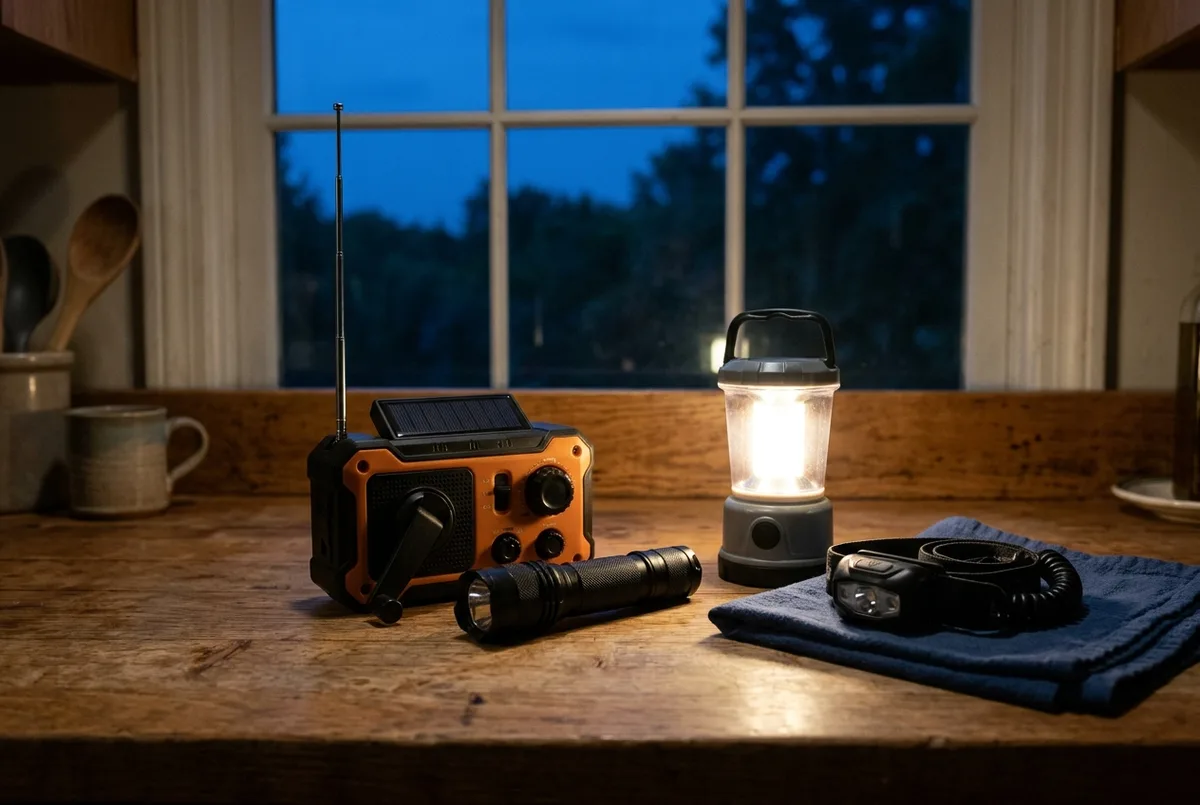
Which radio and light specs matter before you buy?
- A NOAA Weather Radio receiver with the 1050 Hz tone alert or SAME coding is the spec that matters most. The National Weather Service (NWS) lists both, says a simple AM/FM radio cannot pick up the broadcasts, and says Public Alert devices must have both.
- Check your local transmitter before you buy. NWS's notice list, current on Nov. 5, 2026, shows 17 of more than 1,000 transmitters degraded or offline. Seven of those notices are dated June to October 2026, and none gives a return date.
- Battery size matters more than the crank. GearJunkie measured 9 minutes of radio per minute of cranking on its top pick (May 21, 2026). A CNN Underscored excerpt reports 26 minutes for a different Midland model. Treat the crank as a top-up.
- For lights, runtime on the package is the time until output falls to 10% of the 30-second reading (ANSI/PLATO FL 1). A light rated at 2,500 lumens can still count as running at 250. Ready.gov says to have a flashlight for every household member.
Radio and flashlight pages lead with their biggest number: lumens, milliamp-hours, “hours of light.” A few other numbers decide whether the gear helps you in an outage, and most of them sit in the fine print. Black Friday is November 27, so it is worth learning which ones to read before the sales start.
The short answer: For a radio, look for NOAA Weather Radio reception with a 1050 Hz tone alert or SAME, battery backup and a large internal battery you charge before the outage. Treat the crank as a top-up. For a light, read runtime as the time until output drops to 10% of its starting level, check the rating for the mode you will use, and plan one flashlight per person. Use flashlights and battery lanterns, not candles or gas lanterns.
This is a research-based guide. We have not bought or tested any radio or light named here. Facts come from the sources listed at the end, all read on November 5, 2026. Some links below are affiliate links, so we may earn a commission if you buy through them, at no extra cost to you.
What the NWS Page Showed on Nov. 5
Black Friday is November 27 and Cyber Monday is November 30. As of November 5 we have not verified a sale price on any emergency radio or flashlight.
The more useful news is on the National Weather Service’s NOAA Weather Radio page, which was current as of 05:25 GMT on November 5. NWS lists 17 transmitters as degraded or out of service, out of more than 1,000. Seven of those notices are dated this year, from June 23 to October 20. The newest is WNG610 at Waubun, Minnesota, out since October 20 because of antenna damage. NWS gives no estimated return date for it, and none for the other 16. It tells listeners to check the county coverage listings for another transmitter that serves their county.
That is a small share of the network, and most households will never see a gap. It is still the first thing to check, because a radio can only play what a nearby transmitter sends. Before you spend, find your county on NWS’s coverage listings and see whether your nearest transmitter is on the notice list.
Radio Specs That Matter
NWS says it cannot recommend one brand over another, but it does recommend receivers that carry the Public Alert or NOAA Weather Radio All Hazards logo. The Public Alert standard (CTA-2009-C) was developed by the Consumer Technology Association with NWS. NWS says a simple AM/FM radio cannot hear the NOAA broadcasts, so the weather band has to be built in.
| Spec | What the source says | What to check on the listing |
|---|---|---|
| Weather band | More than 1,000 NWS transmitters on seven VHF frequencies, 162.400 to 162.550 MHz (NWS, Nov. 5) | “NOAA” or “WX” band, ideally all seven channels |
| Tone alert | NWS sends a 1050 Hz tone before most warnings and many watches. It can wake a radio that is muted. Required for the Public Alert logo | ”Alert” or “tone alert” mode that works while the radio is off or muted |
| SAME | Lets you pick the counties you want alerts for with a 6-digit code. Required for the Public Alert logo | ”SAME” or “county programming,” with room for more than one code |
| Battery backup | Power outages often come with storms. Required for Public Alert radios. NWS suggests wall power when you can, to save the battery | A rechargeable battery with a stated capacity, or removable cells |
| Public Alert or All Hazards logo | Marks devices that meet CTA-2009-C (NWS) | The logo on the box or the manual, not just the word “NOAA” in the title |
| Price | NWS: from about $20, to over $100 for standalone receivers with more features | A price with a date in your log |
SAME has one trap. NWS says not to program a radio to a louder or clearer station that is not designated as a SAME channel, because you will not receive alerts. NWS also schedules a weekly test for each transmitter, normally on Wednesday between 11 a.m. and noon local time (NWS Wilmington). Use that window to confirm your radio sounds.
Crank, Solar and Battery: What Testers Measured
Ready.gov’s kit list says to have a battery-powered or hand crank radio and a NOAA Weather Radio with tone alert, plus a flashlight, extra batteries and a phone charger with a backup battery. The Red Cross lists a crank or battery radio under devices that work without home power. Neither says how big the battery should be, so the only numbers come from testers.
| Source | What it reported | Date |
|---|---|---|
| GearJunkie, Midland ER310PRO (8.9 of 10, $100 at REI) | 10,000 mAh internal battery, USB-C in and out, weight 1 lb 4.8 oz. One minute of cranking gave 9 minutes of radio. An hour of direct sun gave 45 minutes. Cons: no removable batteries, no dust or water rating | Updated May 21, 2026 |
| Wirecutter, Midland ER310PRO (top pick), search-result excerpt | Left on for over six weeks without a recharge. Its 10,000 mAh battery is nearly double the next largest in the test group. Solar and crank only modestly extended battery life | Undated, excerpt only |
| CNN Underscored, Midland ER310 (the standard model, not the PRO), search-result excerpt | 26 minutes of radio after 60 seconds of hand cranking | Undated, excerpt only |
Read the table as a pattern, not a ranking. The two crank figures come from different models and different test methods, and they differ by nearly a factor of three. What they agree on is that a minute of cranking buys minutes of listening, not hours. A radio with a big internal battery that you top up from USB or the wall before the outage gives you days.
GearJunkie also names a budget pick, the RadioShack Portable Multi-Band Radio (6.6 of 10), and an everyday Bluetooth pick, the C.Crane CCRadio Solar BT (8.2 of 10). We read only the headline scores and labels for those two. We do not link to them, and we have not compared their specs.
The radio behind our link. Our affiliate link opens an Amazon listing for a hand-crank weather radio. Amazon blocked our page check, so we cannot name the model, its price, its battery size or what buyers complain about. Compare the live listing against the table above before you order. It should name the NOAA band, tone alert or SAME, the battery capacity and a USB output. If it does not, pick another radio. Our hand-crank weather radio review covers what this type of radio does and does not do, and our NOAA buyer’s guide goes deeper on Public Alert and coverage limits.
Who a crank radio fits: a household that wants an alert source with no outlet, keeps it charged and tests it weekly. Who it does not fit: anyone who expects to run it for days on cranking alone, or who needs a dust or water rating, since GearJunkie lists none for its top pick.
Light Specs That Matter
Flashlight packaging is easier to read once you know the six numbers behind ANSI/PLATO FL 1, the voluntary U.S. standard for portable lights. Streamlight’s summary notes that adherence is voluntary and that each company runs its own tests. PLATO published a revised version, FL 1-2025, on February 2 to 3, 2026, so packaging may show either version.
| FL 1 number | How it is measured | How to read it |
|---|---|---|
| Light output (lumens) | Total light from the lamp, read 30 seconds to 2 minutes after switch-on, with fresh batteries | Describes the first minutes, not the night |
| Peak beam intensity (candela) | Brightness at the center of the beam | Higher means a tighter, longer-reaching beam |
| Beam distance (meters) | Distance at which the beam falls to 0.25 lux, about full-moon light. The formula is the square root of (candela divided by 0.25), or 2 times the square root of the candela | 4,000 candela gives about 126 m. A wide, even beam has low candela and a short beam distance by design |
| Runtime (hours) | Time from the 30-second reading until output reaches 10% of that reading | A light rated at 2,500 lumens can still count as running at 250 |
| Impact resistance (meters) | The light, with batteries installed, is dropped onto concrete and must keep working with no cracks or breaks | Check the stated height against where it lives, such as a garage or a pocket |
| Water and dust resistance | IPX4 is splash resistant, IPX7 survives temporary immersion, IPX8 is continuous immersion at a stated depth. FL 1-2025 adds dust ratings IP5X and IP6X | IPX4 is enough for a kitchen drawer. Look higher for a porch or boat |
One change in FL 1-2025 matters most for shopping. It adds a separate test for short bursts of extra brightness, marketed as “turbo” or “boost,” measured in the first 1 to 10 seconds, with its own stopwatch-style icon. For other modes, runtime still runs from the 30-second reading until the output reaches 10%. A “turbo” number is a short-burst figure, so the mode you will use for hours is the one to compare.
We found no government or standards-body minimum lumen count for a home outage light. Ready.gov, the Red Cross and CDC all say to have flashlights, and they do not set a brightness. Any lumen target from a retailer is a preference.
Lights and Fire Risk
CDC, the U.S. Fire Administration and the Red Cross’s outage checklist all say to use flashlights instead of candles during an outage. CDC adds battery-powered lanterns, rather than candles, gas lanterns or torches, and says never to use a lantern or portable camping stove inside a home, tent or camper because of carbon monoxide. NFPA counts an average of 5,894 home fires a year started by candles from 2020 to 2024, with 63 civilian deaths a year. A battery lantern is the simple fix. Ready.gov says to put carbon monoxide detectors with battery backup on every level of the home.
Count Your Household
Ready.gov’s power outage page says to have flashlights for every household member. Here is a worked example with assumed numbers, so replace them with your own.
| Item | Rule | Household of 4 |
|---|---|---|
| Flashlights | One per person (Ready.gov) | 4 |
| Area light | One battery lantern for the main room (our suggestion, not a source rule) | 1 |
| Light hours per flashlight | 3 hours a night by 3 nights (assumed) | 9 hours each |
| Radio | One NOAA Weather Radio with tone alert in the kit (Ready.gov) | 1 |
| Spare power | Extra batteries and a backup battery for phones (Ready.gov) | Sized to your lights |
Then compare the 9-hour need with the runtime printed for the mode you will use. If a light lists 10 hours measured to the 10% cutoff, it gives you less useful light than that, so plan on spares or a lower mode. Our Blackout Readiness Score asks six quick questions about power, water, food and light and shows your three biggest gaps.
Your Radio and Light Checklist
Numbers are per household. Scale the example to yours.
| Step | Do this | Your number |
|---|---|---|
| Now ($0) | Find your county’s 6-digit SAME code. Check your nearest NWR transmitter against the notice list. Count flashlights against people. Plan on flashlights, not candles. | 1 code per county, 1 flashlight per person |
| This month (before Nov. 27 to 30) | Pick a radio with the Public Alert or All Hazards logo, a stated battery size and USB charging. Add extra batteries. Log the price, seller and date for each candidate. Charge the radio and test it on the Wednesday weekly test. | 1 radio, 3 hours by 3 nights per flashlight |
| Optional (winter) | Add a battery lantern, headlamps for hands-free work and a radio that can charge a phone. GearJunkie says the ER310PRO’s USB-C port can charge a modern phone about three times. | 1 lantern, 1 headlamp per adult |
Where Black Friday Fits
Set the specs first, then use the sale to check them. Our price baseline guide shows the five fields to log, so a “was” price in a banner never sets your idea of a deal. For a radio, the log should carry the model, price, seller, battery size and whether it has the Public Alert logo. For a light, add the mode you will use and its runtime. We have not verified any radio or light sale for November 27 or 30, and we will update this page once live listings can be checked.
We do not yet have an affiliate link for a flashlight, headlamp or lantern, so none is shown here. That is not a verdict on the products.
What We Could Not Confirm
- The radio behind our link. Amazon blocked our checks, so we cannot confirm the model, price, battery size, tone alert or SAME support, or buyer complaints.
- Wirecutter and CNN Underscored. Both pages blocked our browser. We read only search-result excerpts, so we do not state their publication dates or full test methods.
- Flashlight and lantern products. We did not read a product page for any light, so we make no claims about specific models.
- Retail packaging. We did not check which version of FL 1 current retail packages follow.
- Black Friday offers. As of November 5, no radio or light sale has been verified.
- Battery shelf life. We did not read a source on how long stored alkaline or lithium batteries last, so we leave it out.
We will update this page when NWS clears the notice for a transmitter you rely on, when we can read the radio listing, and after November 27 and 30.
The Takeaway
Start with the alert, not the lumens. A radio that carries the NOAA band with tone alert or SAME, runs from a big internal battery and sits near a transmitter that is on the air will do the job most storms ask of it. For lights, count one per person, read runtime to the 10% cutoff for the mode you will use, and leave the candles in the drawer. Log the price today and compare it to the live price on November 27 or 30.
Frequently Asked Questions
- Do I need a NOAA Weather Radio if I already get phone alerts?
- Ready.gov's kit list names a battery-powered or hand crank radio and a NOAA Weather Radio with tone alert, and lists a phone with chargers and a backup battery as separate items. NOAA Weather Radio is a network of more than 1,000 NWS transmitters on seven VHF frequencies from 162.400 to 162.550 MHz, so it does not depend on the cell network. It does depend on a working transmitter near you, which NWS's notice page lets you check.
- What is SAME, and do I need it?
- SAME (Specific Area Message Encoding) lets a radio respond only to alerts for the counties you program in. NWS says to enter your 6-digit SAME code, which you can get online, by calling 1-888-NWR-SAME or by texting the word Go to that number. A tone-alert radio without SAME sounds for any warning in the coverage area of your local transmitter, which can include counties you do not live in. SAME is the better fit for a household that wants fewer false alarms at night.
- How many lumens should an emergency flashlight have?
- We found no government or standards-body minimum for home outage lights, so any single number is a preference. Under ANSI/PLATO FL 1, lumens are measured 30 seconds to 2 minutes after switch-on, so they describe the first minutes, not the night. Compare the runtime and beam distance for the mode you will actually use, and keep the high mode for short tasks.
- Is a hand-crank radio enough on its own?
- It works as a backup. GearJunkie measured 9 minutes of radio from one minute of cranking on the Midland ER310PRO and 45 minutes from an hour of direct sun. CNN Underscored's excerpt lists 26 minutes per minute of cranking for the standard ER310. The two outlets tested different models, so the gap is not a like-for-like result, but both show the crank gives minutes, not hours. A large internal battery and USB charging before the outage do most of the work.
- Should I wait for Black Friday to buy a radio or flashlight?
- Only if you know your list. Black Friday is Nov. 27 and Cyber Monday is Nov. 30. As of Nov. 5 we have not verified a sale price on any radio or flashlight, and Amazon blocked our price checks. A radio for $20 to $100 or more is a small purchase, and NWS says prices start around $20 for a basic receiver. If a storm is on the map this week, buy now and log the price anyway.
Sources & references
- National Weather Service, NOAA Weather Radio All Hazards, with special notices (page current Nov. 5, 2026, 05:25 GMT; read Nov. 5, 2026) (opens in new tab)
- National Weather Service, NWR Receivers: types, Public Alert logo, features (undated; read Nov. 5, 2026) (opens in new tab)
- National Weather Service, Using NWR SAME (undated; read Nov. 5, 2026) (opens in new tab)
- National Weather Service Wilmington OH, NOAA Weather Radio FAQ, weekly test (undated; read Nov. 5, 2026) (opens in new tab)
- Ready.gov (FEMA), Build A Kit (last updated July 1, 2026; read Nov. 5, 2026) (opens in new tab)
- Ready.gov (FEMA), Power Outages (last updated June 4, 2026; read Nov. 5, 2026) (opens in new tab)
- CDC, What to Do to Protect Yourself During a Power Outage (undated; read Nov. 5, 2026) (opens in new tab)
- American Red Cross, Power Outage Safety (undated; read Nov. 5, 2026) (opens in new tab)
- U.S. Fire Administration (FEMA), Candle Fire Safety (undated; read Nov. 5, 2026) (opens in new tab)
- American Red Cross, Power Outage Preparedness Checklist (PDF, undated; read Nov. 5, 2026) (opens in new tab)
- NFPA, Safety with candles, 2020 to 2024 home fire data (read Nov. 5, 2026) (opens in new tab)
- PLATO, publication of revised ANSI/PLATO FL 1-2025 (announced Feb. 2 to 3, 2026; read Nov. 5, 2026) (opens in new tab)
- PLATO, ANSI/PLATO FL 1-2025: Getting the Testing Right (Oct. 4, 2026; read Nov. 5, 2026) (opens in new tab)
- Streamlight, ANSI/PLATO FL1 standard summary and presentation (undated; read Nov. 5, 2026) (opens in new tab)
- GearJunkie, The Best Emergency Radios of 2026 (updated May 21, 2026; read Nov. 5, 2026) (opens in new tab)
- Wirecutter, The 4 Best Emergency Weather Radios of 2026 (undated; the page blocked our browser, so we read only search-result excerpts on Nov. 5, 2026) (opens in new tab)
- CNN Underscored, Best emergency radios in 2026 (undated; the page blocked our browser, so we read only a search-result excerpt on Nov. 5, 2026) (opens in new tab)
Before you go
The 7-Step Blackout Plan
A calm, practical plan for getting a household through a multi-day power outage: power, water, food, temperature, light, medical and a written plan.
Free guide
The 7-Step Blackout Plan
A calm, practical plan for getting a household through a multi-day power outage: power, water, food, temperature, light, medical and a written plan.