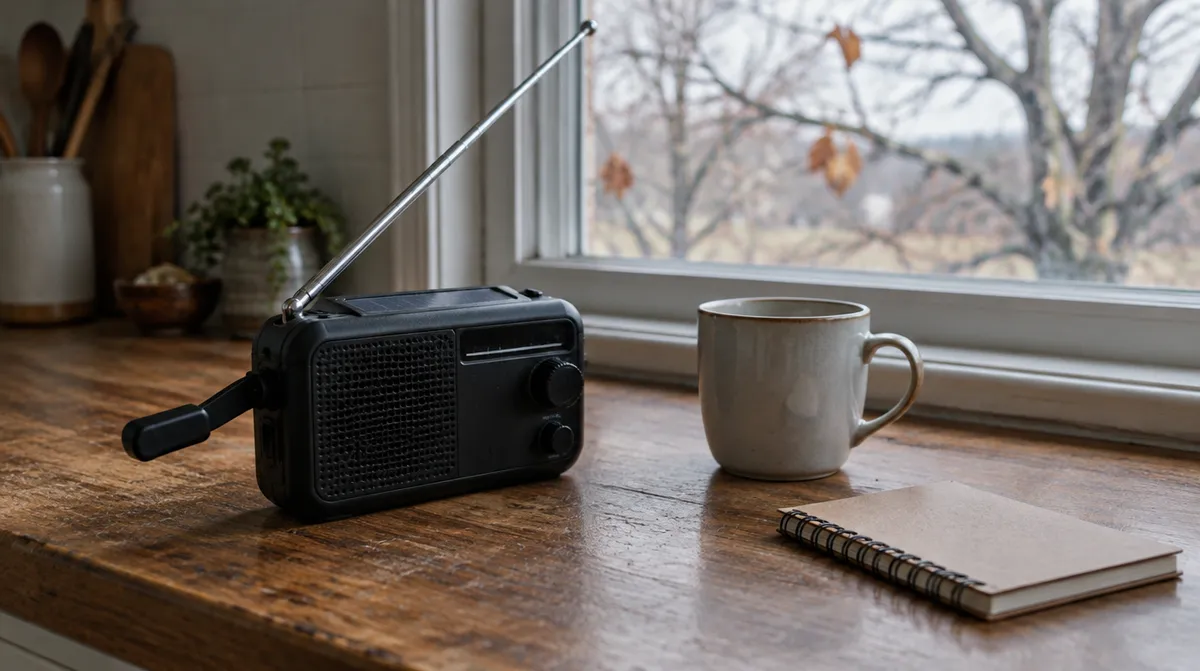
What will the nationwide emergency alert test on Nov. 17 actually do?
- FEMA and the FCC will run a nationwide Emergency Alert System test at about 2:20 p.m. Eastern on Tuesday, Nov. 17, 2026. Radio and TV programming may be interrupted for about one minute. FEMA says no action is required.
- Phones are not part of this test. FEMA's FAQ says Wireless Emergency Alerts were tested in 2023 and are not included this year, so a quiet phone on Tuesday means nothing is wrong.
- If severe weather or a real emergency hits, FEMA and the FCC may postpone the test. The backup date is Dec. 3, 2026.
- The test is a free reminder to check the three ways an alert can reach you: phone settings, a battery-powered weather radio and a local broadcast station. The weekly NOAA Weather Radio test the next day is a better check of a radio than the national test.
On Tuesday afternoon, radios and TVs across the country are scheduled to interrupt their programming to play a test alert. Most people will glance up, hear a tone, and go back to what they were doing. That is the right response, and it is also a missed chance.
The test is a federal exercise in finding weak links. Your household has the same problem on a smaller scale: you probably can’t say which of your alert sources would actually wake you up at 2 a.m. Today’s job is to read what FEMA says will happen, then spend ten minutes on your own setup.
The short answer: FEMA and the FCC will run a nationwide Emergency Alert System test at about 2:20 p.m. Eastern on Tuesday, Nov. 17, 2026. It lasts about one minute on radio, TV, cable and satellite. It does not go to phones, and no action is required. If a real emergency or severe weather interferes, the backup date is Dec. 3.
This is a research-based guide. We have not bought, used or tested any alert device mentioned here. Facts come from the official sources listed at the end, opened on November 16, 2026. Some links are affiliate links, so we may earn a commission if you buy through them, at no extra cost to you.
What FEMA Says Will Happen on Tuesday
FEMA’s FAQ is dated Sept. 17, 2026, and the FCC announced the test in a public notice the day before. The two agencies agree on the date, the time and the backup date. Here is the plan in one table.
| Question | What the sources say |
|---|---|
| When | About 2:20 p.m. Eastern, Tuesday, Nov. 17, 2026 (FEMA, FCC) |
| Who runs it | FEMA, in coordination with the FCC |
| What carries it | Radio and TV broadcasters, cable, satellite and wireline video providers (FEMA) |
| How long | About one minute, then normal programming resumes (FEMA) |
| What it says | ”This is a nationwide test of the Emergency Alert System, issued by the Federal Emergency Management Agency. This is only a test. No action is required by the public.” (FEMA test page) |
| Language | English, Spanish or both, depending on the station (FEMA) |
| Phones | Not part of this test (FEMA FAQ) |
| If real weather or an emergency interferes | The test may be postponed to Dec. 3, 2026 (FEMA FAQ, FCC) |
| Required by law | Nationwide tests at least once every three years, under the IPAWS Modernization Act of 2015 (FEMA FAQ) |
FEMA’s stated reason for doing it is blunt. The tests “allow FEMA to identify technical or operational issues before the system is needed during an actual emergency.” The Emergency Alert System is made of thousands of independently operated stations and providers using different equipment, so something will probably look or sound a little off somewhere.
Your Local Time
FEMA gives the time in Eastern. This is our conversion to standard time, which applies across the country on Nov. 17.
| Zone | Local time |
|---|---|
| Eastern | 2:20 p.m. |
| Central | 1:20 p.m. |
| Mountain (including Arizona) | 12:20 p.m. |
| Pacific | 11:20 a.m. |
| Alaska | 10:20 a.m. |
| Hawaii | 9:20 a.m. |
FEMA says “approximately,” so don’t stand by the radio with a stopwatch. If you want to hear it, turn a station on a few minutes early and leave it playing.
Three Alert Systems, One Test
The word “emergency alert” covers three separate channels, and the test touches only one of them. Mixing them up is the main source of confusion, and it is why some people will wonder why their phone stayed silent.
| Channel | How it reaches you | In Tuesday’s test? | What you need |
|---|---|---|---|
| Emergency Alert System (EAS) | Broadcast TV and radio, satellite, cable (Ready.gov) | Yes | A TV or radio tuned to a participating station |
| Wireless Emergency Alerts (WEA) | Short text-style alerts to WEA-enabled phones, with a distinct sound and vibration (Ready.gov) | No. FEMA says WEA was tested in 2023 and is not part of this test | A WEA-capable phone with the setting on |
| NOAA Weather Radio (NWR) | Continuous broadcasts from National Weather Service transmitters, 24 hours a day (NWS) | Not stated in the sources we read | A receiver or scanner that can pick up the signal |
Ready.gov says the president has sole responsibility for deciding when the national-level EAS is activated, and that FEMA and the FCC are responsible for national-level tests. So Tuesday is a drill, scheduled in public, with a script.
One more difference matters for a household. Ready.gov says WEAs are sent without a subscription and are not affected by network congestion. NWR needs a special receiver, since the NWS says it “requires a special radio receiver or scanner capable of picking up the signal.” Each channel fails in a different way, which is the argument for having more than one.
What Could Look Odd on Tuesday
FEMA’s FAQ expects variation. Because stations use different equipment, “visual displays on television may differ by station.” Some will play it in English, some in Spanish, some in both. None of that is a sign of a problem on your end.
If you are deaf or hard of hearing. FEMA says the test includes standard EAS alert tones to support accessibility. The FCC’s Nov. 4 notice reminds broadcasters that the message must be accessible, and it gives two places to report problems: general feedback on the test goes to the FCC’s Public Safety Support Center through the “Alerting Test Feedback” form, and accessibility complaints go through the FCC’s accessibility complaints form. If a station’s version had no captions or visual text, that is the channel for saying so.
If something shows up on your phone. Treat it with some care. FEMA’s FAQ says the test is not going to phones, and it describes a broadcast with nothing to click. A text or email that claims to be “the national test” and asks you to follow a link or enter information does not match that description.
If you are reading this after Nov. 17. The test may have been postponed. Check FEMA’s test page for the current date before you assume it ran.
A 10-Minute Check of Your Own Alert Setup
You don’t need the test to do this, but it is a good deadline. The list below is built from what Ready.gov and the NWS say about each channel. Nothing in the first row costs money.
| Step | Do this | Why |
|---|---|---|
| Now (10 minutes, $0) | Open your phone’s settings and look for emergency or government alerts. Make sure they are on. If you own a weather radio, put fresh batteries in it | Ready.gov says some phones need WEAs enabled, some carriers call them “Government Alerts” or “Emergency Alert Messages,” and older phones may not support them |
| This week | Listen to your weather radio during your local NWS weekly test. The NWS Philadelphia office says tests are normally done every Wednesday between 11 a.m. and noon local time, and are postponed when severe weather is occurring or threatened. Wednesday is Nov. 18 | A weekly test on your own transmitter is a better check of a home radio than a once-every-three-years national test |
| This month | Pick one phone app that alerts you for your home location. Ready.gov says the FEMA App can send National Weather Service alerts for up to five locations, which lets you add a parent’s or a child’s address. Write down your county’s emergency management office and ask how it sends local alerts | Local alerts come from your own county or city, and the way they arrive varies by place |
| Optional | Fill out a one-page household plan with an out-of-town contact. Print it or save it as a photo | An alert tells you to act. A plan tells you what to do next |
Our family emergency plan guide walks through FEMA’s free one-page template. If you want a quick read on where your household is thin on power, water, food and light, the Blackout Readiness Score asks six questions and takes a couple of minutes.
Check the Phone Without Waiting for a Test
Ready.gov’s troubleshooting steps for a phone that doesn’t receive WEAs are short: check your phone’s settings and manual, then ask your wireless provider if it can resolve the issue. It also says all major providers and some smaller ones take part in WEA. If you have a basic or older phone, the page says it may not support WEAs at all, so don’t assume yours does.
If You Want a Weather Radio
A phone depends on its charge and a carrier signal. A battery-powered NWR receiver listens to a separate National Weather Service broadcast, so the two fail in different ways. Our NOAA weather radio buyer’s guide covers what Public Alert certification, SAME county coding and coverage maps mean, and we won’t repeat it here. The short version is to check that the unit lists the weather band, runs on batteries or a crank, and can be set to your county.
Our affiliate link goes to a hand-crank model. We read its Amazon listing on November 16.
Who it fits: a household that wants a battery-backed alert source that doesn’t depend on an outlet or a cell tower, and will test it on a Wednesday. Amazon’s own customer summary says some buyers report excellent reception and others very poor reception, so plan to try it in your house during the return window. Who it doesn’t fit: anyone who needs alerts limited to one county. If a listing doesn’t state SAME coding, assume the radio can’t filter alerts by county, as the NOAA guide explains. It also isn’t a substitute for checking your local transmitter coverage first. Our hand-crank weather radio review goes through the trade-offs of crank radios in more detail.
Where Black Friday Fits
We have not verified any 2026 Black Friday price for a weather radio. Amazon says its Black Friday Week event starts on November 19, and its page tells shoppers to sign up for Prime ahead of the holiday season. A radio like this is a small purchase, and a sale is not a reason to buy one. The reason is that a household without a working alert source is relying on a phone alone.
If you shop on Amazon anyway, Prime has its own page with eligibility and offers set by Amazon. We include the link as a convenience, not as a recommendation to join.
What We Could Not Confirm
- Whether home weather radios will sound on Tuesday. FEMA’s FAQ names broadcasters, cable, satellite and wireline providers. It does not say how NOAA Weather Radio receivers will respond to the national test.
- Exactly when your station will air it. FEMA says “approximately” 2:20 p.m. Eastern, and stations are independent. The time zone table is our conversion.
- Whether the test will go ahead on Nov. 17. FEMA and the FCC say it may be postponed for a real emergency or significant weather. We did not find a postponement notice on November 16.
- The radio’s performance. We have not used it. We read the Amazon listing and its customer summary, and no individual reviews. The listing shows no price in the text we read.
- Prices during Black Friday Week. None verified.
We will update this page after the test runs or if FEMA moves the date.
The Takeaway
Tuesday’s test asks nothing of you. Hear it if you’re near a radio or TV, ignore the rest, and don’t expect your phone to buzz. The better use of the same afternoon is ten minutes on your own alert chain: confirm your phone’s emergency alert setting is on, put fresh batteries in any weather radio you own, and listen to it during the local weekly test on Wednesday. If you have none of those, a battery-backed NOAA radio is the cheapest gap to close.
Frequently Asked Questions
- Will the Nov. 17 emergency alert test go to my phone?
- No, according to FEMA. Its FAQ says Wireless Emergency Alerts were tested in 2023 and will not be part of this year's test. This year FEMA is assessing the Emergency Alert System, which is made up of thousands of radio, television, cable, satellite and wireline providers. If your phone stays quiet at 2:20 p.m. Eastern, that is the expected result and not a sign of a problem.
- What time is the emergency alert test in my time zone?
- FEMA says about 2:20 p.m. Eastern on Tuesday, Nov. 17, 2026. Our conversion to standard time zones is 1:20 p.m. Central, 12:20 p.m. Mountain, 11:20 a.m. Pacific, 10:20 a.m. Alaska and 9:20 a.m. Hawaii. FEMA says the time is approximate, so allow a few minutes either way.
- What happens if there is a storm or a real emergency on Nov. 17?
- FEMA's FAQ says that if an actual emergency or a significant weather event occurs on test day, FEMA and the FCC may postpone the test. The backup date is Dec. 3, 2026. Check FEMA's test page if you are reading this after Nov. 17 and want to know which date it ran.
- Do I need to do anything when the test plays?
- No. FEMA's test page and FAQ both say no action is required by the public, and the scripted message ends with the same line. FEMA's FAQ also says the Emergency Alert System does not collect personal data from the public. Be careful with any text or email that claims to be the test and asks you to tap a link or enter information, because the sources we read describe a broadcast message and nothing to click.
- Will my NOAA weather radio go off during the national test?
- We could not confirm it. FEMA's FAQ describes radio, television, cable, satellite and wireline video providers and does not mention NOAA Weather Radio receivers. Ready.gov says NOAA Weather Radio also broadcasts non-weather alerts through the Emergency Alert System, but it does not say what a national test does to a home receiver. Do not treat silence on Tuesday as a failed radio. The weekly local NWS test is the check to rely on.
Sources & references
- FEMA, Frequently Asked Questions about the Nationwide Emergency Alert System Test (release date Sept. 17, 2026; opened Nov. 16, 2026) (opens in new tab)
- FEMA, 2026 Nationwide Emergency Alert System Test (undated; opened Nov. 16, 2026) (opens in new tab)
- FCC, FCC Announces Nationwide Emergency Alert System Test on November 17, 2026 (public notice Sept. 16, 2026; page updated Sept. 21, 2026; opened Nov. 16, 2026) (opens in new tab)
- FCC, FCC Reminds EAS Participants to Transmit Accessible Emergency Alerts During 2026 Nationwide Test (public notice Nov. 4, 2026; opened Nov. 16, 2026) (opens in new tab)
- Ready.gov (FEMA), Emergency Alerts (undated; opened Nov. 16, 2026) (opens in new tab)
- National Weather Service, NOAA Weather Radio All Hazards (undated; opened Nov. 16, 2026) (opens in new tab)
- National Weather Service Philadelphia/Mt. Holly, NOAA Weather Radio Frequently Asked Questions (undated; opened Nov. 16, 2026) (opens in new tab)
- Amazon, When is Amazon's Black Friday 2026 event? (undated; opened Nov. 16, 2026) (opens in new tab)
Before you go
The 7-Step Blackout Plan
A calm, practical plan for getting a household through a multi-day power outage: power, water, food, temperature, light, medical and a written plan.
Free guide
The 7-Step Blackout Plan
A calm, practical plan for getting a household through a multi-day power outage: power, water, food, temperature, light, medical and a written plan.