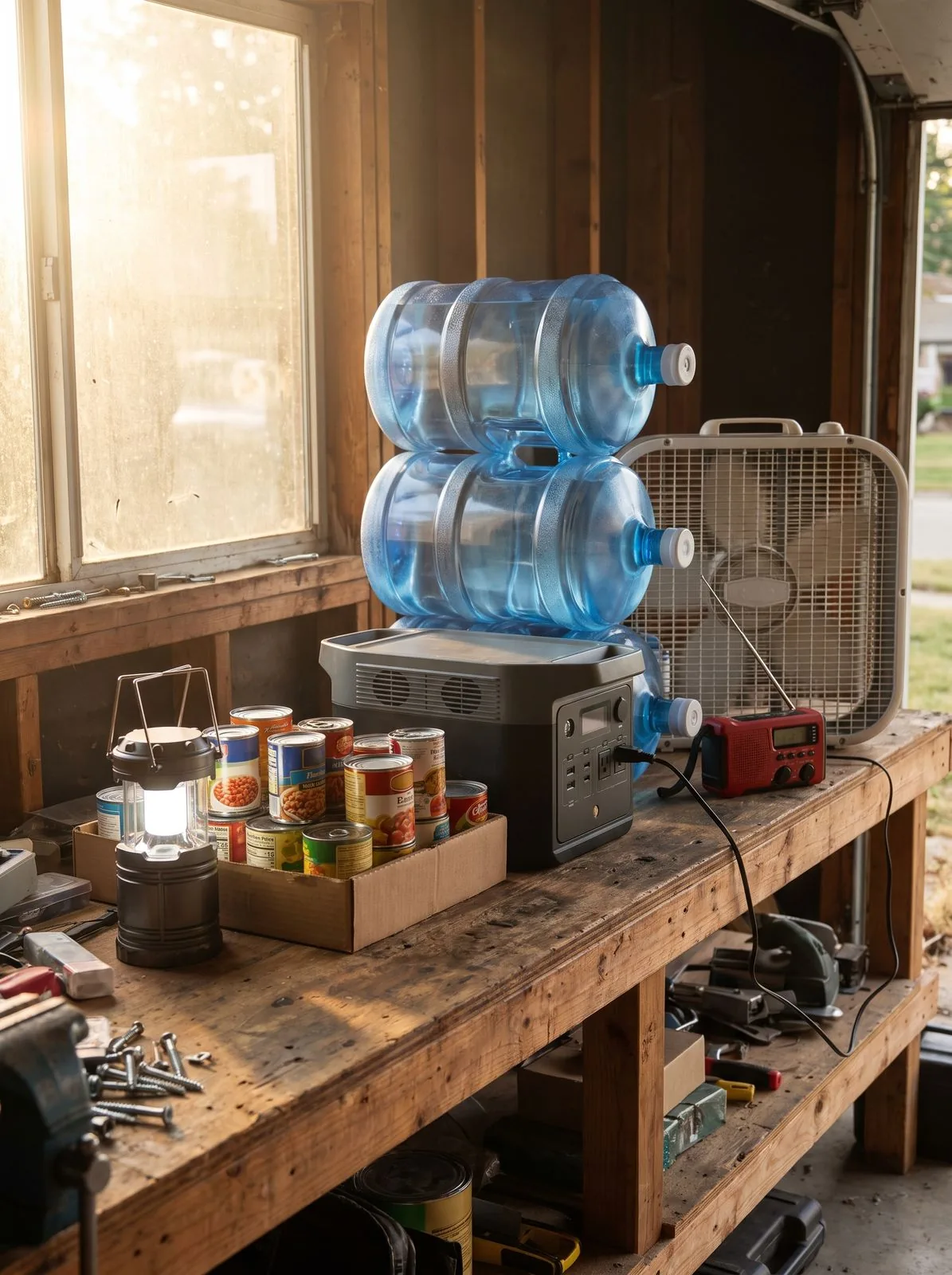
Summer is now the season the grid struggles most. Record heat drives record air-conditioning demand at the exact moment power plants and transmission lines are least efficient, and grid operators have issued emergency alerts and conservation appeals during heat waves. A winter storm gives you days of warning. A summer grid failure can hit on a clear, blistering afternoon with none.
The good news: preparing for a summer blackout comes down to seven needs, and each one has a simple answer. Here is the whole checklist in one breath — power, water, food, staying cool, light and communication, medical, and a written plan. Get each of those handled before the grid goes down and a blackout becomes a manageable inconvenience instead of a dangerous scramble. Below, each step spells out exactly what “handled” looks like.
The 7-Step Summer Blackout Prep Checklist
- Backup power — a portable power station or solar generator for the essentials
- Water — one gallon per person per day, doubled in extreme heat
- Food — a few days of no-cook, shelf-stable food plus a manual can opener
- Staying cool — shade, airflow, and evaporative cooling to survive without AC
- Light and communication — lanterns, a hand-crank radio, and charged power banks
- Medical — a first-aid kit, medication plan, and cooling for temperature-sensitive meds
- A written plan — who does what, where you meet, how you reach each other
1. Backup Power for the Essentials
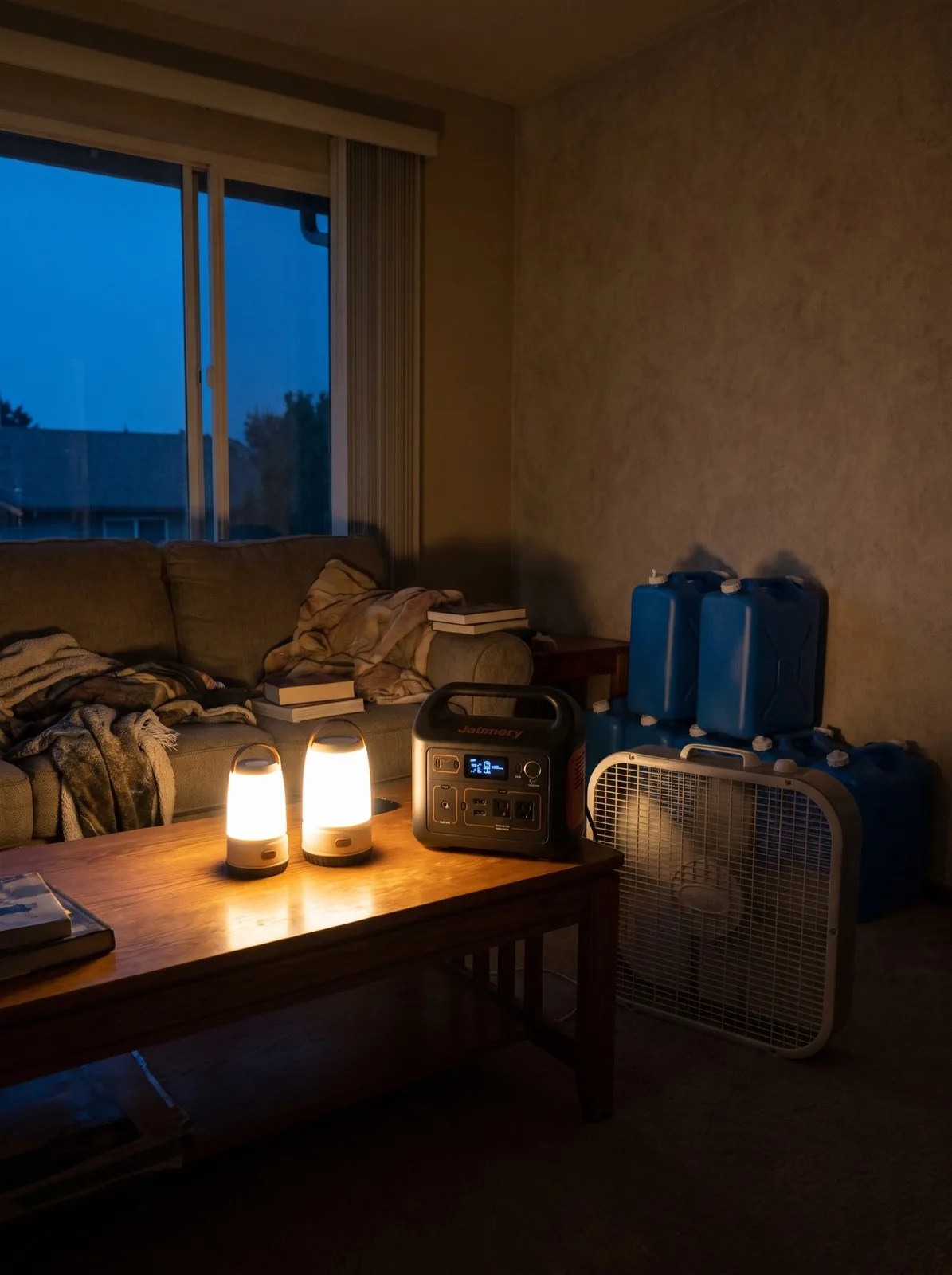
You do not need to power your whole house — you need to power the handful of things that matter: phones, a fan or two, the fridge, and any medical device like a CPAP. A portable power station (Amazon) in the 1,000Wh class handles all of that silently and, unlike a gas generator, safely indoors (American Red Cross). Pair it with a folding solar panel (Amazon) and the long, cloudless days of a heat wave become your recharging source.
If you want to go bigger — running more of the house, or building toward energy independence rather than just outage insurance — a home solar build is the next step up. For sizing a single unit to your actual appliances, our best power stations for a heat-wave blackout comparison does the math.
2. Store Water — and Double It in the Heat
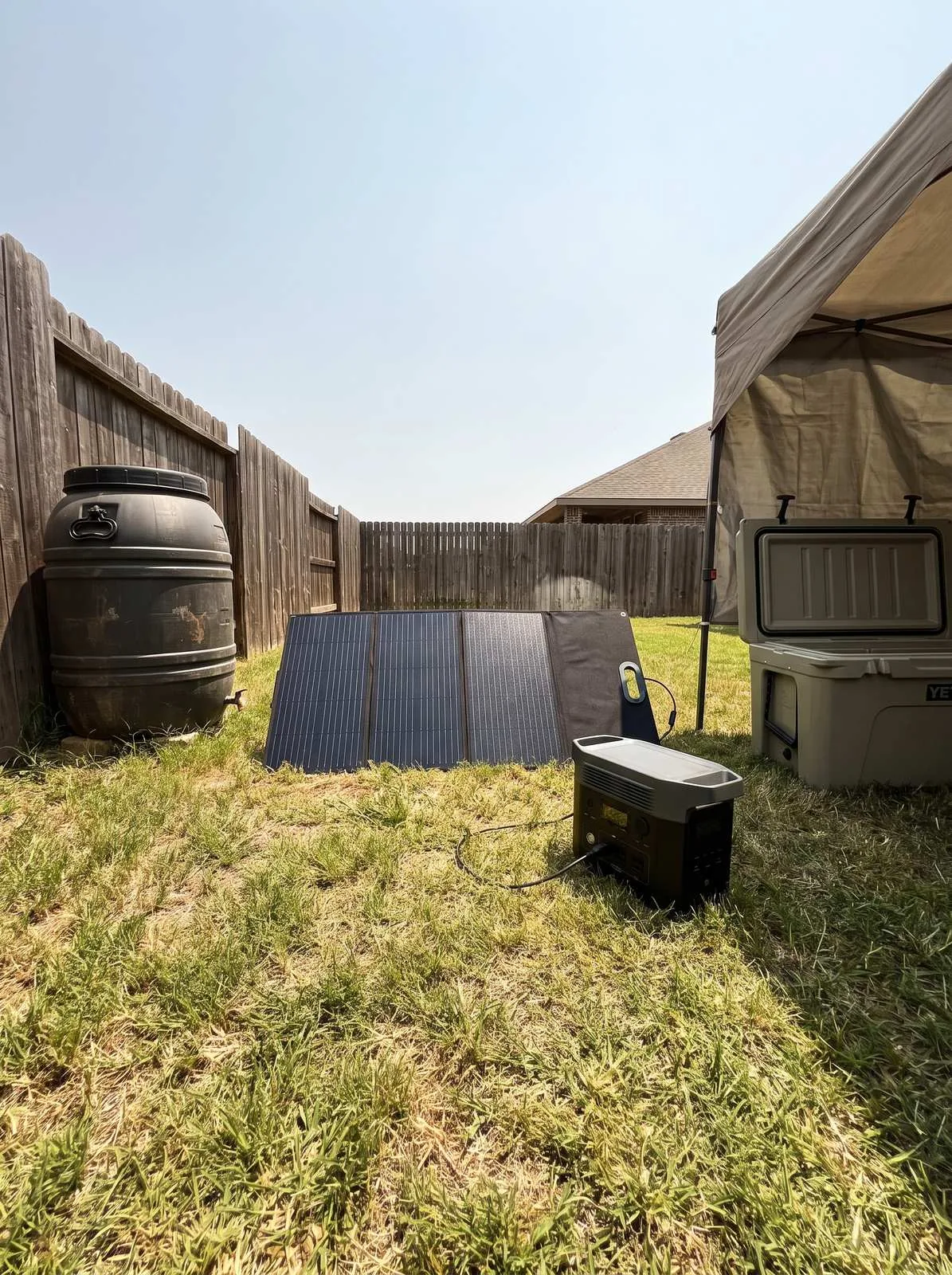
The baseline is one gallon per person per day for drinking and basic sanitation (American Red Cross). In extreme heat, plan to double it — hot environments can double the amount of water a person needs (Southern Nevada Health District), and dehydration is the quiet danger of a summer blackout.
| Household | 3-day minimum | 3-day heat-wave target |
|---|---|---|
| 1 person | 3 gallons | 6 gallons |
| Family of 4 | 12 gallons | 24 gallons |
Store it in food-grade containers, label the fill date, and rotate every six months (Ohio State University). Our full how to store emergency water at home guide covers containers, sanitizing, and rotation. For a renewable source that does not depend on hauling jugs, the Water Freedom System review looks at pulling drinking water from the air, and the Smart Water Box review covers a compact backup. Keep a filter like the Sawyer Squeeze (Amazon) on hand to treat questionable water.
3. No-Cook Food You Can Actually Eat
With the stove and microwave down, the food that matters is what you can eat cold. Stock canned proteins and vegetables, peanut butter, crackers, nuts, dried fruit, and ready-to-eat pouches — and keep a manual can opener with them, because a wall of cans you cannot open is useless.
Eat the most perishable fridge food first while it is still cold (see our keep food cold without power guide for stretching that window), then move to the pantry. For a purpose-built, long-shelf-life stockpile, the Lost SuperFoods review covers calorie-dense recipes designed to store for years without refrigeration. Keep this supply slightly separate from your daily pantry so it is always intact when you need it.
4. Stay Cool Without Air Conditioning
This is the step that makes a summer blackout genuinely dangerous, and it gets skipped most. Without AC, manage heat actively:
- Block the sun by day. Close blinds and curtains on the south and west sides. Sunlit windows are a major source of heat gain.
- Flush heat at night. Open up once the outside air drops below the inside temperature to vent the day’s heat.
- Move down and shady. Retreat to the lowest, shadiest floor. Heat rises; basements stay coolest.
- Keep air moving. A battery- or solar-powered fan makes a big difference; moving air helps sweat evaporate. The National Weather Service notes a fan can make you hotter once the heat index climbs above the 90s (NWS).
- Add evaporative cooling. In a dry climate, a DIY off-grid swamp cooler built from a bucket, a small fan, and a pump delivers real temperature drop for a modest cost in parts.
Watch everyone — especially kids, older adults, and anyone with health conditions — for heat exhaustion: heavy sweating, weakness, cool and clammy skin, dizziness, nausea. Those are signals to cool the person down fast. Confusion, slurred speech, or hot, red, dry or damp skin point to heat stroke, a medical emergency: call 911 (NWS). Heat is the deadliest part of a summer outage.
5. Light and Communication
When the sun sets, you want light that is not an open flame near a hot, dry house. Keep LED lanterns and headlamps with fresh batteries, and give each person their own. For information, a hand-crank or solar emergency radio pulls in NOAA weather and local emergency broadcasts when the internet and cell towers are down or overwhelmed.
Charge a couple of power banks and keep them topped up, and know that your power station can recharge phones dozens of times over. Designate one phone as the “on” phone and keep the rest in low-power mode to conserve.
6. Medical and Medications
Walk through your household’s medical needs before an outage, not during one. Keep a stocked first-aid kit, a printed list of everyone’s medications and doses, and a plan for anything temperature-sensitive — insulin and some other medications need to stay cool (FDA), which is another job for your cooler and ice or a small draw off the power station. If anyone depends on a powered device — CPAP, oxygen concentrator, a medical pump — size your backup power around that device first. It is the one load that is not optional.
7. Write Down the Plan
Gear without a plan turns into confusion at the worst moment. Put it on one page: who grabs the coolers, who fills the bathtub and water containers, where the family meets if you are separated, and an out-of-area contact everyone can text (local lines jam first). Tape it inside a cabinet. If the person who knows the system is at work when the grid fails, everyone else should still be able to run the checklist.
Put the Checklist on Autopilot
The whole point of a checklist is that you only think hard once. Assemble the gear, stage the water, write the plan, and store it all together — then a heat-wave blackout is something you execute rather than something that happens to you.
Start with the two items that carry the most weight: power and water. A portable power station (Amazon) plus a stored, rotated water supply covers the needs that get dangerous fastest in the heat. Build out the rest from there, and revisit the list at the start of each summer.
Frequently Asked Questions
- How do you prepare for a summer power outage?
- Cover seven areas before the grid goes down: backup power (a portable power station or solar generator), stored water at one gallon per person per day, no-cook shelf-stable food, a way to stay cool without air conditioning, light and communication, medications and first aid, and a written family plan. The goal is to have each need already met so an outage is an inconvenience, not a scramble.
- How much water should I store for a summer blackout?
- Start with one gallon per person per day, and plan to roughly double that in extreme heat because your body loses more water to sweat. For a family of four over a 3-day outage that is a minimum of 12 gallons, and closer to 24 in a heat wave. Store it in food-grade containers and rotate it every six months.
- How do you stay cool during a blackout without AC?
- Block the sun during the day by closing south- and west-facing blinds, open up at night to flush hot air, move activity to the lowest and shadiest part of the house, run a battery- or solar-powered fan to keep air moving, and hydrate constantly. A DIY evaporative swamp cooler adds real cooling in dry climates. Watch everyone for heat illness: heavy sweating, dizziness, and nausea signal heat exhaustion, while confusion or hot, red, dry or damp skin can mean heat stroke, which is an emergency.
- What food should I stock for a power outage?
- Focus on shelf-stable food that needs little or no cooking: canned proteins and vegetables, peanut butter, crackers, dried fruit, nuts, and ready-to-eat pouches, plus a manual can opener. Keep a few days of it separate from your daily pantry so it is always there. Eat the most perishable fridge food first while it is still cold.
- Do I need a generator for a summer blackout?
- Not necessarily. A portable power station with a solar panel covers the essentials — phone charging, fans, keeping a fridge cold, running a CPAP or medical device — silently and safely indoors, which a gas generator cannot do. Gas generators deliver more raw power for whole-home loads but must run outside, far from windows, because of carbon monoxide risk.
Sources & references
- American Red Cross, How to Prepare for a Power Outage (opens in new tab)
- American Red Cross, Survival Kit Supplies (opens in new tab)
- Southern Nevada Health District, Does our hot climate mean I should store more water? (opens in new tab)
- Ohio State University, Creating and Storing an Emergency Water Supply (opens in new tab)
- National Weather Service, Heat Illness (opens in new tab)
- FDA, Insulin Storage and Switching Between Products in an Emergency (opens in new tab)
Before you go
The Renter's Homestead Pack
Self-reliance projects for the yard you don't own — container yields, a raised bed built to move with you, balcony preservation basics, and the landlord questions to ask first.
Free guide
The Renter's Homestead Pack
Self-reliance projects for the yard you don't own — container yields, a raised bed built to move with you, balcony preservation basics, and the landlord questions to ask first.