| Best For | Skip If |
|---|---|
| Preppers building a long-term shelf-stable food supply | You want verified nutrition science over traditional methods |
| Homesteaders wanting 126 historical preservation recipes | You can find all this content free online |
| Budget buyers — $37 with 60-day refund | You need modern canning safety guidance (NCHFP/USDA) |
The Lost SuperFoods is a strange product to review, because there are really two products here. There is the book itself, which readers genuinely seem to like. And there is the sales machine wrapped around it, which leans on a fictional narrator and shelf-life claims that outrun what food-safety agencies actually say (NCHFP).
We have not cooked our way through this guide, and we won’t pretend otherwise. This review is based on our research: reader feedback on Goodreads, the commonsensehome.com investigation into the vendor’s sister product, USDA and National Center for Home Food Preservation guidance, and the publisher’s own listings. Here is what we found.
What Is The Lost SuperFoods?
The Lost SuperFoods is a 272-page guide covering 126-plus foods and preservation methods, most of them pulled from history: wartime rations, pioneer staples, and traditional techniques from cultures that had to keep food edible without refrigeration. It sells as a digital PDF, with an optional physical-plus-digital version offered on the sales page.
Now, the authorship — because this is where honesty matters most.
Goodreads lists the authors as “Claude Davis,” Art Rude, and Fred Dwight (Goodreads). Third-party write-ups describe Art Rude as a retired math teacher, but his background could not be independently verified.
“Claude Davis” does not appear to be a real person. According to commonsensehome.com’s investigation of the sister product The Lost Ways, “Claude Davis” is a registered trademark, and the askaprepper.com site behind the brand is owned by Global Brother SRL, a company registered in Romania. The same site says the men who appeared as “Claude Davis” in sales videos were paid actors, and that the grandfatherly one converted sales better (Common Sense Home). The sales page still presents “Claude Davis” as a narrator with a family-recipe backstory. That is marketing theater, plain and simple.
Does a fictional frontman make the book worthless? No — the content underneath is real. But you should know what you are buying and who actually wrote it before the folksy narration starts.
What’s Inside
The table of contents reads like a museum of food security, and that is meant as a compliment. Highlights on the sales page include the US “doomsday ration,” Mongolian aaruul (a hard dried-curd cheese), and the “portable soup” associated with the Lewis and Clark expedition.
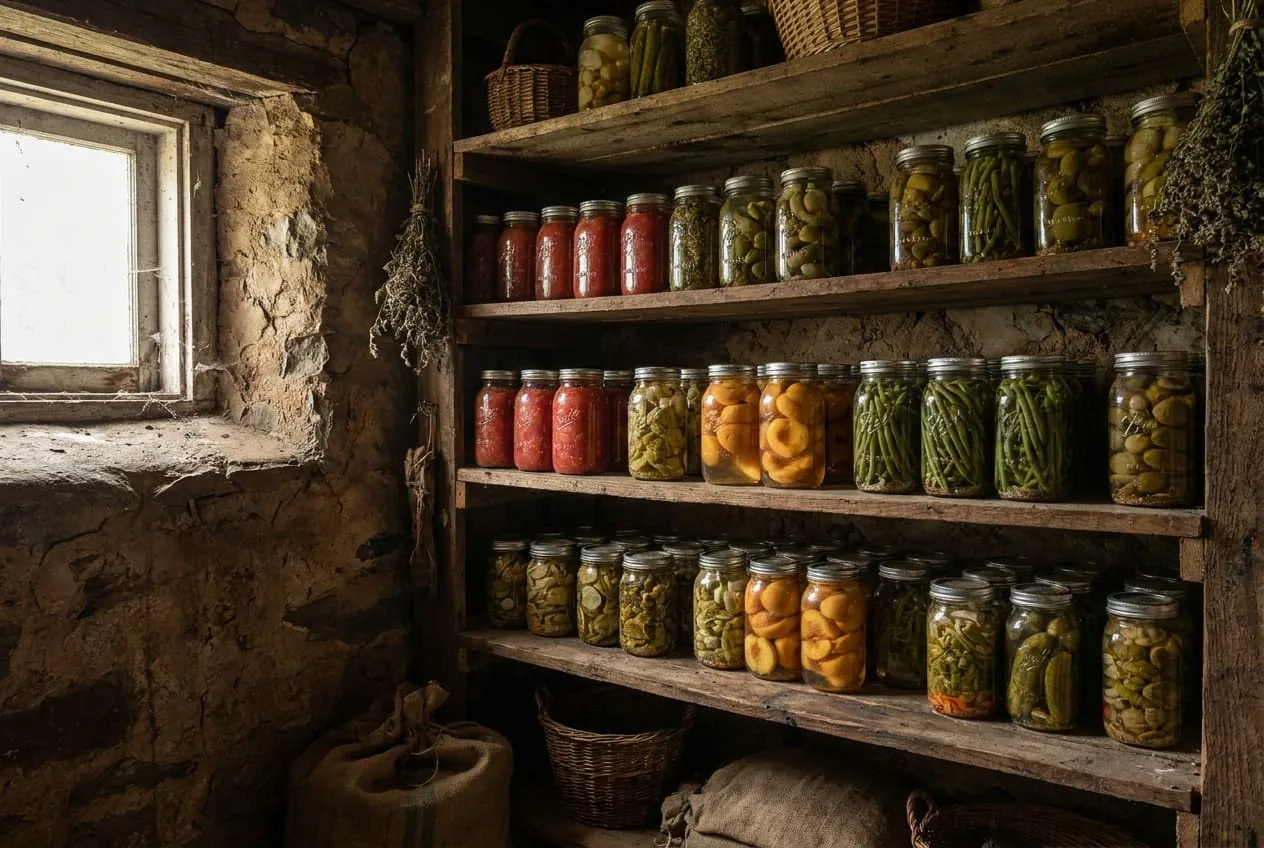
For a 2026 homestead, the useful core is more familiar: canning vegetables and meat, dehydrating, sauerkraut and fermentation, and egg preservation. The most practical modern additions are a DIY 2,400-calorie ration bar, a $20 DIY food bucket, and a $5-per-week stockpiling plan — simple frameworks that give a beginner somewhere to start without a four-figure freeze-dryer budget.
Be clear-eyed about the split, though. Canning, dehydrating, and the budget stockpiling plans are things you will plausibly do. Some of the historical recipes are fascinating history you will almost certainly never need. A good chunk of the page count is curiosity, not utility — enjoyable reading, but not all of it earns a place in your pantry.
Reader reception is solid. The book holds a 4.27 out of 5 rating on Goodreads across 107 ratings, with reviewers praising how comprehensive it is, the easy-to-follow instructions, the color pictures, and the historical context. The recurring criticisms: it is information-dense, and it offers too little practical guidance on sourcing some ingredients.
One more honest caveat: much of this material is repackaged public knowledge. The canning guidance exists free at the National Center for Home Food Preservation, and many recipes trace back to old cookbooks and historical records. What $37 buys is curation and convenience — one organized, illustrated volume instead of forty browser tabs. For a lot of people that trade is worth it; just do not mistake it for secret knowledge.
Worth noting how this fits a broader plan: this book teaches you to store food, not produce it. If you want the production side — gardens, livestock, off-grid systems — that is the territory of The Self-Sufficient Backyard review. The two complement each other more than they overlap.
Pros And Cons
Pros
- 272 pages covering 126+ foods and preservation methods, from canning to biltong to ration bars
- Named co-authors credited alongside the persona: Art Rude and Fred Dwight
- Practical budget frameworks: the $20 food bucket, $5-per-week stockpiling plan, and DIY 2,400-calorie ration bar
- Well-liked by actual readers: 4.27/5 across 107 Goodreads ratings, with praise for clear instructions and color pictures
- Low risk: $37 at the time of writing, backed by a 60-day ClickBank refund window
Cons
- The 'Claude Davis' frontman is a fictional marketing persona, not a real author
- Shelf-life claims on the sales page exceed USDA and NCHFP guidance
- Much of the content is repackaged historical and public-domain knowledge available free elsewhere
- Some recipes require hard-to-source ingredients, and the writing can feel dense
Who Should NOT Buy This
Skip this book if you are expecting modern nutrition science. The “superfoods” framing is historical, not clinical — these are calorie-dense, shelf-stable survival foods. Nothing in here replaces guidance from a dietitian.
Skip it if you already own solid preservation references. If your shelf has the Ball Blue Book, you follow NCHFP guidelines, and you have put up your own harvest for years, this guide will mostly tell you things you know, wrapped in historical anecdotes. The stories are fun, but you would be paying $37 for entertainment.
And skip it if the persona marketing genuinely bothers you. That is a legitimate position. A vendor that invents a grandfatherly narrator to sell books has earned some skepticism, and no refund policy obligates you to reward the tactic. We would rather lose a commission than talk you past a principle.
Price, Guarantee, And How Buying Works
At the time of writing, The Lost SuperFoods costs $37 for the digital version plus two bonuses (official sales page). Funnels vary, and the physical copy is a separate option, so treat the exact number as approximate until you see the checkout page.
Two digital bonuses are included: “The Year-Round Greenhouse in Your Backyard” and “Projects From 1900 That Will Help You in the Next Crisis.” One overlap warning: if you also own The Self-Sufficient Backyard, the greenhouse bonus covers ground its greenhouse chapter already handles, so do not count the bonus as extra value if you are buying both.
Checkout runs through ClickBank, a large retailer of digital products, and comes with a 60-day money-back guarantee. The 60-day window is a standard ClickBank term: ClickBank’s published policy says it will, at its discretion, allow the return of any product within 60 days of purchase (ClickBank) — which makes the guarantee meaningful rather than decorative.
One real warning: be wary of lookalike domains with near-identical spellings of the product name. Copycat sites like these may charge you without delivering the product, the bonuses, or a valid refund path. Buy only through the official ClickBank funnel; the links in this review point there.
Recommended Food Preservation Products
Many of the methods in Lost SuperFoods require basic preservation equipment. Here’s what most homesteaders buy to put the book to work:
| Product | What It’s For |
|---|---|
| COSORI Food Dehydrator (Amazon) | Jerky, dried herbs, fruit leather — all covered in the book |
| NESCO FD-75A Snackmaster Dehydrator (Amazon) | Budget alternative dehydrator with solid reviews |
| FoodSaver Vacuum Sealer (Amazon) | Extends shelf life dramatically for dried and preserved foods |
| Mylar Bags (1-gallon) (Amazon) | Long-term bulk storage — pairs with oxygen absorbers |
| Oxygen Absorbers 300cc (100-pack) (Amazon) | Essential for 5–25 year dry food storage in mylar bags |
| Ball Wide-Mouth Mason Jars 32oz (12-pack) (Amazon) | Standard canning jars — used throughout the book |
| Wise Company Emergency Food Supply (Amazon) | Ready-made backup for while you build your own stockpile |
Best Alternatives
If The Lost SuperFoods isn’t the right fit, here are the closest alternatives:
| Alternative | Best For | Price |
|---|---|---|
| The Self-Sufficient Backyard | Broader homesteading from verified 40-year off-grid authors | ~$37 |
| Ball Complete Book of Home Preserving (Amazon) | Tested canning and preserving recipes | $15–25 |
| NCHFP Canning Guides | Free, scientifically verified canning safety guides | Free |
Final Verdict
The Lost SuperFoods earns its 7.5. The content is real, readers like it, and the budget-stockpiling frameworks are genuinely useful for beginners. Against that: a fictional frontman, shelf-life claims the USDA would not sign off on, and a fair amount of repackaged free knowledge. Buy it as a well-curated, refundable $37 reference, not as lost secret wisdom, and you will probably be satisfied.
And remember that stored food is only half of a resilience plan — backup water is the other, which we cover in our Smart Water Box review.
Frequently Asked Questions
- Is The Lost SuperFoods legit?
- The book is real, 272 pages long, and rated 4.27/5 by 107 readers on Goodreads as of this writing. The content — canning, curing, fermenting, historical rations — is genuine and usable. What is not real is "Claude Davis," the narrator on the sales page, and some shelf-life claims are exaggerated. Legitimate product, hyped marketing. The 60-day ClickBank refund removes most of the risk of finding out.
- Who is Claude Davis?
- Per commonsensehome.com's investigation, "Claude Davis" is a registered trademark rather than an identifiable person, and the askaprepper.com site behind the brand is owned by Global Brother SRL, a company registered in Romania. The same site says the men who appeared as "Claude Davis" in sales videos were paid actors. Goodreads also credits Art Rude and Fred Dwight as co-authors; their backgrounds could not be independently verified.
- Do the foods really last 20 years?
- Treat those numbers as marketing. The sales page mentions eggs preserved for 10 years, canned food stored for 20, and foods that "probably never spoil." National Center for Home Food Preservation guidance is to can no more than you will use within a year for best quality; beyond that you are trading quality for time, and safety depends entirely on correct processing and storage. Some historical foods (hardtack, properly dried goods) do keep for very long periods — but "decades, guaranteed" is not what the food-safety science says.
- Is there a physical book?
- Yes. The base product is a digital PDF, and the official sales page also offers a physical-plus-digital option. Shipping and bundle prices vary by funnel, so check the checkout page for the current total.
- The Lost SuperFoods vs The Lost Ways — what is the difference?
- Same vendor family, different focus. The Lost Ways is a broad pioneer-skills book; The Lost SuperFoods focuses specifically on food storage and preservation. Both are sold under the "Claude Davis" brand. If you only care about food storage, this is the more focused buy.
- Is there a free PDF download of The Lost SuperFoods?
- Sites offering a "free PDF" are the actual risk here — pirated copies are a common vehicle for malware and fake-download traps, and they fund the copycat domains we warned about above. Given a $37 price and a 60-day refund window, the legitimate purchase is close to risk-free; if the book disappoints you, ClickBank returns your money.
- What is The Lost SuperFoods and what do you get?
- The Lost SuperFoods is a digital guide (272 pages, per Goodreads) covering over 126 survival foods, storage tips, and long-term food preservation methods drawn from historical records — including foods that sustained people through famines, wars, and disasters. Content is delivered digitally via download after purchase.
- Is The Lost SuperFoods available as a physical book?
- The primary version sold through the main website is a digital download. A physical edition is offered as a separate option at checkout.
- Does The Lost SuperFoods come with a money-back guarantee?
- Yes. The digital version is sold through ClickBank with a standard 60-day money-back guarantee. You can request a full refund within 60 days of purchase if the guide does not meet your expectations.
Sources & references
- Goodreads, The Lost SuperFoods (opens in new tab)
- The Lost SuperFoods, official sales page (opens in new tab)
- Common Sense Home, The Lost Ways book: does it live up to the hype? (opens in new tab)
- ClickBank, Return and subscription cancellation policy (opens in new tab)
- NCHFP, Storing home canned foods (opens in new tab)
Before you go
The Renter's Homestead Pack
Self-reliance projects for the yard you don't own — container yields, a raised bed built to move with you, balcony preservation basics, and the landlord questions to ask first.
Free guide
The Renter's Homestead Pack
Self-reliance projects for the yard you don't own — container yields, a raised bed built to move with you, balcony preservation basics, and the landlord questions to ask first.