| Best For | Skip If |
|---|---|
| Curious DIYers in humid climates wanting an emergency water backup | You live in an arid or low-humidity region |
| Weekend-project builders who understand this is a PDF guide | You expect a ready-to-use device |
| Off-gridders wanting a water source that needs no pipes | You need drinking-safe water without a filtration add-on |
What Is The Smart Water Box?
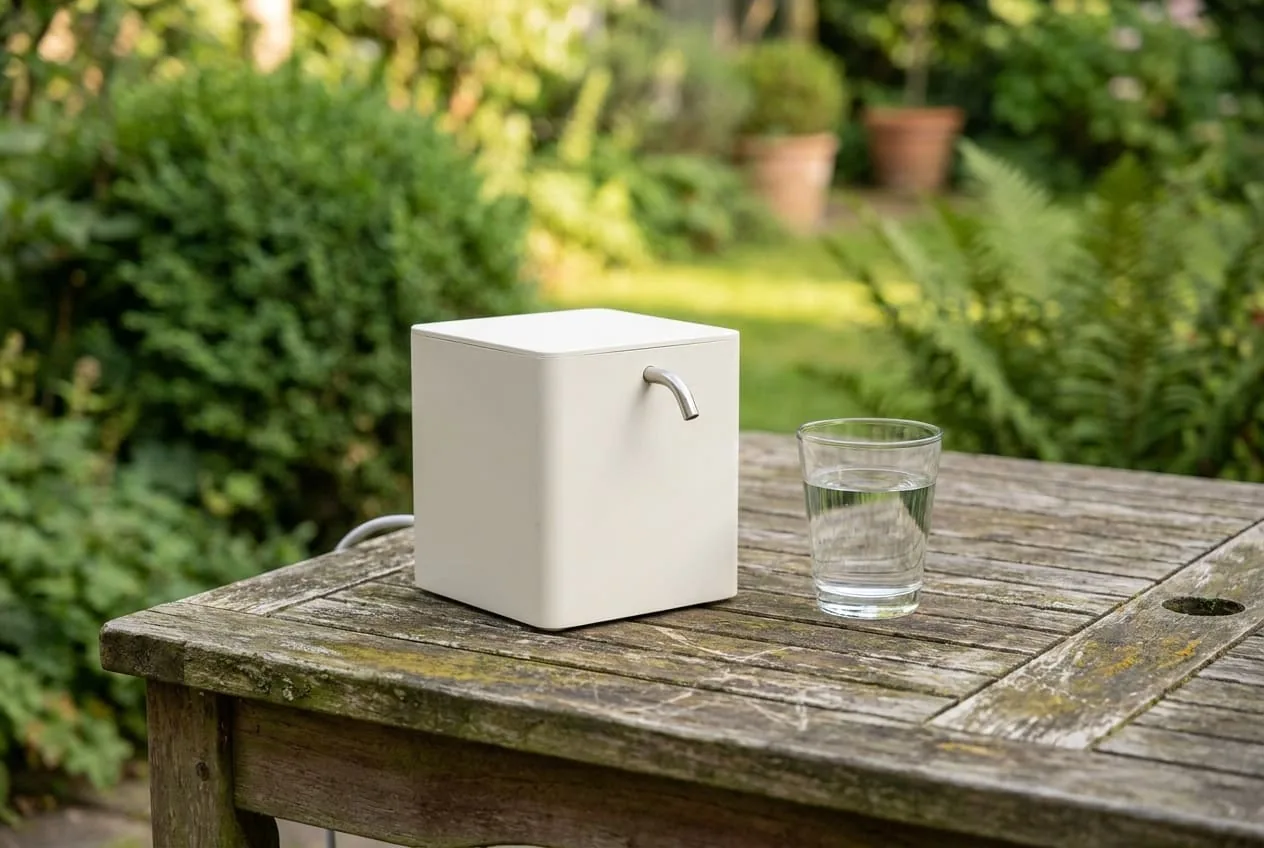
Let’s clear up the single biggest misunderstanding first: the Smart Water Box is not a machine. Nothing arrives in a box. It is a digital PDF build guide — blueprints, a materials list, and step-by-step instructions for assembling a homemade atmospheric water generator (AWG) from off-the-shelf parts. Anyone expecting a gadget will get a download link instead.
The build itself is essentially a purpose-built dehumidifier: the sales letter describes aluminum tubing from an old fridge as the condenser coil, salvaged computer fans to move air across it, and a food-safe barrel to catch the condensate. The vendor says it cost “less than $106” to build (Smart Water Box sales letter), which is plausible if you shop carefully and already own basic tools.
The guide is credited to “James Anderson,” and to the sales page’s partial credit, it admits that is a pen name (Smart Water Box). The backstory attached to it — a late Marine-engineer uncle, “military blueprints,” a suspicious death, the LA fires — is an unverifiable marketing narrative. We found nothing to support any of it, and nothing about the underlying technology requires a dramatic origin story. Pulling drinking water out of humid air by condensation is ordinary, public, century-old engineering. There is nothing classified in this PDF.
We have not built the device ourselves. This review is research-based: we compared the vendor’s claims against published AWG physics and peer-reviewed performance data.
Is Smart Water Box A Scam?
If you searched “smart water box scam,” here is the direct answer.
No — not in the sense most people mean. You pay $39, you receive a real PDF based on real, working technology, and there is a genuine 60-day money-back guarantee processed through ClickBank, which acts as the retailer and whose published policy allows returns within 60 days of purchase (ClickBank). It is not a non-delivery scam.
But “not a scam” is a low bar, and the marketing does not clear a higher one. The sales page claims the device can produce “up to 40 gallons a day” (Smart Water Box sales letter). Based on the physics we walk through below, that figure is not achievable with this build in any realistic residential setting. A machine that actually made 40 gallons a day would be commercial-grade hardware, not a $106 garage project. The predictable result is far less water than advertised, and buyers in dry climates will get the least of all.
One more thing worth flagging: if you have been Googling reviews of this product, be aware that the results are saturated with affiliate content dressed up as independent journalism — including paid newswire placements formatted to look like news coverage. Most “Smart Water Box review” pages exist to earn a commission, not to inform you. We are affiliate-funded too, which is precisely why we are telling you this and putting the physics on the table.
So: legitimate product, legitimate technology, dishonest expectations. Hold that frame for the rest of this review.
What You’ll Actually Get: The Physics
Atmospheric water generation is real. Cool a surface below the dew point, moisture condenses, you collect it. But the physics sets hard limits that no blueprint can engineer around.
Cooling-condensation AWGs stop working efficiently below roughly 60 to 65°F (15 to 18°C) or below about 30% relative humidity. Outside that envelope, output falls off a cliff no matter how well you build.
Peer-reviewed numbers make this concrete. A climatic-chamber study of residential-size, compressor-based units from several manufacturers measured energy use of about 1.02 kWh per liter in warm, humid conditions, ballooning to 6.23 kWh per liter in cold, humid conditions (Water Resources and Industry).
Commercial residential AWGs — engineered, insulated, optimized machines — are typically rated in warm, humid conditions that most homes rarely see, so real-world output in an ordinary home comes in below the rated figure. A homemade dehumidifier-style build will realistically deliver 1 to 5 gallons a day in ordinary conditions, perhaps more on hot, muggy Gulf Coast afternoons, and close to zero in arid climates — our guide to real DIY atmospheric water generator output maps those numbers to specific climates.
Then there is the electric bill. At around 1 kWh per liter and the US average residential rate of about $0.18 per kWh (EIA), AWG water costs roughly $0.70 per gallon in electricity alone. Municipal tap water costs about half a cent per gallon. This is not a way to make cheap water; it is an emergency and backup capability. If your goal is off-grid water supply, rain catchment beats an AWG on cost per gallon almost everywhere that water falls from the sky — our rainwater vs. atmospheric water comparison runs that math in detail — and the rainwater-collection chapter covered in The Self-Sufficient Backyard review is a far better starting point for most homesteads.
Finally, safety. Dehumidifier-style condensate is not safe to drink untreated. Stagnant reservoirs grow bacteria and mold, and condensate can carry metallic residues from the unit (Stanford Magazine). Boiling kills microbes but does not remove metals such as lead (EPA). Whatever the guide says about safety, treat food-safe components plus proper filtration (and ideally UV treatment) as non-negotiable if you intend to drink the output.
Pros And Cons
Pros
- Based on real, proven condensation technology — the device genuinely produces water in the right conditions
- Cheap to try: $39 for the plans, under $106 in parts by the vendor's estimate, and a 60-day refund
- Genuinely educational and fun as a weekend build — teaches condensation, airflow, and filtration basics
- Useful as a supplemental or emergency water source in humid climates
- ClickBank checkout means the refund process is straightforward
Cons
- It is a PDF, not a device: anyone expecting a gadget gets a download link
- The 'up to 40 gallons a day' claim is physically implausible for this build; expect 1-5 gallons in typical conditions
- Near-zero output in arid climates or cool weather (below ~30% humidity or ~60-65°F)
- Electricity costs roughly $0.70 per gallon — over 100x municipal tap water
- The water is not safe to drink without food-safe components and real filtration
- Pen-name author with an unverifiable backstory, promoted through an astroturfed review ecosystem
Who Should NOT Buy This
This is the most important section of this review. Do not buy the Smart Water Box if any of the following describes you.
You live in an arid climate. Phoenix, Las Vegas, El Paso, most of the interior West: daytime humidity regularly sits below 30%, which is below the threshold where condensation-based AWGs meaningfully function. You will build the device correctly and it will produce cupfuls, not gallons.
You expect a ready-made device. Nothing ships. If you are not comfortable sourcing parts, cutting, wiring fans, and troubleshooting, this product is not for you.
You need a primary water source. At 1 to 5 gallons a day and roughly $0.70 per gallon in electricity, an AWG cannot economically supply a household where each person uses about 80 to 100 gallons a day for indoor home uses (USGS). It is a backup, full stop.
You are off-grid without surplus power. The device runs on electricity continuously. If your solar budget is already tight, several kWh a day for a few gallons of water is a poor trade — put that budget into rain catchment and storage instead.
Price, Guarantee, And How Buying Works
At the time of writing, the Smart Water Box costs $39 as a one-time payment. There is no subscription and no physical shipment — you get an instant digital download.
The purchase runs through ClickBank, and two bonus PDFs are included: “SunHeat DIY” and “Home DIY Secrets.” We have not evaluated the bonuses and would treat them as throw-ins, not reasons to buy.
The meaningful part of the offer is the 60-day, no-questions-asked money-back guarantee. Because ClickBank handles refunds directly, this is not an empty promise, and it changes the risk calculation: if you are the right buyer — humid climate, handy, backup-water mindset — you can read the plans, price out the parts, and still back out at zero cost if it is not for you. That refund window is the main reason this review lands at a 6 rather than lower.
Recommended Water Products
Whether you build the AWG or choose a simpler approach, these are the tools most preppers and homesteaders use for water security:
| Product | Use Case |
|---|---|
| Hydrogen Water Pitcher (Amazon) | Practical daily water enhancement — simpler than a full AWG build |
| Hydrogen Water Bottle (Amazon) | Portable hydrogen water option for on-the-go |
| Platypus GravityWorks (Amazon) | No-power gravity filter for any water source |
| LifeStraw Personal Filter (Amazon) | Emergency pocket filter — filters up to 1,000 gallons |
| WaterBOB Bathtub Storage Bladder (Amazon) | 100-gallon emergency water storage in your bathtub |
| 5-Gallon BPA-Free Water Container (Amazon) | Stackable storage for long-term water preparedness |
Best Alternatives
If the Smart Water Box isn’t the right fit, here are the closest alternatives:
| Alternative | Best For | Price |
|---|---|---|
| Water Freedom System | Similar AWG approach with stronger off-grid framing | Check current price |
| Platypus GravityWorks (Amazon) | No-power gravity filtration for any existing water source | Check current price |
| EPA Soak Up the Rain: Rain Barrels | Free guide to rainwater harvesting — no electricity needed | Free |
Final Verdict
The Smart Water Box earns a 6 out of 10 with a simple frame: legitimate technology, dishonest expectations.
The condensation physics is real, the PDF is real, the refund is real, and the build looks like a genuinely fun and educational weekend project. If you live somewhere humid, enjoy building things, and want a supplemental emergency water source alongside stored water and long-shelf-life food — the kind of layered preparedness we discussed in The Lost SuperFoods review — the $39 price with a 60-day refund is a reasonable, low-risk purchase.
But we scored it down hard for the marketing. The 40-gallon claim will leave most buyers with a fraction of the water they expected, dry-climate buyers will get almost nothing, and the pen-name backstory plus the astroturfed review ecosystem around this product do the underlying technology no favors. Buy it as a $39 education in water-from-air with a modest backup payoff — never as a solution to a real water problem.
Frequently Asked Questions
- Does the Smart Water Box really work?
- The technology works; the marketing numbers do not. A correctly built condensation-style AWG will produce water in warm, humid air. Published data and commercial-unit ratings point to roughly 1 to 5 gallons a day in typical residential conditions — not the "up to 40 gallons" the sales page claims.
- How many gallons per day does it actually make?
- Expect roughly 1 to 5 gallons a day in typical conditions, more only in genuinely hot, humid climates, and close to zero in cold or dry air. For reference, a peer-reviewed climatic-chamber test of residential-size compressor units found energy use rising from about 1.02 kWh per liter in warm, humid air to 6.23 kWh per liter in cold, humid air.
- Does it work in Arizona or other dry climates?
- Mostly no. Cooling-condensation AWGs lose efficiency below roughly 30% relative humidity, and much of Arizona, Nevada, and the interior West is frequently below that. If you live in a dry climate, skip this product and invest in rainwater harvesting and storage instead.
- Is the Smart Water Box a physical product?
- No. It is a digital PDF build guide — plans, a materials list, and instructions. You buy the parts (under $106 by the vendor's estimate) and build the device yourself. No hardware ships.
- Is the water safe to drink?
- Not straight from the reservoir. Dehumidifier-style condensate can carry bacteria, mold, and metallic residues from the unit — and boiling does not remove metals such as lead. Drinking it safely requires food-safe components throughout the build plus proper filtration, ideally with UV treatment.
- How much electricity does an atmospheric water generator use?
- Published lab data on residential-size compressor AWGs spans about 1.02 to 6.23 kWh per liter depending on conditions. At around 1 kWh per liter and the US average residential rate of roughly $0.18 per kWh, that works out to about $0.70 per gallon in electricity — versus about half a cent per gallon for municipal tap water.
- What is the Smart Water Box guide?
- Smart Water Box is a digital guide providing plans for building a homemade atmospheric water generator — a device that condenses drinking water from air humidity. Content is delivered digitally via ClickBank after purchase.
- Is the Smart Water Box a scam?
- Not a scam — the underlying condensation physics are real, and the guide provides actual build plans. However, the marketing overstates output. In practice, DIY atmospheric water generators produce 1–5 gallons per day in humid conditions and significantly less (or nothing useful) in dry or cold climates.
- Does Smart Water Box come with a refund guarantee?
- Yes. It is sold through ClickBank with a 60-day money-back guarantee. You can request a full refund within 60 days of purchase if the guide does not meet your expectations.
Sources & references
- Smart Water Box, official sales letter (opens in new tab)
- Smart Water Box, official site (opens in new tab)
- Water Resources and Industry, Performance investigation of atmospheric water harvesting systems (Bagheri, 2018) (opens in new tab)
- U.S. EIA, Average price of electricity to ultimate customers (opens in new tab)
- Stanford Magazine, Don't drink the water (from your dehumidifier) (opens in new tab)
- EPA, Basic information about lead in drinking water (opens in new tab)
- USGS, How much water do I use at home each day? (opens in new tab)
- ClickBank, Return and subscription cancellation policy (opens in new tab)
Before you go
The Renter's Homestead Pack
Self-reliance projects for the yard you don't own — container yields, a raised bed built to move with you, balcony preservation basics, and the landlord questions to ask first.
Free guide
The Renter's Homestead Pack
Self-reliance projects for the yard you don't own — container yields, a raised bed built to move with you, balcony preservation basics, and the landlord questions to ask first.