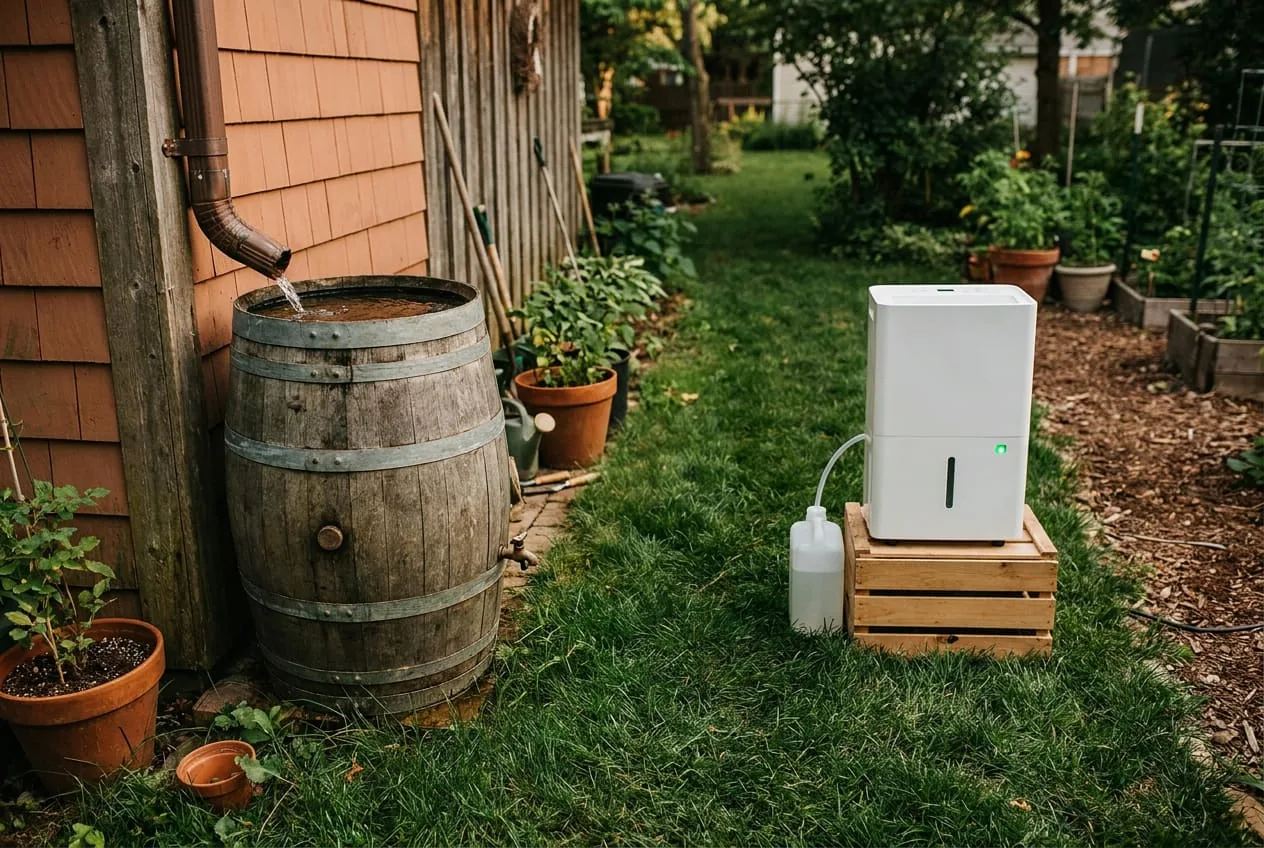
If you want water security that doesn’t depend on a utility, there are two practical ways to produce water on your own property: catch the rain that falls on your roof, or pull moisture out of the air with an atmospheric water generator (AWG). The rainwater vs atmospheric water generator question comes up constantly among preparedness-minded readers, and the numbers point to a clear answer.
Here it is in one sentence: build rain catchment first, because it wins on volume and cost per gallon almost everywhere rain falls — and treat atmospheric water as a niche complement, not a competitor.
The rest of this article shows the math behind that verdict, and the specific situations where an AWG genuinely earns its place.
How Each One Works
Rain catchment is as simple as water systems get. Rain lands on your roof, gutters channel it to a downspout, and a barrel or cistern stores it. A serious system adds a first-flush diverter (which dumps the first dirty runoff from each storm), a screen to keep debris and mosquitoes out, and — if you plan to drink the water — filtration and disinfection. There are no moving parts required and no energy input to collect a single gallon. The sky does the work.
Atmospheric water generation runs the process a dehumidifier uses, plumbed for output. A fan pulls humid air across a chilled coil, moisture condenses into droplets, and the droplets drip into a collection tank. Commercial AWG units and DIY builds — like the popular Smart Water Box plans — all rely on the same physics: the machine has to refrigerate air continuously to squeeze water out of it. That takes electricity, and the amount of water you get depends entirely on how warm and humid the air is.
One point that surprises people about AWG: the condensate is not automatically safe to drink. Published analyses note it can carry metallic residues and biological contaminants (Stanford Magazine), so it needs treatment before drinking — and boiling handles the bacteria but does nothing about metals such as lead (EPA). Plan on proper filtration either way.
The Numbers: Yield And Cost Per Gallon
This is where the comparison stops being close.
Rainwater yield. The standard estimate used across the rainwater harvesting world is roughly 0.6 gallons per square foot of roof per inch of rain. A modest 1,000 sq ft roof collects about 600 gallons from a single inch of rainfall (Texas A&M AgriLife). One decent storm can outproduce months of AWG output.
AWG yield. Published data on DIY atmospheric water builds points to 1–5 gallons per day under typical conditions — we break the claims down climate by climate in our DIY atmospheric water generator output numbers guide. In genuinely hot, humid climates — Gulf Coast summer territory — output can run higher. Below roughly 30% relative humidity or about 60 to 65°F, output drops to near zero. Dry air simply doesn’t carry enough water to condense.
Cost per gallon. AWG burns electricity around the clock: roughly 1 kWh per liter of water produced in warm, humid air, and up to 6.23 kWh per liter in cold air (Water Resources and Industry). At the US average residential rate of about $0.18/kWh (EIA), the favorable end works out to about $0.70 per gallon. Rain catchment has no energy cost to collect at all — your cost is the hardware, amortized over years of use. Spread the cost of a full system across the tens of thousands of gallons a roof sheds over its life, and the per-gallon cost lands orders of magnitude below AWG.
| Factor | Rain Catchment | DIY AWG |
|---|---|---|
| Typical yield | ~600 gal per inch of rain (1,000 sq ft roof) | ~1–5 gal/day; more when hot and humid |
| Upfront cost | Low for a basic barrel; more for a full system | Under $106 in parts (one vendor’s estimate), plus plans |
| Energy cost per gallon | None to collect | ~$0.70 at ~$0.18/kWh |
| Fails when | No rain falls | Below ~30% RH or ~60–65°F |
Both need treatment before drinking, so filtration is a wash between them. The gap is in volume and operating cost, and it’s enormous.
Where Rainwater Wins
Almost everywhere, honestly. If rain falls on your property at all, a roof is the cheapest water-producing surface you will ever own.
Volume. Even in arid regions getting less than 10 inches a year, each individual storm still delivers meaningful water — 600 gallons per inch on a 1,000 sq ft roof doesn’t care about your annual average. In dry climates the design challenge shifts from collection to storage: you need enough tank capacity to bank rare events and stretch them between storms.
Cost. A basic rain barrel with a built-in diverter (Amazon) is inexpensive and connects directly to a downspout in an afternoon — no plumbing experience needed. A full harvesting system with a dedicated first-flush diverter (Amazon), proper screening, and real storage costs more. After that, every gallon is free to collect for the life of the system.
Simplicity. No compressor to fail, no filter-coil to corrode, no power draw. Gravity and a roof.
Two honest caveats. First, roof material matters — some older roofing materials aren’t ideal for potable collection, and any drinking-water setup needs first-flush diversion, filtration, and disinfection, not just a barrel under a downspout. Second, legality: most US states allow rainwater collection, but a few regulate how much you can capture or how you can use it — Colorado, for example, limits households to two rain barrels totaling 110 gallons, for outdoor use on the property (Colorado General Assembly) — and local codes vary. Check your state and local rules before you size a big cistern.
For a starting design, see the rainwater-collection chapter covered in our The Self-Sufficient Backyard review.
Where Atmospheric Water Makes Sense
AWG has real, specific use cases — it’s just not a primary water supply for most people.
Humid climates. If you live somewhere that stays warm and genuinely humid, an AWG operates near the top of its range, which is genuinely useful backup capacity for drinking water.
No roof access. Apartment dwellers and renters can’t install gutters and cisterns. An AWG is one of the only ways to produce water indoors, independent of plumbing.
Drought insurance. Here’s the interesting edge case: droughts are a rain-catchment failure mode, but many droughts happen in places where the air stays humid. An AWG keeps producing when your barrels have been empty for weeks. As an emergency backup layered on top of catchment, that’s a legitimate role — and it’s the exact scenario the water-from-thin-air DIY build is pitched at.
Be clear-eyed about the limits, though. Published performance data points to DIY builds delivering roughly 1–5 gallons per day in typical conditions and near zero in cool or dry air, at roughly $0.70 per gallon in electricity — and the water still needs treatment before drinking. The DIY route costs under $106 in parts by one vendor’s estimate (Smart Water Box sales letter) plus the price of the plans, while commercial units cost far more for similar physics. We dug into the most popular DIY plans in detail in our Smart Water Box review, including where the marketing claims part ways with what the published numbers support.
The Right Setup For Most Homesteads
This isn’t actually an either/or decision — it’s a question of sequence. For readers building layered water security, the order that matches the math looks like this:
- Rain catchment first. Start with a basic barrel to learn the system, then grow into a full setup with first-flush diversion and serious storage. This becomes your volume supply for gardens, livestock, and — properly treated — drinking water.
- Storage second. More tank capacity beats more collection almost everywhere, especially in dry climates. Water in a tank works during a drought; a collection surface doesn’t.
- Treatment third. A filtration and disinfection stage turns stored water into drinking water, and it serves rainwater and AWG condensate alike.
- AWG last, if at all. In a humid climate, or as a drought backup, a small AWG earns a slot at the bottom of the stack. In a dry or cold climate, skip it and put the money into another tank.
The treatment stage in step 3 is the one both sources depend on — rainwater and AWG condensate alike need filtering before anyone drinks them, and a gravity filter handles it with no power:
A homestead that runs this sequence ends up with redundancy that no single system provides: rain fills the tanks cheaply, storage bridges the gaps, and — where the climate supports it — an AWG covers the rare scenario where the sky gives you nothing for months.
Rain catchment is the workhorse; atmospheric water is the specialist. Build the workhorse first, size your storage generously, and add the specialist only if your climate and situation call for it. For a complete off-grid water and food system built around what a normal backyard can actually support, The Self-Sufficient Backyard covers the rainwater, root cellar, and storage designs in real build-level detail — written by two people who have lived off-grid for decades.
Want the full breakdowns as we publish them — including the honest numbers the sales pages leave out? Join the list below.
Frequently Asked Questions
- Is it legal to collect rainwater?
- In most US states, yes — rainwater collection is legal and often encouraged. A few states regulate how much you can collect or what you can use it for, and local plumbing codes may apply to potable systems. Check your state and local rules before installing anything large.
- How much rainwater can I collect from my roof?
- The standard estimate is about 0.6 gallons per square foot of roof per inch of rain. A 1,000 sq ft roof yields roughly 600 gallons from one inch of rainfall. Multiply your roof footprint by your annual rainfall to get a realistic yearly ceiling.
- Are atmospheric water generators worth it?
- In narrow cases. If you live in a hot, humid climate, lack roof access, or want a backup that works during humid droughts, an AWG can make sense. As a primary supply, the numbers don't support it: roughly 1–5 gallons per day in typical conditions, near zero in dry or cool air, and significant electricity costs per gallon.
- Which is cheaper per gallon — rainwater or atmospheric water?
- Rainwater, by orders of magnitude. Collecting rain requires no energy, so your only cost is hardware spread over years of use. AWG water costs roughly $0.70 per gallon in electricity alone at the US average residential rate of about $0.18/kWh, before you count equipment.
- Can you drink water from an atmospheric water generator?
- Not straight from the tank. Published analyses flag potential metal contamination from the condenser coil and bacterial growth in storage. Boiling kills bacteria but does not remove metals, so a proper filtration stage is required before AWG water is drinking water.
Sources & references
- Texas A&M AgriLife Today, Beginner rainwater harvesting system tips (opens in new tab)
- Colorado General Assembly, HB16-1005 Residential precipitation collection (opens in new tab)
- Water Resources and Industry, Performance investigation of atmospheric water harvesting systems (Bagheri, 2018) (opens in new tab)
- U.S. EIA, Average price of electricity to ultimate customers (opens in new tab)
- Stanford Magazine, Don't drink the water (from your dehumidifier) (opens in new tab)
- EPA, Basic information about lead in drinking water (opens in new tab)
- Smart Water Box, official sales letter (opens in new tab)
Before you go
The Renter's Homestead Pack
Self-reliance projects for the yard you don't own — container yields, a raised bed built to move with you, balcony preservation basics, and the landlord questions to ask first.
Free guide
The Renter's Homestead Pack
Self-reliance projects for the yard you don't own — container yields, a raised bed built to move with you, balcony preservation basics, and the landlord questions to ask first.