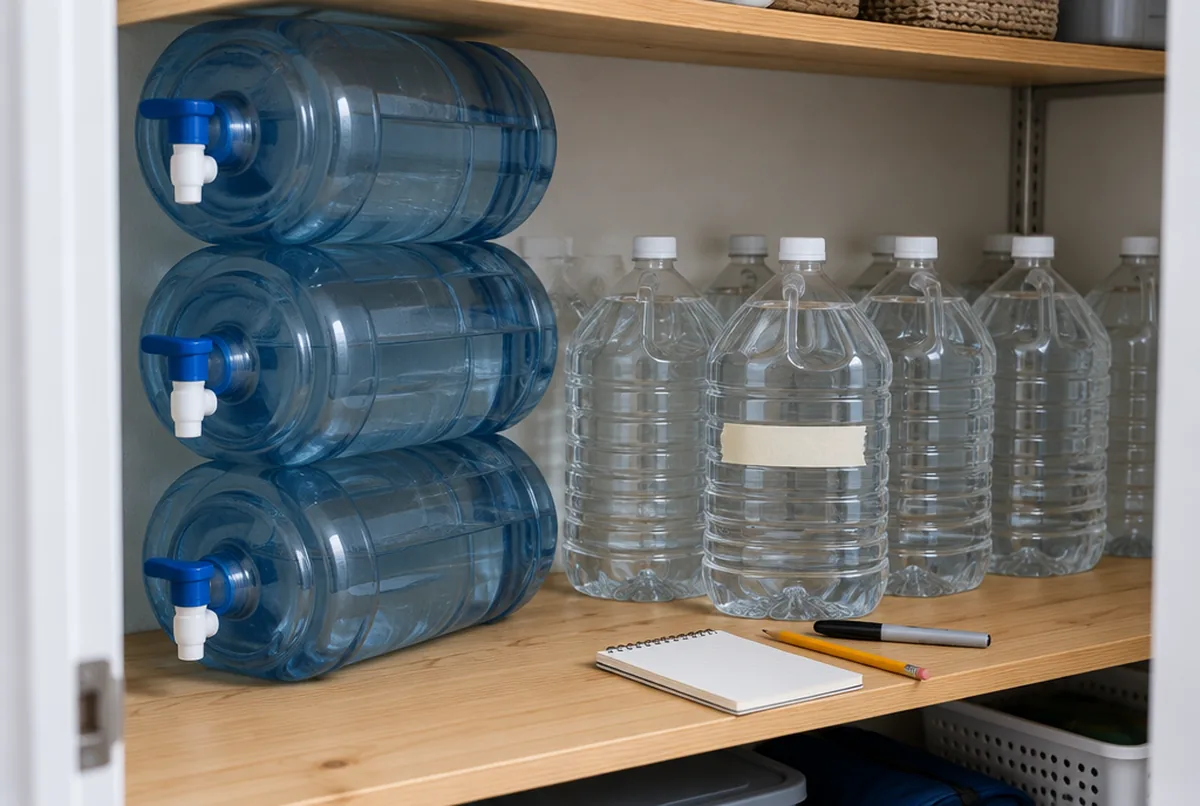
How often should you replace stored emergency water?
- CDC and Ready.gov both say to replace water you stored yourself every six months. For store-bought sealed water, CDC says to observe the expiration date.
- CDC says to label each container as drinking water with its storage date, keep it at 50 to 70°F, and keep it out of sunlight and away from gasoline and pesticides.
- A household of four aiming for CDC's two-week target needs 56 gallons, or 12 five-gallon containers. Rotating in three batches of four means 20 gallons per session.
- Three boil-water advisories were issued or lifted in the U.S. between November 5 and 9, 2026. Use the oldest-dated container first, and do not refill from the tap until the advisory ends.
Between November 5 and 9, 2026, three water systems in Kansas, Michigan and Florida put out boil-water advisories after a chlorine problem, a water main break and a line break. Two were lifted within days. They are routine events, and each one sends a household to the same shelf: the water it stored months ago.
If you filled those jugs last spring and never wrote a date on them, you cannot tell whether they are due. This guide gives the rotation rule from the federal sources, a schedule that does not mean emptying everything on one weekend, and the order to use containers in during an advisory.
The short answer: Replace water you filled into containers yourself every six months (CDC, Ready.gov, and the FEMA and Red Cross checklist). For sealed store-bought water, go by the expiration date and keep it in its original container in a cool, dark place. Label every container “drinking water” with the storage date, keep it at 50 to 70°F out of sunlight, and rotate in batches so only part of your supply is empty at a time.
This is a research-based guide. We have not tested any container or storage method. Facts come from the sources listed at the end, opened on November 10, 2026. One link below is an affiliate link, so we may earn a commission if you buy through it, at no extra cost to you.
What the Federal Sources Say
Three sources give the same interval. None explains why it is six months, and we did not find one that does. Treat it as a maintenance interval, not a spoilage date.
| Source | Rule | Date |
|---|---|---|
| CDC, emergency water supply page | Replace water every six months if you filled the containers. Observe the expiration date on store-bought water. Label containers “drinking water” with the storage date | Page dated June 27, 2025 |
| Ready.gov (FEMA), Water | Water that has not been commercially bottled should be replaced every six months. Store bottled water in the sealed original container in a cool, dark place | Undated page, seen Nov. 10, 2026 |
| FEMA and Red Cross checklist | Store water in sealed, unbreakable containers. Identify the storage date and replace every six months | Undated PDF |
The Red Cross kit checklist adds a second reminder cadence: review your supplies every six months and replace anything near its expiration date.
Which Water Is on Which Clock
| Water | Interval | Why |
|---|---|---|
| Tap water you put into jugs or barrels yourself | Six months | CDC and Ready.gov both say so. Neither source treats “treated” or “filtered” water as a separate category |
| Sealed, store-bought bottled water | The printed expiration date | CDC says to observe it. Ready.gov says to keep it sealed, cool and dark |
| Water in a container with no date on it | Treat it as due now | You cannot show it is under six months. Our rule, not an official one |
The CDC page says it is best to use FDA-approved food-grade containers, and not to use containers that held toxic chemicals such as bleach or pesticides. Rotation assumes you started with the right container. For the first fill and container choice, see our guide to storing emergency water at home.
The Steps for One Container
Rotation is the same job as the first fill. These are CDC’s steps for cleaning and filling a container.
- Empty it. Use the old water for plants or cleaning. None of the sources says what to do with it, so this is our suggestion. We would not drink it as stored emergency water.
- Wash. Soap, then rinse completely.
- Sanitize. Mix 1 teaspoon of unscented household chlorine bleach (5 to 9 percent sodium hypochlorite) in 1 quart (4 cups) of water. Cover, shake so the solution touches every inside surface, wait at least 30 seconds, pour it out and let the container air-dry.
- Fill and close. Fill with clean water and cover with a tight lid.
- Label. Write “drinking water” and the date.
- Store. CDC says 50 to 70°F, out of direct sunlight, and away from gasoline or pesticides. When you take water out, use a clean scoop each time and do not touch the water or the inside of the container with your hands.
A Three-Batch Schedule for a Household of Four
CDC says to store at least 1 gallon per person per day for 3 days and to try for 2 weeks if you can. For four people, that is 12 gallons for three days and 56 gallons for two weeks (4 people x 14 days x 1 gallon). In 5-gallon containers, 56 gallons rounds up to 12 containers, or 60 gallons.
Emptying and refilling 60 gallons at once means a whole supply drained at the same time. Three batches of four containers keeps most of it full while one batch is being swapped.
| Batch | Containers | Gallons | Fill and label | Next swap | Then |
|---|---|---|---|---|---|
| A | 4 | 20 | Nov. 15, 2026 | May 15, 2027 | Nov. 15, 2027 |
| B | 4 | 20 | Jan. 17, 2027 | July 17, 2027 | Jan. 17, 2028 |
| C | 4 | 20 | Mar. 14, 2027 | Sept. 14, 2027 | Mar. 14, 2028 |
Each batch is still replaced every six months. Only the start dates are spread out. That is 120 gallons of tap water a year to turn over for a 60-gallon supply (60 gallons x 2). Your own utility’s rate tells you what that costs.
Change the dates to fit your life. The Mar. 14 start in this table is the day daylight saving time begins in 2027 by NIST’s rule (second Sunday in March). The last change fell on November 1, 2026. Those two dates are about four and a half months apart, so a clock change is a reminder cue, not the interval itself.
For how many gallons your household needs in the first place, see Water Storage Math for Your Home, and for what CDC says about quantity, how much emergency water to store. Our water stockpile gap calculator works out the days you are covered from your household size and stored gallons.
What to Use First in a Boil Advisory
The three advisories this week all gave the same basic advice. The Kansas Department of Health and Environment advisory for the City of Allen, effective November 5, 2026, says to boil water for one minute before drinking or food preparation, or use bottled water. Toho Water Authority’s Eagle Peak Drive notice, issued November 7 and lifted November 9, says to boil for one minute and says that includes filtered water. Delta Township, Michigan, posted its advisory on November 5, and it was lifted on November 8. Local advisories vary, so follow your own utility’s notice.
Stored water is the other option those notices name: bottled water. Our reading of how to use it, which no source states in these words:
- Use the oldest-dated container first. That is what the label is for.
- Do not refill containers from the tap during the advisory unless you boil that water first, since the advisory covers drinking and food preparation.
- Refill after the advisory ends, and write the new date on the container.
The Checklist: Now, This Month, Optional
Numbers are for one household of four. Nothing in the first row needs a purchase.
| Step | Do this | Your number |
|---|---|---|
| Now (this week) | Look at every container. Find the date. If there is none, treat the container as due. Check the shelf temperature against 50 to 70°F | 12 five-gallon containers = 60 gallons. Any undated container: swap it now |
| This month | Pick your three batch dates. Write the next swap date on each label. Put the dates in your calendar. Buy the unscented bleach if you do not have a bottle | 3 batches x 4 containers x 5 gallons. 20 gallons per swap day |
| Optional (before spring) | Add containers to reach CDC’s two-week target. Move water away from sunlight and from gasoline or pesticides | 56 gallons for four people. Two-week supply = 12 containers |
If You Need More Containers
If your count falls short of 12, 5-gallon containers are the usual unit in the table above. This link opens an Amazon search for them, not one model. We have not opened or tested any listing. CDC says to prefer FDA-approved food-grade containers, so check the listing text for that and contact the maker if it is not stated.
What We Could Not Confirm
- Why the interval is six months. CDC, Ready.gov and the FEMA and Red Cross checklist all give it. None of the pages we opened explains it.
- What to do after a store-bought bottle’s printed date. CDC says to observe the expiration date and does not say more.
- Dates on Ready.gov and the checklist PDFs. Both are undated. The CDC page is dated June 27, 2025.
- Amazon container listings. We did not open any. We cannot say what any listing includes.
- Advisory status after November 9. Allen’s advisory had no end date when we read it. Check your own utility.
We will update this page if CDC or Ready.gov change the interval.
The Takeaway
Look at the labels today. Anything without a date counts as due. Then pick three fill dates for a household of four, swap four containers on each, and write the next date on the label. In an advisory, use the oldest-dated container first and refill only after the notice ends.
Frequently Asked Questions
- How often should you rotate stored drinking water?
- Every six months for water you filled into containers yourself. CDC's emergency water page (dated June 27, 2025) says to replace it every six months, and Ready.gov says water that has not been commercially bottled should be replaced every six months. The FEMA and Red Cross preparedness checklist says the same: identify the storage date and replace every six months.
- Does store-bought bottled water need to be rotated every six months?
- Not by the six-month rule. CDC says to observe the expiration date on store-bought water, and Ready.gov says to store it in its sealed original container in a cool, dark place. Neither page says what to do after the printed date.
- What temperature should stored water be kept at?
- CDC says to keep water containers at 50 to 70°F, away from direct sunlight and away from toxic substances such as gasoline or pesticides.
- How do you clean a container before refilling it?
- CDC's steps: wash with soap and rinse, then sanitize with 1 teaspoon of unscented household chlorine bleach (5 to 9 percent sodium hypochlorite) in 1 quart of water, cover and shake so the solution reaches all inside surfaces, wait at least 30 seconds, pour it out and air-dry. Then fill with clean water, close the lid tightly and label it.
- When are the next clock changes for a rotation reminder?
- NIST says daylight saving time ended on November 1, 2026, and that it begins on the second Sunday in March, which makes it March 14, 2027 (our calculation from NIST's rule). Those dates are about four and a half months apart, so they work as a reminder cue, not as a six-month schedule.
Sources & references
- Ready.gov (FEMA), Water (undated; opened Nov. 10, 2026) (opens in new tab)
- CDC, How to Create an Emergency Water Supply (page dated June 27, 2025; opened Nov. 10, 2026) (opens in new tab)
- FEMA and American Red Cross, Emergency Preparedness Checklist, hosted by the U.S. Department of Energy (undated PDF; read in search results Nov. 10, 2026) (opens in new tab)
- American Red Cross, Emergency Kit Check List (undated PDF; read in search results Nov. 10, 2026) (opens in new tab)
- Kansas Department of Health and Environment, Boil Water Advisory Issued for the City of Allen, Lyon County (posted Nov. 5, 2026) (opens in new tab)
- Toho Water Authority, Lifted: Eagle Peak Drive area precautionary boil water advisory (issued Nov. 7, lifted Nov. 9, 2026) (opens in new tab)
- WLNS, Delta Township under boil water advisory after water main break (posted Nov. 5, updated Nov. 8, 2026) (opens in new tab)
- NIST, Daylight Saving Time Rules (2026 dates; read in search results Nov. 10, 2026) (opens in new tab)
Before you go
The Three-Layer Backup Water Plan
Stored water, rain catchment and water-from-air, in the order that makes sense, with the quantities and rotation schedule for your household.
Free guide
The Three-Layer Backup Water Plan
Stored water, rain catchment and water-from-air, in the order that makes sense, with the quantities and rotation schedule for your household.