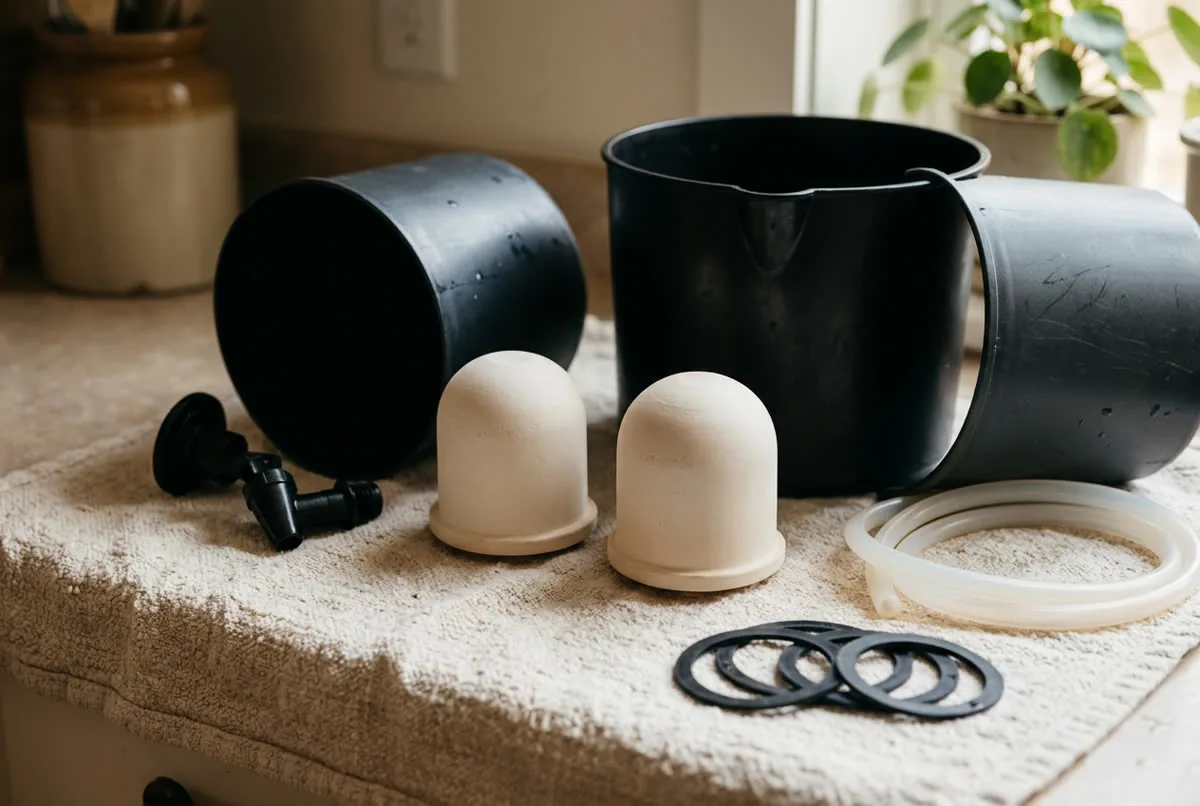
Nights in the Midwest and Northeast often dip below freezing well before Halloween, and an unheated garage, shed, or three-season porch tends to follow the outdoor temperature much more closely than the house does. If a gravity water filter or countertop Berkey system has been sitting out there since summer, the main risk isn’t a cracked housing. It’s the filter elements, which Berkey says can be damaged, even cracked or broken, if the water inside them freezes. Treat filter winterizing the same way as any seasonal maintenance task: do it before the first hard freeze, not after.
The short answer: Yes, a gravity water filter left in an unheated space can be ruined by a freeze even if the housing never cracks, so the safest move is to fully empty, disassemble, and dry the elements before nightly temperatures drop below freezing, then store them somewhere above freezing until spring.
Can my Berkey or gravity water filter actually freeze in the garage?
It can, and it doesn’t need a deep freeze to do damage. If the unit sits anywhere colder than the main living space, a garage, shed, unheated basement corner, cabin, or parked RV, it’s exposed to whatever that space does overnight regardless of how warm the house stays. Filters kept year-round in a heated kitchen rarely face this risk, but the moment a unit moves to a secondary structure or a vehicle for the off-season, it’s on its own. Berkey’s instructions are blunt: never allow wet Black Berkey elements to freeze (Berkey Water Systems, 2025).
Timing matters more than most people assume. NOAA’s 1991-2020 climate normals put the median date of the first fall freeze (32°F or below over a widespread area) between mid-September and early October in the Midwest and Northeast, and between the beginning of September and November in the Northwest (NOAA NCEI, 2023). NOAA explains the median means a freeze has happened on or before that date in five out of ten years, so an unheated space in those regions can reach freezing well before winter proper. If you don’t already know your area’s typical first-freeze window, that’s worth checking before you decide winterizing can wait another few weeks. NOAA notes first freezes come later farther south and near large bodies of water, so check your local date rather than assuming a single deadline.
What freezing actually does to a gravity filter element
The housing cracking is the visible failure, but it isn’t the one that matters most. Filter elements are porous by design; that’s how they trap contaminants. Berkey’s reseller guidance says residual water inside an element expands, which increases the size of the pores and can eventually destroy the element (Berkey Store). Berkey’s own instructions are direct on this point: exposure to freezing temperatures can expand the water into ice, which may damage the elements and cause them to crack or break, and allowing elements to freeze voids the warranty (Berkey Water Systems, 2025; Berkey Water Systems warranty).
The housing isn’t the only thing to protect, and dry-looking elements aren’t automatically safe. The same reseller guidance warns that even unused or completely dried elements can retain a small amount of moisture, especially in humid climates, and that moisture can expand inside the element and render it unusable (Berkey Store). That’s the assumption worth retiring: “if the housing doesn’t crack, the filter is fine.” If an element has frozen, don’t assume it’s fine just because it looks intact.
Does one freezing event ruin a filter permanently?
Berkey’s guidance doesn’t describe any freeze as safe. Its instructions say never to allow wet elements to freeze, because the water can expand into ice and may damage them, and that allowing elements to freeze voids the warranty (Berkey Water Systems, 2025). It does not give a number of freezes an element can survive, so the safe assumption is that one freeze is enough to put an element in doubt. If you already know an element froze while wet last winter, plan on replacing it rather than trusting it through another season, even if flow rate still looks normal today. Our Big Berkey review covers the other ways these elements wear over time.
How do I store a countertop gravity filter over winter so it doesn’t crack?
Berkey’s own longer-term storage process is straightforward: remove the elements, shake off excess water, dry them completely, then store them in a sealable bag (Berkey Water Systems, 2025).
Empty the reservoir completely
Drain both chambers fully rather than leaving a few inches “just in case” for convenience. Any standing water left in the housing is water that can freeze against the shell, and it’s also water sitting directly against the bottom of the elements themselves, which is exactly where you don’t want it.
Remove and dry the elements
Take the filter elements out of the housing rather than leaving them seated inside an empty unit. Shake out any water trapped in the threading or the element body, then let them air-dry fully before storage. Berkey says to air-dry them on a windowsill or other sunny spot for 1 to 3 days until completely dry, with zero moisture, before storing them long-term (Berkey Water Systems, 2025). A quick shake isn’t the same as actually dry.
Store dry, indoors, above freezing
Once dry, store the elements in a sealable plastic bag (gallon-size or larger, per Berkey) somewhere that stays above freezing all winter: a closet, a heated basement, or anywhere else that won’t dip near 32°F overnight even on the coldest nights of the season. Berkey’s reseller guidance advises against storing elements, even unused ones, in very cold climates (Berkey Store). The empty housing can usually stay wherever it normally lives, since the warnings above are about the water inside the elements.
Check them before you put the system back together in spring
Before reassembling in spring, look the dried elements over. Berkey says to scrub the outside with a stiff brush or Scotch-Brite pad under cold running water and then re-prime the elements before putting them back in the system (Berkey Water Systems, 2025). This is also the natural point to decide whether an element is old enough that replacing it, rather than reinstalling it, makes more sense for the season ahead.
Should I remove and dry the elements every time, or just relocate the whole unit?
If the filter lives somewhere unheated only occasionally, a three-season porch used through early fall, for instance, draining and drying before each cold snap is a more realistic habit than hauling the whole unit indoors and back out repeatedly. If it lives in a garage or shed all winter by default, it’s simpler to disassemble once in October and reassemble once temperatures are reliably above freezing again in spring.
Either way, having a backup filtration option covers the gap while your primary system sits dried out and stored. Our comparison of the Big Berkey vs. Platypus GravityWorks is a useful reference if you want something smaller and more portable to keep water moving during the winterizing window itself, rather than going without filtered water for the weeks your main unit is packed away.
What about bottle filters, like Sport Berkey types?
Bottle filters follow the same rule as a gravity system’s elements. The Sport Berkey’s official instructions list “Do not allow filter to freeze” among the precautions (Berkey Water Systems, 2025), and Berkey’s reseller guidance says the freezing recommendation applies to all Berkey items, including the Sport bottle (Berkey Store). If a bottle filter rides in a vehicle, a truck bed toolbox, or an unheated garage shelf through the cold months, bring it inside rather than assuming its smaller size makes it more freeze-tolerant.
Can I leave my RV or cabin water filter installed through freezing temperatures?
Not if the unit will actually be exposed to sub-freezing air for any stretch of time. RVs, hunting cabins, and other seasonal structures are exactly the kind of place where Berkey’s never-let-wet-elements-freeze rule matters: a filter that’s fine sitting in a warm kitchen becomes a liability the moment its building or vehicle goes unheated for the season. The same logic that applies to a garage-stored countertop unit applies here. Empty it, dry the elements, and store them somewhere warm rather than leaving the whole system installed and assuming a few cold nights won’t matter.
It’s worth separating “my house is heated” from “my filter is protected,” because those are two different facts. A kitchen countertop unit in a heated home rarely needs winterizing at all. A filter in a cabin that sits empty most weekends, or an RV parked for the season, needs the same drain-and-dry routine as a garage unit, even though the underlying hardware is identical to the one sitting on the kitchen counter. The building around the filter is what changes the risk, not the filter itself. That’s the piece worth remembering when a cabin or RV gets closed up for the season: a countertop filter sitting on a shelf is easy to overlook when you winterize the plumbing, because it doesn’t look like plumbing at all.
Next step
If your filter has spent the summer anywhere other than a heated room, the next fifteen minutes are worth more than any amount of after-the-fact troubleshooting in December. Drain both chambers, pull the elements, shake and air-dry them fully, and move them somewhere that won’t see freezing air overnight for the rest of the season. While you’re at it, check whether your current elements are already due for replacement, since a freeze on an element near the end of its service life is a far cheaper problem to plan around now than to discover mid-winter with no filtered water and a shut store.
Frequently Asked Questions
- Can my Berkey or gravity water filter freeze in the garage?
- Yes, if the space drops below freezing. Berkey's instructions say never to allow wet Black Berkey elements to freeze, so a garage, shed, cabin, or parked RV that gets that cold is not a safe place to leave wet elements (Berkey Water Systems, 2025).
- Does one freezing event ruin a water filter permanently?
- Berkey says freezing can expand the water inside the elements into ice, which may damage them and cause them to crack or break, and that allowing elements to freeze voids the warranty, so it is safest to treat a frozen element as compromised (Berkey Water Systems, 2025).
- Should I remove and dry filter cartridges before winter?
- Yes. Berkey recommends removing the elements, shaking out excess water, and air-drying them for 1 to 3 days until completely dry before longer-term storage in a sealable plastic bag (Berkey Water Systems, 2025). Keep them somewhere that stays above freezing.
- Can I leave my RV water filter installed through freezing temperatures?
- Not safely if wet elements will see freezing temperatures. Treat an RV or cabin filter the same as a garage-stored unit: remove the elements and dry them before the space goes unheated for the season.
Sources & references
- Berkey Water Systems, Black Berkey Elements Instructions (opens in new tab)
- Berkey Water Systems, Warranty Info (opens in new tab)
- Berkey Water Systems, Sport Berkey Instructions (opens in new tab)
- Berkey Store (reseller), Why shouldn't Berkey water filters be allowed to freeze? (opens in new tab)
- NOAA NCEI, When to Expect the First Fall Freeze (opens in new tab)
Before you go
The Renter's Homestead Pack
Self-reliance projects for the yard you don't own — container yields, a raised bed built to move with you, balcony preservation basics, and the landlord questions to ask first.
Free guide
The Renter's Homestead Pack
Self-reliance projects for the yard you don't own — container yields, a raised bed built to move with you, balcony preservation basics, and the landlord questions to ask first.