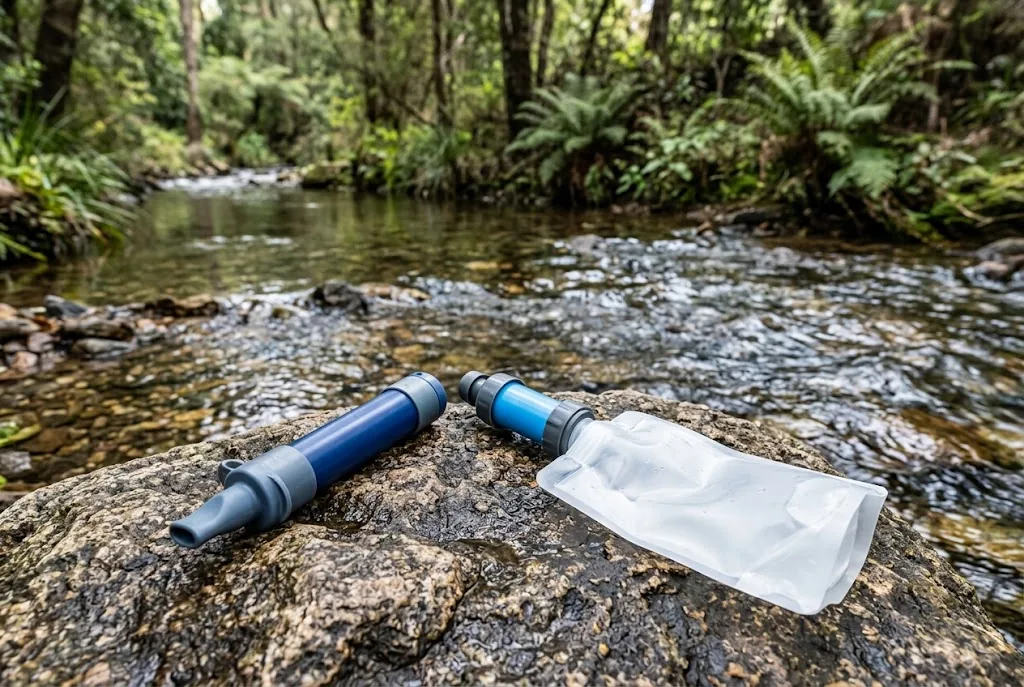
Two little filters dominate every prepping and hiking checklist: the LifeStraw and the Sawyer Squeeze. They look similar and both filter out bacteria and protozoa — yet they solve slightly different problems, and picking the wrong one for your situation is a small but real mistake. Here is the honest comparison, plus when neither is the right tool and you should reach for a household gravity filter instead.
Short answer: the Sawyer Squeeze is the more versatile pick because it filters water into a container for cooking, groups, and camp use, while the LifeStraw wins on sheer simplicity for one person sipping from a source. Both remove bacteria and protozoa but not viruses or chemicals. For whole-household drinking water at home, skip both and step up to a gravity system — see our Big Berkey vs Platypus GravityWorks update for what we currently recommend there.
Disclosure: the links here are affiliate links, and this comparison is based on published specifications and standard hollow-fiber filter behavior, not a side-by-side lab test in our own shop.
Head-to-Head: The Specs That Matter
| LifeStraw Personal | Sawyer Squeeze | Platypus GravityWorks (for contrast) | |
|---|---|---|---|
| Filter type | 0.2-micron membrane microfilter | 0.1-micron absolute hollow fiber | Gravity-fed hollow-fiber cartridge |
| How you use it | Sip directly from source | Squeeze into any bottle/pot | Hang a “dirty” bag, gravity-feeds into a “clean” bag |
| Removes bacteria & protozoa | Yes | Yes | Yes |
| Removes viruses/chemicals | No | No | No |
| Fills a container for later? | No (awkward) | Yes | Yes — its own clean-water bag |
| Best for | One person, on the move | 1–2 people, camp & trail | Small groups, hands-free — camp-scale, not a permanent kitchen fixture |
| Rated volume | Up to 1,000 gallons (4,000 L) | Lifetime limited warranty | High-volume rated (check current listing) |
The single row that decides most purchases is “fills a container for later.” That is the Sawyer’s structural advantage and the LifeStraw’s structural limit.
Where the LifeStraw Wins
The LifeStraw’s whole design philosophy is that there is nothing to think about. Put one end in the water, drink from the other. No pouch to fill, no bottle to thread, no back-flush plunger to lose. For a single person who just needs to drink safely from a stream, a puddle, or a questionable backyard source, that simplicity is genuinely valuable — and it makes the LifeStraw an excellent thing to hand to a family member who will never read an instruction manual.
The catch is that “just drink from it” is also all it does. You cannot easily fill a pot to cook, top off a bottle for the walk back, or filter for someone who is lying down injured. If your only need is to drink at the source, that limit never bites. If your needs are broader, it does.
Where the Sawyer Squeeze Wins
The Sawyer Squeeze threads onto its own pouches and onto standard 28mm threaded bottles (Sawyer), so you can squeeze clean water into whatever container you like. That one feature turns it from a personal straw into a small group and camp filter: fill a pot for cooking, filter for two people, fill bottles for later, or rig it inline on a hydration bladder.
The trade-off is a little more fuss: you fill and squeeze a pouch rather than simply sipping, and you need to back-flush it periodically to keep the flow rate up. For most people, that minor effort is well worth the enormous gain in flexibility.
What Both Filters Do Not Do
This is where honesty matters more than marketing. Both filters are membrane microfilters: 0.2 micron for the LifeStraw (LifeStraw) and 0.1 micron absolute for the Sawyer. That size stops bacteria and protozoa — E. coli, Giardia, Cryptosporidium — reliably. It does not stop:
- Viruses: enteric viruses average about 0.03 micron, and portable microfilters do not reliably remove them (CDC Yellow Book)
- Dissolved chemicals, pesticides, or heavy metals
- Salt (neither will desalinate seawater); Sawyer lists metals, chemicals, pesticides, and salt among what its filter does not remove (Sawyer Help Center)
For remote backcountry water with little human and animal activity, the bacteria-and-protozoa job is usually the whole job, and either filter is enough. But if your water might carry viruses (common where sanitation is poor) or chemical contamination, you need more: boiling, a virus-rated purifier, or a different treatment step. Do not let a hollow-fiber filter give you false confidence about water it was never designed to treat.
One more failure mode to respect: never let a wet filter freeze. Sawyer says a filter is safe from freezing only if it has never been wetted, recommends replacing a used filter you suspect has frozen, and does not warranty frozen filters (Sawyer Help Center). Treat a possibly frozen filter as compromised. In cold weather, keep it in an inside pocket.
When You Want a Gravity System Instead
Personal filters are for one or two people on the move. They are a poor fit for the daily reality of a household: filtering many gallons a day for cooking and drinking, hands-free, at home. That is a gravity system’s job.
A countertop system that stores clean water and processes gallons at a time, hands-free, used to be the easy answer here — the Big Berkey. As of 2026, it isn’t: an active EPA order and lawsuit, plus no genuine replacement elements in production, mean we can’t recommend buying one right now (full story in our updated Big Berkey review). Until a countertop pick earns that recommendation back, the Platypus GravityWorks (Amazon) is the gravity option we can point you to — it’s built for camp and group use rather than as a permanent kitchen fixture, but it fills its own clean-water bag hands-free and beats squeezing bottle by bottle for a household in a pinch.
The Verdict
- Buy the LifeStraw if you want the simplest possible one-person filter — a straw that anyone can use with zero instruction, perfect for a pack or a car kit.
- Buy the Sawyer Squeeze if you want one filter that also fills containers for cooking and small groups — the more versatile choice for most preppers and campers.
- Buy a Platypus GravityWorks if the real need is hands-free, group-scale water at home right now — with the honest caveat that it’s a camp-scale tool, not a permanent kitchen fixture. See our Big Berkey vs Platypus GravityWorks update for the full household-filter picture.
Most prepared households, honestly, end up with a Sawyer or LifeStraw in every bag and a gravity filter for home use — because filtering is only half of water security. The other half is having water to filter in the first place, which is why it pairs with solid emergency water storage and, ideally, a rainwater collection system feeding the whole plan.
Frequently Asked Questions
- What's the real difference between a LifeStraw and a Sawyer Squeeze?
- The LifeStraw is a drink-through straw: you sip directly from the source, which is dead simple but means you can't easily fill a bottle or a pot for later. The Sawyer Squeeze screws onto a pouch or standard bottle and lets you squeeze filtered water into any container, so it doubles as a group and camp filter. Both use membrane microfilters that remove bacteria and protozoa: Sawyer rates the Squeeze at 0.1 micron absolute, and LifeStraw lists a 0.2-micron pore size for the Personal straw.
- Do these filters remove viruses or chemicals?
- No. Both the LifeStraw (0.2 micron) and the Sawyer Squeeze (0.1 micron) are membrane microfilters, which remove bacteria (like E. coli) and protozoa (like Giardia and Cryptosporidium) but not viruses, dissolved chemicals, or heavy metals. The CDC notes portable microfilters do not reliably remove enteric viruses such as norovirus. For remote backcountry water with little human and animal activity that's usually fine; for water that may carry viruses or chemical contamination, you need additional treatment such as boiling, a virus-rated purifier, or a gravity system with a different media.
- How long does each filter last?
- Both last a long time with proper care: LifeStraw rates the Personal straw for up to 1,000 gallons (4,000 liters), more than most people will ever run through one, and Sawyer backs the Squeeze with a lifetime limited warranty. The practical lifespan is limited by how well you maintain flow: back-flush the Sawyer when flow slows and never let either membrane freeze once wet; Sawyer recommends replacing a used filter you suspect has frozen and does not warranty frozen filters.
- Should I get a personal filter or a countertop gravity system?
- It depends on the job. A personal filter like the LifeStraw or Sawyer Squeeze is for one or two people on the move — hiking, a bug-out bag, a quick backyard source. For the household, the traditional answer was a countertop gravity system like the Big Berkey; as of 2026 we don't recommend buying one (see our updated Big Berkey review — active EPA order, unresolved lawsuit, no genuine replacement elements in production). The Platypus GravityWorks is the gravity filter we can currently recommend without a caveat, though it's built for camp and group use rather than as a permanent kitchen fixture — a smaller-scale stand-in until we have a full countertop pick again.
Sources & references
Before you go
The Renter's Homestead Pack
Self-reliance projects for the yard you don't own — container yields, a raised bed built to move with you, balcony preservation basics, and the landlord questions to ask first.
Free guide
The Renter's Homestead Pack
Self-reliance projects for the yard you don't own — container yields, a raised bed built to move with you, balcony preservation basics, and the landlord questions to ask first.