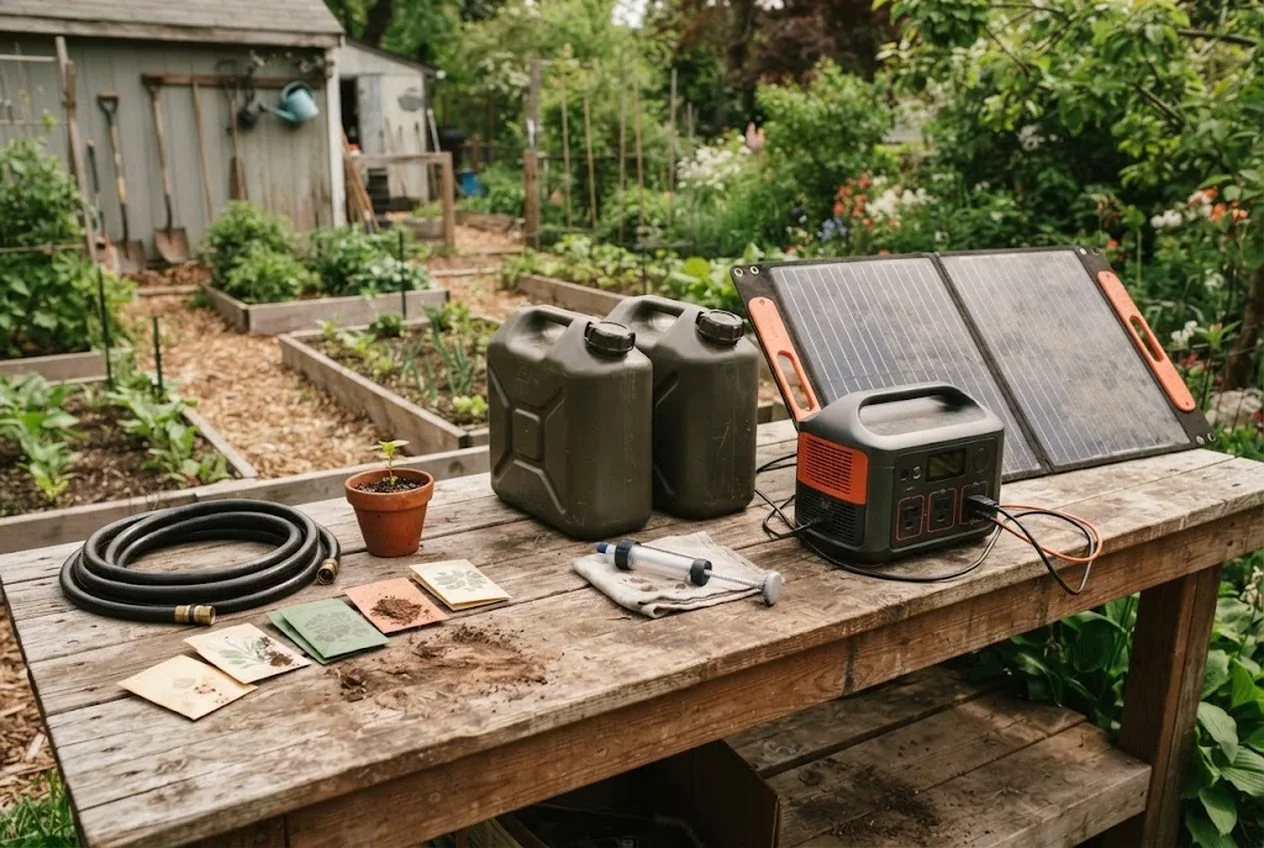
If you downloaded our free Emergency Water & Preparedness Checklist or the Year-Round Backyard Garden Planner, you noticed something on purpose: those PDFs name the gear but never link it. That keeps them clean, printable, and honest — a checklist should tell you what to have, not sell you a cart of it.
This is the companion page where those items get a link. Every product below is something the checklist or planner actually names, matched to the specific model or category we’d buy ourselves. Nothing here is a spec sheet — it’s a plain note on what each thing does and why it earns a spot, so you can decide before you click.
Water & Blackout Essentials
This is the gear from the Emergency Water & Preparedness Checklist. Work top to bottom: water first, then a way to treat it, then power and the small things that make a grid outage an inconvenience instead of a scramble. Our full how to store emergency water at home guide covers the sanitizing-and-rotation routine these containers assume.
For the bigger water picture — pulling drinking water from humid air or from your roof — we looked at those systems in the Water Freedom System review and the Smart Water Box review, and a backyard rain barrel system is the cheapest renewable source of all.
Garden Starter Gear
This is the gear behind the Year-Round Backyard Garden Planner. You don’t need all of it to start — a single raised bed, compost, and seeds will grow real food this season. The rest makes the planner’s watering and season-extension advice easier to actually follow.
Newer to all this? Our first projects for a self-sufficient backyard walks through the order to tackle things, and the Self-Sufficient Backyard review covers the blueprint book many readers start from.
How to Use This List
Don’t buy the whole list at once. Cover the two anchors first — stored, treatable water and, if you grow food, one raised bed with compost and seeds — then fill in power, season-extension, and the small comfort items as budget allows. That order matches the free downloads for a reason: it front-loads the needs that get costly or dangerous when you skip them, and leaves the nice-to-haves for later.
Print the checklist and planner, keep them on the wall, and come back to this page when it’s time to link an item.
Frequently Asked Questions
- What gear do I actually need to start a backyard water and food plan?
- Start with the two needs that get dangerous fastest: water and, if you grow food, a bed to grow it in. For water that means food-grade storage containers, a way to treat questionable water (purification tablets plus a personal or gravity filter), and a test kit so you know what you're drinking. For food-growing it means one raised bed, compost, a soaker hose, and seeds you can save. Everything else on this list builds out from those anchors.
- Do I need a portable power station or a gas generator for a blackout?
- For most households a portable power station covers the essentials — phone charging, a fan, keeping a fridge cold, running a CPAP — silently and safely indoors, which a gas generator cannot do because of carbon monoxide. A gas generator delivers more raw power for whole-home loads but must run outside, far from windows. If you only buy one, a LiFePO4 power station paired with a folding solar panel is the safer, quieter starting point.
- Is a personal water filter enough, or do I need water purification tablets too?
- They do different jobs, so keep both. A hollow-fiber personal filter (LifeStraw or Sawyer) removes bacteria and protozoa as you drink, which is ideal for a stream, rain barrel, or stored jug. Purification tablets treat a larger batch of water and add a chemical kill step for viruses that a basic filter does not catch. Tablets are also tiny and shelf-stable, so they belong in every kit as the compact backup.
- What is the single most useful piece of garden gear for a beginner?
- A single raised bed. It solves drainage, gives you clean soil you control, and is the fastest path to a food-producing garden without fighting your yard's native dirt. Add compost to feed it and a soaker hose so watering is consistent — inconsistent watering is behind common problems like blossom-end rot and cracked tomatoes.
Sources & references
Before you go
The Renter's Homestead Pack
Self-reliance projects for the yard you don't own — container yields, a raised bed built to move with you, balcony preservation basics, and the landlord questions to ask first.
Free guide
The Renter's Homestead Pack
Self-reliance projects for the yard you don't own — container yields, a raised bed built to move with you, balcony preservation basics, and the landlord questions to ask first.