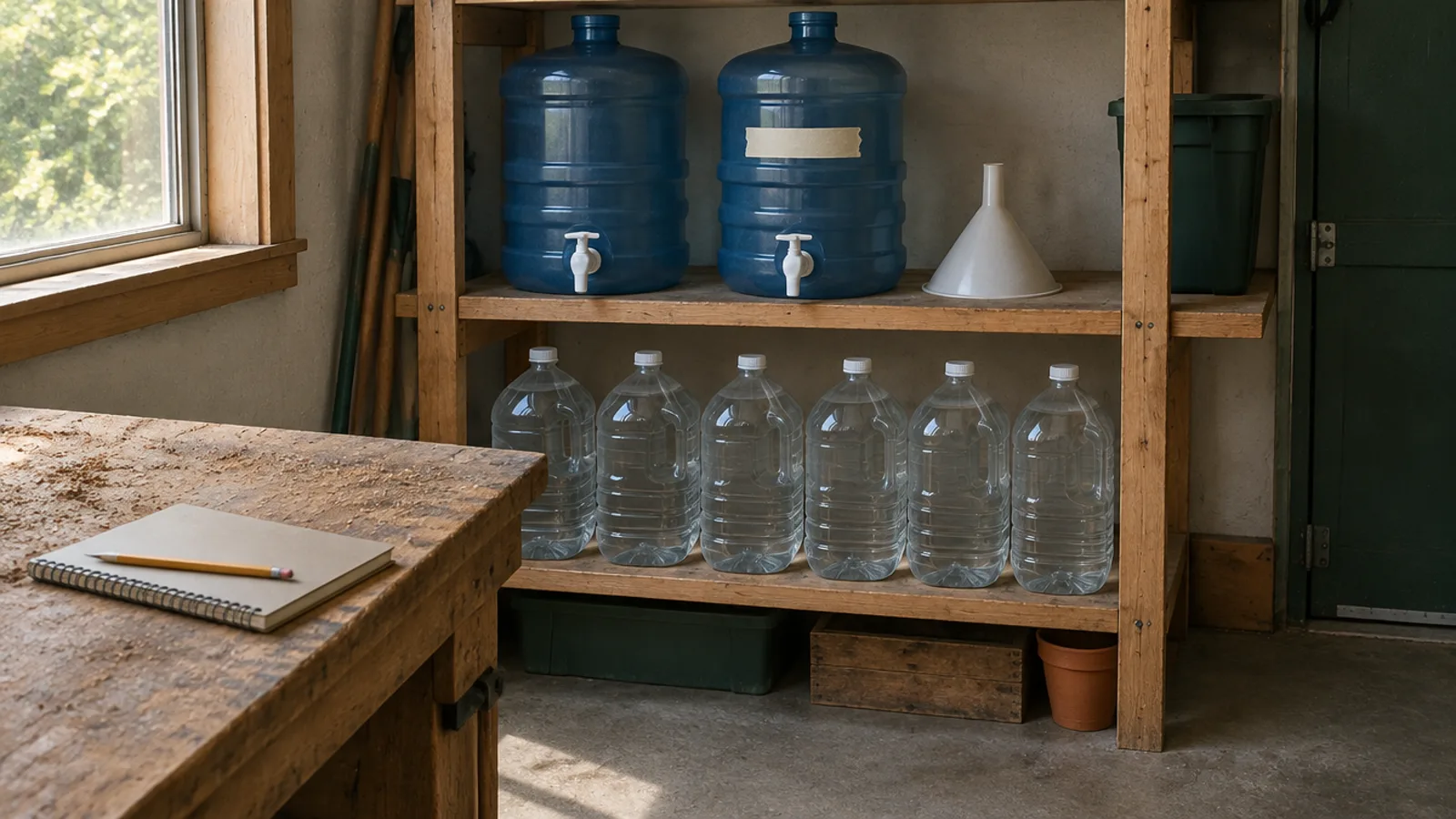
How much water does a household need to store before Black Friday?
- CDC and Ready.gov both use one gallon per person per day. CDC says to store at least three days and to try for two weeks. A household of four lands on 12 gallons, then 56.
- Full containers are heavy. At 8.33 pounds per gallon (USGS), 56 gallons is about 466 pounds of water, before the containers.
- Water you fill yourself should be replaced every six months (CDC). Count six months from the fill date: water filled on Nov. 1 is due for a swap by May 1, 2027.
- Water costs nothing from the tap. The shopping is containers, so price them per gallon of capacity and compare against your own price log, not a banner.
Most water plans start with a shopping cart. They should start with arithmetic. You need a number of gallons, then a number of containers, then a date to swap the water. Everything on a sale page comes after that.
Black Friday is November 27. If you sort out the numbers before then, you walk into the sale knowing what you need and what it is worth to you.
The short answer: Store at least one gallon per person per day, for at least three days, and try for two weeks (CDC, Ready.gov). For four people that is 12 gallons, then 56. Fill and date what you already own first, then buy only the container gap, and compare its price per gallon of capacity against your own price log.
This is a research-based planning guide. We have not bought or tested the products linked here, and the numbers come from the agencies named in the text, all opened on November 1, 2026. Some links below are affiliate links, so we may earn a commission if you buy through them, at no extra cost to you.
Why Settle the Water Math Now
Two dates sit close together. Black Friday is Friday, November 27. The Atlantic hurricane season officially runs through November 30, three days later (NOAA National Hurricane Center, accessed Nov. 1, 2026). The Center’s 1991 to 2020 averages are 14 named storms, 7 hurricanes and 3 major hurricanes per season, and the average date of the 14th named storm is November 19. That is a long-run average, not a forecast for this year.
The CDC names a water main break, a hurricane or a flood as events after which tap water may not be available or safe to use (CDC, accessed Nov. 1, 2026). The practical point is simple. Water is the one item on a kit list you cannot improvise on day two, and the water itself costs almost nothing, so this is the part of the plan where a little arithmetic goes furthest.
The Baseline Numbers
Ready.gov says to store at least one gallon of water per person per day for several days, for drinking and sanitation. It adds that a normally active person needs about three quarters of a gallon of fluid a day, that children, nursing mothers and sick people may need more, and that in very hot temperatures needs can double (Ready.gov, accessed Nov. 1, 2026).
The CDC gets more specific. Store at least one gallon per person per day for three days, and try for a two-week supply if you can. Store more for pregnant women, sick people, pets, or a hot climate (CDC, page dated June 27, 2025, accessed Nov. 1, 2026). The CDC gives no per-pet figure, so we do not invent one. Add margin for pets by judgment.
Here is the table for a one-gallon baseline:
| People | 3 days (CDC minimum) | 14 days (CDC target) | 14 days in very hot weather (doubled) |
|---|---|---|---|
| 1 | 3 gal | 14 gal | 28 gal |
| 2 | 6 gal | 28 gal | 56 gal |
| 3 | 9 gal | 42 gal | 84 gal |
| 4 | 12 gal | 56 gal | 112 gal |
| 5 | 15 gal | 70 gal | 140 gal |
| 6 | 18 gal | 84 gal | 168 gal |
The last column is an upper bound built from Ready.gov’s “can double” line, not a target. Most households should aim for the middle two columns.
Turn Gallons Into Containers and Pounds
A gallon figure means little until you picture the jugs. Four steps get you there:
- Count everyone, including anyone who is often in the house. Add margin for pets.
- Multiply people by days by one gallon. Four people for three days is 12 gallons.
- Subtract sealed water you already have, checking dates on store-bought bottles.
- Round up to your container size. Twelve gallons is three 5-gallon containers (15 gallons). Fifty-six gallons is twelve of them (60 gallons).
Then check the weight. The U.S. Geological Survey lists water at 8.33 pounds per gallon and one gallon as 3.7854 liters (USGS, Facts About Water, Aug. 24, 2026). That puts a full 5-gallon container at about 41.7 pounds of water before the container, and 56 gallons at about 466 pounds. In liters, the three-day minimum for four people is about 45 liters and the two-week target is about 212.
Weight decides where the water can live. A floor or a low, sturdy shelf can hold it. A high shelf should not. If you rent or have little space, size the stored amount to the room you really have, aim for the three-day minimum first, and write the rest of the gap on your list for later.
You can also skip the hand math. Our Water Stockpile Gap Calculator takes household size, days to cover and the water you already have, and shows how many gallons or liters you are short. It uses the same one-gallon guideline as the agencies above.
Four Ways to Hold It, Compared
| Option | Capacity | What the official guidance says | Watch for |
|---|---|---|---|
| Sealed bottled water | 1 gal jugs, cases of small bottles | CDC calls unopened commercially bottled water the safest and most reliable source. Observe the expiration date. | You pay for the water, so compare price per gallon. A simple way to cover your first three days. |
| Food-grade containers you fill | 5 gal and up | CDC prefers FDA-approved food-grade containers. Sanitize before filling, label with the date, replace every six months. | A full 5-gallon container weighs about 41.7 lb. Check that you can lift and pour it. |
| Reused containers | Varies | CDC: tight lid, durable and unbreakable (not glass), narrow neck if possible. Never use containers that held bleach or pesticides. | Cleaning and sanitizing is on you. If you are not sure what a container held, do not use it. |
| WaterBOB bathtub bladder | Up to 100 gal, typically 60 to 70 gal in a standard tub | The maker lists a $39.00 MSRP, 20 to 30 minutes to fill, one-time use, up to 16 weeks fresh. | You need a bathtub and some warning. On Nov. 1 the maker’s order page showed “Out of stock”. We did not check Amazon availability. |
The WaterBOB row is a surge tool. It does not replace the first three. For the fill-and-rotate routine behind the middle two rows, see our guide to storing emergency water at home.
What a Gallon of Storage Costs
Water from the tap costs close to nothing. What you are buying is the container, so compare containers on one number: price divided by gallons of capacity.
A worked example, using only the maker’s own list price from its order page on November 1: the WaterBOB lists at $39.00 and holds up to 100 gallons. That is $0.39 per gallon if you fill all 100. Standard tubs hold about 60 to 70 gallons by the maker’s own figures, so the working number is $0.56 per gallon at 70 gallons and $0.65 at 60. That is the list price, not an Amazon price, and we have not checked the Amazon price.
Do the same for every container you consider. If you already keep a price log, add a column. If you do not, our price log guide shows the five fields to write down for each item.
The Checklist, in Three Steps
Numbers are per person, so you can scale them to your household.
| Step | Do this | Your number |
|---|---|---|
| Now (no purchase) | Count your household. Wash, sanitize and fill every food-grade container you already own. Write the fill date on each. Put a reminder on your calendar six months out. | 3 gal per person covers 3 days |
| This month (before Nov. 27) | Close the gap to three days. Store a bottle of plain unscented liquid household bleach (5% to 9% sodium hypochlorite) for disinfecting. Price the containers you still need per gallon of capacity. | 3 gal per person, stored and dated |
| Optional (this winter and next spring) | Build toward two weeks. Add a bathtub bladder if you have warning-time storms and a standard tub. Test well or stored water if you have a reason to. | 14 gal per person |
If you fill your containers on November 1, the CDC’s six-month rule puts the swap date at May 1, 2027. Fill them later and the date moves with you.
Fill, Label and Rotate
The CDC’s cleaning steps for containers you fill yourself are short. Wash with soap and rinse completely. Sanitize with 1 teaspoon of unscented liquid household bleach in 1 quart of water, cover and shake so the solution touches every inside surface, wait at least 30 seconds and pour it out. Let the container air-dry, fill it with clean water and close it tightly.
Then label it “drinking water” with the storage date, keep it between 50°F and 70°F, out of sunlight and away from gasoline or pesticides, and replace it every six months. When you take water out, use a clean scoop or pour it. Do not put your hands in (CDC).
If the Stored Water Runs Out
Stored water is your first line. Treatment is the second. The CDC says boiling is the best way to kill germs: bring clear water to a rolling boil for one minute (three minutes above 6,500 feet), then cool and store it in clean covered containers. The EPA gives the same one-minute rule but sets the three-minute threshold at 5,000 feet, so if you live above 5,000 feet, boil for three minutes and you satisfy both.
If you cannot boil, the EPA’s bleach table calls for 8 drops of 6% bleach, or 6 drops of 8.25% bleach, per gallon, doubled if the water is cloudy, colored or very cold. Stir, wait 30 minutes and look for a slight chlorine smell (EPA, accessed Nov. 1, 2026). The EPA is also clear on the limit. Boiling or disinfecting does not remove heavy metals, salts or most other chemicals, and the CDC says that if you know or suspect fuel or toxic chemicals in the water, use bottled water or another source and contact your health department.
Two Products From the Plan
We link two things here because both match a real step above. Neither is a requirement, and neither needs to be bought on Black Friday.
WaterBOB. It fits a household with a standard bathtub that usually gets some warning, a hurricane or winter storm watch, and wants a large volume of clean water banked in about half an hour. It does not fit a shower-only home, a sudden outage with no warning, or anyone who expects to reuse it, since the maker designs it for one use. We follow the CDC and EPA on treating water of unknown history, so we would boil or treat it before drinking if there is any doubt. Our step-by-step guide to filling a WaterBOB covers the setup.
Water test kit. It fits a household that wants to know what is in stored or private-well water before relying on it. It does not turn untreated water safe, and it does not replace boiling or a certified lab. Our link opens an Amazon search for test kits, not one model, and we have not compared kits. Read the box for what each kit reports before you buy.
Where Black Friday Fits
Water containers are not where sale pricing makes or breaks a plan. Fill what you own today and buy the gap when it suits you. If a container is a larger purchase, such as a bladder or a stack of 5-gallon jugs, price it per gallon of capacity, write the number in your log, and compare the live price on November 27 with your own number. Cyber Monday, November 30, gives you a second look.
Do not let a sale size the plan. The household count sizes the plan. The sale only sets what you pay for the gap.
What We Could Not Confirm
- Amazon prices, stock and customer reviews. Amazon blocked our automated page check on Nov. 1, so we have not read buyer complaints for either product and cannot report them. Check the live listing and read the lowest-rated reviews before you buy.
- WaterBOB availability. The maker’s order page listed it as out of stock on Nov. 1. Amazon’s status is unknown.
- Black Friday offers. We have not verified any sale on water containers, bladders or test kits for 2026.
- Pet water. The CDC says to store more for pets and gives no figure.
We will update this page once live November 27 listings can be checked.
The Takeaway
Count the people, multiply by three, then by fourteen if you can. Fill and date what you already own. Weigh what it will take to lift. Price the gap per gallon, not per box. Then use the sale to confirm your numbers, not to set them.
Frequently Asked Questions
- How many gallons of emergency water does my household need?
- Both Ready.gov and the CDC use one gallon per person per day. The CDC says to store at least three days and to try for two weeks. That is 3 gallons per person for three days and 14 gallons per person for two weeks, so a household of four needs 12 gallons for the minimum and 56 for the two-week target. Ready.gov says needs can double in very hot weather and can rise for children, nursing mothers and sick people.
- How much does stored water weigh?
- The U.S. Geological Survey lists water at 8.33 pounds per gallon. A full 5-gallon container holds about 41.7 pounds of water before the weight of the container. Four people storing two weeks of water, 56 gallons, are storing about 466 pounds of water.
- How often should stored water be replaced?
- The CDC says to replace water you filled into containers yourself every six months, and to keep it in a cool place between 50°F and 70°F, out of direct sunlight and away from toxic substances such as gasoline or pesticides. For store-bought bottled water, follow the expiration date on the package.
- Is it worth waiting for Black Friday to buy water containers?
- It depends on the item. A few gallon jugs cost little, and having water stored sooner is the point of the plan. For a larger purchase, log the regular price now and compare it with the live price on Nov. 27. As of Nov. 1 we have not verified any Black Friday offer on water containers, a WaterBOB or test kits.
Sources & references
- Ready.gov (FEMA), Water (opens in new tab)
- CDC, How to Create an Emergency Water Supply (page dated June 27, 2025) (opens in new tab)
- CDC, How to Make Water Safe in an Emergency (opens in new tab)
- U.S. EPA, Emergency Disinfection of Drinking Water (opens in new tab)
- NOAA National Hurricane Center, Tropical Cyclone Climatology (opens in new tab)
- U.S. Geological Survey, Facts About Water (Aug. 24, 2026) (opens in new tab)
- waterBOB, Order page and product details (opens in new tab)
Before you go
The Renter's Homestead Pack
Self-reliance projects for the yard you don't own — container yields, a raised bed built to move with you, balcony preservation basics, and the landlord questions to ask first.
Free guide
The Renter's Homestead Pack
Self-reliance projects for the yard you don't own — container yields, a raised bed built to move with you, balcony preservation basics, and the landlord questions to ask first.