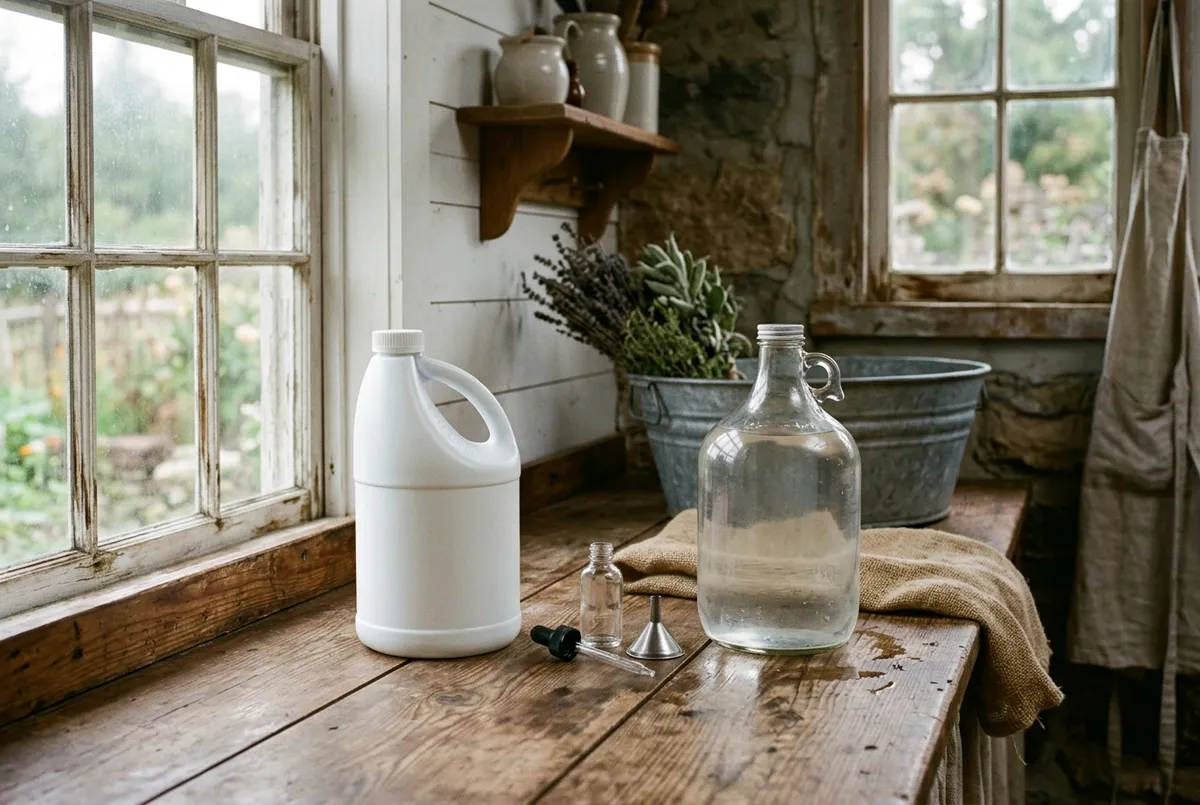
How much bleach does it take to make a gallon of water safe to drink?
- CDC's table for 5% to 9% bleach: 8 drops per gallon, 2 drops per quart or liter, 40 drops per 5 gallons. Stir, then wait at least 30 minutes.
- Cloudy, murky, colored or very cold water gets double the dose. Clear cloudy water through a cloth, paper towel or coffee filter first.
- Use regular, unscented bleach at 5% to 9% sodium hypochlorite, no added cleaners, and under a year old. Never mix it with ammonia or any other cleaner.
- Boiling is still CDC's best method. Bleach does not work as well on Cryptosporidium or Giardia, and nothing here fixes fuel or chemicals in the water.
A boil-water order covered most of Scituate, Massachusetts from Oct. 30 to Nov. 1, and a precautionary notice from Toho Water Authority in Florida ended the same day. Both said to boil or use bottled water, which is the right first move. The gap is the household that cannot boil: no power, no fuel, no safe place for a stove. CDC lists household bleach as one way to disinfect water, and the dose is short enough to learn before you need it.
The short answer: CDC’s table for household bleach at 5% to 9% sodium hypochlorite says 8 drops per gallon of clear water, 2 drops per quart or liter, and 40 drops per 5 gallons. Stir, then let it stand at least 30 minutes. Cloudy, murky, colored or very cold water gets double. Boiling remains CDC’s best method, and bleach does not work as well on parasites or chemicals (CDC, page dated Sept. 19, 2024, read Nov. 2, 2026).
Disclosure: some links on this page are affiliate links, so we may earn a commission if you buy through them, at no extra cost to you. This is a research-based guide. We read the agency, utility and manufacturer pages listed under Sources on Nov. 2, 2026, and we have not bought or tested any bleach, tablet or product on this page.
What the Notices Said, and Where Bleach Fits
Three local events show how ordinary these notices are. None of them was a national emergency.
- Scituate, Massachusetts. The town posted a boil-water order on Oct. 30, 2026. The Patriot Ledger reported that a sample collected Oct. 27 tested positive for E. coli, and that follow-up samples came back negative for E. coli but positive for total coliform. The order told residents to boil water for at least one minute or use bottled water. The same report says the notice also listed disinfection as an alternative, with household bleach instructions and commercial tablets. The town lifted the order on Nov. 1 after the state environmental department approved it, per CBS Boston.
- Toho Water Authority, Florida. The utility announced a precautionary advisory for S. Orlando Avenue on Oct. 28, reported service restored and the advisory in effect on Oct. 30, and lifted it on Nov. 1.
- Zanesville, Ohio. The city scheduled a controlled shutdown on Maple Avenue from 11 p.m. Nov. 1 to 7 a.m. Nov. 2 (reported Oct. 29), with a precautionary boil advisory to follow once service returns. We have not seen the follow-up notice.
Each notice said to boil. CDC agrees that boiling is the best way to kill germs in water, and it tells you to follow your health department’s recommendations first. Bleach is for the cases where boiling is not available: a long outage, a camp stove with no fuel, a car kit. It is also for the household that wants a second method before it needs one.
CDC’s Bleach Table, Drop by Drop
CDC’s instructions put the bottle’s own directions first. If the label has disinfection instructions for drinking water, follow those. If it has none, find the sodium hypochlorite percentage under “active ingredient,” which in the United States is typically 5% to 9%, and use CDC’s table for that strength. Cloudy water gets filtered through a clean cloth, paper towel or coffee filter, or settled, and the clear water drawn off. Then stir well and let it stand at least 30 minutes.
| Bleach at 5% to 9% (CDC) | Dropper | Milliliters | Measuring spoon |
|---|---|---|---|
| 1 quart or liter | 2 drops | 0.1 mL | A tiny amount, too small to measure |
| 1 gallon | 8 drops | 1/2 mL | A little less than 1/8 teaspoon |
| 5 gallons | 40 drops | 2 1/2 mL | 1/2 teaspoon |
| 1 gallon, cloudy, murky, colored or very cold | 16 drops | 1 mL | Double the row above (our arithmetic) |
CDC also prints a table for bleach at 1% sodium hypochlorite, a weaker product you may see on some labels. The doses are higher: 10 drops per quart or liter, 40 drops per gallon (2 1/2 mL, 1/2 teaspoon), and 200 drops per 5 gallons (12 1/2 mL, 2 1/2 teaspoons). The doubling rule applies there too. If you are unsure which strength you hold, do not guess from this page. Read the label.
Two practical notes come from the table itself. First, CDC’s drops and milliliters do not line up perfectly: 8 drops is listed as 1/2 mL, which implies about 16 drops per mL, while 2 drops is listed as 0.1 mL, which implies 20. Droppers differ. If you own a small oral syringe marked in milliliters, the mL column is the more repeatable measure (that tip is ours, not CDC’s). Second, a capful is not a substitute. A cap holds far more than 8 drops.
How the three agencies compare
| Source | Bleach strength | Dose per gallon | Smell check |
|---|---|---|---|
| CDC (Sept. 19, 2024) | 5% to 9% | 8 drops (1/2 mL) | None stated; wait 30 minutes |
| EPA (updated Feb. 24, 2026) | 6% or 8.25% | 8 drops at 6%, 6 drops at 8.25% | Slight chlorine odor; if none, repeat the dose and wait 15 more minutes |
| Ready.gov (last updated Feb. 22, 2021) | 5.25% to 6% only | 1/8 teaspoon | Slight odor; if none after the repeat, discard the water and find another source |
The three agree on the shape of the method and differ on details. EPA splits the dose by strength, so a bottle that lists 8.25% takes 6 drops, not 8. CDC covers the whole 5% to 9% range with one number, which is the simpler rule to remember. By the tables it matches EPA at 6% and gives a larger dose than EPA at 8.25%. Ready.gov’s 1/8 teaspoon is about 0.6 mL by our arithmetic, roughly 20% to 25% more than CDC’s 1/2 mL, and that page has not been updated since 2021. We use CDC’s numbers throughout because they are the newest and cover the widest range, and we show the others so you can see where they differ.
Which Bleach Qualifies
This is where people go wrong, so it gets its own section.
- Regular and unscented. EPA says to use regular, unscented chlorine bleach that the label says is suitable for disinfection and sanitization. It says not to use scented or color-safe bleach, or bleach with added cleaners.
- 5% to 9% on the label. CDC’s bleach page (dated Apr. 24, 2024) says most household bleach contains 5% to 9% sodium hypochlorite and not to use a product whose percentage is outside that range or is not specified. EPA notes that labels may list 6% or 8.25%.
- Fresh. EPA asks for fresh liquid bleach, or bleach stored at room temperature for less than one year. Clorox says its bleach lasts up to a year when stored away from heat and direct sunlight, and that after a year the active ingredient breaks down faster. The bottle has no expiration date, only a production code on the neck: after the plant code, the last two digits of the year, then the day of the year. Clorox’s example code, A82223411, was made on the 234th day of 2022, which is Aug. 22.
- Never mixed. CDC says never to mix bleach with ammonia or any other cleaner, and to avoid breathing the fumes. Measure into the water, not into a bucket that held something else.
Our reading of those four lines: the bottle you want is a plain, recent one that you keep for this purpose, separate from the laundry bleach. A half-used jug that has been in a hot garage fails the freshness test even if the label is right.
When the Water Is Cloudy or Cold
Cloudy water is the most common reason the table gets misused. CDC and EPA both say disinfection works less well in cloudy or colored water, so you clear it first by settling or by pouring it through a clean cloth, paper towel or coffee filter, then draw off the clear water. If it is still cloudy, murky, colored or very cold, double the dose. CDC lists “very cold” in the same rule as cloudy, and neither agency gives a temperature cutoff, so treat water from a cold cellar or an unheated tank as very cold.
Water from a roof, stream or barrel is where this comes up. EPA adds a warning about sources: do not use water with floating material, a dark color or a questionable odor, and flowing water is generally better than still. If the source looks like that, find another one rather than adding more bleach.
The smell check is EPA’s. After 30 minutes the water should have a slight chlorine odor. If it has none, EPA says to repeat the dose and wait 15 more minutes before use. If the taste is too strong, EPA says to pour the water between clean containers and let it stand for a few hours.
What Bleach Does Not Do
The limits matter more than the dose.
- Parasites. CDC says disinfectants do not work as well as boiling for some germs, including the parasites Cryptosporidium and Giardia. CDC adds that portable filters rated to an absolute pore size of 1 micron or smaller remove parasites, and that you add a disinfectant after filtering to deal with viruses and bacteria. If parasites are a concern, filter first or boil.
- Chemicals and fuel. CDC says water containing fuel, toxic chemicals or radioactive materials cannot be made safe by boiling or disinfecting. EPA says the same about heavy metals, salts and most other chemicals. If you suspect any of those, use bottled water or a different source and call your health department.
- A lifted advisory. When your utility lifts a notice, the treatment is over. Toho’s page for its Nov. 1 notice says customers are no longer advised to boil their water.
Who This Method Fits, and Who It Doesn’t
It fits: a household that stores water and wants a way to treat extra or doubtful water without fuel. A person who already keeps a fresh, plain bottle of bleach. A car or garage kit where a dropper and a bottle weigh almost nothing.
It does not fit: anyone whose only bottle is scented, color-safe, or past a year old. Water from a source that could carry fuel, farm runoff or industrial chemicals. A household whose main worry is Cryptosporidium or Giardia, which is a filter-or-boil problem. Anyone who would not read the label before measuring.
Cost and scale for four people
The numbers use 1 gallon per person per day, which is Ready.gov’s minimum, so a household of four treats about 4 gallons a day. They use CDC’s 5% to 9% row for clear water.
| Period | Water | Drops (clear) | Milliliters (clear) | If cloudy or very cold |
|---|---|---|---|---|
| 1 day | 4 gallons | 32 | 2 mL | 64 drops, 4 mL |
| 3 days | 12 gallons | 96 | 6 mL | 192 drops, 12 mL |
| 2 weeks | 56 gallons | 448 | 28 mL, just under 1 fluid ounce | 896 drops, 56 mL, about 2 fluid ounces |
Two weeks of clear water for four people takes under an ounce of bleach. A 121-ounce bottle holds about 3,580 mL, enough for roughly 7,000 gallons at CDC’s rate, so cost is not the issue. Walmart search listings we saw on Nov. 2 showed 121-ounce Clorox between $7.98 and $12.90 depending on the product, but the product page blocked our browser, so we have not confirmed a current price. The real constraint is freshness: you will discard nearly all of a bottle at the one-year mark.
Bleach Against the Alternatives
| Method | Time | Viruses and bacteria | Cryptosporidium and Giardia | What it needs |
|---|---|---|---|---|
| Boiling (CDC, EPA) | Rolling boil 1 minute; 3 minutes above 6,500 ft per CDC (5,000 ft per EPA) | Yes | Yes | Fuel, a pot, time to cool |
| Household bleach (CDC table) | 30 minutes | Yes | Not as reliable as boiling, per CDC | Fresh plain bleach, a dropper |
| Chlorine dioxide tablets (CDC) | Per label | Yes | Kills Cryptosporidium if you follow the instructions, per CDC | The right tablet and the full label time |
| Iodine or chlorine tablets (CDC) | Per label | Yes | Do not kill Cryptosporidium, per CDC | Tablets, a clock; iodine has restrictions for pregnancy and thyroid conditions |
| Filter, then a disinfectant (CDC) | Filter, then the disinfectant’s time | Yes, from the disinfectant | Yes, if the filter is 1 micron or smaller | A filter and a tablet or bleach |
Our guide to ways to purify water when the power is out ranks the full set. For the filter layer, our comparison of LifeStraw and Sawyer filters covers the one-on-one differences.
Tablets as a second method
Bleach and tablets cover different failures. A tablet comes pre-measured, which is its appeal for a go-bag. It still has limits of its own, and its dose is printed on the package, not in CDC’s bleach table.
A Three-Level Checklist for a Household of Four
| Level | What to do | Quantity for 4 people |
|---|---|---|
| Now (this weekend) | Read the bleach label: unscented, 5% to 9% sodium hypochlorite, no added cleaners, and any disinfection directions it prints. Check the production code. Put a dropper with the bottle. Write the dose on tape: 8 drops per gallon, 16 if cloudy or very cold, 30 minutes. | 12 gallons stored (3 days); 96 drops or 6 mL of bleach for all of it |
| This month | Buy an oral syringe marked in mL as a backup measure. Run one practice gallon so you know the chlorine smell. Build toward 2 weeks of water. Put a replace-by date on the bleach. | 56 gallons stored; about 28 mL of bleach for all of it |
| Optional | Add a second method: chlorine dioxide tablets, a filter rated to 1 micron or smaller, or a stove with fuel. Replace home-filled water every 6 months, per Ready.gov. | One filter or tablet pack per go-bag |
Use our water stockpile gap calculator to turn your own household size into gallons, and our guide on how to store emergency water at home for containers and rotation.
What We Could Not Confirm
- A current price for bleach. Walmart’s product page blocked our browser on Nov. 2. The $7.98 to $12.90 range comes from search listings, not a page we could open.
- The original Scituate notice. We read the town’s alert page and press coverage, but could not open the notice file, so the description of its bleach instructions comes from The Patriot Ledger’s summary. We do not quote its numbers.
- Zanesville’s follow-up. WHIZ News reported the plan on Oct. 29. We did not find a lifted or active notice.
- Aquatabs details on Amazon. Amazon blocks our checks. The price and stock above are the maker’s own page, and the 1-liter figure is from an Amazon.ca listing seen in search results. We could not confirm the active ingredient of the linked listing.
- Complaints about bleach as a method. A method has no product reviews, and we found no complaint data worth citing for the tablets beyond the single review mentioned.
- A cold-water temperature cutoff. CDC and EPA say “very cold” and give no number.
We have not tested any product on this page. We will update it when CDC, EPA or Ready.gov change their tables, or when the Scituate notice file becomes readable.
The Takeaway
If your utility says to boil, boil. If you cannot, CDC’s table is short enough to write on a piece of tape: 8 drops of plain 5% to 9% bleach per gallon, 16 if the water is cloudy or very cold, stir, wait 30 minutes, then check for a faint chlorine smell. Buy the plain bottle now, put a dropper with it, and treat parasites as a separate problem for a filter or a pot.
For the fuller plan, our free backup water plan walks through storage, treatment and rotation layer by layer.
Frequently Asked Questions
- How many drops of bleach purify a gallon of water?
- CDC's table for household bleach at 5% to 9% sodium hypochlorite says 8 drops per gallon (about 1/2 mL, a little less than 1/8 teaspoon) for clear water. Stir, then let it stand at least 30 minutes. Read your bottle's own disinfection instructions first; CDC's tables are for bottles that have none.
- How much bleach do I add if the water is cloudy or cold?
- Double it. CDC says to add twice the listed amount if the water is cloudy, murky, colored or very cold, which makes 16 drops per gallon. EPA gives the same doubling rule. Settle or filter cloudy water through a clean cloth, paper towel or coffee filter first.
- Which kind of bleach can I use?
- Regular, unscented household bleach with sodium hypochlorite listed at 5% to 9% (CDC) and no added cleaners. EPA says not to use scented or color-safe bleach, or bleach with added cleaners. CDC says to skip any bleach whose percentage is outside that range or is not stated.
- How do I know the treated water is okay to drink?
- EPA says treated water should have a slight chlorine smell after 30 minutes. If it has none, EPA says to repeat the dose and wait another 15 minutes. Ready.gov, last updated Feb. 22, 2021, says to discard water that still has no chlorine smell and find another source.
- Does bleach kill everything in the water?
- No. CDC says disinfectants do not work as well as boiling for some germs, including the parasites Cryptosporidium and Giardia. Neither boiling nor bleach makes water safe if it holds fuel, toxic chemicals or heavy metals. Boiling is CDC's best method when you can do it.
Sources & references
- CDC, How to Make Water Safe in an Emergency (page dated Sept. 19, 2024, read Nov. 2, 2026) (opens in new tab)
- EPA, Emergency Disinfection of Drinking Water (page updated Feb. 24, 2026, read Nov. 2, 2026) (opens in new tab)
- Ready.gov (FEMA), Water (page last updated Feb. 22, 2021, read Nov. 2, 2026) (opens in new tab)
- CDC, Cleaning and Disinfecting with Bleach (page dated Apr. 24, 2024, read Nov. 2, 2026) (opens in new tab)
- CDC, How to Safely Clean and Sanitize with Bleach (page dated Aug. 26, 2026, read Nov. 2, 2026) (opens in new tab)
- Clorox, How to Tell When a Bleach Bottle Was Made (no page date shown, read Nov. 2, 2026) (opens in new tab)
- Town of Scituate, MA, Boil Water Alert (posted Oct. 30, 2026; lifted Nov. 1, 2026) (opens in new tab)
- The Patriot Ledger, Scituate issues boil-water order after bacteria found (Oct. 30, 2026) (opens in new tab)
- CBS Boston, Scituate boil water order lifted (Nov. 1, 2026) (opens in new tab)
- Toho Water Authority, Water Advisories (entries dated Oct. 28 to Nov. 1, 2026, read Nov. 2, 2026) (opens in new tab)
- WHIZ News, Water Service Interruption on Maple Avenue, Zanesville (published Oct. 29, 2026) (opens in new tab)
- Aquatabs US, Aquatabs 49mg Tablets (price range, stock and directions read Nov. 2, 2026) (opens in new tab)
Before you go
The Three-Layer Backup Water Plan
Stored water, rain catchment and water-from-air, in the order that makes sense, with the quantities and rotation schedule for your household.
Free guide
The Three-Layer Backup Water Plan
Stored water, rain catchment and water-from-air, in the order that makes sense, with the quantities and rotation schedule for your household.