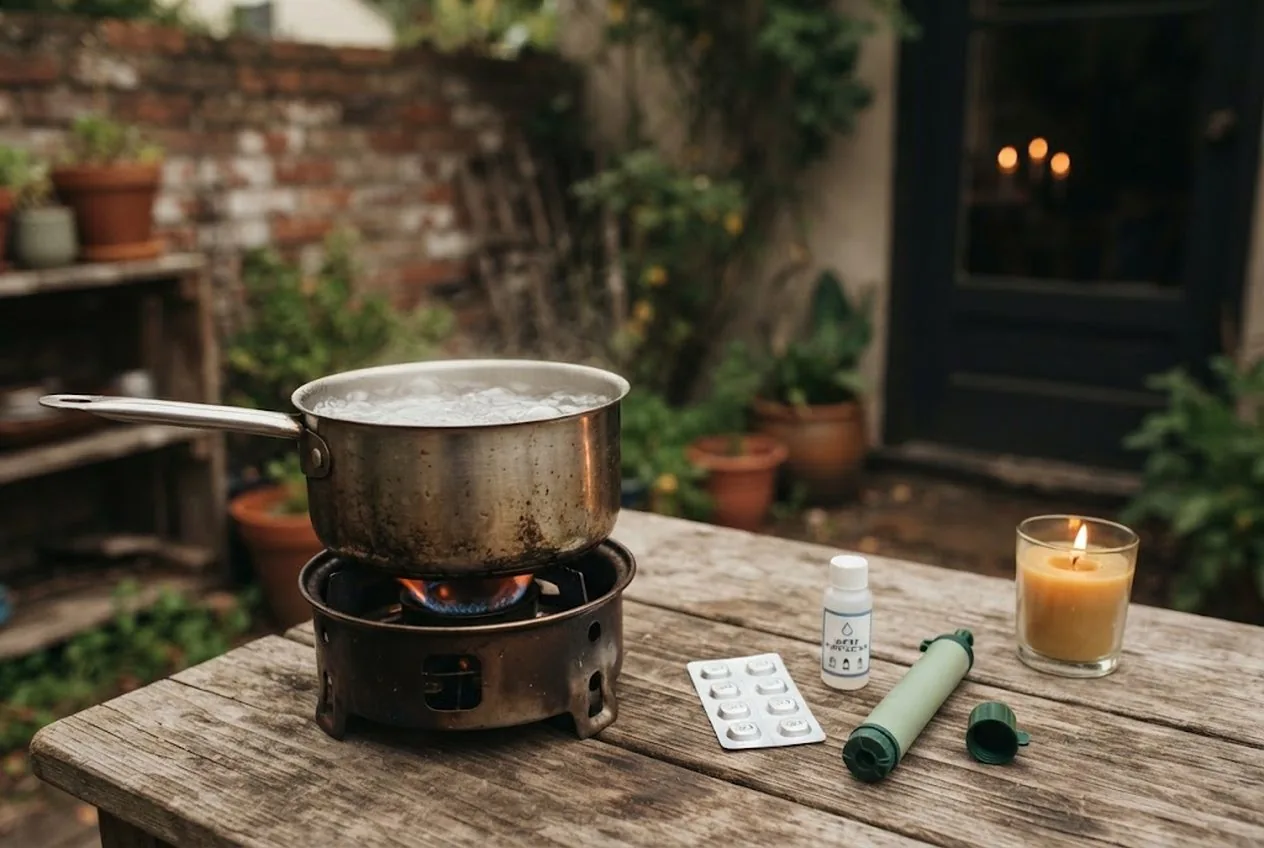
When the power goes out for more than a day, water becomes the problem that outranks everything else. Municipal systems can lose pressure, wells that depend on electric pumps stop, and a boil-water advisory can turn your own tap into something you can’t trust. The good news: purifying water doesn’t require electricity at all. The methods that have kept people alive for generations work fine in a blackout — if you know which to reach for, and what each one can and can’t do.
The short version: the safest blackout water plan is layered. Boiling is the most reliable single method, chemical tablets are the most packable, and filters handle the water you can’t or don’t want to boil. Below are five ways to purify water without power, ranked by reliability, with the honest limits of each so you can match the method to your situation.
One rule cuts across all of them: pre-filter cloudy water first. Straining visible sediment through a cloth or coffee filter before you boil, dose, or filter makes every method that follows more effective, because dirt shields pathogens and weakens chemical treatment.
1. Boiling — The Gold Standard
If you can make heat, boiling is the most reliable purification there is. A rolling boil for one minute — three minutes above roughly 6,500 feet — kills the full range of waterborne pathogens: bacteria, viruses, and protozoa alike (CDC). No product, no shelf life, no guesswork. On a camp stove, a grill, a wood fire, or a rocket stove, you can purify water all day.
Its limits are worth stating plainly. Boiling uses fuel and time, it does nothing about chemicals, heavy metals, or cloudiness (EPA), and hot water is inconvenient to drink and store until it cools. But for making biologically unsafe water safe when you have a heat source, nothing beats it. Keep a way to boil water — and the fuel to do it — at the center of your plan.
2. Chemical Tablets — The Most Packable
When you can’t make fire, a tiny foil strip of tablets is the next line. Chlorine dioxide, chlorine, or iodine tablets disinfect water against most germs (only chlorine dioxide kills tough protozoa like Cryptosporidium; chlorine and iodine tablets do not) (CDC), weigh almost nothing, and store for years. That combination makes them the ideal backup to stash in every kit, car, and bag.
The trade-offs: tablets expire, so you rotate them; they ask for a wait time of 30 minutes or more (longer for cold or dirty water) before the water is safe; and they treat pathogens, not chemicals (Aquatabs). Some leave a faint taste. None of that undercuts their value as the most portable, most redundant option you can own.
Disclosure: the product links here are affiliate links, so we may earn a commission if you buy through them at no extra cost to you. The methods and contact times here follow long-standing CDC, EPA, and manufacturer guidance, not any brand’s marketing.
3. Gravity Filter — No Power, Hands-Free
For purifying water at home through a long outage, a gravity filter is hard to beat on paper, because it needs no power or pressure and runs hands-free — you fill a reservoir and let it drip or hang. This slot on the list used to belong to a countertop system that also reduced heavy metals and chemicals; as of 2026 we don’t have that pick to give you (see our updated Big Berkey review — an EPA stop-sale order and a court challenge, with the manufacturer saying it hopes to resume manufacturing (Berkey Water Systems)). Until that gap is filled, treat gravity filtration as covering the biological side — bacteria and protozoa — and if metals or chemicals are a concern, test the water and use a different source rather than relying on filtering or boiling.
Its downsides, regardless of which system you pick: it’s slower than a personal filter’s burst flow, and the models built to store a reservoir ready to pour are exactly the ones currently tangled in the Berkey situation. A collapsible system trades the stored reservoir for something you can buy today.
We weigh it against the product this slot used to hold in our Big Berkey vs. Platypus GravityWorks update — worth reading if you’re deciding what to buy for the house versus a bug-out bag.
4. Personal Filter Straw — The Grab-and-Go
For water you drink on the move — or a source you stumble on when your stored water runs low — a personal filter straw is the fastest tool there is. Sip directly from a stream, pond, or questionable tap, and its hollow-fiber membrane strains out bacteria and protozoa on the spot. It’s cheap, tiny, needs no wait time, and lives easily in a pocket or bag.
Know its boundaries: a portable filter does not remove viruses (CDC), generally doesn’t remove heavy metals or chemicals, and can’t make seawater drinkable. Bacteria and protozoa are exactly the job it’s built for; add a chemical disinfectant after filtering if viruses are a concern. Torn between the two big names in this category? Our LifeStraw vs Sawyer Squeeze comparison settles which belongs in your kit.
5. Improvised Chlorination — The Last Resort
When you have nothing purpose-built, plain unscented household bleach can disinfect water in a pinch. The standard guidance is a very small dose — 2 drops of regular unscented bleach (5–9% sodium hypochlorite) per quart, doubled for cloudy water — stirred in and left to stand at least 30 minutes (CDC), after which the water should carry a faint chlorine smell. If it doesn’t, repeat the dose and let it stand another 15 minutes (EPA).
Treat this as a genuine last resort, not a plan. Bleach degrades over time so old bottles lose strength, dosing must be precise, and only regular, unscented bleach is safe to use (not scented, color-safe, or bleach with added cleaners). It kills most bacteria and viruses but works less well against parasites like Cryptosporidium and Giardia, and it’s fussy and easy to get wrong. Own tablets or a filter so you rarely have to fall back on it — but know the ratios anyway, because knowledge weighs nothing.
How to Rank Them for Your Situation
There’s no single “best” method — the right one depends on where you are and what you’ve got:
- At home, long outage → gravity countertop filter, backed by boiling.
- You can make fire → boiling, every time, for biologically unsafe water.
- On the move or bugging out → tablets plus a personal filter.
- Water might be chemically contaminated → use a different water source; boiling and tablets won’t make it safe.
- Nothing else on hand → improvised chlorination, done by the ratios.
The through-line is redundancy. A serious water plan doesn’t bet on one method — it stacks a filter, a heat source, and a foil strip of tablets so no single failure leaves you without safe water.
Purifying Is Only Half the Plan
Making water safe matters most when you have water to make safe. The other half is storing it before the emergency — clean, treated, rotated water you can reach for the moment the tap fails. Our guide to storing emergency water at home covers containers, treatment, and rotation, and for the fastest way to bank hundreds of extra gallons when a storm is bearing down, see how to fill a WaterBOB before a storm hits. Store first, purify second, and a blackout stops being a water crisis. And if rain barrels are part of your supply, collection quality matters as much as treatment — adding a first-flush diverter to your rain barrel keeps the dirtiest roof runoff out before you ever have to purify it.
Frequently Asked Questions
- What's the single most reliable way to purify water in a blackout?
- Boiling. Bringing water to a rolling boil for one minute (three minutes above about 6,500 feet) kills bacteria, viruses, and protozoa — the full range of waterborne pathogens — and it needs no special product, only heat you can make on a camp stove, grill, or wood fire. Its limits are that it uses fuel, takes time, and does nothing about chemicals, heavy metals, or cloudiness, so you pre-filter dirty water first. When you have a way to make fire, boiling is the gold standard.
- Do water purification tablets expire?
- Yes, and it matters for a preparedness stock. Chemical tablets like chlorine, chlorine dioxide, or iodine have a shelf life — often a few years — after which their disinfecting strength drops, so check dates and rotate them into your kit rather than buying once and forgetting. Store them cool and dry, keep the packaging sealed until use, and note that tablets treat pathogens, not chemical contaminants, and usually ask for a wait time of 30 minutes or more before the water is safe to drink.
- Can a personal filter straw make any water safe to drink?
- Almost any freshwater source, with limits. A quality personal filter removes bacteria and protozoa — the pathogens behind most waterborne illness — so it turns a stream, pond, or questionable tap into drinkable water on the spot. What it does not remove is viruses, and it generally doesn't remove heavy metals or chemicals or desalinate seawater. Bacteria and protozoa are exactly what a personal filter is built for; if viruses are a concern, add a chemical disinfectant after filtering.
- Should I combine more than one purification method?
- For suspect water, yes — layering is the safest approach. A filter that removes protozoa and sediment followed by boiling or a chemical treatment that also handles viruses covers more of the threat spectrum than either alone. At minimum, always pre-filter cloudy water through a cloth before boiling or dosing tablets, because sediment shields pathogens and weakens chemical treatment. Redundancy is the whole philosophy of a good water plan: no single point of failure.
- Does purifying water remove chemicals and heavy metals too?
- Usually not — and this trips people up. Boiling, chemical tablets, and most personal and hollow-fiber filters are designed to kill or remove pathogens, not to pull out chemicals, pesticides, or heavy metals. The CDC warns that water containing fuel, toxic chemicals, or radioactive materials cannot be made safe by boiling or disinfecting it. If your water might be chemically contaminated rather than just biologically unsafe, use a different water source.
Sources & references
Before you go
The Renter's Homestead Pack
Self-reliance projects for the yard you don't own — container yields, a raised bed built to move with you, balcony preservation basics, and the landlord questions to ask first.
Free guide
The Renter's Homestead Pack
Self-reliance projects for the yard you don't own — container yields, a raised bed built to move with you, balcony preservation basics, and the landlord questions to ask first.