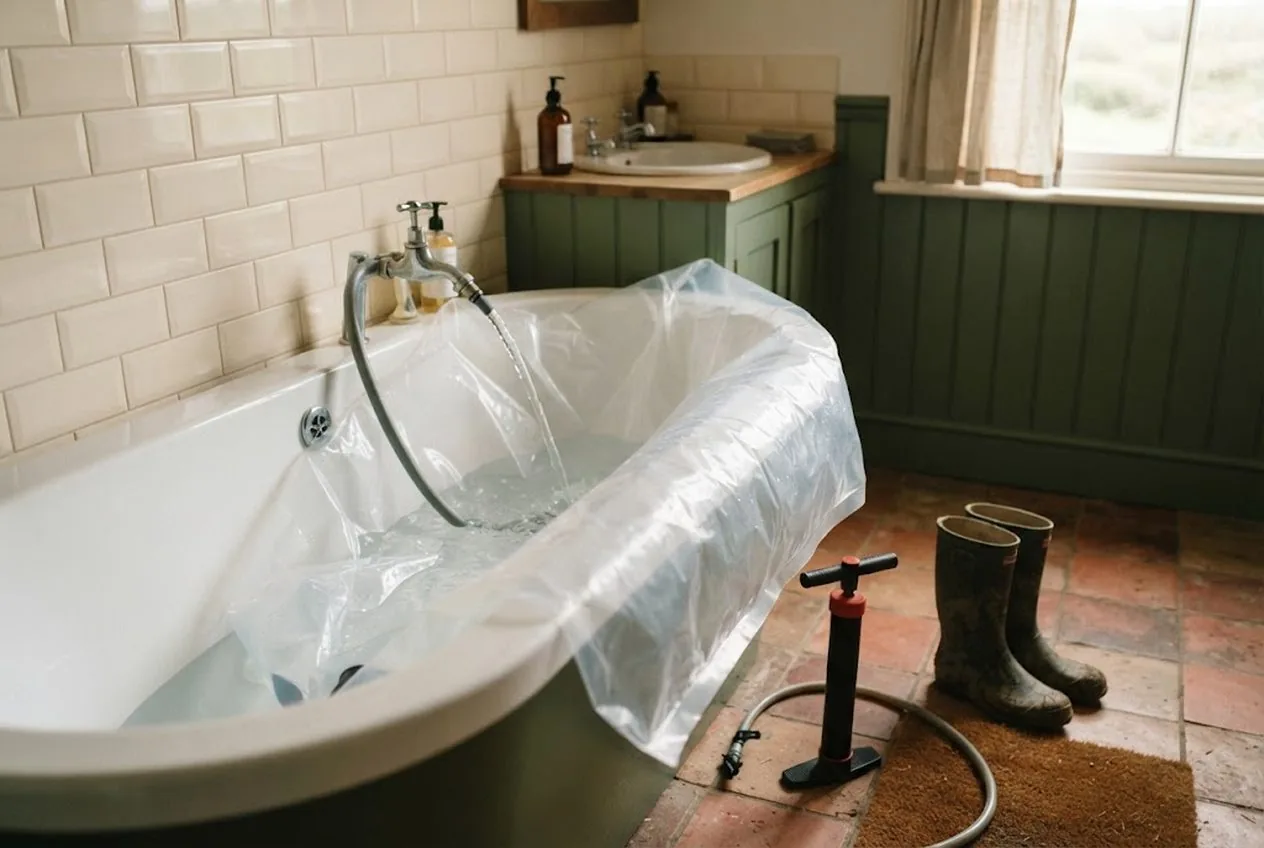
When a hurricane or a hard winter storm is bearing down, the smartest 20 minutes you can spend is banking water while the tap still runs clean. The classic advice is to “fill the bathtub” — but open bathtub water is only good for flushing and washing, because dirt, soap film, and debris contaminate it. A WaterBOB solves both problems at once: it turns your tub into up to 100 gallons of sealed water storage, filled from your clean supply before the storm can spoil it.
The short version: a WaterBOB is a food-grade bladder that lines your bathtub, fills from the faucet in about 20 minutes, seals shut, and dispenses through a hand pump. Use it for flushing and washing; drink it only after boiling or treating it. The single most important rule is timing: fill it while your water is still on and uncontaminated, not after the storm hits. Here’s exactly how.
Why a WaterBOB Beats an Open Tub
The instinct to fill the bathtub before a storm is right; the execution is usually wrong. Water left open in a tub is exposed to dust, hair, soap film, and whatever bacteria live on the tub surface, so it’s fit only for flushing toilets and washing — not for drinking (waterBOB). You’ve stored a lot of water and can’t safely drink any of it. (If long outages are a recurring reality where you live, a waterless option like the one in our Nature’s Head composting toilet buyer’s guide removes the flushing demand from the equation entirely.)
A WaterBOB fixes that by sealing the water inside food-grade plastic (waterBOB). Use it for flushing and washing; drink it only after boiling or treating it. You get the huge capacity of a bathtub and the cleanliness of a sealed container, in space you already have and at a fraction of the cost and bulk of stacking equivalent jugs. That’s the whole case for it: up to 100 gallons of water, ready in about 20 minutes.
Step 1: Clean the Tub and Lay Out the Bladder
Start by scrubbing and rinsing the bathtub, even though the water will be sealed inside the bag. A clean tub means no grit or cleaning-product residue pressing against the bladder and a safer surface if the bag shifts while it fills.
Then unfold the WaterBOB along the length of the tub, positioning the fill opening directly under the faucet. Smooth out the major folds so the bladder can expand evenly as it fills, and keep the cap and hand pump within easy reach — you don’t want to be hunting for parts with the water running.
Step 2: Fill It While Your Water Is Still Clean
This is the step where timing is everything. Fit the fill sleeve over the tub faucet as directed, turn on the cold water, and fill the bladder from your clean, potable tap supply. It expands to hold up to 100 gallons, and the fill takes roughly 20 minutes, depending on your water flow (waterBOB).
Do this as soon as a storm is in the forecast — while the water main still has pressure and clean water. Once a storm hits, the supply can lose pressure or quality, and a boil-water advisory can follow (CDC), so the entire value of a WaterBOB depends on capturing the clean supply before any of that happens. Filling after the storm arrives is the one mistake that defeats the purpose.
Disclosure: the product links here are affiliate links, so we may earn a commission if you buy through them at no extra cost to you. This guidance follows manufacturer instructions and long-standing emergency-preparedness advice, not brand marketing.
Step 3: Seal It, Then Pump From It
Once the bladder is full, shut off the water, remove the fill sleeve, and seal the opening completely with its cap so no air, dust, or debris can get in. Use it for flushing and washing; drink it only after boiling or treating it.
To draw water, attach the included siphon hand pump to the opening rather than unsealing the whole bag each time. Pumping keeps the stored water protected with every withdrawal, so the last gallon is as clean as the first. Keep the bathroom cool and dark while the WaterBOB is in use to stretch freshness as far as it will go.
Step 4: Verify It’s Safe to Drink
Use it for flushing and washing; drink it only after boiling or treating it. When there’s any doubt, treat before drinking — filter or boil the water (CDC; EPA), following our ranked guide to ways to purify water when the power’s out.
For peace of mind about what’s actually in your stored or well water — before or after a storm — a home test kit tells you whether contamination is a real concern rather than a guess.
The WaterBOB Is a Surge Reserve, Not Your Only Plan
A WaterBOB is unbeatable for one job: banking a large volume of clean water fast, right before a known storm. But it’s a just-in-time tool — you can’t fill it until a storm is coming, and the bladder is designed for one-time use (waterBOB). It shouldn’t be the whole water plan. For the complete power-and-water stack around it, see our hurricane-season blackout kit.
The foundation underneath it is water you’ve already stored and rotated, ready before any warning is issued. Our guide to storing emergency water at home covers the food-grade containers, treatment, and rotation schedule that keep a standing reserve safe year-round, and if summer heat is part of the threat, the heat-wave water storage numbers show how much more to bank per person. Pair a stocked, rotated reserve with a WaterBOB you deploy when a storm threatens, and you’ve covered both the everyday emergency and the big one bearing down on the forecast. And remember the same storm fills any rain barrels you own — adding a first-flush diverter keeps that bonus water clean enough to be useful too.
Frequently Asked Questions
- What is a WaterBOB and how much water does it hold?
- A WaterBOB is a large, food-grade plastic bladder that lines your bathtub and holds up to 100 gallons of water (most standard tubs hold about 60–70) — far more than any stack of jugs, in space you already have. You fill it from the tub faucet before a storm, seal it, and draw water off with the included hand pump. Use it for flushing and washing; drink it only after boiling or treating it.
- How long does water stay fresh in a WaterBOB?
- Use it for flushing and washing; drink it only after boiling or treating it. For the longest safe window, fill with clean municipal tap water, seal it fully, keep the tub area cool and dark, and use the hand pump rather than opening the bladder to draw water.
- Can you drink WaterBOB water, or is it only for washing?
- Use it for flushing and washing; drink it only after boiling or treating it.
- When should I fill a WaterBOB — how much warning do I need?
- Fill it as soon as a storm is in the forecast and while your water is still on and clean — not after. Filling takes roughly 20 minutes, so once a watch or warning is issued, set it up. The reason to move early is that the water main can lose pressure or quality once a storm hits, and a boil-water advisory can follow, so you want your 100 gallons banked from the clean supply while it's still flowing. Waiting until the storm arrives defeats the purpose.
- Is a WaterBOB reusable?
- No. The manufacturer designs the WaterBOB for one-time use, because reusing it would require emptying it and getting it completely dry and free of contaminants, and damage from emptying might go unnoticed until the next emergency. Many people keep one sealed in its box as part of their hurricane or winter-storm kit and deploy a fresh one each season. Check the manufacturer's guidance for your specific product, and if you do reuse one, inspect it for pinholes and make sure it's completely dry inside before storing.
Sources & references
Before you go
The Renter's Homestead Pack
Self-reliance projects for the yard you don't own — container yields, a raised bed built to move with you, balcony preservation basics, and the landlord questions to ask first.
Free guide
The Renter's Homestead Pack
Self-reliance projects for the yard you don't own — container yields, a raised bed built to move with you, balcony preservation basics, and the landlord questions to ask first.