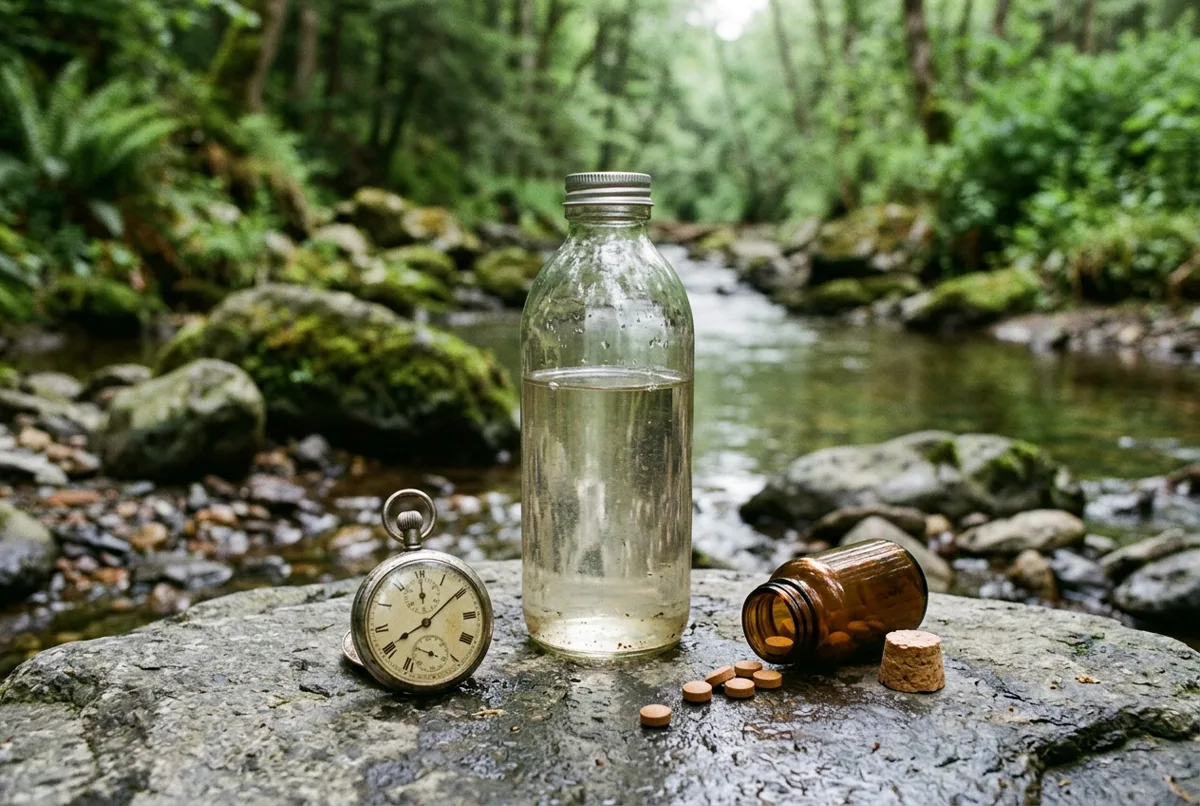
How long should you wait after dropping iodine tablets in water?
- The Potable Aqua label says 2 tablets per quart or liter, cap loosely for 5 minutes, shake, tighten, and wait 30 minutes before drinking. EPA says at least 30 minutes for tincture of iodine.
- Cold water needs longer. Newcastle University gives one hour below 50°F (10°C). Cloudy water needs clearing first, then a higher dose or longer wait per CDC.
- Iodine does not kill Cryptosporidium. CDC says to avoid it if you are pregnant, have thyroid problems or an iodine sensitivity, and to stop after a few weeks.
- At 2 tablets per quart, a gallon takes 8 tablets, about $1.59 at REI's $9.95 for 50. That makes tablets a backup layer, not the main supply.
Boil advisories are in effect in Florida and scheduled in Ohio this week, and a Kansas advisory was lifted on Oct. 30. Each notice leaves the same gap: what do you do when you cannot boil? Iodine tablets are one answer CDC lists, but the tablet is only half the instruction. The other half is a clock most people shortcut.
The short answer: the Potable Aqua label says to add 2 tablets to 1 quart or liter, cap loosely for 5 minutes, shake, tighten the cap, and wait 30 minutes before drinking. EPA also says at least 30 minutes for tincture of iodine. Cold water needs longer, cloudy water needs clearing first, and iodine does not kill Cryptosporidium. CDC says to skip it if you are pregnant or have thyroid problems, and Ready.gov does not recommend iodine at all.
Disclosure: some links on this page are affiliate links, so we may earn a commission if you buy through them, at no extra cost to you. This is a research-based guide. We read the agency, manufacturer and retailer pages listed under Sources on Nov. 1, 2026, and we have not bought or tested any tablet, filter or product on this page.
What the Advisories Say, and Where Tablets Fit
These were ordinary local events, not a national emergency. Two were active or scheduled when we checked on Nov. 1, 2026, and one had already ended:
- Galesburg, Kansas (rescinded). The Kansas Department of Health and Environment issued an advisory that took effect Oct. 27, 2026 after a waterline break caused a loss of pressure. Its instruction: boil water for one minute before drinking or food preparation, or use bottled water. KDHE rescinded the advisory on Oct. 30, 2026 after laboratory testing of samples found no evidence of bacteriological contamination. We keep it here as an example of how quickly these notices start and end.
- Toho Water Authority, Florida. The utility posted a precautionary advisory for S. Orlando Avenue on Oct. 28, and its page showed service restored and the advisory in effect on Oct. 30, the latest entry we could see for that street. Toho lifted several other advisories on its page the same day, so check the utility’s page for current status.
- Zanesville, Ohio. The city’s water division scheduled a controlled shutdown on Maple Avenue from 11 p.m. Nov. 1 to 7 a.m. Nov. 2 (reported Oct. 29), with a precautionary boil advisory to follow once service returns.
None of those notices tells anyone to use tablets. They say boil, or use bottled water. That is the right first move, and CDC agrees that boiling is the best way to kill germs in water. CDC also tells you to follow your health department’s recommendations for boiling or treating your water, so your utility’s wording comes first.
Tablets matter in the other cases: no fuel, no safe place to run a stove, a power cut that outlasts the stored water, or a bottle in a car kit. That is where the timing rule decides whether the water is actually treated.
The Clock, Source by Source
The numbers differ by source because the products differ. Use the row that matches what you hold.
| What you are using | Dose | Wait | Cloudy or cold water |
|---|---|---|---|
| Potable Aqua tablets (EPA label file, Dec. 10, 2018; REI listing, Nov. 1, 2026) | 2 tablets per 1 quart or liter | Cap loosely, wait 5 minutes, shake so the threads get wet, tighten, wait 30 minutes before drinking | The label gives no separate cloudy or cold rule |
| 2% tincture of iodine (EPA, updated Feb. 24, 2026) | 5 drops per quart or liter | Stir, stand at least 30 minutes | Cloudy or colored: 10 drops |
| Iodine in general (Newcastle University) | Per package | 30 minutes minimum at 77°F (25°C) | Longer in cold water, for example one hour below 50°F (10°C) |
| Any chemical disinfectant (CDC Yellow Book, Apr. 23, 2025) | Per label | Enough contact time | Cloudy water needs a higher dose or a longer contact time |
Two readings of the label are worth stating plainly. The neutralizing tablets sold with Potable Aqua say to wait “a minimum of 30 minutes after the addition” of the iodine tablets, which suggests the 30 minutes runs from when the tablets go in, with the loose-cap step inside it. If you want margin, start your clock when you tighten the cap. It costs five minutes. And the label says to add the neutralizer only after the full 30 minutes: adding it sooner “may allow harmful bacteria to remain in the drinking water.”
EPA’s advice for any tablet is short: follow the instructions on the product label, because each product may have a different strength. CDC says the same, and notes that chemical disinfectants are made to treat specific amounts of water. The timing in the table is a starting point for reading your label, not a replacement for it.
Cold and Cloudy Water: Where People Get It Wrong
Two conditions stretch the wait, and they often arrive together in an emergency: water from a creek, a barrel or an unheated tank.
Cold. Newcastle University says contact time has to increase for colder water and gives one hour for temperatures below 10°C (50°F). That is the only temperature figure we found that states the iodine case directly, and it comes from a university page rather than a health agency. The Potable Aqua label is silent on cold water. If the water is near freezing, a one-hour wait is a cautious reading, not a guarantee. CDC’s bleach table points the same way: double the dose if the water is “cloudy, murky, colored, or very cold.”
Cloudy. CDC’s Yellow Book says cloudy water contains substances that neutralize chemical disinfectants, so it needs higher concentrations or longer contact times, and that you should clarify it first by settling, coagulation or filtration. EPA and CDC’s emergency page both give the simple version: let it settle, then pour it through a clean cloth, paper towel or coffee filter, and draw off the clear water. After that, the only dose change we can quote is EPA’s for tincture of iodine (10 drops instead of 5). We could not find a published “extra tablets” rule for cloudy water on the Potable Aqua label, so do not invent one. If the water is murky and you cannot clear it, use a different method.
Where Iodine Stops
Waiting longer fixes some limits. It does not fix these.
- Cryptosporidium. CDC says iodine, iodine tablets (tetraglycine hydroperiodide) and chlorine tablets will not kill it, and its Yellow Book says it is poorly inactivated “even with extended contact times.” Chlorine dioxide tablets will, as long as you follow the instructions, per CDC. A filter with an absolute pore size of 1 micron or smaller will also remove it.
- Giardia. More resistant than bacteria or viruses, but CDC’s Yellow Book says field-level iodine and chlorine are effective against it with longer contact times. It gives no minutes, so a label that only lists 30 minutes is not proof of Giardia coverage.
- Chemicals. CDC says boiling or disinfecting will not make water with fuel or toxic chemicals safe, and EPA says the same about heavy metals, salts and most other chemicals. If you suspect any of those, use bottled water.
- Duration. CDC says no one should drink iodine-disinfected water for more than a few weeks at a time. Newcastle University’s page says “more than a few months.” We used the stricter agency figure.
- People. CDC says to avoid iodine-treated water if you are pregnant, have thyroid problems or are hypersensitive to iodine.
- Taste. CDC’s Yellow Book says neither iodine nor chlorine is “particularly pleasant” at field doses. Neutralizing tablets, a carbon filter or a pinch of vitamin C powder help, per CDC and Newcastle University.
One more conflict you should know about. Ready.gov’s water page (last updated Feb. 22, 2021) describes only boiling, plain household bleach and distillation, and says iodine and camping-store treatment products “are not recommended and should not be used.” CDC and EPA both list iodine as an option. We follow the agencies that name iodine and give directions, and flag the disagreement so you can choose with it in view.
Who Iodine Tablets Fit, and Who They Don’t
They fit: a go-bag or car kit where weight matters, a small-volume backup for a household that already stores water, and a source you have already cleared and that is unlikely to carry parasites.
They do not fit: a household that would rely on them as the main supply for weeks. Anyone who is pregnant, has thyroid problems or is sensitive to iodine. Surface water downstream of livestock or sewage, where Cryptosporidium is a real possibility. Any water you suspect holds chemicals or fuel.
Cost and scale
REI lists a 50-tablet bottle at $9.95 on Nov. 1, 2026, and says 2 tablets treat 1 quart, so one bottle treats 25 quarts. By our arithmetic that works out to:
- 1 gallon (4 quarts): 8 tablets, about $1.59.
- A household of four for 3 days (12 gallons at 1 gallon per person per day, per Ready.gov): 96 tablets, 2 bottles, about $19.90.
- The same household for 2 weeks (56 gallons): 448 tablets, 9 bottles, about $89.55, and longer than the few weeks CDC says is the limit for drinking iodine-treated water.
That last line is why tablets belong in the backup layer. REI also lists an unopened bottle as effective for up to 4 years stored at 60 to 86°F, and says an opened bottle should not be kept more than 1 year.
What buyers say
REI’s listing shows 4.5 stars from 53 reviews (read Nov. 1, 2026). We read the eight reviews displayed on the listing page; they are a small sample and two of them are marked 18 and 19 years old, so treat them as a pattern, not a rating. What they complain about:
- Taste and aftertaste. Four of the eight mention it. One calls the taste horrible and says Katadyn tablets taste better, another says the water tastes “a little funny,” another notes an aftertaste, and another says a pinch of vitamin C takes out the iodine taste.
- Color. Two mention the color of treated water. One says it turns “a little orange” and found that useful as a sign that the tablets had dissolved.
- The wait. One reviewer points out that the full routine takes about 35 minutes (5 minutes, then 30), which is awkward with a single bottle.
- What helped. Two reviewers use vitamin C powder to cut the taste, in line with the neutralizing options above.
- Where it worked. Four reviewers switched to the tablets after a filter stopped flowing, broke, froze or iced up. Two reported little or no iodine taste.
These are customer opinions, not test results, and they say nothing about Cryptosporidium or the other limits above.
Iodine Against the Alternatives
| Method | Time | Kills bacteria and viruses | Cryptosporidium | What it needs |
|---|---|---|---|---|
| Boiling (CDC, EPA) | Rolling boil 1 minute; 3 minutes above 6,500 ft per CDC, above 5,000 ft per EPA | Yes | Yes | Fuel, a pot, time to cool |
| Household bleach (CDC table, 5% to 9%) | 30 minutes; 8 drops per gallon, double if cloudy or very cold | Yes | No | Plain unscented bleach, a dropper |
| Chlorine dioxide tablets (CDC) | Per label | Yes | Yes, if you follow the label | The right tablet and the full label time |
| Iodine tablets (label, CDC) | 30 minutes or more | Yes | No | Clear water, a clock, no iodine restrictions |
| Filter, then a disinfectant (CDC) | Filter, then label time | Yes, from the disinfectant | Yes, if 1 micron or smaller | A filter and a tablet or bleach |
The filter-first row is CDC’s own “next best option” after boiling: filter the water, then disinfect it. A filter handles parasites and the disinfectant handles viruses. Our comparison of LifeStraw and Sawyer filters covers the one-on-one differences, and our guide to ways to purify water when the power is out ranks the full set.
A Three-Level Checklist for a Household of Four
The numbers use 1 gallon per person per day, per Ready.gov and CDC, so a household of four needs about 4 gallons a day.
| Level | What to do | Quantity for 4 people |
|---|---|---|
| Now (this weekend) | Read the label on any tablets you own and write the wait on the bottle. Check the date. Find a pot and a timer. Store a 3-day supply. | 12 gallons stored; 96 tablets if tablets were your only layer (2 bottles) |
| This month | Build toward a 2-week supply. Add one filter that fills containers. Learn the CDC bleach table. If you keep iodine, note the date you open the bottle. | 56 gallons stored; about 4 gallons to treat per day |
| Optional | A chlorine dioxide or chlorine option for anyone who cannot use iodine. A spare filter in each go-bag. Replace home-filled water every 6 months, per Ready.gov. | One filter per bag; tablets sized to the label |
Use our water stockpile gap calculator to turn your own household size into gallons, and our guide on how to store emergency water at home for containers and rotation.
What We Could Not Confirm
- A cold-water time from the maker. The Potable Aqua label has no separate cold or cloudy rule. The one-hour figure is Newcastle University’s, not the label’s or a health agency’s.
- Giardia contact time. CDC says longer, and gives no number.
- Buyer complaints beyond REI’s first page. REI lists 53 reviews (4.5 average, read Nov. 1, 2026), and we read the eight shown on the listing page, not all 53. Amazon blocks our checks, so we did not read its reviews.
- Current Amazon prices and stock for the two linked products. The $45.99 Sawyer price is the maker’s own page, read Nov. 1, 2026.
- The newest Potable Aqua label. The EPA label file we read is dated Dec. 10, 2018. Check the printed label on the bottle you buy.
We have not tested any product on this page. We will update it when CDC, EPA or Ready.gov change their guidance, or when a maker publishes a cold-water time.
The Takeaway
Read the label, start a timer the moment the tablets go in, and treat the time as part of the dose. Thirty minutes is the floor for clear water, cold water needs more, cloudy water needs clearing first, and some limits no clock fixes. If a utility tells you to boil, boil. Keep tablets as a light backup, and add a filter or a chlorine dioxide option if the source could carry parasites.
For the fuller plan, our free backup water plan walks through storage, treatment and rotation layer by layer.
Frequently Asked Questions
- How long do iodine tablets need to purify water?
- Read your own label first. The Potable Aqua label says to add 2 tablets to 1 quart or liter, cap loosely, wait 5 minutes, shake, tighten the cap, and wait 30 minutes before drinking. EPA says 2% tincture of iodine needs at least 30 minutes, and Newcastle University gives 30 minutes as the minimum in water at 77°F (25°C).
- Do iodine tablets need more time in cold water?
- Yes. Newcastle University says contact time has to increase in colder water and gives one hour for water below 50°F (10°C) as its example. The Potable Aqua label does not give a separate cold-water time, so if your label is silent, treat the one-hour figure as a cautious minimum and check with the maker.
- Can I use iodine tablets on cloudy water?
- Clear it first. CDC and EPA both say to let cloudy water settle and pour it through a clean cloth, paper towel or coffee filter before disinfecting. CDC's Yellow Book adds that cloudy water neutralizes disinfectants and needs a higher dose or a longer contact time. For tincture of iodine, EPA doubles the dose from 5 to 10 drops per quart or liter.
- Do iodine tablets kill Cryptosporidium?
- No. CDC says iodine, iodine tablets and chlorine tablets kill most germs but will not kill Cryptosporidium, and its Yellow Book says extended contact times do not fix it. CDC says chlorine dioxide tablets will, if you follow the instructions. A filter rated to 1 micron or smaller also removes it.
- Who should not drink iodine-treated water?
- CDC says people who are pregnant, have thyroid problems or are hypersensitive to iodine should avoid it, and that no one should drink iodine-treated water for more than a few weeks at a time. Ready.gov goes further and does not recommend iodine at all.
Sources & references
- EPA, Emergency Disinfection of Drinking Water (page updated Feb. 24, 2026, read Nov. 1, 2026) (opens in new tab)
- CDC, How to Make Water Safe in an Emergency (updated Sept. 19, 2024, read Nov. 1, 2026) (opens in new tab)
- CDC Yellow Book 2026, Water Disinfection for Travelers (updated Apr. 23, 2025, read Nov. 1, 2026) (opens in new tab)
- CDC, Water Treatment Options When Hiking, Camping, or Traveling (checked Nov. 1, 2026, no page date shown) (opens in new tab)
- Ready.gov (FEMA), Water (page last updated Feb. 22, 2021, read Nov. 1, 2026) (opens in new tab)
- EPA, pesticide product label for Potable Aqua iodine tablets (label file dated Dec. 10, 2018) (opens in new tab)
- REI, Potable Aqua Iodine Tablets (price, count, storage terms and customer reviews read Nov. 1, 2026) (opens in new tab)
- Newcastle University, Chemical disinfection (no page date shown, checked Nov. 1, 2026) (opens in new tab)
- Kansas Department of Health and Environment, Boil Water Advisory for Galesburg (posted Oct. 27, 2026) (opens in new tab)
- Kansas Department of Health and Environment, Boil Water Advisory Rescinded for City of Galesburg (posted Oct. 30, 2026) (opens in new tab)
- Toho Water Authority, Water Advisories (entries dated Oct. 28 to Oct. 30, 2026) (opens in new tab)
- WHIZ News, Water Service Interruption on Maple Avenue, Zanesville (published Oct. 29, 2026) (opens in new tab)
- Sawyer Products, Squeeze Water Filter System (price and rating read Nov. 1, 2026) (opens in new tab)
Before you go
The Three-Layer Backup Water Plan
Stored water, rain catchment and water-from-air, in the order that makes sense, with the quantities and rotation schedule for your household.
Free guide
The Three-Layer Backup Water Plan
Stored water, rain catchment and water-from-air, in the order that makes sense, with the quantities and rotation schedule for your household.