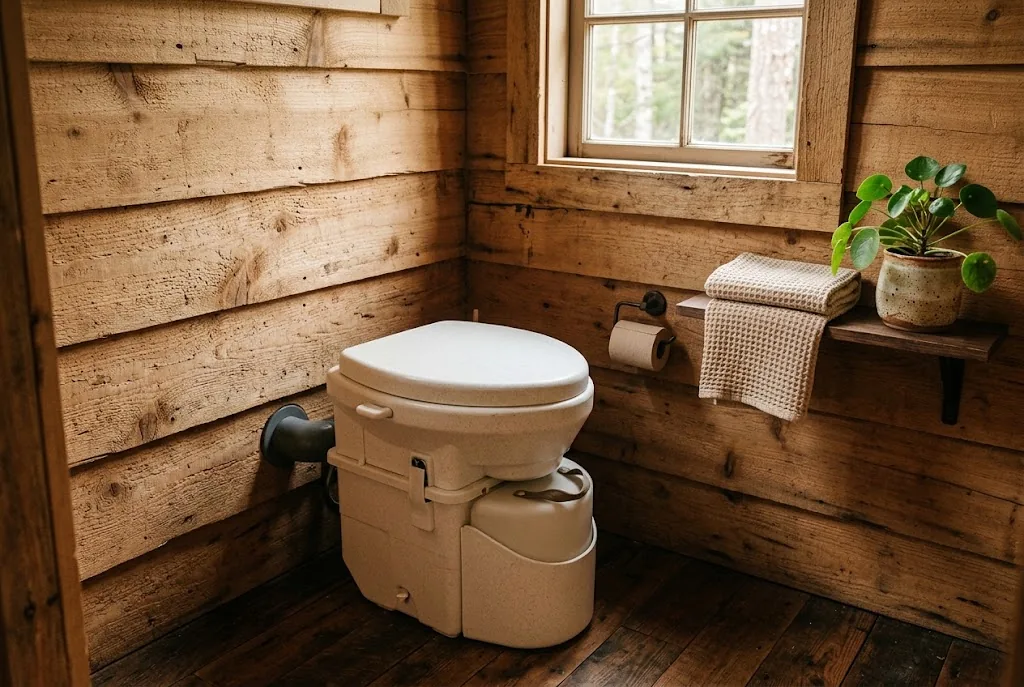
If you have spent any time researching off-grid sanitation, you already know the Nature’s Head by name — it is a composting toilet that shows up in many cabin, van, and tiny-home builds. This is a single-product buyer’s guide: what it actually does well, where its limits are, what owning one is really like week to week, and whether it fits your situation. For a head-to-head against other models, see our roundup of the best composting toilets for off-grid cabins.
Short answer: the Nature’s Head is a rugged, near odor-free, no-plumbing toilet that earns its popularity, with one honest caveat — the liquids bottle fills fast and sets your emptying routine. For a cabin, RV, tiny home, or boat off the sewer grid, it is close to the default choice.
Disclosure: the product link here is an affiliate link, and this assessment is built from the manufacturer’s specifications and the cited sources, not a multi-year test in our own cabin.
How the Nature’s Head Works
The Nature’s Head is a urine-diverting composting toilet, and that design choice is the key to everything good about it. A molded front section channels liquid into a separate bottle, while solids drop into a larger bin containing a carbon medium — organic coco coir or sphagnum peat moss, per the maker.
Keeping liquids and solids apart is what prevents odor. Nature’s Head attributes sewage smell to the mixture of liquid and solid waste (Nature’s Head); separate them and the solids stay relatively dry and compost quietly instead of turning septic. A small 12V vent fan pulls air out through a hose to the outside, holding the bathroom side at slight negative pressure so any residual odor goes outdoors, not into the room.
After each use, you turn a crank agitator that mixes waste into the medium. That is the entire daily interaction: separate by design, crank to mix, and let the medium do its work.
Capacity and the Emptying Reality
This is the part every honest buyer’s guide has to lead with, because it is the one thing that surprises new owners.
- Solids bin: Nature’s Head says to empty it when the agitator handle gets hard to turn, a sign there is more waste than compost material in the bin — so it goes much longer between emptyings than the bottle. A weekend cabin or a single user stretches that further.
- Liquids bottle: this is the schedule-setter. In full-time use it fills quickly and must be emptied before it overflows; the maker also advises against leaving urine in it for long, since it smells worse over time (Nature’s Head).
So the mental model is not “empty the toilet every few weeks.” It is “empty the liquids bottle often, and the solids bin far less often.” If you plan around the liquids bottle from day one, the Nature’s Head is painless. If you expect a weeks-long set-and-forget fixture, the bottle will frustrate you. Many owners keep a spare bottle so a full one can be swapped and dealt with later.
Installation: What It Actually Needs
The appeal here is what it does not need: no water supply, no sewer, no septic. Installation comes down to three things:
- A stable spot and secure mounting so the unit cannot tip.
- A vent hose to the outside for the fan — Nature’s Head recommends venting whenever possible and includes a 4-foot ventilation hose — the one piece people most often rush and regret, because a good vent run is what protects the low-odor performance.
- A little 12V power for the fan, which the maker says draws less than 1.8 amp-hours in 24 hours of continuous running (Nature’s Head), easily supplied from a small battery or solar setup.
That short list is exactly why it drops so cleanly into vans, boats, cabins, and tiny homes. If your build already has a scrap of 12V power — and most off-grid builds do — the toilet asks almost nothing of the structure around it.
Living With It: Upkeep
Day-to-day upkeep is modest and predictable:
- Start the bin with a moistened block of coir or peat, broken up to form the base.
- Crank after use to mix waste into the medium.
- Empty the liquids bottle often in full use; dilute and dispose of it appropriately for your location.
- Empty the solids bin when the agitator gets hard to turn, and follow your state and local rules for the contents; the EPA notes composting-toilet end product legally must be buried or removed by a licensed septage hauler under those rules (EPA). The contents are far more manageable and less offensive than newcomers fear, thanks to the dry, coir-mixed composting.
- Keep the fan running — it is the quiet guardian of the whole system.
None of this is glamorous, but none of it is grim either. Follow the rhythm and it becomes background routine.
Pros
- Truly no plumbing: no water, sewer, or septic needed
- Low odor in normal use thanks to urine diversion and the vent fan
- Rugged, simple construction with few parts to fail
- Low solids-bin maintenance — weeks between emptyings
- Drops easily into cabins, RVs, tiny homes, and boats
Cons
- Liquids bottle fills fast and sets a daily-ish emptying routine
- Emptying is a hands-on task some will never love
- Higher upfront cost than a basic bucket or portable toilet
- Vent hose and 12V fan must be installed correctly to stay odor-free
Who Should Buy One — and Who Shouldn’t
Buy it if you are outfitting an off-grid cabin, an RV or van, a tiny home, or a boat with no realistic sewer or septic connection (the maker pitches it for properties without septic access (Nature’s Head)), and you want a durable fixture that controls odor and asks little of your structure. In that context, the Nature’s Head is close to the default answer, and its popularity is earned rather than hyped.
Think twice if your site could reasonably support a simpler solution — a home on septic has no reason to switch — or if the daily liquids-bottle routine is a dealbreaker for how you actually live. It is also a premium purchase; if you only need occasional backup sanitation, a basic portable toilet costs a fraction. And if your real problem is water rather than waste, that is a different project — start with proper emergency water storage instead.
The Bottom Line
The Nature’s Head does the hard part of off-grid sanitation genuinely well: no plumbing, minimal smell, and rugged reliability. The single honest caveat is the liquids bottle, and once you plan your routine around it, the friction largely disappears. For an off-grid build that needs a real toilet and cannot tap a sewer, it is a confident recommendation — and pairing it with the right composting knowledge, like our backyard compost system guide, rounds out a genuinely closed-loop setup.
Frequently Asked Questions
- How often do you empty a Nature's Head composting toilet?
- Nature's Head says to empty the solids bin when the agitator handle gets hard to turn, which comes around less often for a weekend cabin or one person. The liquids bottle is the real schedule-setter — it fills much faster in full-time use and must be emptied before it overflows, and the maker advises against leaving urine in the bottle for long because it smells worse over time. For most households, the liquids bottle, not the solids bin, is what dictates the routine.
- Does a Nature's Head composting toilet smell?
- Not when it's working correctly. The design separates liquids from solids — which is what prevents the odor — and a small vent fan pulls air out through a hose, keeping the bathroom side at slight negative pressure. Nature's Head says a properly working unit has only a slight earthy smell. Odor problems usually trace to a full liquids bottle, a fan that isn't running, or urine getting into the solids bin.
- Do you need water or plumbing to install one?
- No, and that's the whole point. A Nature's Head needs no water supply and no sewer or septic connection. It requires only a small amount of 12V power for the vent fan (the maker says under 1.8 amp-hours in 24 hours) and, ideally, a vent hose to the outside. That makes it a genuine off-grid fixture for cabins, RVs, tiny homes, and boats where running water and plumbing aren't available or practical.
- What do you put in the solids bin to start?
- A moistened carbon medium — Nature's Head recommends organic coco coir or organic sphagnum peat moss. You dampen a block of coir, break it up, and add it to the solids bin to create the base the composting action works in. Each user turns the agitator handle after use to mix waste into the medium, and you top up or refresh the medium as needed when you empty the bin.
Sources & references
Before you go
The Renter's Homestead Pack
Self-reliance projects for the yard you don't own — container yields, a raised bed built to move with you, balcony preservation basics, and the landlord questions to ask first.
Free guide
The Renter's Homestead Pack
Self-reliance projects for the yard you don't own — container yields, a raised bed built to move with you, balcony preservation basics, and the landlord questions to ask first.