| Best For | Skip If |
|---|---|
| Off-grid cabins, tiny homes, vans and boats with no sewer or septic | Your lot already has a working septic connection and code requires it |
| Two-person households wanting weeks between solids emptying | You can’t run a continuous 12V vent fan or route a vent hose outside |
| DIYers comfortable emptying a urine bottle every few days | You expect a flush-and-forget experience with zero maintenance |
A cabin can run on solar, catch its own rainwater, and grow half its own food, and still be stopped cold by one unglamorous problem: what to do with human waste when there’s no sewer line and a septic system is expensive to install. This is where a composting toilet earns its place in an off-grid setup — and where a lot of marketing oversells what these units do.
This review is for people building or outfitting an off-grid cabin, tiny home, van or boat who are weighing a composting toilet for off-grid use against a septic system, a pit privy, or a basic RV cassette toilet. We researched the three units that dominate the category, cross-checked manufacturer specifications and the cited sources, and focused on the four things that actually decide whether you’ll be happy a year from now: capacity, emptying, odor control, and footprint. Cons come before the verdict, as always.
What a Composting Toilet Actually Is
Strip away the branding and a modern composting toilet is a simple, honest machine. It’s waterless — no flush, no plumbing, no connection to a sewer or septic tank. Instead of moving waste with water, it manages waste by keeping it dry and separated.
The core idea is urine diversion. A molded seat routes liquid forward into a removable bottle and drops solids straight down into a separate chamber. That separation is the whole trick (Nature’s Head). Urine on its own is easy to deal with; solids on their own, mixed with a dry carbon medium, stay aerobic and break down into a dry, earthy material. It’s when the two mix — as they do in a bucket or a flush toilet holding tank — that you get the anaerobic sludge responsible for the smell everyone associates with outhouses.
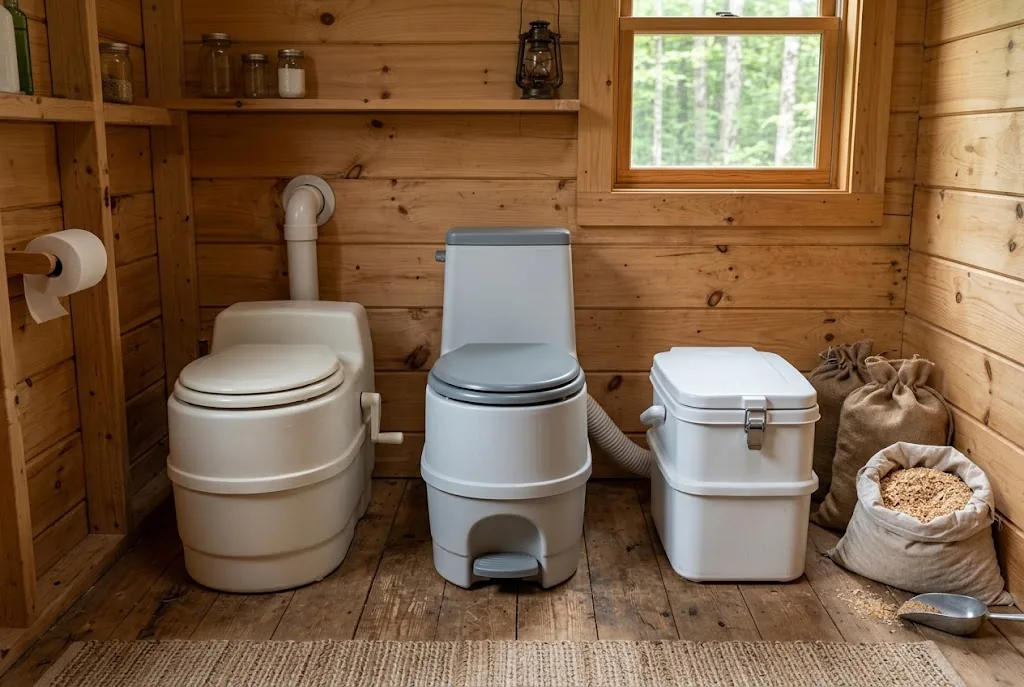
Below the seat, the solids chamber holds a carbon medium — coco coir, peat moss, or fine wood shavings. A hand crank or a small electric motor turns the solids into the medium a few times a day. A continuously running vent fan, usually 12V, pulls air down through the bowl and out through a hose to the outside, taking moisture and any odor with it. That fan is not optional; it’s the difference between a bathroom that smells like potting soil and one that doesn’t.
These aren’t budget items. A quality self-contained unit runs roughly $850 to $1,000 (Nature’s Head, CompoCloset), plus a vent hose, and in most cases you’ll want it wired to your 12V system for the fan. What you get for that money is independence from water and sewer infrastructure — which, in an off-grid build, is often priceless. If you’re already thinking in terms of closed loops, a composting toilet pairs naturally with the rest of a self-reliant property; our backyard compost system guide covers where the finished solids and carbon medium ultimately belong.
How We Ranked These
We weighted four practical factors and one that people forget until it bites them:
- Solids capacity — how many weeks between emptying the lower chamber for two people.
- Emptying experience — how clean and simple the urine bottle and solids removal are.
- Odor control — fan design, urine separation, and how forgiving the unit is when you get lazy.
- Footprint — whether it fits a tight van or cabin bathroom.
- Durability — the quiet factor. An off-grid toilet that fails in year two is worse than no toilet.
The Ranked Picks
1. Nature’s Head Self-Contained — Best Overall (~$965)
The Nature’s Head is our top pick, and the reason is boring in the best way: it is built to last. The molded body and the spider-handle crank agitator are simple and mechanical, with no motor to fail. For a cabin you plan to keep, that longevity matters more than any single feature.
Capacity is its other strength. The solids chamber is generously sized — the maker rates it at approximately 60–80 solid uses before emptying, depending on conditions and composting medium (Nature’s Head). The crank agitator mixes solids into the coir medium with a few turns, and the included 12V fan keeps the whole thing dry and odor-free.
The honest downsides: the urine bottle is a modest 2.2 gallons (Nature’s Head), so for two people it’s an every-few-days empty, and there’s no level sensor — you learn the timing or you overfill it once and never again. The footprint is chunky; measure your bathroom before you commit, because it’s the largest of the three here. And the crank means the unit sticks out a bit further than a motorized design. None of these are dealbreakers for a cabin, but they’re real.
2. OGO Composting Toilet — Best for Hands-Off Convenience (~$1,000)
The OGO is the modern-convenience pick. Instead of a hand crank, it uses an electric churning motor — press a button and it mixes the solids for you. It also adds the feature the Nature’s Head lacks: a liquid-level sensor that lights up before the urine bottle overflows, which is genuinely useful and removes the one recurring annoyance of waterless toilets.
Its footprint is more compact than the Nature’s Head, which makes it a favorite in vans and small tiny homes where every inch counts. The trade-offs are the flip side of its strengths. The solids chamber is smaller, so two people empty it more often. And an electric agitator is one more motor that can fail — in an off-grid setting where you can’t run to a store, a hand crank you can fix with a screwdriver has a certain appeal that a sealed motor doesn’t. We rank it just behind the Nature’s Head for that durability reason, not because it’s a worse daily experience — for many people it’s a better one.
3. CompoCloset Cuddy — Best Compact / Budget (~$850)
The CompoCloset Cuddy is the smallest and cheapest of the three, and it’s aimed squarely at vans, boats and tiny homes. At around $850 it’s the easiest entry into the category, and its compact footprint is the best here for genuinely tight spaces. It’s urine-diverting like the others, uses a 12V fan for odor control, and has a front-mounted manual agitator plus an LED urine level indicator (CompoCloset).
What you give up is capacity. The solids chamber is smaller — the maker rates it at 2 to 3 weeks for two people full-time (CompoCloset). For a solo van-lifer or a weekend micro-cabin, the Cuddy is arguably the smartest buy. For a two-person cabin you’ll live in year-round, its capacity will have you emptying noticeably more often.
| Model | Price | Solids capacity (2 people) | Agitator | Footprint | Best for |
|---|---|---|---|---|---|
| Nature's Head | ~$965 | ~60–80 solid uses (maker rating) | Hand crank | Largest | Durable two-person cabin workhorse |
| OGO | ~$1,000 | Smaller than Nature's Head | Electric motor | Medium | Hands-off use in tight spaces |
| CompoCloset Cuddy | ~$850 | 2–3 weeks (maker rating) | Manual crank | Smallest | Vans, boats and budget micro-cabins |
Nature’s Head: Pros and Cons
Pros
- Simple, mechanical design with no motor to fail, a safe long-term bet for a cabin
- Largest solids capacity here — approximately 60–80 solid uses between emptying, per the maker
- Fully waterless and self-contained — no plumbing, sewer or septic connection, ideal for true off-grid builds
- Hand-crank agitator is simple and mechanical, with no motor to fail where you can't replace it
- Effective odor control when installed correctly — continuous 12V fan plus strict urine diversion keeps it smelling earthy at most
Cons
- Small 2.2-gallon urine bottle with no level sensor — every-few-days emptying for two people, and one overfill before you learn the rhythm
- Largest footprint of the three — measure your bathroom carefully before buying, especially in a van
- Requires a continuously running vent fan and an outside vent route, which means 12V wiring and a hull or wall penetration
- Higher upfront cost than a basic cassette toilet — the value is in longevity, not the sticker price
Buyer’s Guide: What Actually Decides Whether You’re Happy
Check legality first — before you buy anything. This is the step people skip and regret. Composting toilets are widely accepted for RVs, boats and tiny homes, and several states permit them outright, but some counties still require a permitted septic system or an approved disposal method for the diverted urine and finished solids regardless of what toilet you install. Call your county building and health department and ask specifically about composting or “waterless” toilets and about legal disposal of the output. Getting a clear answer up front is far cheaper than a red-tagged cabin later.
Ventilation is non-negotiable. Every unit here depends on a fan running continuously to stay odor-free. Plan the vent route before you install: you need a path for the hose to the outside and a small, constant 12V draw for the fan. If you can’t commit to that, a composting toilet is the wrong choice — no amount of carbon medium compensates for a dead fan. This is one more small load to account for in your off-grid power budget alongside pumps and lighting.
Pick your composting medium and stock it. Coco coir is the popular default: cheap, compact to store as bricks, and it rehydrates into an ideal texture. Peat moss works but has sustainability drawbacks; fine kiln-dried wood shavings are a workable backup. Whatever you choose, keep a reserve on hand — running out mid-season is a miserable, avoidable problem. The finished solids should be handled as the product they are, and our backyard compost system guide walks through curing it properly rather than treating it as trash.
Think of it as one part of your water and waste plan, not a magic box. A composting toilet solves the blackwater problem elegantly, but it doesn’t solve greywater, and it doesn’t reduce how much water you need to store and catch. If you’re building the full picture, pair this with a rain barrel system for catchment and a plan for storing emergency water at home so your independence is real and not just partial. For the rest of the off-grid water stack, our water security pillar collects everything we’ve covered.
Who Should Skip a Composting Toilet
Anyone with a working, code-required septic connection. If your lot already has septic and local code mandates its use, a composting toilet adds cost and maintenance for no gain. These shine where sewer and septic aren’t options, not where they already exist.
People who won’t maintain a vent fan and a urine bottle. This is a low-effort system, not a no-effort one. If emptying a bottle every few days and keeping a fan running sounds like too much, you’ll be unhappy, and the toilet will smell — not because it’s a bad product, but because it’s being used wrong.
Very tight budgets where a used RV cassette toilet would do. If you’re outfitting a temporary or occasional-use space and $850–$1,000 is a stretch, a simpler cassette or even a well-managed sawdust bucket may be the honest answer for now. Buy the composting unit when you’re committed to the build.
Final Verdict
Score: 9/10
For a genuine off-grid cabin, the Nature’s Head is the composting toilet we’d choose and keep choosing. It’s not the cheapest, its urine bottle is smaller than we’d like, and it takes up real space — those are the honest cons, and they’re all manageable. What you get in return is the thing that matters most when the nearest hardware store is an hour away: a waterless, plumbing-free toilet built rugged enough to run for years, with enough solids capacity that two people aren’t chained to a weekly emptying routine. The hand crank you can fix yourself is a feature, not a limitation, once you’ve spent a winter off-grid.
The OGO is the better call if you value hands-off convenience and a tighter footprint and don’t mind depending on a motor; the Cuddy is the smart budget and van pick if capacity isn’t your priority. But if you’re building something to live in and want the unit least likely to let you down, the Nature’s Head is the one. Just do the unglamorous homework first — confirm it’s legal where you are, plan the vent, and stock your coir — and it will quietly do its job for years.
Frequently Asked Questions
- How does a composting toilet actually work?
- A self-contained composting toilet separates urine from solids at the seat. Liquid drains into a front bottle you empty regularly; solids drop into a lower chamber packed with a dry carbon medium like coco coir or peat moss. A hand crank mixes the solids with the medium, and a small fan vents moisture and odor outside through a hose. The result is a dry, earthy, low-odor material you empty every few weeks — no water, no plumbing, and no sewer or septic connection required.
- Do composting toilets smell?
- A correctly installed unit should have little odor. The trick is the two things people skip: keep the vent fan running continuously (it pulls air down through the bowl and out the hose), and separate urine from solids so the two never mix and go anaerobic. When people report odor, it is almost always a fan that was switched off, a blocked vent hose, or a urine bottle left too long. Get those right and the bathroom smells like potting soil at most.
- How often do you empty a composting toilet?
- The urine bottle is the real schedule-setter: a 2.2-gallon bottle needs emptying every few days for two people, more often with heavy use. The solids chamber is far more forgiving — Nature's Head rates its solids bin at roughly 60–80 solid uses before emptying, and the maker of the smaller Cuddy rates it at 2–3 weeks for two people full-time. Solids come out as dry, compacted, soil-like material, not raw waste.
- Are composting toilets legal for an off-grid cabin?
- In many places yes, but it is entirely local. Composting toilets are widely accepted for RVs, boats, tiny homes and cabins, and several states explicitly permit them under their plumbing or on-site wastewater codes. But some counties still require a permitted septic system or an approved secondary treatment method for the diverted urine and finished solids, regardless of what toilet you install. Always check your county building and health department before you rely on one as your only system. Legality is the single most overlooked step.
- Nature's Head vs OGO — which is better?
- Nature's Head is the durability and capacity pick: a bigger solids chamber and a simple hand-crank agitator with no motor to fail. OGO's advantage is convenience — an electric churning motor instead of a hand crank, a more compact footprint, and a liquid-level sensor that warns you before the bottle overflows. If you want the longest-lasting workhorse for a two-person cabin, Nature's Head. If you want the most hands-off daily experience in a tight space and don't mind depending on a motor, OGO.
Sources & references
Before you go
The Renter's Homestead Pack
Self-reliance projects for the yard you don't own — container yields, a raised bed built to move with you, balcony preservation basics, and the landlord questions to ask first.
Free guide
The Renter's Homestead Pack
Self-reliance projects for the yard you don't own — container yields, a raised bed built to move with you, balcony preservation basics, and the landlord questions to ask first.