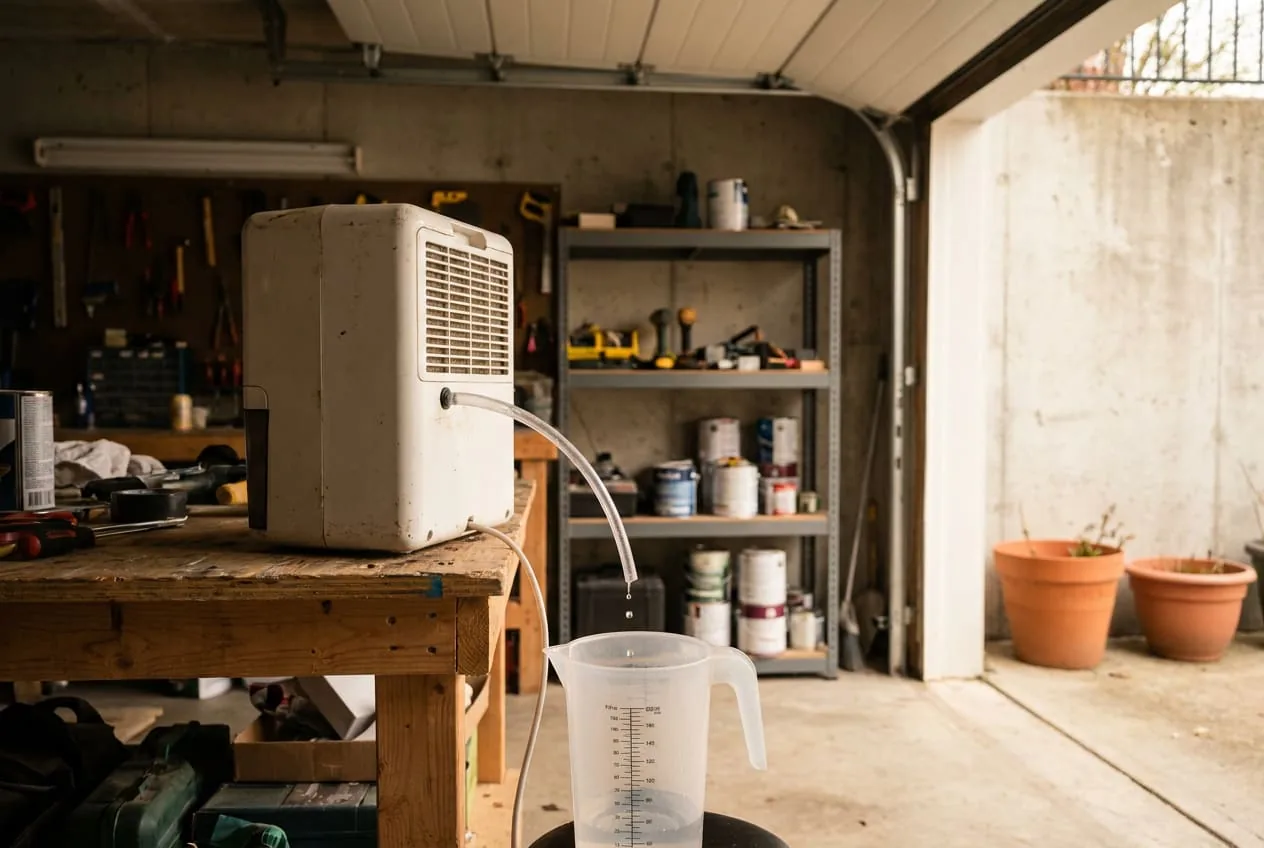
How much water can a DIY atmospheric water generator really produce? In typical residential conditions, expect 1 to 5 gallons per day — and the reason is physics, not build quality. Air simply doesn’t hold that much water, and pulling it out takes far more energy than most plans admit. This article walks through the published numbers so you can decide whether a build is worth your time before you buy a single part.
The Physics That Sets The Ceiling
Every cooling-condensation atmospheric water generator — whether it’s a commercial unit or a dehumidifier rebuilt in a garage — works the same way. A cold coil chills incoming air below its dew point, water vapor condenses on the coil, and the droplets drip into a reservoir. That’s it. There is no clever plumbing trick that gets around the dew point.
The dew point is set by two things: temperature and relative humidity. Warm, humid air carries a lot of water and condenses easily. Cool or dry air carries little, and the machine has to work much harder to extract anything at all.
This creates two hard cutoffs that matter more than any component you choose. Cooling-condensation AWGs stop working efficiently below roughly 60 to 65°F (15 to 18°C), and below about 30% relative humidity. Under either threshold, the coil struggles to reach the dew point at all, and output drops toward a trickle — or zero — while the compressor keeps drawing full power.
So before you look at any DIY atmospheric water generator plan, look at your own weather data. A humid Gulf Coast summer and a Colorado winter are two entirely different machines’ worth of output, even with identical hardware.
What Published Data Actually Shows
The most useful numbers come from a peer-reviewed climatic-chamber study of residential-size, compressor-based units from several manufacturers — machines in the same class as an ambitious DIY build. In warm, humid test conditions, the units used about 1.02 kWh of electricity per liter of water (Water Resources and Industry).
Then the researchers turned the temperature down. In cold, humid conditions — a damp, cool morning almost anywhere in the northern United States — energy consumption ballooned to 6.23 kWh per liter. Same kind of machine, humid air in both cases, wildly different result.
Commercial residential AWGs tell the same story. Their ratings are typically measured in warm, humid conditions that most homes rarely see, so expect real-world output in an ordinary home to come in below the rated figure.
If purpose-built commercial machines with engineered coils and optimized airflow only reach their rated output under ideal lab conditions, that rated output is the honest ceiling for what any garage build can aspire to. It won’t exceed it.
What A DIY Build Realistically Delivers
Put the published data together and the picture for a DIY atmospheric water generator is consistent:
- 1 to 5 gallons per day in typical residential conditions — the range most builders in most of the US should plan around.
- More than that only in genuinely hot, humid climates: Gulf Coast summers, South Florida, coastal Texas, and similar conditions where temperature and humidity stay high around the clock.
- Near zero in arid climates or cool weather. Below the roughly 60-65°F / 30% humidity thresholds, a condensation-based build produces almost nothing while still consuming electricity.
Which brings up the claim you’ll see attached to DIY plans sold online: “up to 40 gallons a day.” The Smart Water Box plans are the best-known example (Smart Water Box sales letter). Taken at face value, that figure would mean a garage build outproducing purpose-built commercial residential units, at a fraction of the hardware cost. Nothing in the published data supports that. A machine that genuinely produces 40 gallons per day exists — but it’s commercial-grade hardware with a commercial-grade compressor, footprint, and price tag, not something assembled from a plans PDF. We took that claim apart in detail in our Smart Water Box review if you want the full breakdown.
None of this means a DIY build is pointless. A few gallons a day of emergency drinking water, produced from air with no well and no municipal hookup, is a real capability. It just isn’t forty. If you’re curious how the best-known plans package that capability, our plain-English look at the water-from-thin-air build explains what you’re actually buying.
Most DIY builds start with a quality 30-pint dehumidifier (Amazon) as the core component — the compressor and coil are already sized for residential humidity extraction, and adapting the output is straightforward. The remaining components (food-safe tubing, reservoir, filtration housing) are modest additions on top of that base.
Is An AWG Right For Your Climate?
Before you buy a single part, spend ten minutes with your local weather data — it decides everything. Pull up the average relative humidity and temperature for your area month by month (your national weather service or almanac sites list both). What you are looking for is how many months sit comfortably above the two thresholds: roughly 60 to 65°F and 30% relative humidity, with genuinely useful output only in noticeably humid air.
A Gulf Coast, Southeast, or mid-Atlantic summer clears that bar for months at a time — an AWG there is a legitimate backup source. The arid Southwest fails it for most of the year: Phoenix or Albuquerque air simply does not carry enough water to condense, and the machine will draw full power for a trickle. The upper Midwest and Northeast are seasonal — useful in a humid July, near useless in a dry, cold January.
The honest takeaway: an AWG is a climate-specific tool, not a universal one. If your area spends more than half the year below the thresholds, the money is better spent on stored water or rainwater catchment, which do not care what the humidity is doing.
Troubleshooting Low Output
If your build is producing less than the published numbers suggest it should, work through these in order:
- Low humidity. The most common cause, and there is no fix except waiting for more humid conditions. Log the room humidity at the same time you measure output — the correlation is usually obvious.
- Air too cold. Below roughly 60 to 65°F the coil struggles to reach the dew point. A build running in an unheated garage in shoulder season will underperform the same build in a warm, humid room.
- Weak airflow. The fan has to move a lot of air across the coil. A clogged filter or an undersized fan starves the coil of the moisture-laden air it needs.
- Reservoir warming and re-evaporating. In a hot space, collected water can partly evaporate back out of an open reservoir. A covered, insulated collection tank preserves your yield.
- Coil not cold enough. On a repurposed dehumidifier, a failing compressor or low refrigerant charge shows up as a coil that never gets truly cold. If the unit is old, this is often the real problem.
The Electricity Bill Nobody Mentions
Atmospheric water is expensive water, and the plans rarely do this math for you.
Take the favorable end of the published range: about 1 kWh per liter. A gallon is 3.79 liters, so each gallon costs roughly 3.8 kWh of electricity. At the US average residential rate of about $0.18 per kWh (EIA), that’s about $0.70 per gallon. In cooler conditions, where energy consumption climbs toward that 6.23 kWh-per-liter figure, the cost per gallon multiplies accordingly.
For comparison, municipal tap water costs about half a cent per gallon in most of the US; EPA’s WaterSense calculator assumes a national average of $6.06 per 1,000 gallons (EPA). Condensed atmospheric water runs more than a hundred times that — before you count the cost of the hardware, filters, and maintenance.
That comparison isn’t an argument against building one. It’s an argument for being honest about what the machine is: an emergency and backup capability for when other sources fail, not a way to save money on water. If cheap everyday water is the goal, rainwater collection delivers far more volume for far less energy.
Is The Water Safe To Drink?
Straight out of the reservoir — no. This is the part of AWG projects that deserves the most caution, and it applies doubly to builds based on repurposed dehumidifiers.
There are two separate problems. First, biology: a reservoir of standing water at room temperature is an ideal environment for bacteria and mold, and condensate collection surfaces are rarely designed for hygiene. Second, chemistry: condensate can carry metallic residues from the coils and fittings it touches (Stanford Magazine). Live Science has also covered why dehumidifier water isn’t potable as collected, largely because the tank is a hospitable place for bacteria and mold (Live Science). And note that boiling solves only the first problem. Boiling kills microbes; it does not remove metals such as lead (EPA).
For a DIY atmospheric water generator that produces drinking water, two things are non-negotiable. Use food-safe components anywhere water condenses, flows, or sits — food-grade tubing, a food-safe reservoir, coils that aren’t shedding metals into your supply. Then treat the output: sediment and activated-carbon filtration at minimum, and ideally UV disinfection before the water is consumed. Treat the machine’s output as raw water that needs processing, not as finished drinking water.
A comprehensive drinking water test kit (Amazon) that checks for heavy metals, bacteria indicators, pH, and common contaminants is the only way to confirm your output is actually safe — and worth running before you rely on your AWG in a real emergency.
For the treatment stage itself, a gravity filter is the simplest no-power option for the biological side of the problem — bacteria and protozoa in the condensate. It’s worth being precise about what it does and doesn’t cover: a basic hollow-fiber gravity filter does not remove the heavy metals discussed above, so pair it with a dedicated sediment/activated-carbon stage (or a certified countertop system, once we have one to point you to — see our Big Berkey update for why we no longer recommend that specific product) for the metals side, and confirm results with a test kit either way:
Frequently Asked Questions
- How much water does a DIY atmospheric water generator produce per day?
- In typical residential conditions, roughly 1 to 5 gallons per day, with more possible only in genuinely hot, humid climates. Published climatic-chamber testing of residential-size compressor units shows performance falling off sharply as air gets cooler, so treat higher claims with skepticism.
- Do atmospheric water generators work in dry climates?
- Effectively, no. Cooling-condensation AWGs stop working efficiently below about 30% relative humidity, which is routine in the arid Southwest for much of the year. Output in those conditions approaches zero while the machine still draws full power. In dry climates, stored water and hauled water are far more dependable options.
- How much electricity does an AWG use?
- Published lab data on residential-size compressor units spans about 1.02 kWh per liter in warm, humid air to 6.23 kWh per liter in cold, humid air. At around 1 kWh per liter and the US average residential rate of roughly $0.18 per kWh, that works out to about $0.70 per gallon — versus about half a cent for municipal tap water. Cold weather pushes the cost several times higher.
- Is dehumidifier water safe to drink?
- Not untreated. Dehumidifier condensate can harbor bacteria and mold from the reservoir (Live Science) and carry metallic residues from the unit (Stanford Magazine). Boiling kills bacteria but does not remove metals such as lead. Safe drinking water from a condensate source requires food-safe components plus filtration, ideally with UV disinfection.
- Can a DIY atmospheric water generator really make 40 gallons a day?
- No realistic garage build can. Even commercial residential units, with engineered coils and optimized airflow, reach their rated output only in warm, humid conditions. Machines that truly produce 40 gallons a day are commercial-grade hardware. Plans claiming that output from a low-cost DIY build are promising something the physics doesn't support. A DIY atmospheric water generator is a legitimate backup water source that can deliver a few gallons a day where the climate cooperates — build it with exactly that expectation, not the numbers on a sales page.
Sources & references
- Water Resources and Industry, Performance investigation of atmospheric water harvesting systems (Bagheri, 2018) (opens in new tab)
- U.S. EIA, Average price of electricity to ultimate customers (opens in new tab)
- EPA WaterSense, How the WaterSense Calculator works (opens in new tab)
- Smart Water Box, official sales letter (opens in new tab)
- Stanford Magazine, Don't drink the water (from your dehumidifier) (opens in new tab)
- Live Science, Is dehumidifier water safe to drink? (opens in new tab)
- EPA, Basic information about lead in drinking water (opens in new tab)
Before you go
The Renter's Homestead Pack
Self-reliance projects for the yard you don't own — container yields, a raised bed built to move with you, balcony preservation basics, and the landlord questions to ask first.
Free guide
The Renter's Homestead Pack
Self-reliance projects for the yard you don't own — container yields, a raised bed built to move with you, balcony preservation basics, and the landlord questions to ask first.