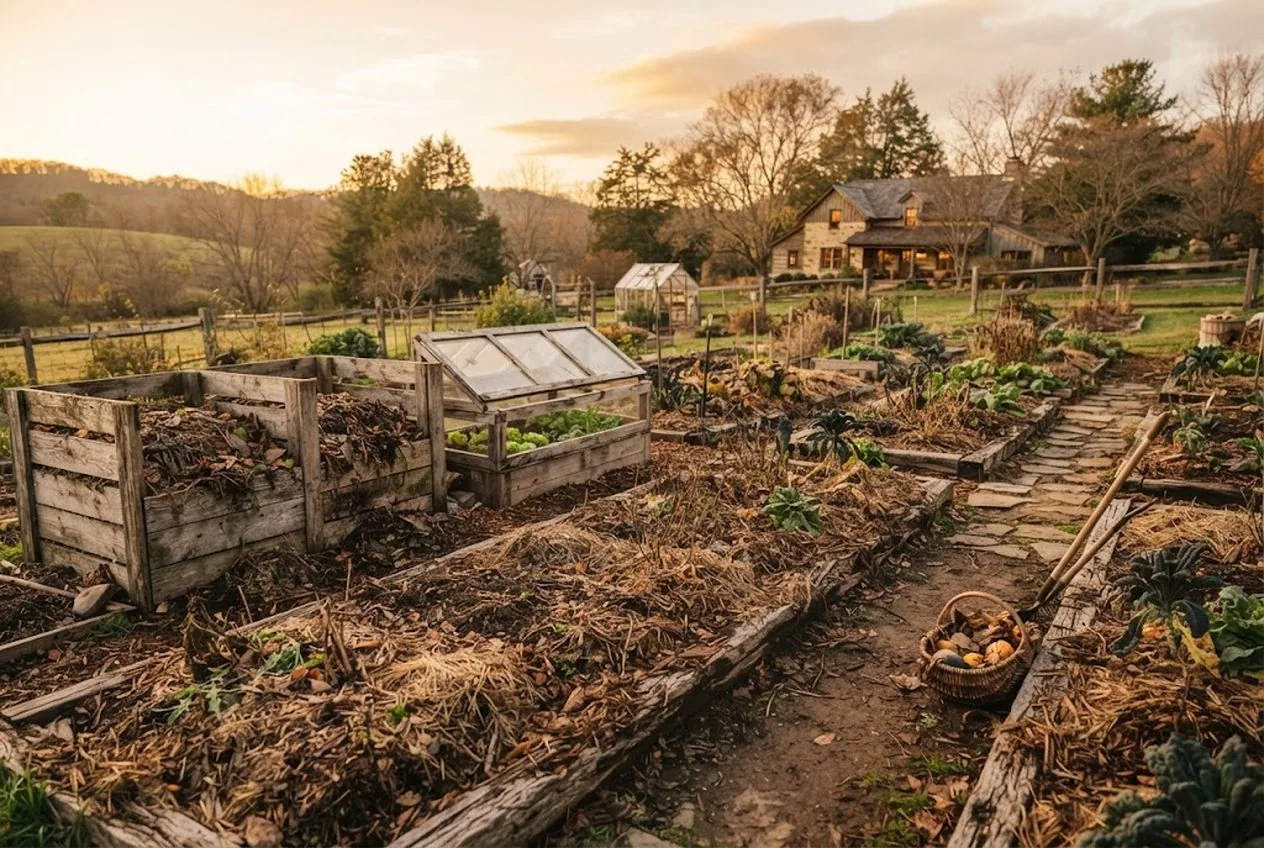
Fall on a homestead runs on a countdown clock. Every project that touches open ground — building beds, setting posts, turning soil, starting compost — has to happen before the hard freeze locks everything solid, and the list always feels longer than the daylight allows. The trick isn’t doing everything; it’s doing the right things in the right order, so the jobs that need unfrozen earth get done first and the indoor work fills the cold evenings after.
The short version: put your beds to rest, get compost cooking, build your season extenders, and secure water, structures, and stored food while the ground is still workable — then save tool care and planning for after the freeze. Below are the eight projects worth finishing before winter, roughly in the order the weather demands.
Follow the order — ground-dependent jobs first — so nothing gets left half-done under the first snow. Here’s the checklist.
1. Put Your Beds to Rest
This is the highest-return job of the season. Clear out spent summer crops, amend the soil with compost, and cover every bed with a thick mulch of leaves, straw, or chopped material. A bed put to bed properly comes through winter loose, fed, and protected — the mulch shields soil life from frost heave and hard rain.
Do this the no-till way to protect the structure you’ve built: loosen without inverting, amend the surface, and let winter do the rest. Our full method is in building fall garden soil with coco coir and a broadfork. Adding new beds this fall too? Our pick for the best raised garden bed for fall planting covers the container side. If you do only one project on this list, make it this one.
2. Get a Compost System Cooking
Fall hands you more compostable material than any other time of year — spent plants, fallen leaves, and the debris of the whole garden cleanup. Don’t waste it. Getting it into a bin now means it starts breaking down before dormancy and finishes fast when spring warmth returns, instead of you starting from an empty pile in April.
For bulk fall waste, a high-capacity stationary bin is the workhorse: it swallows leaves and spent crops by the barrow-load and contains it all so nothing blows across the yard over winter.
Disclosure: the product links here are affiliate links, so we may earn a commission if you buy through them at no extra cost to you. The guidance here follows long-standing homestead and extension-service practice, not brand marketing.
If you want faster, cleaner batches from kitchen scraps alongside the big bin, a tumbler is the complement — we compare the options in compost tumbler vs. worm factory, and our dual-chamber compost tumbler review covers the specific model we’d buy for a fall start.
3. Build a Season Extender
Every week you can keep the garden producing past the first frost is a week of free fresh food, and fall is the time to build the structure that buys it. A cold frame, a low tunnel, or a small greenhouse all do the same job — trap warmth and hold off the cold — and building one late in fall pays off immediately.
Twin-wall polycarbonate is the glazing that makes any of these durable: lighter and more insulating than single-pane glass (UT Extension), shatter-proof, and cuts to any size with a utility knife. Get the base or posts set before the ground freezes and you can finish the framing and glazing even after the first frosts arrive.
Ready to build the bigger version? Our step-by-step guide to a backyard greenhouse from polycarbonate panels walks the whole project from base to venting.
4. Plant Garlic and Cover Crops
The ground you’re not actively harvesting shouldn’t sit bare. Garlic goes in now — cloves planted a few weeks before the freeze set roots in fall, overwinter dormant, and burst up for an early-summer harvest (University of Maryland Extension). And any bed you’re not planting should get a cover crop like winter rye or clover, which holds the soil against erosion, smothers weeds, and feeds the ground when you turn it under in spring (University of Maryland Extension). Both are quick jobs that quietly make next year better.
5. Secure Your Water Systems
Water is the thing that freezing weather attacks hardest, and a burst pipe or cracked barrel is a miserable spring surprise. Before the freeze: drain and store hoses, shut off and drain outdoor spigots, and either empty your rain barrels or set them up to keep flowing. Ice expands with enough force to split almost any container (American Red Cross), so anything holding water needs to be drained, insulated, or protected. Ten minutes of prep now saves a cracked barrel and a flooded line later.
6. Winterize Animals and Structures
If you keep livestock, fall is when their shelter gets ready for the cold — coops and hutches checked for drafts and topped up with bedding, waterers protected from freezing, and feed stores secured against damp and rodents. Our checklist of fall chores to get chickens and bees ready for winter walks the animal side in detail, and if short days have you trudging out at dusk to shut the coop, an automatic coop door is the upgrade that earns its keep by December. Even without animals, this is the moment to check that sheds, fences, and outbuildings are sound before winter storms test them. A loose panel or a leaking roof is far easier to fix in October than in a January gale.
7. Organize Stored Food and the Root Cellar
The harvest is only saved if it stores well. Move your keeping crops — squash, potatoes, onions, apples — into a cool, well-ventilated root cellar or storage spot, and set it up for airflow so nothing rots in a damp corner. Check on stored and preserved food, label and rotate it, and match each crop to its conditions: cold and humid for potatoes and apples, drier for onions, and warmer for winter squash (UGA Extension). A well-organized store is the difference between eating your harvest all winter and composting half of it.
8. Clean, Sharpen, and Oil Your Tools
Save this one for last, because it needs no open ground and it’s the perfect job for the first cold, dark evenings. Tools that go into storage dirty and damp come out rusted and dull; a season’s neglect can ruin a good spade or pair of pruners. Clean off the soil and sap, sharpen every cutting edge, and protect the metal and wood with oil before they sit idle. Everything is then ready to work the moment spring returns. Our full method is in how to clean, sharpen, and oil garden tools for winter.
Work the List in Order
The homesteads that come through winter in good shape aren’t the ones that did the most — they’re the ones that did the ground-dependent jobs before the freeze and left the indoor work for after. Put the beds to rest, get compost going, build your season extender, and lock down water, structures, and stored food while the earth is still soft. Then, once the ground is hard, retreat to the workshop for tools and planning.
For the deeper how-to on every one of these jobs, a good all-in-one homestead reference is worth its shelf space through the winter reading season.
Frequently Asked Questions
- When is the real deadline for fall homestead projects?
- Your hard-freeze date, not the first light frost. A light frost nips tender plants but leaves the soil workable; a hard freeze locks the ground solid and ends anything that involves digging, pouring, or setting posts. Find your average first hard-freeze date from your local extension office and treat it as the true deadline. Work backward from it and tackle the projects that need open ground — beds, compost, structures — first, leaving indoor and tool jobs for after the freeze.
- Which fall project matters most if I only do one?
- Putting your beds to rest properly — clearing spent crops, amending the soil, and mulching. It's the single job that most improves next year's garden, protects the soil life over winter, and takes the least specialized gear. A mulched, amended bed comes out of winter loose and fed, unlike bare ground that's been battered by rain and frost heave. If time is short, prioritize the soil.
- Is it worth starting compost in fall if it freezes?
- Yes. Fall hands you the biggest pile of compostable material all year — spent plants, fallen leaves, and garden cleanup — and getting it into a bin now means it starts breaking down before dormancy and finishes fast when spring warmth returns. Even if the pile freezes mid-process, the material is contained, protected from blowing away, and a season ahead of where you'd be starting from scratch in April. Fall is the best time to build a compost system, not the worst.
- What can I still build outdoors late in fall?
- Anything that doesn't depend on unfrozen ground, and ideally the season-extenders that buy you more growing time: cold frames, low tunnels, and small greenhouses. Building a season extender late in fall is time well spent because it directly pushes your harvest deeper into the cold. Get posts and bases set before the ground freezes, and you can often finish the glazing and framing even after the first frosts have arrived.
- Should I clean my garden tools before or after the freeze?
- After the outdoor work is done, as one of your winter wind-down jobs. Tool care doesn't need open ground, so it's the perfect project for the cold, dark evenings once the beds are put away. Cleaning, sharpening, and oiling your tools before they sit idle all winter prevents the rust and dulling that ruin them in storage, and means everything is ready to work the moment spring arrives. Save it for the end of your fall list.
Sources & references
- UT Extension, Selecting and Designing Small-Scale Greenhouses (opens in new tab)
- University of Maryland Extension, Growing Garlic in the Home Garden (opens in new tab)
- University of Maryland Extension, Cover Crops for Gardens (opens in new tab)
- American Red Cross, Frozen Pipes (opens in new tab)
- UGA Extension, Storage of Fresh Produce (opens in new tab)
Before you go
The Renter's Homestead Pack
Self-reliance projects for the yard you don't own — container yields, a raised bed built to move with you, balcony preservation basics, and the landlord questions to ask first.
Free guide
The Renter's Homestead Pack
Self-reliance projects for the yard you don't own — container yields, a raised bed built to move with you, balcony preservation basics, and the landlord questions to ask first.