What’s the short answer?
- Disconnect and drain garden hoses before your region's average first freeze date, mid-September to early October in the Midwest/Northeast, later further south.
- A hose left attached to a frost-free spigot can still trap water in the line and cause a freeze-related rupture.
- A freeze means 32°F or below over a wide area; hard-freeze thresholds vary by NWS office (25°F or below in Tallahassee).
- Check your local NWS office or NOAA's climate normals for your actual first freeze date rather than assuming one national date.
- Close and drain any interior shutoff valve for outdoor spigot lines, especially before extended cold snaps.
The forecast just flipped from sweater weather to a hard freeze warning, and the garden hose is still coiled on the spigot from last weekend’s watering. That is a common problem for anyone with a yard: the growing season often stretches longer than the habit of checking outdoor plumbing, and the first freeze rarely announces itself more than a few days ahead. Whether the spigot outside is a bare stub sticking out of the foundation or a newer frost-free model, what happens to it over the next few cold nights depends on habits set now, not on scrambling once the warning is already posted.
The short answer: Disconnect, drain, and store garden hoses before your region’s average first freeze date, shut off and drain any interior valve serving outdoor spigots if the house has one, and keep frost-free fixtures genuinely empty by never leaving a hose attached through winter. Timing shifts by region, running from mid-September to early October across the Midwest and Northeast and considerably later across the South and coastal Southeast.
When Does the First Freeze Actually Hit Your Region?
There is no single national date to circle on the calendar. Using the 1991-2020 U.S. Climate Normals, NOAA’s first-freeze maps show dates ranging from early September in northern and high-elevation areas to December or later in the warmest parts of the South and Southwest (NOAA National Centers for Environmental Information, October 23, 2023). October is a reasonable trigger month to start thinking about outdoor plumbing, but it is not a universal deadline.
Regionally, the pattern moves in a fairly predictable wave. The Midwest and Northeast typically see their first freeze from mid-September to early October. The South’s first freeze starts in Virginia in early October and then arrives progressively later as you move further south, stretching into December further south, and parts of Florida may not see a freeze every year (NOAA NCEI, same source). If the household is in one of the earlier zones, October is not a suggestion, it is close to the actual timeline. If the yard is in the Deep South, along the Gulf, or right on the coast, that October target can be weeks premature, and the real risk window is later in the fall.
The practical fix for “what’s the average first frost date for my state” is not a single number pulled from a national headline. It is checking the climate normals or extended outlook from the local NWS forecast office, since even within one state, elevation and distance from large bodies of water can shift the date (NOAA NCEI).
Frost, Freeze, and Hard Freeze Are Not the Same Thing
A light frost on the grass in the morning is not the same event as the kind of cold that threatens a pipe, and treating them as identical leads to both overreacting in September and underreacting in November. NOAA describes a “freeze” as surface air temperature of 32°F or below over a widespread area for a climatologically significant period of time (NOAA NCEI, October 23, 2023). A “hard freeze” is a colder threshold whose definition varies from one National Weather Service office to another; the Tallahassee office uses 25°F or below (National Weather Service Tallahassee, “Frost and Freeze Information”). Frost itself is a separate, milder condition that can form at or near ground level while air temperatures are slightly above freezing (same source).
That distinction matters for outdoor plumbing because a stray light frost is not the trigger point. The relevant threshold is the freeze mark, and the hard freeze mark is where the risk becomes serious and prolonged rather than a brief overnight dip. A single frosty morning does not mean a hose has to come off the spigot that afternoon, but a forecast freeze warning, and especially a hard freeze warning, is the point where winterizing outdoor plumbing stops being optional.
Why a Garden Hose Left on the Spigot Can Split a Pipe
Water left inside a garden hose or spigot line expands as it freezes, and that expansion can force ice back into the spigot or the indoor pipe it connects to, which is what actually risks a rupture (University of Illinois Extension, “How to winterize outdoor plumbing - irrigation, hoses, spigots,” November 26, 2020). It is not the cold air touching the outside of the pipe that causes most of the damage. It is trapped water with nowhere to expand.
That is also the answer to when to disconnect a garden hose for winter: before the first hard freeze in the household’s region, and ideally once overnight lows start consistently dropping toward the freeze mark rather than waiting for a single cold snap to catch the hose still connected. A hose left attached, even loosely, blocks water in the spigot from draining the way it is designed to, so removing it is the first and most reliable step regardless of what kind of spigot is behind it.
Draining the hose itself matters too. Coiling it up while it is still full of water just moves the same freeze-expansion problem into hose material instead of pipe, which shortens the hose’s working life even if it does not burst outright. Draining fully before storage, then keeping it somewhere it will not sit in standing water over winter, protects the hose as much as the plumbing.
Frost-Free Spigots Still Need Attention
A frost-free (sometimes called frost-proof) spigot has a long stem that reaches back through the wall, so the actual shutoff valve sits inside the heated part of the house rather than out at the exterior wall where cold hits hardest. It is a real improvement over a standard hose bib, but it is not a substitute for winterizing habits, and treating it as one is a common misread.
Frost-free spigots reduce, but do not eliminate, freeze risk. Whether one actually freezes depends on how cold it gets and how well-insulated the wall cavity is around the supply line (University of Illinois Extension, same source). That answers a question a lot of homeowners assume works the other way: will a frost-proof spigot still freeze if a hose is left on it? Yes, it can. The frost-free design depends on water draining back out of the long stem after the valve closes, and a hose still connected traps that water in the line instead of letting it drain, which defeats the point of the fixture. In a poorly insulated wall cavity, an older frost-free spigot, or an unusually deep cold snap, the same design can still freeze even with the hose off.
So do outdoor faucets need to be shut off even with frost-free fixtures installed? Yes, in two situations worth checking every fall: if a hose habitually stays connected through the cold months, and if the wall cavity behind the spigot is exposed, uninsulated, or backs onto an unheated space like a garage or crawlspace. Neither situation is unusual, which is why frost-free spigots still show up on winterizing checklists rather than being treated as a one-time upgrade that ends the conversation.
The Step-by-Step Shutoff and Drain Routine
None of the individual steps here are complicated. The value is doing them in order, before the first hard freeze rather than during it.
1. Disconnect and drain every hose
Unscrew hoses from every outdoor spigot, walk the length of the hose to let gravity pull the water out, then coil and store it somewhere it will not sit in standing water. This is the single step with the most leverage, since a connected hose is what most often turns a frost-free spigot into a freeze risk anyway.
2. Close the interior shutoff valve, if there is one
Many homes built with dedicated outdoor spigot lines have a separate shutoff valve inside the house, often in a basement, crawlspace, or utility area, feeding just that line. If one exists, close it, then go back outside and open the spigot to let the remaining water in the line drain out through the now-closed valve. Leave the outdoor spigot open through winter so any residual moisture has somewhere to go instead of sitting trapped in the pipe.
3. Insulate exposed spigots
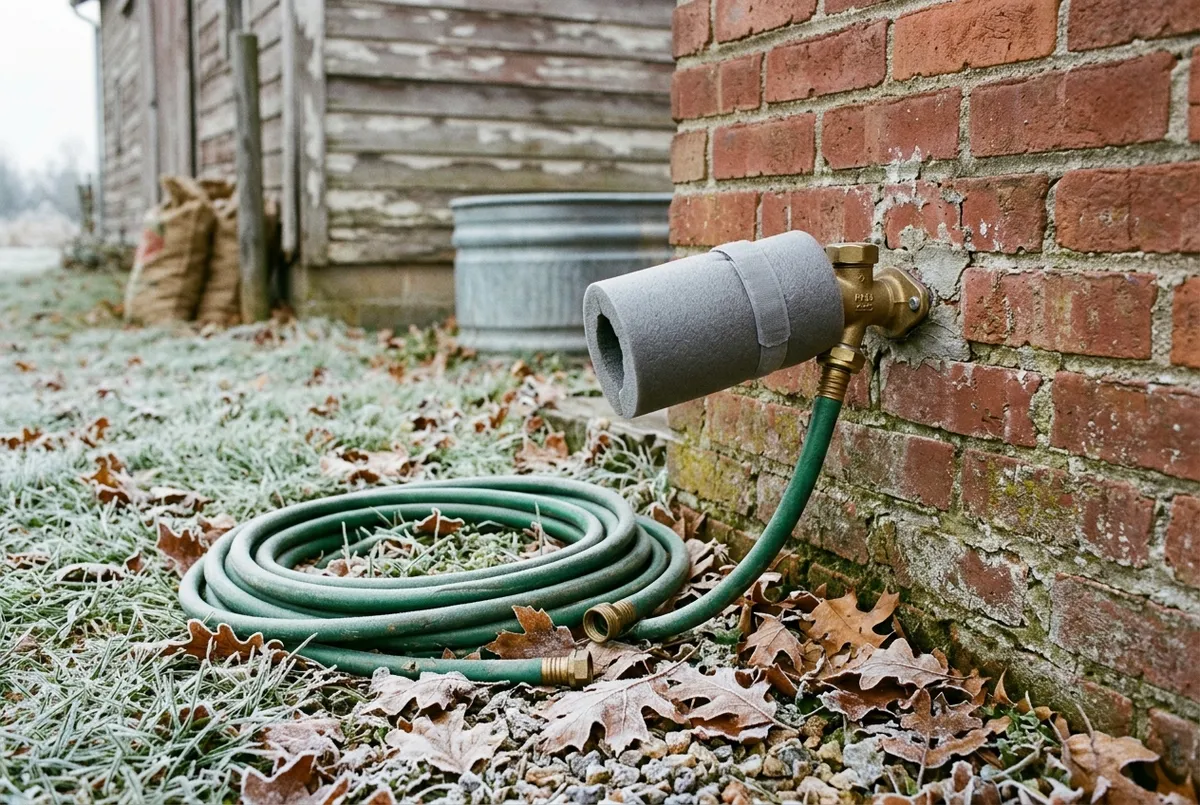
A foam spigot cover, or an insulating wrap for less exposed fixtures, adds a buffer against wind chill and radiant cold, especially useful for spigots on north-facing walls or anywhere backing onto an unheated space. This is a supplement to draining the line, not a replacement for it.
4. Winterize irrigation lines separately
Drip lines, soaker hoses, and any inground or timer-based irrigation system need their own shutoff and drain process, typically following the manufacturer’s instructions for that specific system, since these often hold more standing water across more fittings than a single hose bib does.
5. On the coldest nights, let faucets drip if full shutoff is not possible
For a spigot without an interior shutoff valve, or in a home where isolating that specific line is not practical, letting the faucet drip slightly during the coldest overnight stretches keeps water moving instead of sitting still, which reduces (though does not fully eliminate) freeze risk on those specific nights.
Building This Into the Fall Routine
Frost-proofing outdoor plumbing is one piece of a broader fall and winter prep list, and it tends to get overlooked because it is quick rather than because it is unimportant. For a longer list of projects worth tackling while the weather is turning, 5 Backyard Homestead Projects for Slow Winter Weeks covers other tasks that pair naturally with a plumbing walk-around. And if outdoor water access, storage, or a future upgrade to the yard’s water setup is on next year’s list, 2027 Homestead Planning: Budget and Timeline is a useful starting point for sequencing bigger projects against a realistic budget.
The next step is simple: walk the outside of the house this week, note every spigot and hose connection, and check the local NWS office’s forecast for the region’s next freeze warning rather than relying on a national average. For households already thinking about water security beyond a single winter, from storage to filtration for everyday use, that same walk-around is a reasonable moment to take stock of the broader water setup and decide what, if anything, is worth adding before next season.
Frequently Asked Questions
- When should I disconnect my garden hose for winter?
- Before your region's average first freeze date. That runs mid-September to early October across the Midwest and Northeast, and starts in Virginia in early October before moving progressively later further south (NOAA NCEI, October 23, 2023).
- Will a frost-proof spigot still freeze if I leave a hose on it?
- Yes. Frost-free spigots depend on water draining out of the long stem after the valve closes, and a hose left attached traps that water in the line, which defeats the design (University of Illinois Extension, November 26, 2020).
- What temperature does an outdoor faucet actually freeze at?
- NOAA describes a freeze as surface air temperature of 32°F or below over a widespread area for a climatologically significant period of time (NOAA NCEI, October 23, 2023). A hard freeze is a colder threshold whose definition varies by National Weather Service office; the Tallahassee office uses 25°F or below (National Weather Service Tallahassee).
- What's the average first frost date for my state?
- It varies by region rather than following one national date. NOAA's 1991-2020 Climate Normals put the first fall freeze in mid-September to early October across the Midwest and Northeast, with dates running later further south and in most of California and southern Arizona not until at least December (NOAA NCEI, October 23, 2023).
- Do I need to shut off water to outdoor faucets even with frost-free fixtures?
- Yes, if a hose stays attached through winter or the wall cavity around the supply line is poorly insulated. Extension guidance notes frost-free spigots still freeze depending on how cold it gets and how well-insulated that cavity is (University of Illinois Extension, November 26, 2020).
Sources & references
Before you go
The Renter's Homestead Pack
Self-reliance projects for the yard you don't own — container yields, a raised bed built to move with you, balcony preservation basics, and the landlord questions to ask first.
Free guide
The Renter's Homestead Pack
Self-reliance projects for the yard you don't own — container yields, a raised bed built to move with you, balcony preservation basics, and the landlord questions to ask first.