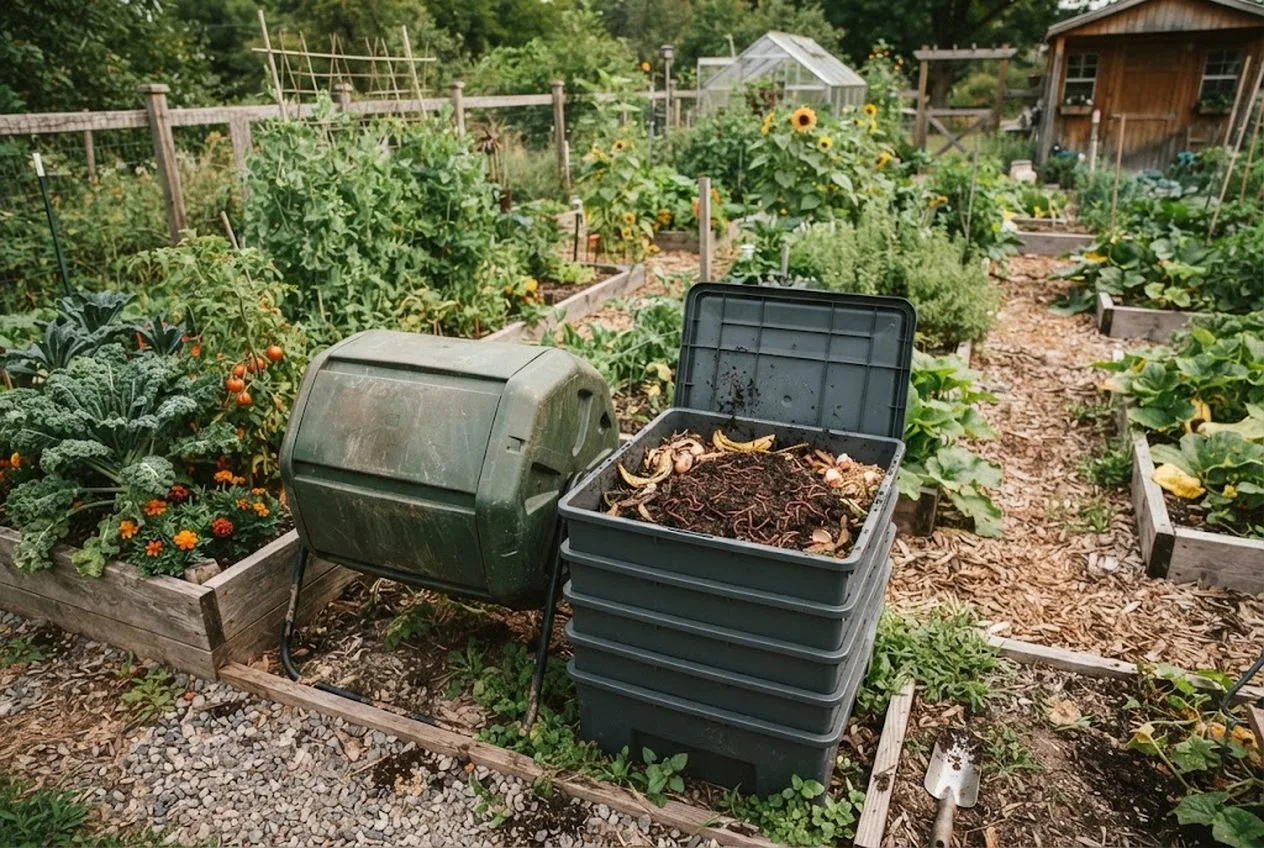
When you decide to stop buying bagged soil amendments and make your own, you hit a fork in the road: the spinning drum of a compost tumbler, or the stacked trays of a worm factory. Both turn kitchen and garden waste into black gold, but they work in completely different ways, run on different timelines, and produce two different products. Buy the wrong one for your household and you’ll end up with a composter that never quite fits how you actually generate waste.
Here it is in one sentence: a tumbler makes a larger amount of good compost in fast warm-season batches, while a worm factory makes a smaller amount of premium castings continuously — including indoors through winter. Pick based on whether you want volume and speed or quality and year-round operation.
The rest of this compares how fast each finishes, what they cost and hold, which waste suits which, and how to choose your first one — or run both.
The Core Difference: Heat vs. Worms
Both composters break organic matter into finished soil, but the biology behind them is opposite, and that drives everything else.
- A compost tumbler runs on aerobic composting. Sealed in the drum, aerobic microbes break the material down, and you speed them along by spinning to mix and aerate; extension guidance notes tumbler volume is usually too small for true hot composting (University of Maryland Extension). It’s a batch process: you fill, it cooks, you empty. Fast in warm weather, dormant in the cold.
- A worm factory runs on vermicomposting. Red wiggler worms eat their way through scraps in stacked trays and leave behind castings — a nutrient-rich amendment full of beneficial microorganisms (Oregon State University Extension). It’s a continuous process that keeps going indoors all winter, as long as the bin stays in the worms’ comfortable temperature range.
That single contrast — hot batches versus a steady worm-driven trickle — explains every decision below.
Speed, Cost, and Output at a Glance
| Compost Tumbler | Worm Factory | |
|---|---|---|
| How it works | Aerobic; spin to aerate | Worms digest scraps into castings |
| Speed | As little as 2–3 weeks per full batch (turned daily) | Continuous; steady output |
| Winter | Slows or stops when it freezes | Keeps working indoors year-round |
| Volume | Higher — amends whole beds | Lower — a potent top-dressing |
| Product | Good all-purpose compost | Premium worm castings |
| Best waste | Broad; tougher garden waste | Picky; best kitchen scraps only |
| Effort | Spin every day or two | Feed and harvest trays; low fuss |
Notice the tumbler is a volume-and-speed tool and the worm factory is a quality-and-continuity tool. The tumbler gives you enough finished compost to actually amend beds; the worm bin gives you a smaller amount of something richer, and it never takes the winter off.
When to Reach for a Compost Tumbler
Choose a tumbler if your priority is volume and a fast fall batch. It processes a broad range of kitchen and garden waste, handles tougher material worms won’t touch, and — loaded as a full batch and turned daily — can hand you usable compost in as little as two to three weeks (University of Arkansas Extension) to top-dress your beds before the freeze. It’s also pest-resistant and low-effort, spinning where a pile would need forking.
Disclosure: the product links here are affiliate links, so we may earn a commission if you buy through them at no extra cost to you. The comparisons here reflect the mechanics of each method and long-standing composting guidance, not brand marketing.
Its limits are volume ceiling and the winter pause: a drum holds far less than a big bin, and it goes dormant once it freezes. Our full dual-chamber compost tumbler review digs into how fast it really works and how it compares to a plain stationary bin.
When to Choose a Worm Factory
Reach for a worm factory if you want the highest-quality amendment and year-round operation. A stacked-tray system like the Worm Factory 360 lets worms migrate upward into fresh trays as new food is added (Nature’s Footprint), so harvesting finished castings is as simple as lifting off the bottom tray. Kept in a basement, garage, or mudroom, a well-tended bin is odorless (Oregon State University Extension), compact, and — crucially — it keeps composting through winter while your tumbler is frozen solid.
The catch is that a worm bin is only as good as its worms, and you’ll need to stock it with the right ones: red wigglers, the composting species that thrive in a shallow tray environment and eat prodigiously.
Worms are pickier than a hot pile — no meat, dairy, oily food, or heavy citrus and onion (Oregon State University Extension) — and the output is smaller in volume. What you get in return is a nutrient-rich, biologically active amendment you can use straight from the bin.
The Best Move: Run Both
Like most homestead tools, these two aren’t really rivals — they’re a pair. The most resilient soil-making setup uses a tumbler for volume and tougher waste and a worm factory for premium castings and winter operation. The tumbler produces enough finished compost to amend whole beds each season; the worms turn your best kitchen scraps into a concentrated booster for potting mix and a top-dressing for seedlings. Between them you cover both quantity and quality, and you’re never composting-less in January.
So Which Should You Buy First?
Let your waste stream and your goals decide:
- Start with a tumbler if you generate a lot of mixed kitchen and garden waste and want a bed-amending quantity of compost fast, especially a fall batch before the freeze.
- Start with a worm factory if you want the highest-quality amendment, year-round operation, and a tidy system that lives indoors — even in an apartment or a garage.
- Own both eventually and you get the full range: bulk compost from the drum, premium castings from the worms, and something making soil no matter the season.
Whichever you choose, homemade compost is one of the cheapest and best things you can feed your garden — and if the budget for either system isn’t there yet, our DIY compost bin for $0 build gets scraps composting for free while you decide. Put it to work in the beds you’re prepping this fall — our guide to building fall garden soil with coco coir and a broadfork shows exactly where finished compost fits in a no-till bed.
Frequently Asked Questions
- Which makes finished soil faster, a tumbler or a worm bin?
- It's close, and it depends on conditions. A compost tumbler is faster in warm weather — as little as two to three weeks for a full batch when you turn it daily and keep the greens and browns balanced. A worm factory works at a steadier pace, producing rich castings continuously rather than in batches, and it keeps going indoors through winter when a tumbler stalls. For a single fast batch in fall, the tumbler usually wins; for a year-round trickle of the highest-quality soil amendment, worms win.
- Is worm compost better than regular compost?
- Worm castings are often treated as the premium end of compost — rich in beneficial microorganisms and nutrients such as nitrogen, phosphorus, and potassium, and usable straight from the bin as a top-dressing or potting-mix blend. The trade-off is quantity: a worm bin produces castings in modest amounts, so it's less a bulk soil-builder than a potent top-dressing and potting-mix booster. Tumbler compost gives you more volume to actually amend beds with; worm castings give you a smaller amount of something richer.
- Can a worm factory live indoors?
- Yes, and that's one of its biggest advantages. A well-managed worm bin is odorless and compact enough to keep in a basement, garage, mudroom, or under a counter, which means it keeps composting all winter while an outdoor tumbler freezes and goes dormant. The worms need to stay in a comfortable range — roughly 55–77°F — so an unheated space in deep cold may still slow them, but indoors they run year-round in a way a tumbler simply can't.
- What can't you put in a worm bin that a tumbler handles?
- Worms are pickier eaters. Skip meat, dairy, oily food, and large amounts of citrus or onion in a worm bin, and go easy on anything that heats up or turns acidic. A compost tumbler is more omnivorous and can process a wider range of garden and kitchen waste, including tougher material like spent plants and small amounts of things worms won't touch. If your waste stream is varied and bulky, the tumbler is the more forgiving home for it.
- Do I need to choose just one?
- No — the two are complementary, not competing. Many gardeners run a tumbler for volume and fast batches of bed-amending compost and a worm factory for a steady supply of premium castings to boost potting mix and top-dress seedlings. The tumbler handles the bulk and the tougher waste; the worms turn your best kitchen scraps into the richest amendment you can make. Together they cover both quantity and quality.
Sources & references
Before you go
The Renter's Homestead Pack
Self-reliance projects for the yard you don't own — container yields, a raised bed built to move with you, balcony preservation basics, and the landlord questions to ask first.
Free guide
The Renter's Homestead Pack
Self-reliance projects for the yard you don't own — container yields, a raised bed built to move with you, balcony preservation basics, and the landlord questions to ask first.