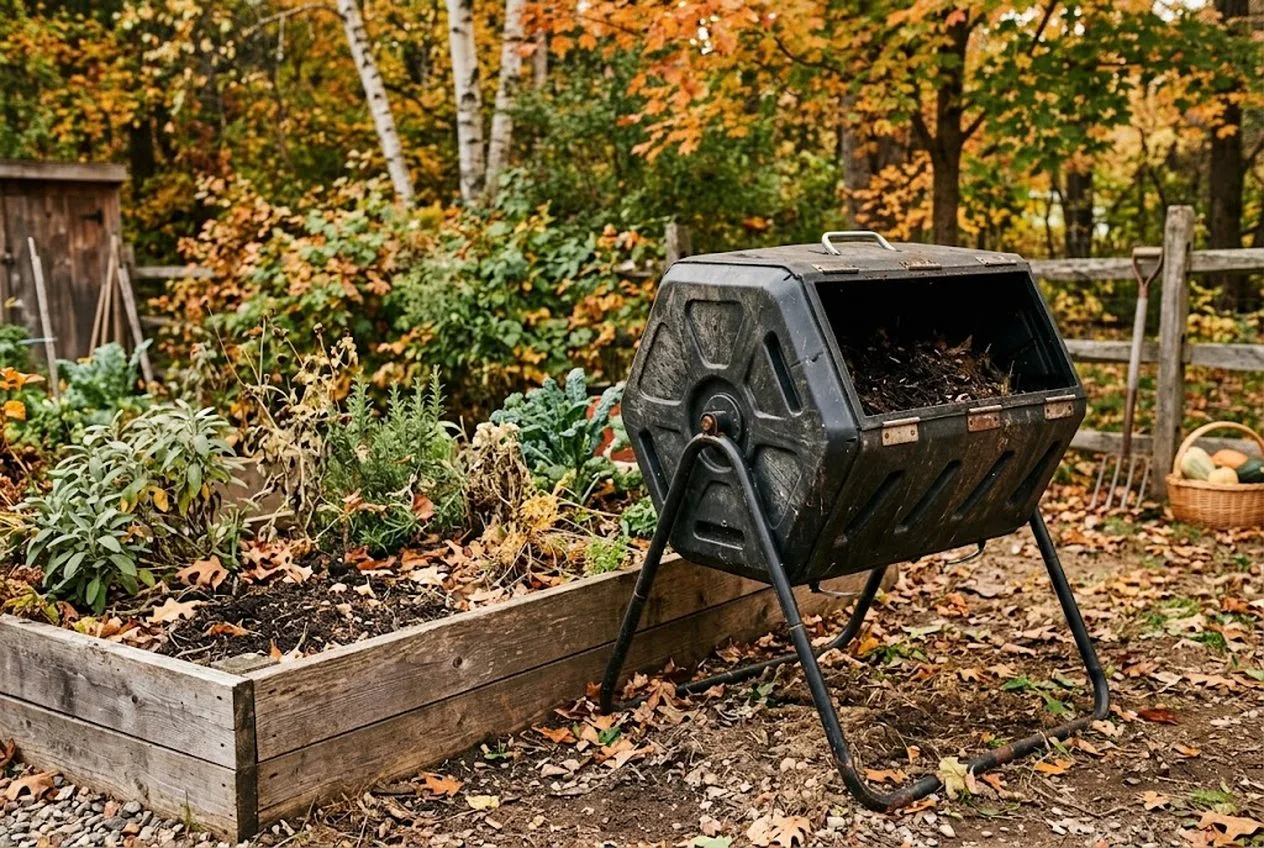
If you want a batch of finished compost ready to feed your beds before winter shuts the garden down, the tool most likely to get you there is a compost tumbler — a sealed drum on a frame that you spin to mix and aerate the contents. The pitch is faster, cleaner, pest-proof compost with none of the fork-and-sweat of turning an open pile. The question is whether the reality lives up to it, and whether the pricier dual-chamber design earns its keep over a plain bin.
Short answer: a dual-chamber tumbler is genuinely faster and far less work than an open pile, and the two chambers fix the one flaw that makes single tumblers frustrating. It only approaches the fast times on the box when you load a full batch and turn it daily, and it holds less than a big stationary bin, but for a household feeding it steady kitchen and garden waste it’s the setup most likely to hand you finished compost by the first freeze. Here’s the full picture.
Disclosure: the product links here are affiliate links, so we may earn a commission if you buy through them at no extra cost to you. This assessment is built from the design’s mechanics and the cited sources, not a controlled side-by-side test of every tumbler on the market.
What a Dual-Chamber Tumbler Actually Does
A compost tumbler is a closed drum mounted on a stand so it spins on its axis. You load greens and browns through a hatch, close it, and give it a few rotations every day or two. That spinning does three useful things at once: it mixes the material so everything decomposes evenly, it aerates it so the fast, hot, aerobic microbes stay active, and the sealed drum holds moisture that an open pile can lose. Those are precisely the conditions that speed composting, which is why a turned, enclosed drum outpaces a pile you rarely get around to forking.
The dual-chamber part addresses the classic single-tumbler problem. With one drum, you can never stop adding scraps long enough for a batch to finish — every handful of fresh kitchen waste resets the clock. Two chambers let you fill one side while the other cures. When the first is full you leave it to finish and switch to feeding the second, so you always have a batch maturing toward “done” instead of one perpetually half-composted drum.
The Case For It
It’s fast — realistically. A full batch, turned daily with a good carbon-to-nitrogen mix, can yield usable compost in as little as two to three weeks (University of Arkansas Extension); a drum you keep topping up with fresh scraps takes longer. That’s still much quicker than a neglected pile, and the reason is simple: the tumbler makes turning easy enough that you’ll actually do it often, and frequent turning is what drives fast compost.
It’s clean and pest-resistant. An enclosed container with no large gaps is what keeps rodents out of compost (EPA), and the drum keeps the whole operation tidy — no exposed heap, no smell when it’s balanced right. For a suburban lot or anywhere with a rat or dog problem, that alone can be the deciding factor.
It’s low-effort and back-friendly. Spinning a balanced drum takes a fraction of the effort of turning a pile with a fork. If a bad back has kept you from composting, a tumbler removes the physical barrier.
It’s elevated and dry. Off the ground on a frame, it drains and stays out of standing water, and you can position it on a patio or deck where an open bin would never work.
The Trade-Offs
No tool is all upside, and a tumbler’s limits are worth knowing before you buy.
Volume is the big one. A drum holds a fraction of what a big stationary bin does, and extension guidance notes tumbler volume is usually inadequate for hot composting (University of Maryland Extension). If your garden generates piles of leaves, spent plants, and grass clippings, a tumbler simply can’t swallow it all — it’s built for a steady trickle of kitchen scraps and modest garden waste, not a bulk operation.
Cold weather stops it. The insulation is limited, so as temperatures fall the microbes go dormant and decomposition slows or halts. In fall, that means getting a batch cooking now to finish before hard freezes, then using the drum over winter mainly as a sealed holding vessel.
Balance still matters. A tumbler is forgiving but not magic. Overload it with wet greens and it turns to sludge and smells; the fix is always more dry browns — shredded leaves, cardboard — and a few extra turns (EPA).
Pros
- Two chambers give a genuine finished batch on a rolling basis
- Spinning mixes and aerates with almost no effort — back-friendly
- Sealed drum is pest-resistant and low-odor
- Holds moisture and aerates for faster decomposition than a neglected pile
- Elevated and mobile — works on a patio or hard surface
Cons
- Holds far less than a big stationary bin
- Slows or stops in freezing weather
- Fast '2-week' results need full batches and daily turning
- Still needs a sensible green-to-brown balance
Tumbler vs. a Stationary Bin
The honest comparison isn’t tumbler-versus-nothing, it’s tumbler-versus-bin. A plain stationary compost bin costs much less and holds far more, which makes it the better tool for a high-output garden drowning in leaves and spent crops. Its downsides are the ones the tumbler solves: it’s open to pests, it’s harder to turn, and it composts more slowly unless you fork it regularly.
For many homesteads the answer is both — a tumbler for fast, clean kitchen-scrap batches and a big bin for bulk garden waste. We break down the full decision, including the worm-bin option, in our compost tumbler vs. worm factory comparison.
The Bottom Line
A dual-chamber compost tumbler earns a strong recommendation for the gardener it’s built for: limited space, a pest problem, back concerns, or simply a desire for clean, fast compost without forking a heap. The two chambers are the feature that makes it genuinely useful rather than perpetually half-done, and if you start a batch now it can hand you finished compost to top-dress your beds before the ground freezes.
Buy it understanding its limits — modest volume and a winter pause — and pair it with a bigger bin if your garden runs heavy on bulk waste. Either way, homemade compost is one of the cheapest, best soil amendments there is; feed it back into the beds you built this fall, the same ones covered in our guide to building fall garden soil with coco coir and a broadfork.
Frequently Asked Questions
- Does a compost tumbler actually make compost faster?
- Yes, meaningfully faster than a neglected pile, though the fast times depend on how you run it. The tumbler's sealed drum holds moisture and the spinning mixes and aerates the material every time you turn it, which are exactly the conditions that speed decomposition. Loaded as a full batch and turned daily with a good carbon-to-nitrogen mix, a tumbler can produce usable compost in as little as two to three weeks; a drum you keep topping up takes longer. What a tumbler really beats is the effort and mess of turning a pile with a fork — the speed gain comes from actually turning it often, which the design makes easy enough that you'll do it.
- What's the point of two chambers?
- Two chambers solve the biggest flaw of a single tumbler: you can never stop adding material long enough to let a batch finish. With a dual-chamber design you fill one side and let it cure while you feed fresh scraps into the other, then swap. That gives you a genuine finished batch on a rolling basis instead of one perpetually half-done drum. For a household that generates kitchen and garden waste continuously, the two-chamber workflow is the feature that makes a tumbler practical.
- Can you use a compost tumbler through winter?
- You can keep adding to it, but decomposition slows dramatically or stops once temperatures drop, because the microbes that break material down go dormant in the cold. The realistic fall strategy is to get a batch cooking now and finish it before hard freezes set in, then use the tumbler over winter mainly as a sealed holding vessel for scraps that will break down when it warms again. A tumbler's insulation is limited, so don't expect active composting in freezing weather.
- Do compost tumblers smell or attract pests?
- Far less than an open pile, which is one of their main advantages. The enclosed drum helps keep rodents and raccoons out and, when you keep the green-to-brown ratio balanced and the contents from going waterlogged, it stays earthy rather than foul. Smell almost always means too much wet 'green' material or not enough air — add dry browns like shredded leaves or cardboard and give it a few extra turns and it corrects quickly.
- Is a tumbler worth it over a cheap stationary bin?
- It depends on your priorities. A tumbler costs more but turns easily, keeps pests out, and produces cleaner, faster compost with no fork work — ideal if you have limited space, back concerns, or a pest problem. A stationary bin holds far more volume for less money and is better for a high-output garden that generates more material than a drum can hold. Many homesteads run both: a tumbler for fast kitchen-scrap batches and a big bin for bulk garden waste.
Sources & references
Before you go
The Renter's Homestead Pack
Self-reliance projects for the yard you don't own — container yields, a raised bed built to move with you, balcony preservation basics, and the landlord questions to ask first.
Free guide
The Renter's Homestead Pack
Self-reliance projects for the yard you don't own — container yields, a raised bed built to move with you, balcony preservation basics, and the landlord questions to ask first.