What’s the short answer?
- Carrots, parsnips and turnips freeze well after blanching, beets and winter squash after cooking; baked or boiled potatoes tend to thaw soft and mealy.
- A root cellar keeps vegetables fresh and raw; a freezer preserves them in a blanched or cooked state, so the two aren't interchangeable.
- Onions and garlic store best cold and fairly dry (32-40°F, 65-70% humidity) and winter squash at 50-55°F, so they rarely need freezer space.
- Freezer burn is mainly a quality issue, not a safety one, and comes from food that isn't wrapped tightly enough.
- Portioning into meal-ready, diced amounts before bagging makes a Thanksgiving-sized harvest easier to cook from all winter.
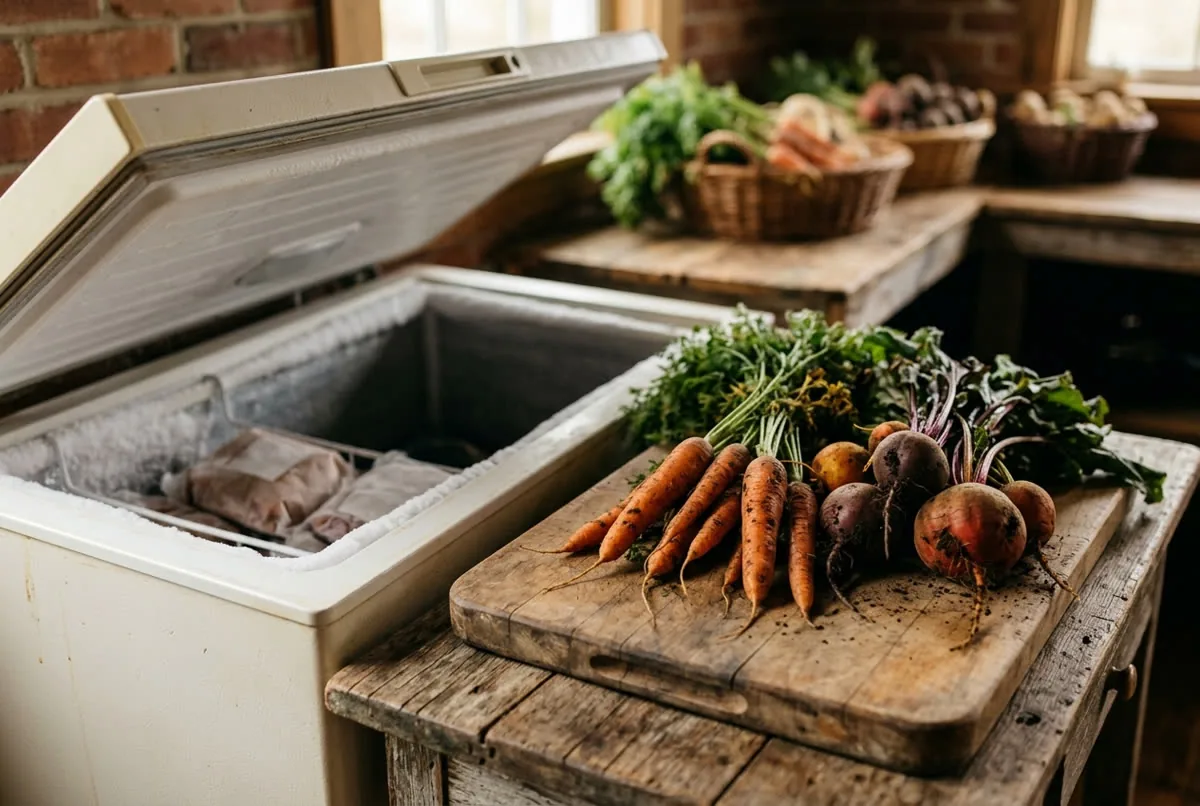
The last of the carrots and beets are out of the ground, the squash is cured on the porch, and Thanksgiving is close enough that the harvest needs a real plan instead of a corner of the garage. Most yards don’t have a root cellar, and a lot of what’s left in the basket won’t hold in a kitchen cabinet past a few weeks. A chest freezer or the extra shelf in a standard fridge-freezer is what most households actually have on hand, so the question isn’t whether to use one, it’s how to use it well.
The short answer: Carrots, beets, parsnips and winter squash freeze well once blanched (or, for beets and squash, cooked) and cut into meal-ready portions, while onions, garlic and squash still do better in cool, drier storage than in the freezer; potatoes are the one root vegetable that needs specific prep to avoid a soft, mealy texture after freezing.
Root Cellar or Deep Freeze? They Solve Different Problems
It’s tempting to treat a chest freezer as a substitute root cellar, but the two systems preserve food in different states. A root cellar keeps vegetables fresh and raw, holding them at cold, humid conditions so they stay crisp and usable exactly as they came out of the ground. Carrots keep 4 to 6 months at 32-35°F and 98-100% humidity, and potatoes 5 to 8 months at 40°F and 90-95% humidity, while onions and garlic want drier air, around 32-40°F and 65-70% humidity, and winter squash wants 50-55°F (Iowa State University Extension).
A freezer doesn’t hold vegetables in that fresh state. It shifts them into a blanched or cooked state, which is a different kind of preservation with a different texture on the other end. That’s a useful trade for a lot of households, since not everyone has a basement, root cellar or unheated shed that can hold steady humidity and temperature all winter. But it means root cellaring and deep freezing aren’t interchangeable techniques you swap based on convenience. Pick freezing for vegetables you plan to cook from frozen in soups, stews and sides, and reserve cool-dry or cold-moist storage for what you want to use fresh.
Which Root Vegetables Actually Freeze Well
Not every root in the Thanksgiving harvest handles the freezer the same way. The vegetables that hold up best in the freezer are largely the same ones that already show up in root-cellar guidance: carrots, beets, parsnips and winter squash (Iowa State University Extension). These crops keep their structure well enough after blanching or cooking that diced or cubed portions cook up close to their fresh texture in a pot of stew.
Turnips and rutabagas, which the same extension guidance lists alongside parsnips for roughly 2 to 6 months of cold-moist storage, also freeze reasonably once cut into chunks and blanched. Cabbage is a mixed case: it can be frozen, but it’s better suited to root-cellar or fridge storage if you want it for slaws or fresh sides rather than cooked dishes.
Potatoes are the exception worth remembering. Baked or boiled potatoes are on NCHFP’s list of foods that don’t freeze well, coming out soft, crumbly, water-logged and mealy (National Center for Home Food Preservation). If potatoes are a big part of the harvest, follow a tested method such as blanching small new potatoes or par-frying mature ones as french fries before freezing, or simply route them to cold-moist storage at 40°F instead, where they hold for 5 to 8 months (Iowa State University Extension).
For a renter or a small yard without a basement or shed, the calculus tips further toward the freezer by default, since damp sand boxes and cool-dry shelving aren’t always available. In that case, prioritize freezer space for the roots that genuinely need cold-moist conditions to last, carrots, beets, parsnips and turnips, and treat cabbage as a short-term fridge item instead of a long-term storage project.
Blanching Before You Freeze
Blanching, a short dunk in boiling water followed by an ice-water bath, is the step that keeps frozen root vegetables from turning limp and off-color over the winter. It stops the enzyme activity that can cost a vegetable its flavor, color and texture even after it’s frozen (National Center for Home Food Preservation). Skip it, and carrots that go straight into a freezer bag raw tend to lose color and turn soft faster once thawed. Beets are the exception to the blanch-only rule: NCHFP has you cook them until tender, cool them, then slice or cube before freezing (National Center for Home Food Preservation).
Exact blanching times vary by vegetable and by how small you’ve cut the pieces, and that’s not a number worth guessing at. For those specifics, defer to a state Cooperative Extension office or the National Center for Home Food Preservation, which publish vegetable-by-vegetable blanching charts built for home kitchens. The general shape holds across roots: cut to a consistent size first, blanch briefly, then shock in ice water immediately so the pieces stop cooking before you bag and freeze them. Consistent sizing matters as much as the blanching step itself, since unevenly cut pieces blanch unevenly and freeze unevenly too.
Winter squash is usually handled a little differently, since it’s often cooked and pureed or cubed after roasting rather than blanched raw. Either approach fits under the same deep-freeze umbrella as the blanched roots, as long as the squash is fully cooled before it goes into the freezer.
How Long Frozen Roots Stay Safe and Good to Eat
Freezing generally holds a vegetable’s nutritional quality better than sitting at room temperature would, but that only works if the freezer stays consistently cold and the packaging is sealed tight. Freezers should hold 0°F or lower, and wrapping tightly helps maintain quality and prevent freezer burn (Ohio State University Extension); bags with air pockets left in them are a common reason frozen roots turn freezer-burned and dehydrated well before a winter is over.
Quality and safety aren’t quite the same question here. A well-sealed, consistently frozen root vegetable can stay safe to eat far longer than it stays good to eat. Freezer-burned food is usually still safe to eat; the damage is to the surface, flavor and texture (Iowa State University Extension AnswerLine), which is why the packaging and temperature consistency matter more for a Thanksgiving harvest than a hard countdown clock. If your freezer has had a habit of losing power or running warm, that’s the detail to fix before you trust it with months of stored roots.
That consistency question matters most for households where the power supply to the freezer isn’t a given year-round, whether that’s an older chest freezer in a detached garage or a home that’s seen its share of winter outages. A deep-cycle battery bank sized to keep a chest freezer running through a multi-hour outage protects the same harvest you just spent an afternoon blanching and bagging, which is a smaller investment than redoing the whole batch after a thaw.
Packaging Meal-Ready Portions to Beat Freezer Burn
The best defense against freezer burn is also the most useful trick for a small household: portion before you freeze, not after. Cutting carrots, beets, parsnips and squash into diced or cubed, meal-ready portions before bagging means each package is sized for one pot of soup or stew, so nothing sits half-thawed in the freezer while you decide what to do with the rest. NCHFP’s own packaging advice is to pack foods in single-meal quantities with as little air as possible and to label each package with the product and date (National Center for Home Food Preservation).
Press as much air out of each bag as you can before sealing, lay bags flat in the early days so they freeze quickly and evenly, and label each one with the vegetable and the date it went in. A wooden crate or bin near the freezer works well as a staging area to sort blanched, cooled vegetables into portions before they get bagged, especially if you’re processing a full Thanksgiving-sized harvest in one session rather than a handful at a time. Flat, well-sealed bags also stack more efficiently in a chest freezer than round containers do, which matters if the same freezer is also holding meat or other bulk food.
Vegetables That Skip Both the Cellar and the Freezer Debate
Not everything in a fall garden belongs in this conversation at all. Sweet corn, peas and green beans are poor candidates for long-term cold-cellar storage in the first place, and the standard advice for them is to can, freeze, ferment or dehydrate soon after harvest rather than trying to hold them fresh. For these crops, freezing usually is the right call, and quickly, rather than a choice between two storage methods the way it is for carrots or beets.
That distinction is worth keeping straight when you’re sorting a big harvest: root vegetables have a real choice between cold-moist storage and the freezer, while corn, peas and green beans mostly don’t. Treating every vegetable in the basket the same way, whether that means freezing all of it or cellaring all of it, is where a lot of Thanksgiving harvests lose quality they didn’t need to lose.
Minutes in the Pot for Each Root
Timing differs by vegetable and by how the pieces are cut. Colorado State University Extension lists these home-freezing times (Colorado State University Extension, 2025-08):
- Carrots: water blanch whole carrots 6 minutes, or diced or sliced carrots 3 minutes.
- Turnips and parsnips: cut into 1/2-inch cubes and water blanch 3 minutes.
- Potatoes: cut into 1/4- to 1/2-inch cubes and water blanch 4-6 minutes.
- Beets: cook in boiling water until tender, 25-30 minutes for small beets and 45-50 minutes for medium-sized beets, then cool, peel, and slice or cube.
- Sweet potatoes: cook until almost tender, cool, and peel. Dip halves or slices for 5 minutes in a citric acid or lemon juice solution to prevent darkening.
After blanching, cool and drain the pieces, then dry pack them with headspace in the freezer container. Larger carrots are diced or sliced 1/4-inch thick before the 3-minute blanch.
What to Do With the Rest of the Harvest
Not every root vegetable needs a spot in the freezer this season. Onions and garlic generally hold up better in cold, fairly dry storage, around 32-40°F and 65-70% humidity, and winter squash at 50-55°F, than they do frozen (Iowa State University Extension). A shelf in an unheated shed, garage corner or basement stairwell, with vegetables spread out in open crates rather than stacked in bags, does the job without tying up freezer space you’d rather use for blanched carrots and beets.
Splitting the harvest this way, freezer for the roots that freeze well, cool-dry storage for the ones that don’t need it, gets more out of a Thanksgiving harvest than committing everything to one method.
Start by sorting what’s left in the basket into three piles: roots to blanch and freeze, alliums and squash for cool-dry storage, and anything, like corn or green beans, that needs canning or freezing right away regardless. Process the freezer pile in one sitting if you can, since blanching and portioning go faster in a single afternoon than spread across a week of half-finished batches. For the tool care and season-closing chores that come after the harvest is in, cleaning, sharpening and oiling garden tools for winter and dealing with the trimmings and scraps left over from processing round out the last of the fall garden work before the ground freezes for good.
Frequently Asked Questions
- Which root vegetables actually freeze well without turning mushy?
- Carrots, parsnips, turnips and rutabagas freeze well once blanched, and beets and winter squash freeze well once cooked. Potatoes are the exception: baked or boiled potatoes tend to thaw soft and mealy, so NCHFP guidance blanches small new potatoes or par-fries mature ones as french fries instead.
- Do I need to blanch carrots or beets before freezing my Thanksgiving harvest?
- Carrots, yes. Blanching briefly in boiling water and then cooling quickly stops the enzyme activity that would otherwise cost flavor, color and texture in the freezer. Beets are handled differently: NCHFP has you cook them until tender, then cool, slice or cube and freeze. Exact times vary by vegetable, so follow a Cooperative Extension or NCHFP chart for specifics.
- How long can frozen root vegetables safely stay in the freezer?
- Vegetables stay safe far longer than they stay at peak quality, as long as the freezer holds a consistent 0°F or lower and the packaging is sealed tight. Freezer burn from loose packaging hurts flavor and texture, and freezer-burned food is usually still safe to eat.
- Is deep-freezing better than using an improvised root cellar in a suburban home?
- It depends on the vegetable. A root cellar keeps produce fresh and raw, while a freezer preserves it in a blanched or cooked state. For carrots, beets, parsnips and squash, either works; for onions, garlic and winter squash, cool, drier storage generally holds up better than the freezer.
- How should I package frozen roots to avoid freezer burn over the winter?
- Cut vegetables into meal-ready, diced or cubed portions before bagging, press out as much air as possible, lay bags flat to freeze quickly, and label each one with the vegetable and date.
Sources & references
- Iowa State University Extension, Storing winter storage vegetables (opens in new tab)
- National Center for Home Food Preservation, Blanching vegetables (opens in new tab)
- National Center for Home Food Preservation, Foods that do not freeze well (opens in new tab)
- National Center for Home Food Preservation, Freezing beets (opens in new tab)
- National Center for Home Food Preservation, Packaging and labeling foods (opens in new tab)
- Ohio State University Extension, Freezer storage (opens in new tab)
- Iowa State University Extension AnswerLine, Freezer burn and food safety (opens in new tab)
- Colorado State University Extension, Freezing vegetables (opens in new tab)
Before you go
The Renter's Homestead Pack
Self-reliance projects for the yard you don't own — container yields, a raised bed built to move with you, balcony preservation basics, and the landlord questions to ask first.
Free guide
The Renter's Homestead Pack
Self-reliance projects for the yard you don't own — container yields, a raised bed built to move with you, balcony preservation basics, and the landlord questions to ask first.