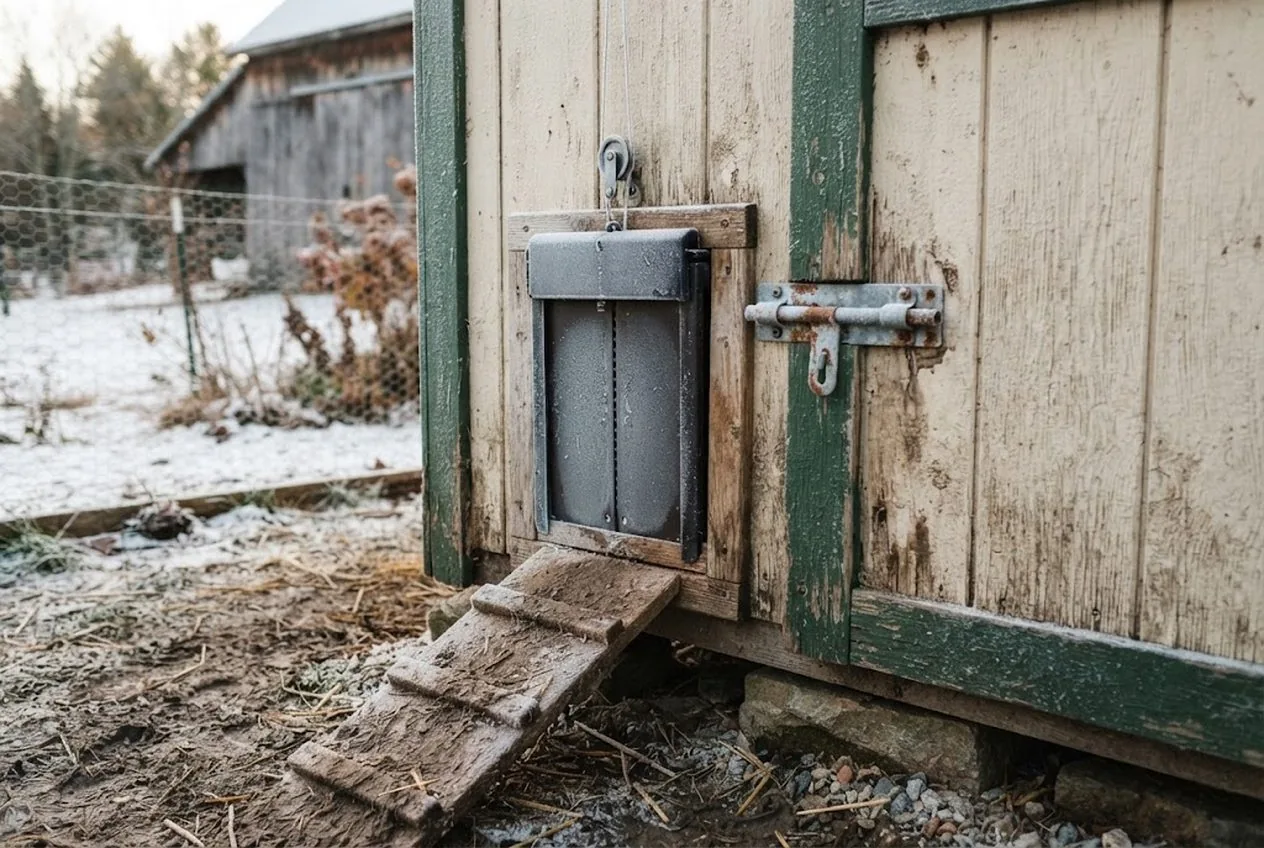
The pop-door is the one coop chore you truly can’t skip. Chickens must be let out at first light and shut in tight after they roost — extension guidance is to close birds in securely every night (Penn State Extension) — because a coop left open at dusk is how a flock gets wiped out by a single raccoon; raccoons that get into a poultry house often take several birds in one night (eXtension). In summer the dawn-and-dusk routine is a pleasant walk. In winter it’s a trek into the cold and dark at both ends of the day — exactly when it’s most tempting to put off, and most costly to forget. That’s what puts the question on the table every fall: is an automatic coop door worth it, or does a manual latch do the job just as well?
Short answer: an automatic door wins on consistency and convenience — it locks the flock in every single night regardless of the weather or your schedule, which matters most in winter — while a manual latch wins on cost, simplicity, and having nothing to fail. If the twice-daily timing is a burden or you’re ever away at dusk, automation is worth it; if you’re reliably home and don’t mind the walk, a good latch is perfectly safe. Here’s how they actually compare when it’s cold.
Disclosure: this comparison reflects standard backyard-coop practice and manufacturer specifications rather than a bench test of every door on the market, and the product link here is an affiliate link. With that said, here’s the head-to-head.
Automatic vs Manual: Side-by-Side
| Automatic Door | Manual Latch | |
|---|---|---|
| Upfront cost | Moderate (motor + kit) | Very low (a bolt or slide latch) |
| Daily effort | None once set | Two trips a day, every day |
| Winter reliability | Good on quality units; cold/ice can jam cheap ones | Total — nothing to freeze or fail |
| Predator protection | Consistent — never forgotten | Only as good as your discipline |
| Power needed | Solar, battery, or mains | None |
| Failure mode | Motor, battery, or ice jam | Human forgetfulness |
| Best for | Busy keepers, away at dusk, harsh dark winters | Home-based keepers who don’t mind the walk |
The two decisive rows are daily effort and winter reliability — and they pull in opposite directions, which is exactly why this is a genuine choice rather than a blowout.
The Case for the Automatic Door
The automatic door’s whole pitch is consistency. It opens at dawn and closes after the flock roosts at dusk, on a light sensor or timer, every day without fail. It doesn’t forget, doesn’t get talked out of the walk on a sleety January night, and doesn’t leave the coop open because you got home late. Since predator protection is only as reliable as the person doing the latching, removing the human from the loop is a real security gain — one missed lock-up is all it takes, and winter is when both your discipline and a hungry predator’s motivation are most tested.
In winter the convenience is at its most valuable, because the dawn-and-dusk timing lands in full cold and darkness at both ends. Automating it means never again pulling on boots at 5 a.m. or trudging out after dinner just to slide a bolt.
The honest caveats live in winter too. A cheap door with a weak motor can be slowed by cold or jammed by ice and snow in its track, so this is a place to buy a quality, cold-rated unit and keep the track clear. Power source matters: a solar or battery door keeps working through the grid outages winter storms bring, while a mains-only unit needs a manual override for when the power drops. And the one setup mistake to avoid is a close time set too early — it must close after every bird is reliably in, or a straggler gets shut out in the cold.
The Case for the Manual Latch
Don’t underestimate the humble latch. Its great virtue is that there is nothing to fail — no motor to stall, no battery to die in the cold, no track to ice up, no firmware to glitch. In the depth of winter, when the automatic door is fighting exactly the conditions that stress it, a simple sliding bolt just works. It costs almost nothing, installs in minutes, and lasts indefinitely.
For a keeper who’s home at dusk anyway, the manual door also has a quiet benefit: the twice-daily trip is your daily check. You count the birds, notice the hen that didn’t come in, spot the loose board or the frozen waterer, and catch problems early precisely because you’re out there. Automation removes the chore, but it can also remove the habit of looking.
The single point of failure is human. A manual latch is only as reliable as your memory and your presence — and the cost of forgetting once, on the wrong night, is the whole flock. If you travel, work late, or simply know yourself well enough to admit you’ll skip the walk on the worst evenings, that risk is the real argument for automating.
The Cost and Setup Reality
The price gap is real but smaller than it looks once you factor in a winter of your time. A manual latch is a few dollars — a predator-proof slide bolt or a spring-loaded latch a raccoon can’t work open. An automatic door is a moderate one-time outlay for the motor and kit, plus a little more if you add a solar panel or run a power line. Set against months of twice-daily trips in the cold and dark, a single winter of avoided treks can justify the cost for keepers who value their mornings.
Installation isn’t a barrier either way. Most automatic doors are sold as kits that mount over or replace an existing pop-hole with basic tools in an afternoon — the main checks are that your opening matches the door’s size and that a solar model’s panel can catch sun; the Department of Energy notes that solar panels perform best facing south and away from heavy shade (U.S. Department of Energy). A manual latch is even simpler, but “simple” is exactly its trade: it hands the reliability back to you every single night. The right question isn’t which is easier to install, but which failure mode — a stalled motor or a forgotten latch — you’re more likely to actually suffer.
Which Should You Buy for Winter?
The decision comes down to one question: is the dawn-and-dusk timing a burden you’ll sometimes skip, or a routine you’ll reliably keep?
- Choose an automatic door if you’re ever away at dusk, hate the cold-dark trek, or don’t fully trust yourself to lock up every single night through a long winter. Buy a quality cold-rated unit on solar or battery so a storm outage doesn’t defeat it, and set the close time carefully. The consistency is the security.
- Choose a manual latch if you’re reliably home at roosting time, want the lowest cost and nothing that can freeze or fail, and value the daily trip as your flock check. A sturdy predator-proof bolt, latched without fail, is genuinely all a disciplined keeper needs.
For most keepers the deciding factor is honest self-assessment of winter behavior. If you know the dark evenings will occasionally win, automate — the door pays for itself the first time it locks up on a night you’d have skipped.
Beyond the Door
The door is one piece of a cold-ready coop, not the whole job. Whichever way you go, pair it with dry ventilation, deep-litter bedding, and water that won’t freeze — our guide to winterizing a chicken coop before the first frost covers the full setup, and our heated chicken waterer review tackles the other chore worth automating for winter. If your coop is off-grid, our solar coop automation guide shows how to run an automatic door on a small panel so it stays reliable through the short, cloudy days — and the same panel can power the solar automatic chicken feeder that automates the morning chore too.
The Verdict
- Best for consistency and cold-weather convenience: an automatic coop door — it never forgets the lock-up, which is the whole point of the door.
- Best for cost, simplicity, and freeze-proof reliability: a solid manual latch — nothing to fail, and your daily flock check built in.
Both keep chickens safe when they’re used the way they’re meant to be. The automatic door removes the human error; the manual latch removes the mechanical one. Pick the failure mode you trust least to happen to you, and buy against it.
Frequently Asked Questions
- Do automatic chicken doors work reliably in freezing weather?
- The better ones do, but cold is where cheap units get exposed. Freezing temperatures can slow a weak motor, and ice or snow can jam a door in its track, so winter is exactly when reliability matters most. Look for a model rated for cold-climate use with enough motor torque to break light ice, keep the track clear, and — if it's battery-powered — remember that battery performance drops in cold weather, so a solar-charged or mains unit is more dependable than one on disposable cells in deep winter.
- Is an automatic coop door safe for the chickens?
- Many doors are designed with obstruction detection or a slow, low-force close so they won't harm a bird in the opening, but timing is what keeps it safe. Set the close for after your flock reliably roosts, watch the first several cycles to confirm no straggler gets caught, and keep the track clean so the door moves freely. Set up carefully, an automatic door is far safer than a coop accidentally left open to night predators.
- What happens to an automatic door in a power outage?
- It depends on the power source. A solar-charged or battery unit keeps running through a grid outage, which is a real advantage when a winter storm knocks out power. A mains-only door stops when the grid does, so if you rely on one, keep a manual override and a plan to lock up by hand during outages. Many keepers choose solar or battery models specifically so a storm doesn't leave the coop open.
- Is an automatic coop door worth it if I'm home every day?
- It can still be, because the value isn't only about being away — it's about the timing and the dark. The door has to close after dusk and open at dawn every single day, and in winter that means trekking out in the cold and black twice a day, precisely when it's least pleasant and easiest to put off. If you're reliably home and don't mind the walk, a manual latch is cheaper and perfectly safe; if the dawn-and-dusk timing is a burden, automation buys it back.
- Can I add an automatic door to an existing coop?
- Almost always, yes. Most automatic doors are sold as kits that mount over or replace the existing pop-hole, and they fit a wide range of coop styles with basic tools. The main things to check are that your pop-hole matches the door's opening size and that you have a spot to mount the motor and, for solar models, a panel that catches sun. It's a straightforward afternoon upgrade rather than a rebuild.
Sources & references
- eXtension, Predator management for small and backyard poultry flocks (opens in new tab)
- Penn State Extension, Successfully raising a small flock of laying chickens (opens in new tab)
- FuelEconomy.gov (DOE/EPA), Fuel economy in cold weather (opens in new tab)
- U.S. Department of Energy, Homeowner's guide to going solar (opens in new tab)
Before you go
The Renter's Homestead Pack
Self-reliance projects for the yard you don't own — container yields, a raised bed built to move with you, balcony preservation basics, and the landlord questions to ask first.
Free guide
The Renter's Homestead Pack
Self-reliance projects for the yard you don't own — container yields, a raised bed built to move with you, balcony preservation basics, and the landlord questions to ask first.