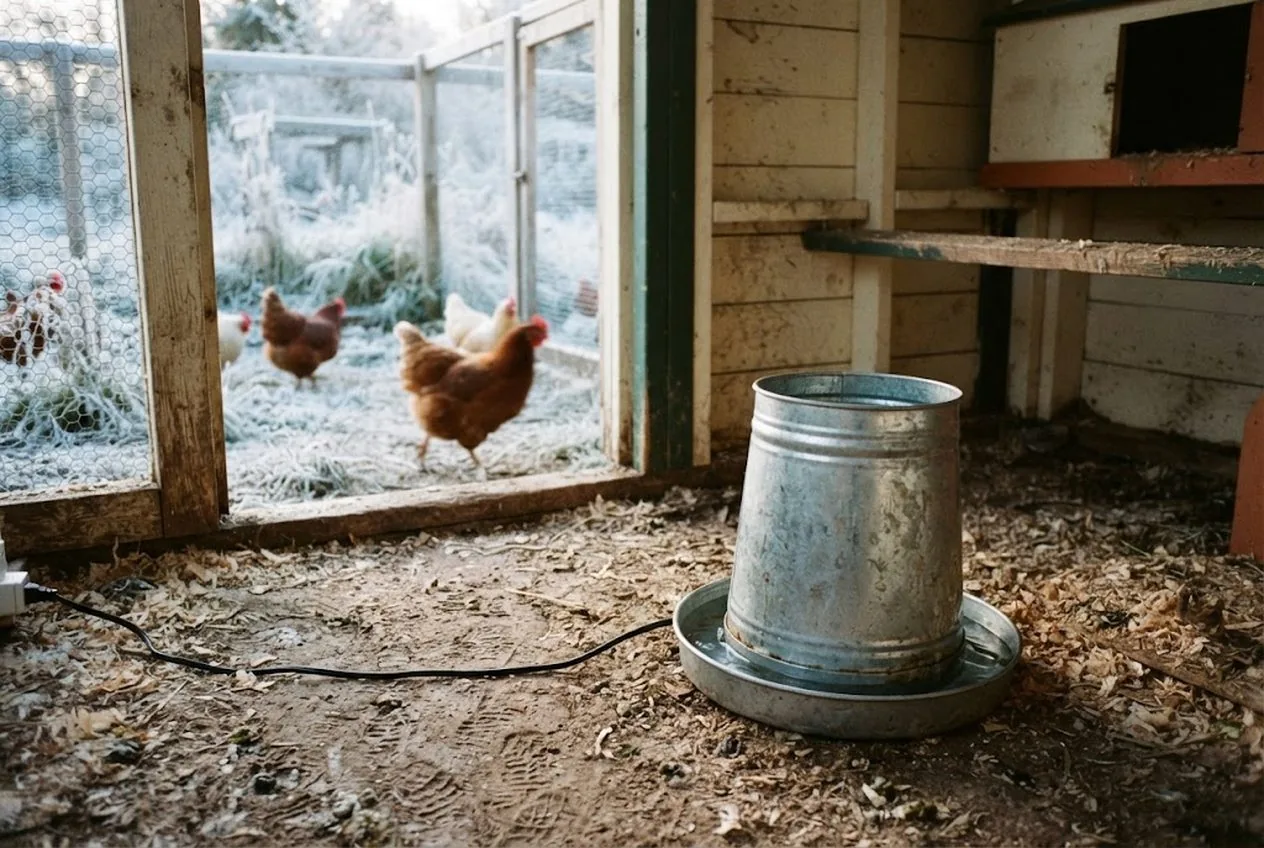
Every backyard chicken keeper in a cold climate hits the same wall around the first hard freeze: the waterer turns to ice overnight, the flock stands around thirsty by mid-morning, and you’re suddenly on the hook for hauling warm water out to the coop two or three times a day until spring. A heated poultry waterer promises to end that chore in one purchase. The fair question this review answers is whether it actually delivers — does it really stop the freeze, and is it worth the money and the extra cord running to the coop?
This is a single-product review of a standard heated poultry waterer — the thermostatically heated founts and heated bases that keep drinking water liquid through winter. If you’re building out the whole cold-weather coop, our guide to winterizing a chicken coop before the first frost puts this piece in context; here we’re focused on the waterer itself.
Short answer: a well-sized heated waterer is a genuinely high-value winter upgrade — it does its one job reliably, uses less power than people expect, and removes the single most tedious and consequential winter chicken chore. Its limits are minor and mostly about placement and power access. For anyone who actually gets hard freezes, it’s an easy recommendation.
Disclosure: the product links here are affiliate links, so we may earn a commission if you buy through them at no extra cost to you. This assessment is built from manufacturer specifications, the cited sources, and cold-climate poultry practice, not a multi-winter teardown of one specific model in our own coop.
Why Winter Water Is the Chore That Matters Most
It’s easy to fixate on keeping chickens warm in winter, but the flock handles cold far better than most keepers assume: adult birds protected from wind and wet weather shouldn’t need added heat even in the coldest part of the year (University of Maryland Extension). Water is the real pressure point. Hens are more sensitive to a lack of water than a lack of feed, and a lack of water for several hours will probably cause a decline in egg production (UF/IFAS Extension), at exactly the season a hen can least afford to lose condition.
That’s what makes a frozen waterer more than an inconvenience. Miss a single mid-day thaw in a hard freeze and the flock goes hours without water; do it repeatedly across a winter and you’ll see it in the eggs and in the birds. A heated waterer’s whole value is that it keeps that lifeline open automatically, so the flock’s intake never depends on whether you got out there with the kettle.
Does It Actually Stop the Freeze?
Yes — this is the part it gets right, and it’s the reason to buy. A heated poultry waterer uses a thermostatically controlled heating element that keeps the water just above freezing. On most designs the element only kicks in as temperatures fall toward freezing and shuts off once the water is warm enough, so it’s holding the water liquid rather than warming it up; Farm Innovators’ HPF-100, for instance, operates only below 35°F and is rated to keep water from freezing down to 0°F (Farm Innovators). Down to well below freezing, a properly sized unit standing in a sheltered spot simply keeps working.
The honest boundary is extreme, sustained cold paired with poor placement. A small waterer sitting exposed in an open, windy run during a prolonged deep freeze can still struggle, because wind chill pulls heat off the water faster than a modest element replaces it. The fix isn’t a bigger heater so much as smarter placement — stand it inside the coop or a wind-sheltered corner, off the cold floor, and it holds temperature far more easily. Treat the rating as “keeps water liquid through normal winter cold,” not “immune to any conditions.”
Running Cost: Cheaper to Run Than It Looks
The sticker on the power bill is what makes people hesitate, but the thermostat is what keeps it reasonable. Because the element cycles — running only when the water approaches freezing and idling whenever it’s warm enough — the average draw across a day is a fraction of the unit’s peak wattage. Typical waterers pull on the order of tens of watts to a bit over a hundred while actively heating, and much less averaged over the freeze-thaw cycle of a normal winter day.
Over a full winter that adds a modest, real amount to a power bill — but weigh it against what it replaces: a daily, weather-dependent chore and the genuine risk of a flock going without water. On that trade, the running cost is easy to justify. You can trim it further by siting the waterer out of the wind so the element cycles less often.
The Real Consideration: Getting Power to the Coop
If there’s a catch, it isn’t the heater — it’s the cord. A heated waterer draws far more than a low-power gadget like an automatic pop-door, so it generally wants mains power. For a coop near the house that’s a protected outdoor extension run to a GFCI outlet; Farm Innovators’ instructions call for a heavy-duty grounded 16/3 AWG cord plugged into a grounded GFCI receptacle and routed away from livestock (Farm Innovators). For a coop at the back of the property it means either running a proper line or going off-grid with a battery and panel sized for the heater’s real draw — not the little kit that runs a door motor.
This is worth planning before you buy. Many keepers land on a hybrid: the door runs on solar year-round because it sips power, while the heated waterer plugs into mains for the coldest months. If your coop is genuinely off-grid, our solar coop automation guide covers how to size the system so the water heater doesn’t flatten your battery on the first cloudy week, and our solar-powered automatic chicken feeder build shows what else that small panel can run.
Pros and Cons
Pros
- Does its one job reliably — keeps water liquid through normal winter cold
- Thermostat cycles the element, so running cost is modest
- Ends the two-or-three-times-daily warm-water haul all winter
- Keeps the flock drinking, eating, and laying in the cold
- Simple and low-maintenance — clean it and check the cord, that's it
Cons
- Needs mains power for most setups; off-grid takes a properly sized battery
- An exposed, undersized unit can struggle in an extreme, windy deep freeze
- Adds a modest amount to the winter power bill
- One more cord in the coop to keep protected and out of the birds' reach
Who Should Buy One — and Who Shouldn’t
Buy it if you get genuine hard freezes and you keep birds through winter. In that world a heated waterer is close to essential: it protects the flock’s water intake, keeps laying steadier, and hands you back the single most tedious cold-weather chore. The upfront cost is small against a winter of dawn water hauls and the risk of missing one.
Think twice if you’re in a mild climate where the waterer freezes only a handful of nights a season. There, a well-insulated waterer, a black rubber tub set in the sun (it absorbs heat, won’t crack, and makes ice easy to break out, per University of Maryland Extension), or simply bringing water out on the rare cold morning may be enough, and the heater’s power access isn’t worth the trouble for a few nights of duty.
The Bottom Line
The heated poultry waterer earns its 8/10 by doing exactly what it claims and removing a chore that genuinely matters. It keeps water liquid through normal winter cold, sips power thanks to its cycling thermostat, and keeps the flock hydrated so they keep eating and laying — all set-and-forget. Its limits are real but small: it wants a power source, and it holds temperature best out of the wind. For a cold-climate backyard flock, it’s one of the most worthwhile winter purchases you can make.
Pair it with the rest of a cold-ready coop — dry ventilation, deep litter, and a door that locks every night — using our coop winterizing guide, and winter chicken-keeping stops being a daily battle.
Frequently Asked Questions
- Does a heated chicken waterer actually keep water from freezing?
- Yes — that's the one job it's built for, and a properly sized unit does it reliably down to well below freezing. A thermostatically controlled heating element keeps the water just above freezing and, on most models, only switches on when temperatures drop, so it's not running constantly; Farm Innovators' HPF-100 fountain, for example, heats only below 35°F and is rated to 0°F. The limit is extreme, sustained cold combined with an undersized or exposed unit: in a deep, prolonged freeze a small waterer in an open run can still struggle, which is why the manufacturer's own instructions say to use it in a sheltered area and protect it from wind.
- How much electricity does a heated poultry waterer use?
- Less than most keepers fear, because the thermostat cycles the element rather than running it flat out. Typical units draw on the order of tens of watts to a bit over a hundred when actively heating — Farm Innovators rates its heated poultry fountain at 100 watts — and far less averaged over a day since they idle whenever the water is warm enough. Over a winter it adds a modest amount to a power bill — real, but small next to the daily labor and the risk to the flock that it removes.
- Do I need to run it on mains power, or will solar work?
- A heated waterer draws far more than a low-power device like an automatic door, so it's usually run from mains power. Off-grid coops can power one from solar, but only with a battery bank and panel sized for the heater's real draw — a small door-sized kit won't carry it. Many keepers run the door on solar year-round but plug the heated waterer into mains for the coldest months.
- Is a heated waterer safe to leave running in a coop?
- It is when it's set up sensibly: use a unit designed for poultry, keep the cord protected and routed away from the birds, run it from a GFCI-protected outlet, and make sure a heated base can't contact the litter, where it could start a fire. The heating elements are low-wattage and thermostatically controlled, so the main precautions are electrical — clean connections, no frayed cords, and a dry, stable spot to stand the unit.
- Is a heated waterer worth it over just carrying out warm water?
- For anyone in a genuine freeze climate, yes. Hauling warm water works for a day or two but becomes a two- or three-times-a-day chore all winter, and the moment you miss a round the flock goes without water — and even several hours without it will probably cut egg production. A heated waterer turns that daily, weather-dependent job into a set-and-forget one for a modest upfront cost. In a mild climate that rarely freezes hard, it's less essential.
Sources & references
- Farm Innovators, Heated Poultry Fountain HPF-100 (opens in new tab)
- Farm Innovators, HPF-100 instructions (opens in new tab)
- UF/IFAS Extension, Factors affecting egg production in backyard chicken flocks (opens in new tab)
- University of Maryland Extension, Winter weather and small flocks (FS-1133) (opens in new tab)
Before you go
The Renter's Homestead Pack
Self-reliance projects for the yard you don't own — container yields, a raised bed built to move with you, balcony preservation basics, and the landlord questions to ask first.
Free guide
The Renter's Homestead Pack
Self-reliance projects for the yard you don't own — container yields, a raised bed built to move with you, balcony preservation basics, and the landlord questions to ask first.