What’s the short answer?
- Shortening daylight triggers the fall molt and egg slowdown, most often in September and October.
- Peak production needs about 16 hours of light per day; going over that stresses hens.
- Preventing the seasonal drop needs day length held above 12 hours, usually a 14-16 hour day.
- Add light gradually, about 1 hour per week, and use warm-toned bulbs of up to 30-40 watts at a minimum of 5 lux.
- Penn State puts a molt at about 10-12 weeks, but hens left to molt naturally in the fall return to laying in the spring.
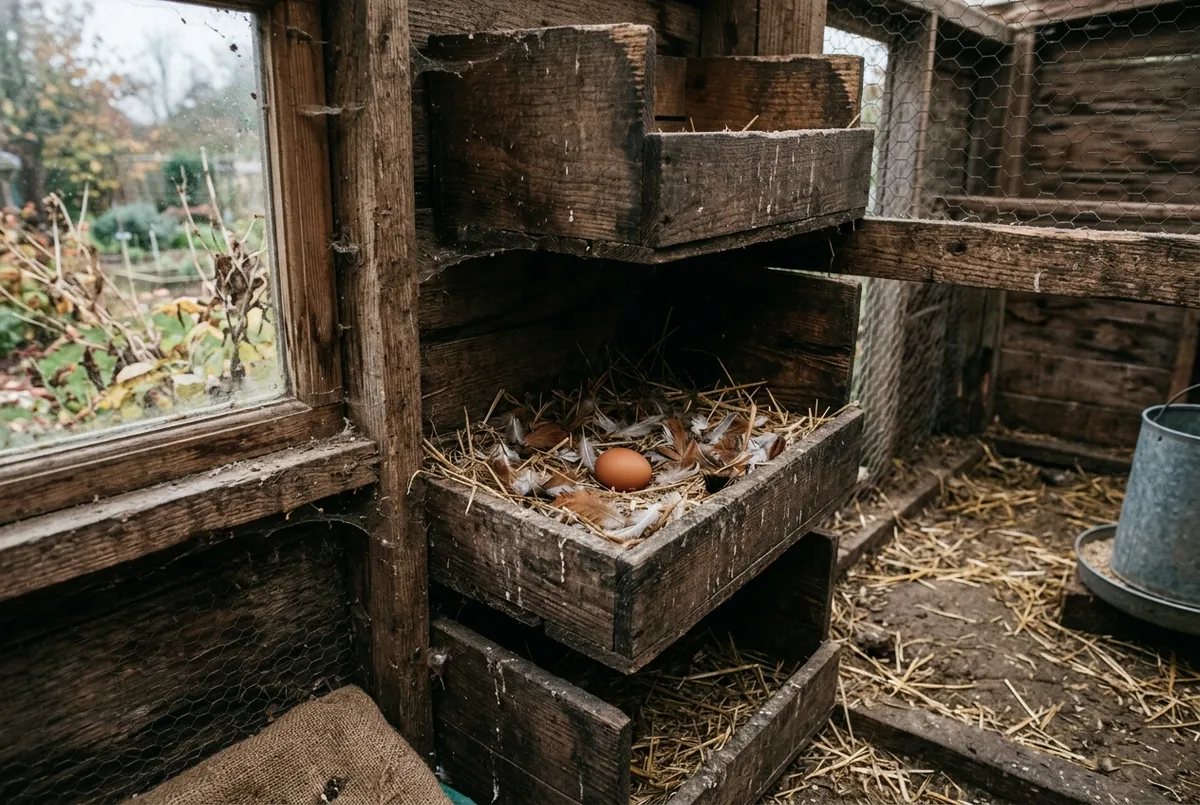
Your hens were reliable all summer, then October arrived and the nesting boxes went quiet almost overnight. Nothing else changed: same feed, same water, same coop, and no sign of illness. It’s often a light question rather than a sick-bird question.
The short answer: Hens slow down or stop laying in the fall because shortening daylight triggers a natural molt, and you can help sustain production through winter with a 14 to 16 hour light day, added gradually. You can’t skip the underlying biology entirely, only work with it.
Why Did My Chickens Suddenly Stop Laying in October?
Egg production in hens is driven primarily by day length. As daylight shortens through September and October and the photoperiod reaches and dips below about 12 hours, the drop shows up “most often” right in this window (Penn State Extension, September 9, 2025). The shortening days signal a hen’s body to shift out of egg production and into molt, the process of dropping and regrowing feathers.
Oregon State University Extension Service frames the same mechanism from the other side of the country: day length there falls from nearly 16 hours at the start of summer to just over 8 hours at the start of winter, and that change in day length causes hens to molt and cease egg production, a process that may take several months (Oregon State University Extension Service, reviewed 2023). If your flock went from a full basket a day to one or two eggs, or none, right as the days got noticeably shorter, this is very likely what happened. It’s a normal seasonal shift, not a sign that something in your setup failed.
A quiet nesting box in October is easy to mistake for a health problem. Owners often assume a hen has stopped laying because she’s sick or has gone “bad.” In most flocks, a healthy hen stopping in the fall is the normal photoperiod-driven molt working as it should, not illness. Watch for actual illness signs (lethargy, inactivity, lameness, coughing, a dull appearance) separately from the seasonal slowdown, since a drop in laying can also be the first sign of disease (Oregon State University Extension Service, reviewed 2023); a molting hen that’s still eating, moving, and alert is behaving normally for the season.
Not every bird in the flock will slow down at the same time or to the same degree. Older hens tend to molt more often and for longer: Oregon State notes that after a hen’s second or third year, egg production declines and molts become more frequent and prolonged (Oregon State University Extension Service, reviewed 2023). If your flock has a mixed age range, don’t expect the slowdown to look uniform across every bird.
How Long Does Chicken Molting Season Last?
Molt isn’t instant and it isn’t permanent. Penn State Extension’s laying-flock guide says birds take about 10 to 12 weeks to complete a molt and come back into production (Penn State Extension, 2016), but that figure comes from a managed flock where lighting is controlled. For hens left to molt naturally in the fall, Penn State’s lighting guide says they return to production in the spring (Penn State Extension, September 9, 2025), and Oregon State says the molt itself may take several months (Oregon State University Extension Service, reviewed 2023). There’s bird-to-bird variation, so treat the 10-to-12-week figure as a rough guide to the molt, not a date for the first egg.
Because the molt runs through the shortest, darkest weeks of the year, expect eggs to stay scarce without added light until days lengthen again.
Do I Need a Light in the Coop to Keep Hens Laying Through Winter?
Only if you want to keep production going. Supplemental light is a productivity tool, not a health requirement. Extension guidance is clear that preventing the natural fall-winter production loss requires holding day length above 12 hours, typically a 14 to 16 hour day (Oregon State University Extension Service, reviewed 2023). Skip the light, and your flock will molt and slow down on its own schedule; add the light correctly, and you can help keep hens laying through the darker months.
Where people run into trouble is assuming any bulb in the coop counts as “a light.” It doesn’t. Extension guidance specifies both a minimum duration and a minimum intensity, not just some illumination in the space. A string of holiday lights or a dim porch bulb left on won’t reliably hit either threshold.
There’s also a real cost side to this decision that’s worth weighing before you commit to a light schedule. Running a fixture on a timer every dark morning and evening through winter is an ongoing chore, not a one-time purchase, and a molt is also when a hen puts the bulk of her energy into regrowing feathers, leaving little for egg production (Oregon State University Extension Service, reviewed 2023). Some keepers push through winter production every year; others treat the fall slowdown as a built-in rest period for the flock and only add light in years when they specifically need the eggs. Neither approach is wrong; it’s a tradeoff between winter egg count and how much you want to manage the coop through the darkest months.
How Many Hours of Light Do Chickens Need to Lay Eggs?
For mature laying hens, the target is about 16 hours of light per day, which simulates a summer photoperiod and supports peak egg production (Penn State Extension, September 9, 2025). That’s a ceiling as well as a target: going over 16 hours causes stress in the flock, so more light isn’t automatically better.
Light Intensity and Bulb Color
Duration alone isn’t enough. Hens need a minimum of about half a foot-candle (5 lux) of light to stimulate laying, and Extension recommends “warm” color bulbs (not heat lamps) rated under 3500K, up to 30 to 40 watts (Penn State Extension, September 9, 2025). Penn State adds that a typical “daylight” or “white” bulb also works as long as it isn’t too green or blue, so a dim decorative bulb is the likelier problem, even if it’s technically on for the right number of hours.
Introducing Light Gradually
Don’t flip a 16-hour light schedule on overnight. Photoperiod changes should be introduced gradually, no more than about 1 hour of difference per week, to avoid stressing the flock (Penn State Extension, September 9, 2025). If your coop is currently close to natural fall daylight, step the supplemental hours up a little at a time rather than jumping straight to 16.
A basic mechanical timer, rather than remembering to flip a switch by hand, is what makes the gradual step-up and the consistent daily schedule realistic. An inconsistent schedule, lights on some evenings and forgotten on others, works against the whole point, since hens respond to a predictable pattern rather than an occasional boost. It’s also worth remembering to reverse the process in spring: once natural daylight climbs back past your supplemental total on its own, the extra light isn’t doing anything further and can be scaled back down.
Powering the Light Without Rewiring the Coop
Most backyard coops weren’t built with permanent electrical service in mind, and running new mains AC wiring, outlets, or breakers out to a coop is a job for a licensed electrician and your local code official, not a weekend project. That part sits outside what this guide covers on purpose.
The lower-friction path for a lot of flock owners is a low-voltage DC setup: a small LED fixture on a timer, run off a battery or a portable power station that gets recharged near the house or off a small solar panel. It sidesteps the permanent-wiring question entirely and still delivers the duration and intensity the birds need, as long as the fixture and timer are sized correctly for your coop. If you already have, or are considering, a portable power station for outages or other yard projects, the same unit can usually run a coop light circuit too. If you’re already looking at coop upgrades for the colder months, our automatic coop door vs. manual comparison covers another piece of that same winter-readiness project.
Is It Bad to Let My Hens Molt Naturally Instead of Using Supplemental Light?
No. Skipping supplemental light isn’t a welfare problem; it’s a choice about egg output. Penn State Extension says it does not harm birds to molt naturally, and that they return to production in the spring (Penn State Extension, September 9, 2025). Hens that molt on their own schedule and rest from laying over the darker months are doing exactly what they’d do without any human intervention at all. The tradeoff is simply fewer or no eggs for a stretch, followed by a return to laying once day length works back in their favor.
If you’d rather not manage a light schedule, gradual dimming, and bulb specs, letting the flock molt naturally is a completely reasonable call, especially for a small backyard setup where a stretch without eggs isn’t a real hardship. For readers building out a broader backyard food system beyond the coop, our Backyard Liberty review walks through what that kind of pocket-farm setup actually involves.
If you want eggs through the darker months, the practical next step is deciding on a light source and a power plan that fits your coop, not just buying a bulb. Check your coop’s realistic natural daylight against the 12-hour threshold, pick a warm-toned fixture of up to 30 to 40 watts on a timer, and step the hours up gradually rather than all at once. If your coop sits away from existing power, sort out how you’ll run that light safely, low-voltage and battery-backed rather than a rushed extension cord, before the days get much shorter. And if you’d rather let the flock rest for the season, that’s a fine call too; just plan on fewer or no eggs through the darker months, with production picking back up in the spring.
Frequently Asked Questions
- Why did my chickens suddenly stop laying eggs in October?
- Shortening daylight in September and October drops the photoperiod to and below about 12 hours, which triggers a natural molt and a real production slowdown that does not by itself mean illness (Penn State Extension, September 9, 2025).
- How many hours of light do chickens need to lay eggs?
- About 16 hours per day supports peak production, similar to a summer day length; going over that causes stress (Penn State Extension, September 9, 2025).
- Do I need a light in the coop to keep hens laying through winter?
- Only if you want to sustain production. Preventing the seasonal drop requires holding day length above 12 hours, typically a 14 to 16 hour day (Oregon State University Extension Service, reviewed 2023).
- How long does chicken molting season last?
- Penn State puts a molt at roughly 10 to 12 weeks from start to a return to production, but hens left to molt naturally in the fall return to laying in the spring (Penn State Extension, 2016 and September 9, 2025).
- Is it bad to let my hens molt naturally instead of using supplemental light?
- No. Supplemental lighting is a productivity choice, not a welfare requirement; Penn State says it does not harm birds to molt naturally, and they return to production in the spring (Penn State Extension, September 9, 2025).
Sources & references
Before you go
The Renter's Homestead Pack
Self-reliance projects for the yard you don't own — container yields, a raised bed built to move with you, balcony preservation basics, and the landlord questions to ask first.
Free guide
The Renter's Homestead Pack
Self-reliance projects for the yard you don't own — container yields, a raised bed built to move with you, balcony preservation basics, and the landlord questions to ask first.