What’s the short answer?
- Honey targets run from about 40-60 lb in Missouri to 80-90 lb or more in New York and Illinois; check stores while days are still above 50°F (MU Extension; Cornell CALS; Illinois Extension).
- Wrap or block wind, but leave ventilation open so moisture does not condense inside the hive (Cornell CALS; Illinois Extension).
- Feed 2:1 sugar syrup in fall while bees are still active; once it is below about 50°F, switch to dry feed (Cornell CALS; Illinois Extension, 2021-11-11).
- Check varroa mite load and the queen's laying before winter; both affect whether a colony can hold a strong cluster (MU Extension; ISU Extension).
- A colony with a small fall population may need to be consolidated or combined with a larger one (ISU Extension).
Your bees made it through their first summer, drew comb, and built up brood at a steady clip. Now the days are shorter and the real test is coming: does this young colony have enough stored honey, enough mite control, and enough shelter from wind to get through months of cold with no forage coming in. Winter colony losses commonly trace back to weak colonies, starvation, mites, or condensation, gaps that are easier to close before the first hard frost than after (Illinois Extension, 2021-11-11).
The short answer: A first-winter colony needs enough stored honey for your climate (extension targets run from about 40-60 lb in Missouri to 80-90 lb or more in New York and Illinois), a low varroa mite load, a laying queen, a reduced entrance, and protection from wind and drafts, and nearly all of that prep has to be finished while days are still mild, not once the cold sets in. (MU Extension, 2016; Cornell CALS)
How Much Honey Does a First-Year Hive Need to Survive Winter?
Stored honey is the fuel a colony burns to stay warm and feed itself when there’s nothing blooming outside. University extension targets shift with climate: Missouri guidance calls for 40 to 60 lb of honey or feed per hive (MU Extension, 2016), Cornell sets a minimum of 80 lb for a full-size hive in Upstate New York (Cornell CALS), and Illinois Extension says at least 90 lb (Illinois Extension, 2021-11-11). That’s a range, not a fixed number, because it shifts with your region’s winter length and severity: a milder climate needs less, a long hard winter needs more toward the top of that range.
For a first-year colony, don’t guess at stores from the outside. Pull frames on a warm, calm day in early-to-mid fall and estimate weight by how heavy each frame feels and how much comb is capped. A frame that’s mostly capped honey on both sides is a good baseline; a colony with only a few partially filled frames going into fall is behind and needs help closing the gap before cold weather locks the bees in place. Cornell’s guidance is to do this work while daytime temperatures are still above 50°F (10°C), because opening colonies in the cold is stressful and can be lethal for the bees (Cornell CALS).
If you don’t own a hive scale, the frame-by-frame check above is still useful as a rough gut check rather than an exact measurement. A hive that’s carrying mostly capped comb across most of its frames is trending toward a safe range; a hive where most frames are open, uncapped, or empty is trending short, regardless of what the overall number turns out to be. Lifting one side of the hive body by hand and comparing it to how heavy it felt earlier in the season is a low-cost second check worth doing at the same visit.
If your hive is short, the fix is feeding, not panic. See the feeding section below for what and when.
Should You Wrap the Hive for Its First Winter, and With What?
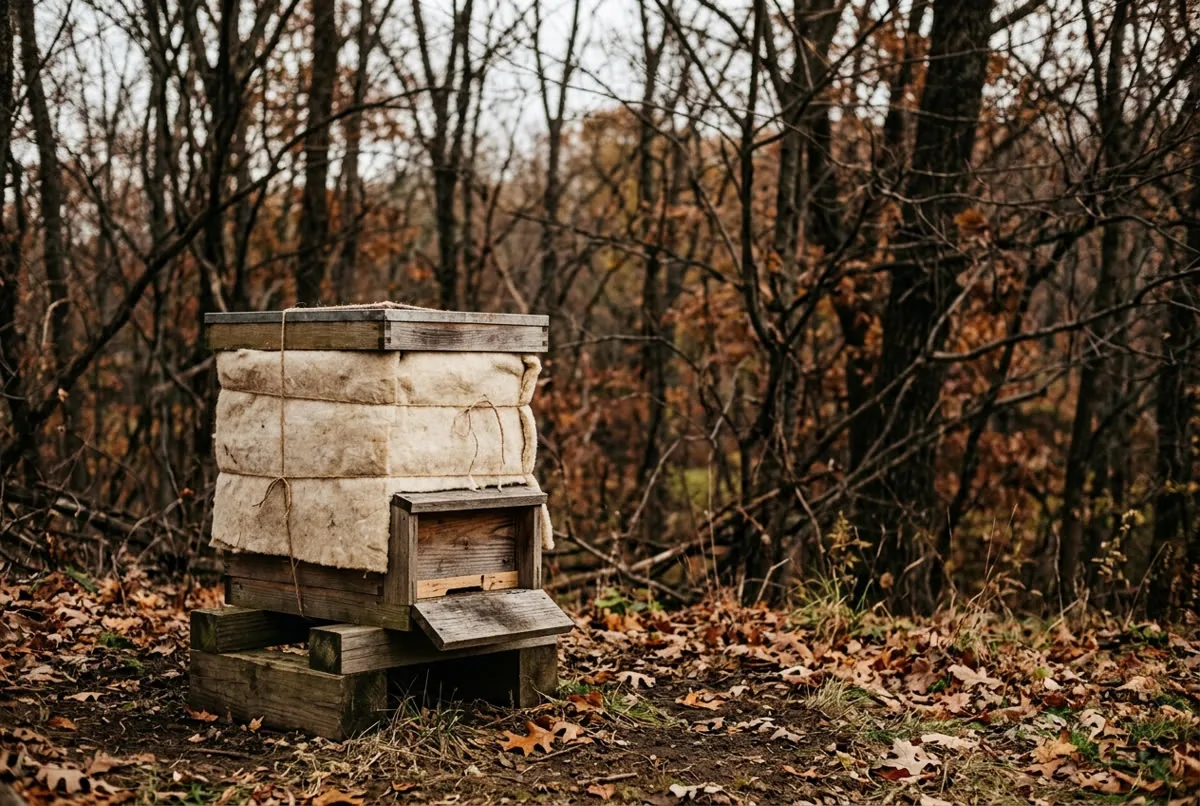
This is one of the most common new-beekeeper questions, and the honest answer is: it depends, and doing it wrong can hurt more than doing nothing. Cornell’s Pollinator Network notes that winter wrapping prevents drafts and calls ventilation critical to overwintering survival (Cornell CALS), and Illinois Extension explains why: moisture from the bees’ respiration condenses on the inner cover and drips down onto the winter cluster, chilling it (Illinois Extension, 2021-11-11).
Iowa State University’s small-farms program describes usually-black hive wraps, an entrance reducer or mouse guard, and a sunny site protected from cold winds as practical steps, and reports that its research team found wrapping and insulating hives can increase overwinter survival by over 20% (ISU Extension).
The insulation trade-off
The instinct to over-insulate a young hive is understandable, but “more insulation” is not automatically better. A tightly wrapped hive with no way for moist air to escape can trap condensation inside, and damp, moldy comb is a real risk to a small first-year colony. The extension guidance above lands on a balance: block wind and drafts, add insulation where it makes sense for your climate, but leave an upper vent or crack so moisture has somewhere to go (Cornell CALS; ISU Extension). If you’re also getting other animals ready for the cold season, the checklist in 7 Fall Chores to Get Chickens and Bees Ready for Winter covers the broader yard alongside the hive.
Reducing the entrance to a smaller opening does double duty here: it cuts down on drafts and gives a smaller first-year colony less space to defend against mice looking for a winter shelter (ISU Extension).
Placement matters as much as wrapping material. A hive tucked against a shed, fence line, hedge, or stack of straw bales on the side the prevailing winter wind comes from gets meaningful shelter without any wrap at all, and that windbreak works alongside whatever wrap or insulation you add on top; Cornell lists a tree line, burlap, snow fencing, or straw bales as simple windbreaks (Cornell CALS). If your yard doesn’t have a natural windbreak, that’s worth solving before winter with whatever you have on hand, since a hive sitting fully exposed on an open, windy site is working against every other step in this guide.
Gear you need for this last round of fall inspections
Most of this fall prep work still means opening the hive: pulling frames to check stores, fitting a reduced entrance, and adding a wrap or windbreak. A hive tool for prying apart boxes and frames that have been propolized shut over summer, and protective gear you’re comfortable working in on a cool afternoon make this last round of inspections faster and calmer for both you and the colony. If either is still missing from your kit, close that gap now, while the weather still allows a full inspection.
When Should You Start Feeding, and With What?
If your stores assessment above came up short, feeding is the fix, and timing matters. Cornell says syrup feeding must be done in the fall while the bees are still active, using a 2:1 sugar-to-water mix, and that once clustering begins it is too late for liquid feed (Cornell CALS). Illinois Extension puts the cutoff for syrup at about 50°F and recommends dry food below that (Illinois Extension, 2021-11-11).
The general logic that guides most feeding decisions: bees need warm enough temperatures to take up and process liquid syrup, so syrup feeding works best while days are still mild, and a solid supplement like fondant is the fallback once temperatures drop too low for the colony to process liquid feed efficiently. Either way, the goal is the same one covered above: get the colony to your region’s target weight before the cold locks in (MU Extension, 2016).
Don’t wait for a cold snap to start. A colony that’s already stressed by cold and short on food has a much harder time taking up syrup than one that’s still active and only moderately short.
Keep feeding until one of two things happens: the frame check from the section above shows the hive is trending into a safe range, or the weather turns cold enough that the bees stop taking syrup down at all, at which point switching to a solid supplement is the more realistic option. Checking back in on stores every week or two during active feeding, rather than assuming a feeder is doing its job, is the only way to know which of those two you’ve hit.
How Do You Know If a New Colony Is Strong Enough to Overwinter?
Three things determine whether a first-year colony is a good winter candidate: a healthy, actively laying queen, a low varroa mite load, and a population large enough to form a tight winter cluster. Extension guidance checks for a laying queen, adequate food, and varroa mites through the season (MU Extension, 2016), and notes that a winter cluster needs to be robust and large enough to heat the hive (ISU Extension).
Checking mite load before winter matters for a first-year colony as much as for an established one. A mite wash or sugar roll count gives you an actual number instead of a guess, and Iowa State recommends monitoring and treating soon after the honey harvest, usually late August or early September in Iowa, so the bees can build healthier winter populations (ISU Extension). If you’re still building out your kit, the Backyard Beekeeping Starter Checklist for 2026 covers the baseline gear most new beekeepers are missing going into their first fall.
Population is the harder call to make objectively, but a rough gut check works: on a warm afternoon, a first-year colony that’s strong enough to winter well should have bees covering most of the frames you pull, not just a small cluster on two or three. A colony that looks thin on bees in September, even with decent stores, is the kind of hive covered in the next section.
A healthy queen shows up as an even, solid brood pattern rather than scattered, spotty cells, and continued laying activity into early fall rather than a queen that already appears to have shut down for the season. If you spot a patchy pattern, very little brood at all, or no eggs on a fall inspection, that’s a signal the colony’s queen situation, not just its stores or wrap, is the bigger risk going into winter.
Should You Combine Weak First-Year Hives Before Winter?
Sometimes the honest answer is yes. Iowa State’s overwintering guidance notes that a cluster needs to be robust and large enough to heat its hive through the winter, and that a colony with a smaller population in fall can be consolidated into a single box, reducing the space the cluster has to heat, or combined with a larger colony (ISU Extension).
This isn’t a decision to make lightly if you only have one hive, since it usually means merging into a neighbor’s stronger colony or a nucleus you’re keeping in reserve. But for anyone running two or more hives, it’s worth an honest late-summer inventory: a weak first-year hive and a strong one combined is very often a better bet than two hives where one is almost certain to fail alone.
Combining hives is typically done gradually rather than by simply dumping one box of bees into another: Mississippi State Extension advises separating the colonies with a sheet of newspaper to let colony odors mix and keep fighting to a minimum (MSU Extension). A hive tool is what you’ll use either way, to separate boxes, lift frames for inspection, and rearrange combs once the merge has settled. Do the combine while there’s still enough mild weather left for the merged colony to reorganize itself before the real cold arrives, not as a last-minute move once frost is already a regular occurrence.
Monitoring the Hive Through Winter Without Opening It
Once the hive is packed, fed, and wrapped, the temptation to check on it fades but doesn’t disappear. Resist opening the hive during cold periods: Cornell warns that opening colonies in the cold is at best stressful and at worst lethal. Instead, monitor from the outside: Cornell describes listening for a faint hum by putting an ear (or a stethoscope) against the hive body (Cornell CALS). Watching for activity on warmer days and keeping a simple log of what you observe and any losses also builds a record you can use to plan better for next winter.
If your area gets a genuine warm spell, a quick check to confirm the cluster is alive and stores haven’t run out is reasonable. It’s also worth a quick look at the entrance after a heavy snow or an extended cold stretch, since dead bees or ice can block the reduced opening entirely and cut off the airflow the ventilation work above was meant to preserve; Cornell suggests visiting about once a month and sweeping dead bees out of the lower entrance with a slim stick, which doesn’t require opening the hive body itself (Cornell CALS).
Otherwise, the work is largely done once fall prep wraps up, and the colony’s odds now come down to how thoroughly that prep was handled.
Start with the honey check this week if you haven’t already: pull frames on the next warm day, estimate stores against your region’s target range, and note whether the queen is still laying and the population looks solid. Whatever’s short, whether that’s feed, wind protection, or a mite count you haven’t run yet, close that gap before the weather makes it harder to fix.
Frequently Asked Questions
- How much honey does a first-year beehive need for winter?
- Extension targets vary by climate: about 40 to 60 lb of honey or feed per hive in Missouri, a minimum of 80 lb for a full-size hive in Upstate New York, and at least 90 lb in Illinois, alongside a laying queen and a low varroa mite load.
- Do I need to wrap my hive for its first winter?
- Wrapping and added insulation can cut drafts and improve survival odds, but the hive still needs an outlet for moisture so condensation does not build up inside.
- Should I combine a weak first-year hive with a stronger one?
- A winter cluster needs to be large enough to heat the hive. A colony with a small fall population can be consolidated into fewer boxes or combined with a larger colony before winter.
Sources & references
Before you go
The Renter's Homestead Pack
Self-reliance projects for the yard you don't own — container yields, a raised bed built to move with you, balcony preservation basics, and the landlord questions to ask first.
Free guide
The Renter's Homestead Pack
Self-reliance projects for the yard you don't own — container yields, a raised bed built to move with you, balcony preservation basics, and the landlord questions to ask first.