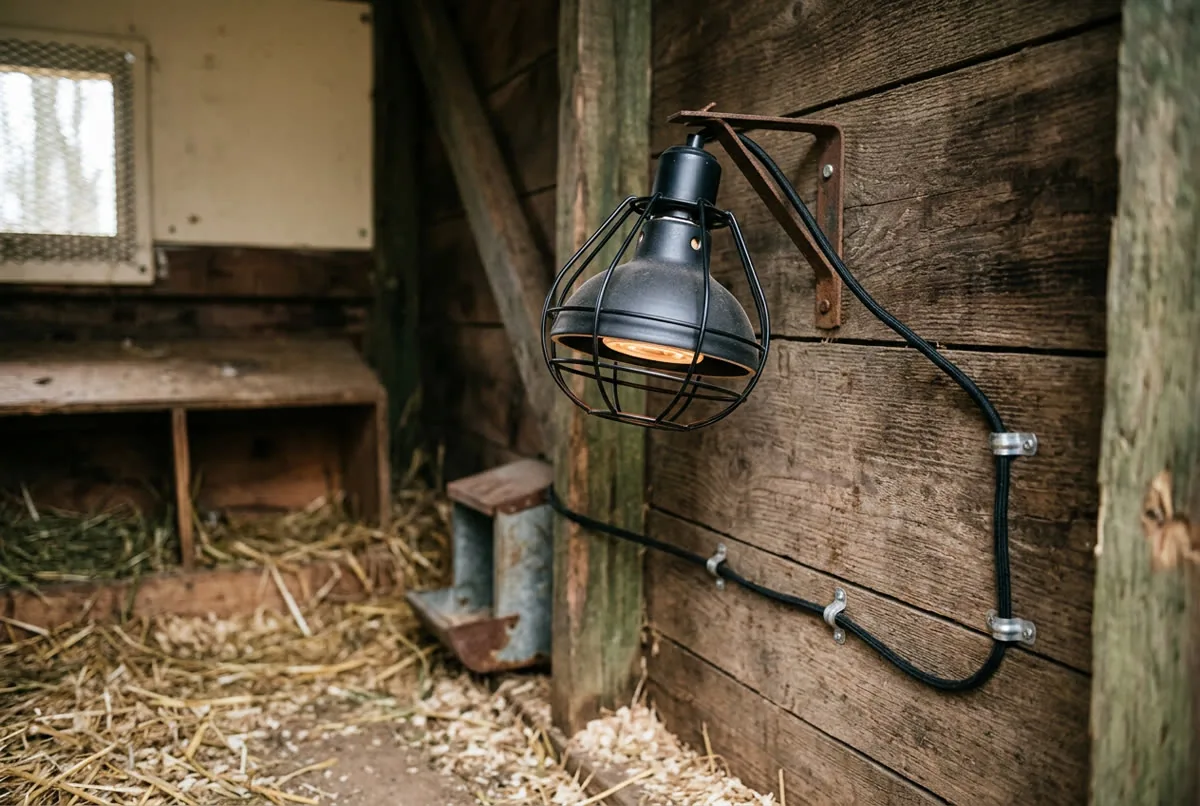
Turn over a 250-watt heat lamp and read the notice its own manufacturer publishes. OSRAM Sylvania’s warning sheet for the R40 and BR40 infrared lamp says the bulb “should never be placed closer than 18 inches to any person or surface,” tells you not to use it “in close proximity to combustible materials (litter, paper, etc.),” and adds the line almost nobody quotes: do not use the soft-glass version “in wet or moist environments… where steam or moisture may accumulate” (OSRAM Sylvania FAQ0030-0299).
A chicken coop is a small wooden box floored with dry litter, hung with cobwebs, and kept damp all night by a dozen birds breathing. The lamp people reach for first is one whose maker rules out all three conditions on the label.
Short answer: the DIY chicken coop heater that will not start a fire is not a heating element you build. It is a listed, low-surface-temperature radiant panel, bolted to framing with a second independent tether, kept well clear of bedding, and run from a GFCI-protected circuit on a thermostat. The DIY part worth doing is the mount, the clearance and the cleaning routine. And before any of it: extension poultry specialists broadly agree that a dry, well-ventilated coop full of acclimated adult birds does not need supplemental heat at all, which is the cheapest fire prevention available.
Disclosure: the product links here are affiliate links, so we may earn a commission if you buy through them at no extra cost to you. The fire guidance below comes from state fire marshals, US Fire Administration incident data and university cooperative extension poultry publications, and the electrical boundaries are drawn where a licensed electrician takes over — not from brand marketing, and not from a bench test of any heater named on this page.
The heater you keep worrying about is the safe one, and the one you stopped thinking about is the problem.
Why Coop Heaters Start Fires
Heating equipment is not one risk among many in a barn or a coop. It is the category.
Penn State Extension’s barn fire prevention guidance singles out heating equipment, such as space heaters and heat lamps, and tells owners to use it according to the manufacturer’s recommendations and to clean and inspect it yearly (Penn State Extension, Fire Prevention in Barns). Vermont’s Division of Fire Safety names the same category first for farm fires in the state, and lists heat lamps explicitly (Vermont Division of Fire Safety). More recently, the Animal Welfare Institute tracked 328 barn fires that killed farmed animals between 2022 and 2024; a cause was reported in 111 of them, and roughly 70 percent of those were a malfunctioning heating device or another electrical fault (AWI barn fire report, January 2025).
Scaled down to a backyard coop, the ranking is the same. Greg Day, fire inspection supervisor at the Office of the Maine Fire Marshal, puts the top four coop-fire causes as heat lamps, extension cords, bedding and water heaters — with heat lamps the most dangerous of the four (Bangor Daily News, February 2023).
The mechanism is dull and consistent. Federal data on residential heating fires finds that the heat source being too close to something combustible is the single most common ignition factor, at 27 percent — ahead of every equipment defect (USFA, Heating Fires in Residential Buildings, 2017–2019). A coop concentrates that failure. The fuel is the floor. The fixture hangs above it. And the thing holding the fixture up is usually a spring clamp, which Clark County’s fire marshal’s office addresses directly: “Relying on the spring clamp alone is not adequate to prevent the lamp from dislodging” (Clark County, WA).
So the failure chain is short. Something bumps or corrodes the clamp, the fixture drops, the hot face lands in six inches of dry shavings, and the whole thing happens at two in the morning while you are asleep in the house.
The seasonal part, stated accurately
You will read that coop fires spike in autumn. What is actually documented is broader and more useful. In federal residential fire data, heating fires climb from 2.6 percent of the annual total in September to 6.8 percent in October, 12.2 percent in November and 15.1 percent in December — then peak in January at 20.4 percent (USFA, 2017–2019). Barn fires follow the same curve: the Animal Welfare Institute counted nearly three times as many barn fires in winter (January through March) as in summer (AWI).
The practical read is not that October is dangerous. It is that October is the last quiet month to get the install right, because whatever you hang now runs through November, December and the January peak untouched.
Before You Heat Anything, Check Whether the Flock Needs It
This is the part that saves the most money and prevents the most fires, and it is the part the search results skip.
The extension consensus is close to unanimous. New Hampshire’s is the bluntest: “In most circumstances, we advise against adding supplemental heat to your chicken coop,” specifically because of the fire risk around combustible bedding (UNH Extension, February 2024). Maryland’s fact sheet says that “as long as adult birds are protected from the wind and wet weather, they should not need any additional heat even during the coldest time of year” (UMD Extension FS-1133). Ohio State reaches the same place: cold-tolerant breeds, acclimated, in an insulated dry coop with adequate ventilation, “do not usually need supplemental heat” (OSU Extension, Ohioline ANR-66). Penn State compresses it to five words: “Poultry can handle cold very well if they are dry” (Penn State Extension).
Dry is the operative word, and it is where most keepers get the diagnosis backwards. Frostbite on combs and wattles is not a straightforward function of temperature — it is what happens when moisture-laden air meets bare tissue. Chickens generate a large amount of that moisture themselves, through breathing, droppings and spilled water, and it turns into a problem in a cold, poorly ventilated coop with damp bedding (poultry.extension.org, Frostbite in Chickens). Ohio State puts it plainly: humid air creates more frostbite risk than drier air.
There is a free test for this, and it takes ten seconds. If there is condensation on the windows or the uninsulated walls of the coop in the morning, your ventilation is too low — and the fix is more high airflow, not a heater (poultry.extension.org). A heater in a coop that fails that test treats the symptom and leaves the cause running.
Extension sources put the frostbite danger zone at extremely low temperatures — single digits Fahrenheit and below, especially sustained over several days — and flag large-combed birds and Mediterranean breeds such as Leghorns as the most vulnerable (poultry.extension.org; UMD Extension FS-1133). That is a narrower window than most keepers assume, and it is why the honest first move is to measure rather than to buy.
Run it for a week before you spend anything on heat. If the coop is sitting dry and the birds are roosting calmly through a hard night, you have your answer, and it is the cheap one. Our guide to winterizing a chicken coop before the first frost covers the ventilation and bedding work that makes that outcome likely.
There are real exceptions, and extension sources name them: bantams, which put out less body heat for their size, hens in a heavy molt, and young birds (UMD Extension FS-1133). Those are cases for careful supplemental heat, not for skipping the rest of this article.
The Coop Heaters You Should Not Build
Search this topic and you will find plans for all four of these. Each one puts a heat source inside a wooden box packed with the finest, driest fuel on your property.
The terracotta pot and tea light heater. An open flame, unattended, overnight, in a structure floored with shavings and tended by animals that knock things over for a living. The pot does not make the flame safer. It makes it harder to see.
The clamp lamp with a 250-watt bulb. Not really a build, but the default, and the one that starts fires. The clamp is a temporary fixture doing a permanent job over a fuel bed, and the fire marshal’s office already told you it is not adequate on its own.
A repurposed indoor space heater or hair dryer. Room heaters are designed for clean, dry, occupied rooms. Tip-over switches assume a hard flat floor. Thermostats assume clean airflow. Neither assumption survives bedding, dander and feathers in the intake. Clark County’s guidance is to “choose electrical equipment manufactured for agricultural or commercial purposes” instead, and that is exactly why.
A homemade heating element. Nichrome wire, salvaged heat tape, a stripped toaster element — anything built around bare resistance wire in a damp, dusty enclosure. Set the fire risk aside for a second: this is mains-voltage work in a wet location. Low-voltage DC projects are fair game on this site. A homebuilt AC heating element is not, and the wire, socket and overcurrent questions it raises belong to a licensed electrician and your local code official, not to a blog post.
If the appeal of the DIY route is price, do the arithmetic honestly. Once you have bought a fixture, a rated cord and a thermostat, the homemade version saves less than people assume — and it is competing against a purpose-built panel whose current price you can check in thirty seconds.
What a Safe Coop Heater Actually Is
The safer category is radiant, low-wattage and low-surface-temperature: a flat panel mounted on a wall, rather than a bulb suspended over bedding. Donna Coffin of the University of Maine Cooperative Extension recommends exactly that trade — wall-mounted heaters that radiate low-temperature heat, in place of a lamp (Bangor Daily News).
The clearest way to see the difference is to line up what each manufacturer and authority actually publishes.
| Option | Power draw | Published clearance / surface | Where the risk sits |
|---|---|---|---|
| 250 W infrared heat lamp | 250 W | 18 in. minimum from any surface (Sylvania); 20 in. from flammable material (Penn State) | Mount failure, dust and moisture on a hot bulb |
| Flat radiant coop panel | 150 W for the two panels cited | Cozy Products states an ETL listing for zero clearance; Sweeter Heater states a 160-170°F lens and a snap thermostat | Mounting hardware and cord condition |
| Radiant brooder plate (chicks) | Far below 250 W, model dependent | Chicks contact the underside directly | Cord damage, mostly |
| No heater at all | 0 W | Not applicable | Requires a dry, ventilated, right-sized coop |
Two honest caveats about that table.
That comparison is ours, not an authority’s. No fire agency or extension service publishes a head-to-head safety ranking of panels against 250-watt lamps. What exists are the individual published figures: Sylvania’s 18-inch minimum (warning notice), Penn State’s 20 inches from flammable material (Brooding of Domestic Fowl), and Cozy Products’ stated ETL zero-clearance listing for its 150-watt panel. Put a device that its own listing says can sit against a surface next to one its own maker says must stay a foot and a half away from everything, and the ranking makes itself.
Verify the listing mark yourself before you buy. Sweeter Heater’s own FAQ gives 150 W for its OH1140 model, a lens surface temperature of roughly 160 to 170°F and a built-in snap thermostat, but does not state a UL or ETL listing on that page — retailer copy that claims one is not the manufacturer speaking. A listing mark is the single most checkable safety fact about any heater, so check it on the maker’s page, not the product listing.
One thing this article will not tell you: whether a ceramic heat emitter is safe in a coop. They are widely sold for it, but there is no fire agency, extension service or standards body publishing surface-temperature, socket-rating or clearance guidance for that use that we could verify. Where the authorities are silent, we would rather say so than fill the gap with confident-sounding invention.
The Five Parts of a Safe Install
This is the DIY that actually belongs in this article. None of it is heating work. All of it is mounting, clearance and hygiene.
1. Mount it. Never hang it by the cord.
Bolt or screw the fixture to structural framing, not to a perch, a wire or a strip of trim. Then add a second, independent tether — a chain or steel cable to a different anchor — so that if the primary mount lets go, the fixture ends up dangling rather than lying in the bedding. Extension guidance says the same thing for lamps specifically: suspend with a chain or wire, never the electrical cord, and use a porcelain socket rated for the lamp (poultry.extension.org, Brooding Poultry Hatchlings). Two independent supports fail together far less often than one fails alone.
2. Clear the ignition zone, using the manufacturer’s number.
Nothing combustible under or beside the unit, and a real gap to bedding, walls, nest boxes, feed sacks and cobwebs. Use the number the maker publishes: 18 inches for the Sylvania lamp, 20 inches from flammable material per Penn State, or whatever the panel’s own listing states. Treat it as a minimum, not a target. If the geometry of your coop cannot deliver that gap, the answer is a different heater or no heater — never a smaller gap.
3. Put dust on the maintenance list.
Coop dust is fuel and insulation at the same time. It settles on hot surfaces, works into cord jackets and accumulates faster than anyone expects. Clark County’s advice is to “brush cobwebs and dust from light fixtures and outlets on a regular basis,” and in a coop that means monthly, not annually. While you are there, run the cord through your fingers and look for cracking, stiffness and chew marks. Retire it at the first of the three.
4. Power it the boring way.
Two rules, and neither is negotiable. Extension cords are temporary, not wiring. Clark County’s fire marshal guidance for coops specifically says not to use extension cords in them at all, choosing equipment manufactured for agricultural or commercial purposes instead (Clark County, WA).
And any receptacle serving the coop needs GFCI protection. The National Electrical Code treats outdoor outlets and accessory buildings at dwellings differently from agricultural buildings, which have their own article. Which of those applies to your coop is a call for your local code official, not for a website — and any permanent circuit run out to an outbuilding is licensed-electrician work with a permit attached, not a weekend project.
5. Give it a thermostat, then test it in mild weather.
A thermostat or plug-in temperature controller means the heater runs on the nights it is genuinely needed and sits dark the rest of the time. That cuts the power bill, and more importantly it cuts the total hours the thing is energized and unattended. Then run the complete setup for a week in October, while a failure is merely annoying, and watch what the coop temperature and humidity actually do. Our solar coop automation guide covers the same test-before-winter logic for a coop with no mains power at the far end of the yard.
The Heat You Can Build With No Wires at All
Everything above manages a risk. This section avoids it, and it is where the word DIY genuinely belongs.
Deep litter. A deep layer of pine shavings or chopped straw, topped up rather than stripped out, composts in the lower layers and produces a low, steady warmth while drying the floor from underneath. It is the only heat source in this article that cannot fail electrically. Extension guidance describes flocks doing well at sub-zero temperatures on deep litter plus a waterer warmer, with no external heat required (poultry.extension.org). The catch, and Ohio State is honest about it, is that deep bedding can raise coop humidity — so it is a partner to strong high ventilation, never a substitute for it.
Thermal mass. Water jugs, a couple of paving slabs, or a dark-painted barrel absorb whatever heat the coop collects by day and release it slowly overnight. The effect is modest, and it flattens the overnight low rather than raising the average. The overnight low is the half that matters.
Right-sized volume. A coop with far more airspace than the flock can warm is a coop that always feels cold. Dropping a false ceiling below the roofline, or partitioning off the unused half of an oversized shed, does more for real warmth than a 100-watt panel.
Wind blocking that is not sealing. Break the wind at roost level, bank the windward wall with straw bales or stacked leaves, and leave the high vents completely alone. The difference between a draft and ventilation is height, and it is the entire game.
Wide, flat roosts. A hen keeps her toes warm by squatting and covering them with breast feathers, which she cannot do on a narrow round bar. A two-by-four laid flat side up gives her that surface, which is exactly what Maryland Extension recommends, and it costs nothing (UMD Extension FS-1133).
If you are going to power exactly one thing in the coop this winter, make it the water rather than the air. A hen that cannot drink stops eating, and a hen that stops eating loses condition fast — which is a far more common winter problem than cold itself.
If You Do Heat It, Two Things to Plan For
The power will fail at the worst possible time. This one is reasoning rather than a cited finding — no extension source we could find studies it directly — but keepers raise it constantly and the logic holds: a flock that has spent the winter in a heated coop has less incentive to acclimate, and an outage during a cold snap removes the heat precisely when the outside temperature is at its worst. The mitigation is not a bigger battery. It is keeping any supplemental heat modest enough that losing it is an inconvenience rather than an emergency.
Chicks are a separate problem with a better answer. Brooding targets are specific: roughly 92 to 95°F at chick level in week one, dropped about 5°F a week until you reach 62 to 65°F (Penn State Extension). Radiant brooder plates hit that target with a fraction of a 250-watt lamp’s draw, by warming the chicks directly rather than the room — the same physics University of Georgia extension documents for commercial radiant brooders, which put roughly 90 percent of their heat toward the floor against about 10 percent into the air (UGA Bulletin 1287). Worth knowing honestly: extension brooding publications still describe lamp brooding and have not published a safety record for plates, so the case for them rests on the wattage, the contact-warmth design and the absence of a hot bulb over bedding rather than on an agency endorsement.
The Takeaway
The honest version of a DIY coop heater is a mounting job, not a heating job. Build the bracket. Build the redundant tether. Build the clearance and the monthly dust routine. Buy the heat itself from a manufacturer that publishes a listing mark, and check that mark on the maker’s own page. Then do the step that comes before all of it and check whether you need heat at all, because the extension consensus is that a dry, ventilated, right-sized coop full of acclimated adult birds does not.
A heater is one layer, and it is the last one to add. Winterizing the coop before the first frost gets the ventilation and bedding right, which is what makes the heater unnecessary; keeping hens laying through fall and winter covers the light-versus-heat question that sends most people to a heat lamp in the first place; and the fall chore list for chickens and bees puts the whole job on a schedule that finishes before the ground freezes.
Frequently Asked Questions
- How cold is too cold for backyard chickens?
- There is no clean threshold, and extension sources deliberately avoid giving one. Frostbite becomes a real risk at single-digit Fahrenheit temperatures and below, especially when they hold for several days, and large-combed birds and Mediterranean breeds such as Leghorns are most exposed. Humidity matters more than the number on the thermometer: University of Maryland Extension says adult birds protected from wind and wet weather should not need additional heat even during the coldest part of the year.
- Is a heat lamp ever safe in a chicken coop?
- It is the option with the worst safety record, and most extension sources advise against supplemental heat in a coop at all. The Maine fire marshal's office ranks heat lamps as the most dangerous of the four leading coop-fire causes, and Sylvania's own warning notice for the 250-watt R40 and BR40 lamp says to keep it 18 inches from any surface, away from combustible litter, and out of moist environments entirely. If one is used anyway, it must be suspended by chain or cable rather than its cord, in a porcelain socket, with the manufacturer's clearance respected.
- Can I put a space heater in a chicken coop?
- No. Indoor room heaters assume a clean, dry, occupied room: tip-over switches assume a hard flat floor and thermostats assume clean airflow, and neither survives bedding, dander and feathers in the intake. Clark County's fire marshal guidance is to choose electrical equipment manufactured for agricultural or commercial purposes instead, which is what a listed coop panel is.
- What should I use to warm chicks instead of a heat lamp?
- A radiant brooder plate is the low-wattage alternative, drawing far less power than a 250-watt lamp, and warming chicks by contact rather than heating the room. Hit the published brooding targets either way: about 92 to 95°F at chick level in week one, dropping roughly 5°F per week until 62 to 65°F. Be aware that extension brooding publications still describe lamp brooding and have not published a safety record for plates, so the case rests on the design and the wattage rather than on an agency endorsement.
Sources & references
- OSRAM Sylvania, 250 W R40/BR40 heat lamp warning notice (opens in new tab)
- US Fire Administration, Heating Fires in Residential Buildings 2017-2019 (opens in new tab)
- Animal Welfare Institute, Barn fires (opens in new tab)
- Clark County WA, Safety tips to prevent a chicken coop fire (opens in new tab)
- University of Maryland Extension, Winter weather and small flocks (FS-1133) (opens in new tab)
- UNH Extension, Caring for backyard chickens in winter (opens in new tab)
- Poultry Extension, Frostbite in chickens (opens in new tab)
- Penn State Extension, Brooding of domestic fowl (opens in new tab)
Before you go
The Renter's Homestead Pack
Self-reliance projects for the yard you don't own — container yields, a raised bed built to move with you, balcony preservation basics, and the landlord questions to ask first.
Free guide
The Renter's Homestead Pack
Self-reliance projects for the yard you don't own — container yields, a raised bed built to move with you, balcony preservation basics, and the landlord questions to ask first.