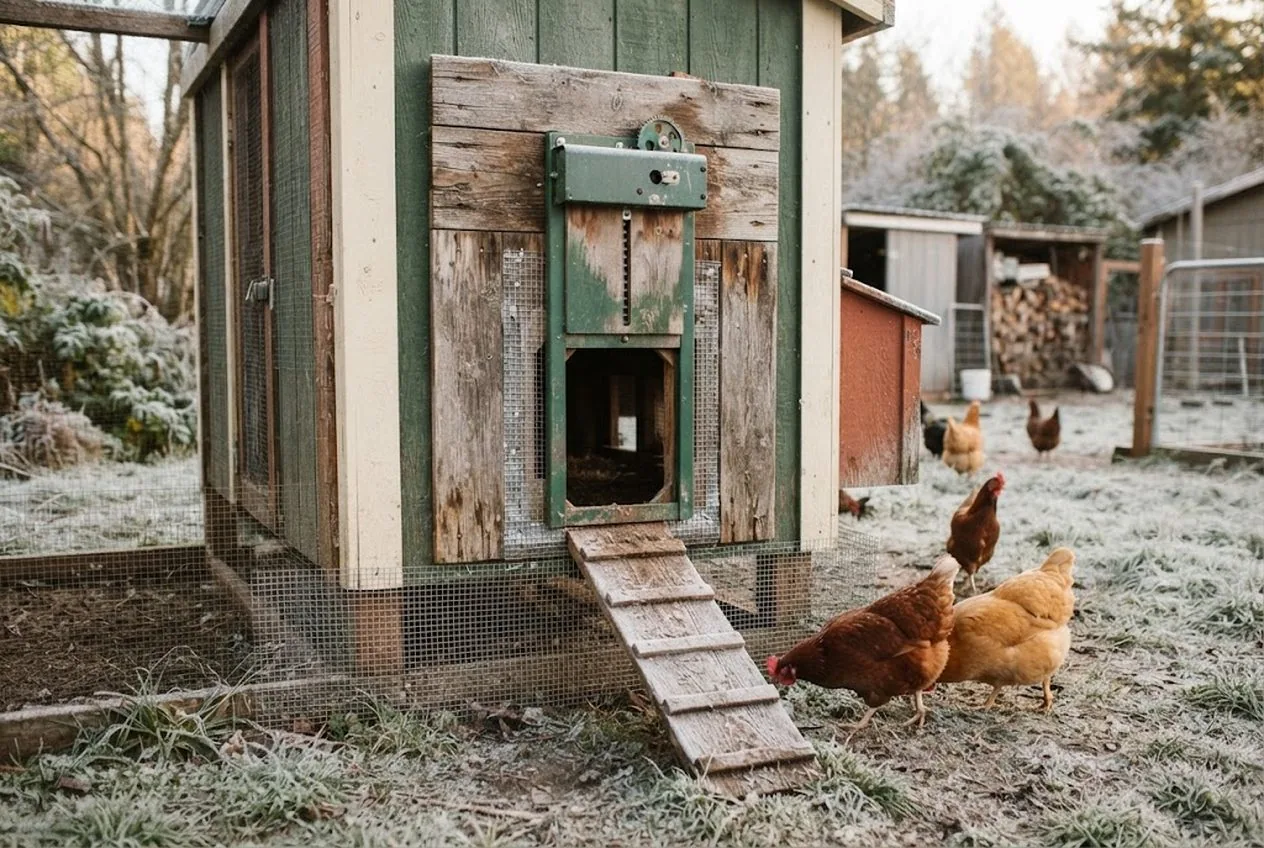
A raccoon doesn’t need much: one pop-hole left open past dusk is enough to end a flock in a single night, since raccoons that get into a poultry house often take several birds at once (eXtension). That’s the chore an automatic coop door exists to remove — the lock-up happens on schedule, whether you’re home, awake, or three states away, and it happens on the coldest, darkest nights of the year, exactly when you’re least likely to want the walk. The catch is that “automatic door” is a wide category. Some units shrug off an ice storm and lock out nothing but the cold; others jam solid on the first hard freeze, or close a beat too early and leave a straggler exposed. The night you skip the lock-up because you’re tired is exactly the night it costs you a bird.
Short answer: the door worth buying is a cold-rated, solar- or battery-powered model with light-sensor or obstruction-aware timing — that single combination is both the best overall pick and the safest default for large-breed coops and solar setups. A cheap, fixed-timer, mains-only door is the one to be careful with; it’s the type most likely to jam in ice or lock a straggler out on the exact nights predator pressure is highest. Here’s what separates the tiers, and which one fits your coop.
Disclosure: the product link here is an affiliate link, so we may earn a commission if you buy through it at no extra cost to you. This breakdown is built from manufacturer specifications, cold-climate poultry-keeping practice, and the cited sources, not a multi-winter bench test of every door on the market.
What Actually Matters in a Winter, Predator-Ready Coop Door
Before ranking anything, it helps to know which specs are load-bearing and which are marketing. Five things decide whether a door earns its keep once the temperature drops and a hungry animal starts testing the run:
- Motor torque and cold rating. A motor that’s fine in October can stall against a skin of ice in January. Look for a manufacturer-stated cold-weather operating range, not just a generic “works outdoors” claim.
- Closing logic. A light sensor or timer that closes after the flock reliably roosts is safer than a fixed clock time that can shut a slow bird out in the open. Obstruction detection or a slow, low-force close adds a real margin of safety.
- Power source. Solar or battery keeps the door running through a grid outage — the exact kind of storm that also brings predator pressure and cold. A mains-only door needs a manual backup plan for when the power drops.
- Opening size. The pop-hole and track have to clear your largest bird, not your average one. This is the spec large-breed keepers skip most often.
- Housing and track sealing. Snow and ice jam an exposed track fast. A door with a sealed or shielded track holds up through a storm that a bare rail won’t.
Hold every option up to those five, and the picks below sort themselves out.
Best Overall: A Cold-Rated Solar or Battery Door
For most backyard coops, the single configuration worth buying is a cold-rated automatic door running on solar or battery power, with light-sensor or obstruction-aware timing. It checks every box that matters in winter: the power source survives an outage, the timing adapts to how late dusk actually falls rather than a clock set once in October, and a properly rated motor has the torque to push through a light ice skin instead of stalling against it.
This is also the safest default if you’re not sure which category you fall into: it covers large-breed coops as long as the opening size clears your birds, and it covers solar and off-grid setups by definition. The honest caveat is that “automatic door” is sold under many brand names and price points, and the spec sheet — not the price tag — is what tells you whether a given listing actually meets this bar.
The Budget Pick: What a Cheap Door Gets Right — and What It Risks
A lower-cost door isn’t a scam; it’s a real trade-off. Where it holds up: light predator pressure, a mild climate that rarely sees a hard freeze, and a keeper who wants to try automation before committing more. Where it tends to fall short is precisely where winter and predators test hardest — a weaker motor that a skim of ice can stall, a basic fixed timer instead of a light sensor, and a housing that isn’t sealed against snow and moisture working into the track.
None of that makes a budget door a bad buy for the right coop. It does mean checking the same five specs from above even at the low end, rather than assuming “automatic” means “winter-ready” out of the box. If your climate brings real hard freezes, or you’ve already lost a bird to a predator, the money saved on a bargain unit is the wrong place to cut.
Best for Large-Breed Coops: The Spec Most Buyers Skip
Large breeds — Brahmas, Orpingtons, and other heavy dual-purpose birds — need a taller, wider pop-hole than bantams or standard layers; the Livestock Conservancy lists Brahma hens at about 10 pounds (The Livestock Conservancy) and Orpington hens at about 8 (The Livestock Conservancy), and the door panel has to clear a big bird moving through in a hurry without scraping feathers or catching a wing. This is the spec that gets skipped most often, because most listings advertise power source and timing features prominently and bury the opening dimensions in the fine print.
Before buying, measure your existing pop-hole and compare it against the manufacturer’s stated opening size, not just a “fits most coops” marketing line. If you’re building or modifying the opening anyway, size it generously — a wider clearance costs little extra at build time and removes an entire category of problems, from feather-catching to a hesitant bird refusing to duck through, before they start.
Best for Solar and Off-Grid Coops: Powering It Through Short Winter Days
A solar-powered door is a genuinely good winter fit — it draws very little power, and being independent of mains means a storm-driven outage doesn’t leave the coop unlocked. The variable that actually matters isn’t the season so much as the panel’s placement: a south-facing panel with a clear, unobstructed view of the sky will typically keep a small battery topped up even through shorter, cloudier winter days. A panel mounted in shade, under an eave, or wherever snow piles up and isn’t brushed off is the setup that leaves a battery-powered door underpowered — not winter itself; the Department of Energy notes that solar panels perform best facing south and away from heavy shade (U.S. Department of Energy).
If your whole coop runs off-grid, our solar coop automation guide covers sizing a small panel and battery so the door stays reliable through the darkest stretch of the year, and the same modest system can run a solar-powered automatic chicken feeder too, so the whole morning routine takes care of itself.
Pros and Cons
Pros
- Removes the one nightly chore that predator-proofing actually depends on
- A cold-rated, solar- or battery-powered model keeps working through a grid outage
- Fits over most existing pop-holes with basic tools in an afternoon
- Light-sensor or obstruction-aware timing keeps a straggler from getting shut out
- Frees you from the dawn-and-dusk trek in the coldest, darkest months
Cons
- A budget unit's motor and battery are the first things winter cold tests
- Large-breed coops need to check opening width and track clearance before buying
- Solar models need a panel that actually sees winter sun, not shade
- Doesn't replace hardware cloth and a secure run as the rest of predator-proofing
Who Should Buy One — and Who Shouldn’t
Buy one if you’re ever away at dusk, live somewhere winter brings a real hard freeze, or simply know the cold, dark walk to the coop is the chore you’ll eventually skip on the wrong night. In that situation, a cold-rated, solar- or battery-powered door with good closing logic is close to a must — it removes one of the easiest ways for a flock to get caught out.
Think twice if you’re reliably home at roosting time, your predator pressure is low, and you don’t mind the twice-daily trip. A sturdy manual latch, worked without fail, protects a flock just as well and has nothing to freeze or fail — our automatic door vs. manual latch comparison walks through that decision in full if you’re still weighing whether to automate at all.
Setting It Up So It Actually Holds Up This Winter
Buying the right tier is half the job; setup decides the rest. Set the close time to trigger only after every bird has reliably gone in to roost — closing too early is a common mistake, and it’s the one that leaves a straggler shut out in the cold rather than protected from it. Watch the first several cycles yourself before trusting it unattended.
Keep the track and frame clear of snow and ice buildup after a storm, since an iced-up track is a classic winter failure point regardless of price tier. Reinforce any gap around the door frame with hardware cloth — an automatic door secures the one opening it controls, but a loose seam beside it is still an opening. And if you’re running the door on solar or battery, check it on the coldest, darkest morning of a cold stretch, not just the first sunny day after installation, since that’s the condition it actually has to survive.
The Bottom Line
For most winter coops, the door worth buying is the cold-rated, solar- or battery-powered model with light-sensor or obstruction-aware timing — it’s the overall pick, and it doubles as the right choice for large-breed and off-grid setups once you’ve checked the opening size and panel placement. A budget door is a fair trade for a mild climate and light predator pressure, as long as you check the same specs rather than assuming a lower price still clears the winter bar.
The door is one layer of a cold-ready, predator-proof coop, not the whole job. Pair it with the rest of the setup in our guide to winterizing a chicken coop before the first frost, and the twice-daily worry stops being a daily worry at all.
Frequently Asked Questions
- Do automatic chicken coop doors actually hold up in winter cold?
- The better ones do, and cold is exactly where the difference shows. A cold-rated motor with enough torque to break a skin of ice, a sealed track that doesn't trap snowmelt, and a power source that holds up in the cold — solar with a battery buffer, or mains, since battery performance drops in cold weather — are what separate a door that keeps working through a hard freeze from one that jams solid on the first cold snap. Check the manufacturer's stated operating range before you buy; a door with no cold-weather spec at all is the one to skip.
- Does an automatic coop door really stop predators?
- It removes a major predator entry point — a pop-hole left open at dusk — which is a real, meaningful gain. It's not a complete predator barrier on its own: hardware cloth over any gaps or windows, a secure run, and hardware cloth buried at least 12 inches deep against diggers still matter. Set the close time to trigger only after every bird has reliably gone in to roost, and check the first several cycles yourself, since a close time set too early is what locks a straggler out in the open.
- Will an automatic door fit a coop with large-breed chickens?
- Usually, but check before you buy rather than after. Large breeds need a wider, taller pop-hole opening than bantams or standard layers, and the door panel has to clear a taller bird without scraping feathers on the way down. Compare your existing pop-hole dimensions against the manufacturer's stated opening size, and confirm the track has enough clearance for a bird moving through in a hurry — that's the spec buyers skip most often.
- How well does a solar-powered coop door work through short winter days?
- It depends on panel placement more than the season itself. Solar panels perform best facing south and away from heavy shade, and a south-facing panel with a clear view of the sky, kept clear of snow buildup, will usually keep a small battery topped up even on the shorter, often overcast days of winter. The honest risk is a panel mounted in shade or under an eave that blocks low winter sun — that's the setup that leaves a battery-powered door underpowered, not the season. If your coop is largely shaded, a mains or hybrid setup is the safer call.
- Is a cheap automatic coop door worth buying?
- For a mild climate with light predator pressure, it can be a reasonable way to try automation before spending more. Where budget doors typically fall short is exactly where winter and predators test them hardest: a weaker motor that a skim of ice can stall, a basic timer instead of a light sensor or obstruction detection, and a housing that isn't sealed against snow and moisture. If you get real winters or persistent predator pressure, those are the corners not worth cutting.
Sources & references
- eXtension, Predator management for small and backyard poultry flocks (opens in new tab)
- The Livestock Conservancy, Brahma chicken (opens in new tab)
- The Livestock Conservancy, Orpington chicken (opens in new tab)
- U.S. Department of Energy, Homeowner's guide to going solar (opens in new tab)
- FuelEconomy.gov (DOE/EPA), Fuel economy in cold weather (opens in new tab)
Before you go
The Renter's Homestead Pack
Self-reliance projects for the yard you don't own — container yields, a raised bed built to move with you, balcony preservation basics, and the landlord questions to ask first.
Free guide
The Renter's Homestead Pack
Self-reliance projects for the yard you don't own — container yields, a raised bed built to move with you, balcony preservation basics, and the landlord questions to ask first.