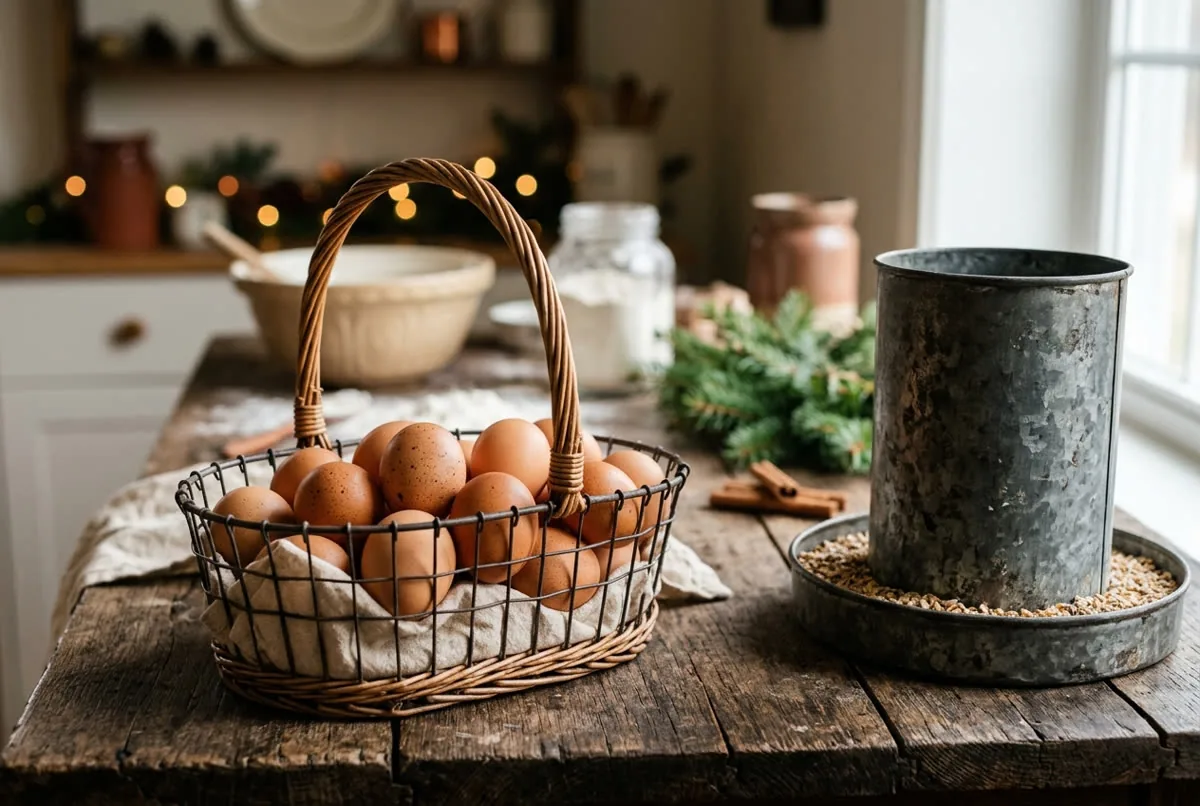
How many chickens do you need for a self-sufficient holiday table?
- A flock of 4 to 8 laying hens covers holiday baking and breakfast eggs for a family of 4 to 6.
- The average U.S. layer hen produced about 290 eggs in 2024, roughly 0.8 eggs per hen per day (USDA NASS).
- National per capita egg consumption was about 271 eggs in 2024, so even a small flock offsets real grocery demand.
- Meat birds need 6 to 8 weeks to reach table weight, so a home-raised holiday bird must start by early October.
- Pairing one or two home-raised birds with a purchased turkey is more realistic than a fully self-sufficient holiday spread.
Every fall, homesteaders eyeing their coop start doing the same math: with birds already scratching around the yard, why not have them cover more of the holiday table? Between stuffing, pies, and a full house of breakfast requests, egg demand spikes hard in November and December, and it is worth knowing whether four hens or fourteen actually gets a household there.
The short answer: A flock of 4 to 8 laying hens covers holiday baking and breakfast eggs for a family of 4 to 6, but a fully home-raised meat course takes months of planning that most last-minute holiday hosts do not have.
How Many Laying Hens Do You Need to Cover Holiday Baking and Breakfasts?
Holiday menus lean on eggs more than most people realize. Stuffing binders, pies, custards, and breakfast casseroles typically call for 2 to 4 eggs per recipe, so a weekend with company can run through 12 to 24 eggs for baking and breakfast service alone.
The math on the supply side is straightforward. The average layer hen in the United States produced about 290 eggs in 2024, up 1% from the year before (USDA National Agricultural Statistics Service, 2025-02). Spread across a year, that works out to roughly 0.8 eggs per hen per day, so a flock of four hens lays about 3 eggs on an average day (USDA NASS, 2025-02).
For most families, a typical backyard flock of 4 to 8 hens produces enough eggs to cover baking and breakfasts for a household of 4 to 6 people straight through the holiday season, assuming that same roughly 0.8-egg-per-hen daily average holds (USDA NASS, 2025-02). At the smaller end of that range, four hens keep up with everyday breakfast needs but leave little cushion for a big baking weekend. At the larger end, eight hens build in a buffer for guests, gifting extra eggs, and the inevitable off day when a hen goes broody or starts to molt.
What a Bigger Flock Actually Buys You
The jump from four hens to eight is not just double the eggs on paper. It is the difference between a flock that meets baseline demand and one that has slack built in for the weeks when production dips. Daylight hours shrink through November and December, and laying rate tends to follow the light (Penn State Extension), so the extra birds at the top of that range are really buying predictability, not just volume.
If You Only Have Room for Two or Three Hens
Not every reader has yard space for eight birds. Many city and suburban zoning codes limit how many hens a household can keep, and renters often work within even tighter limits set by a landlord or a homeowners’ association. At that scale, a flock will not fully cover a big baking weekend on its own, but it still meaningfully cuts into weekday breakfast needs and can stretch into holiday baking when eggs are used deliberately: set aside a few days ahead for a pie, held back from breakfast in favor of a stuffing recipe, rather than eaten as fast as they are laid. Fresh eggs keep for several weeks when refrigerated, so a smaller flock can build toward a holiday weekend over the two or three weeks beforehand instead of trying to meet the full demand from a single week’s laying. A small flock plus a planned grocery top-up is a realistic middle ground for anyone without room for a larger setup.
Can a Small Backyard Flock Replace Store-Bought Eggs Completely in November and December?
Nationally, per-person egg consumption was about 270.6 eggs in 2024, down roughly 2.6% from 2023 (Egg-News, citing USDA). That is about three eggs every four days, per person, across shell and liquid eggs combined. Scaled to a household, that is exactly the kind of steady demand a modest flock can meaningfully offset, even if it cannot erase the grocery list entirely.
A common misconception is that it takes a large flock to make a dent in a holiday grocery bill. The data point the other way: a handful of hens supplies dozens of eggs a month, and even 4 to 6 birds materially offset store-bought egg purchases for baking and breakfasts (Egg-News; USDA NASS, 2025-02). Where a small flock falls short is consistency: fewer hens mean less buffer against molting, slower production as daylight shortens, or a hen going broody right before company arrives. Anyone who has watched egg prices swing after an avian flu outbreak already knows how quickly store supply and pricing can shift too, which is covered in our look at how bird flu affects backyard flocks.
Should You Raise Dual-Purpose Birds for Both Eggs and Meat?
Dual-purpose breeds are worth considering if the goal is stretching a flock’s contribution to the holiday table beyond eggs. These birds lay reasonably well and still reach a usable table weight, unlike specialized egg breeds bred almost entirely for laying rate. The tradeoff runs both directions: dual-purpose hens typically lay somewhat fewer eggs per year than a dedicated layer breed, and dual-purpose roosters take longer to reach table weight than a commercial broiler line.
For anyone weighing that tradeoff, the practical question usually comes down to space and existing setup. If the coop and run were built for a small laying flock, adding meat birds or switching breeds means planning for more square footage, more feeder and waterer capacity, and more nesting boxes if the flock grows. Our guide to building a backyard chicken coop for 4 to 6 hens walks through sizing a setup before birds arrive, which is the easier time to plan for growth than after the flock is already established.
The decision is easier to frame around one question: is this a first flock, or an addition to one that already exists? A first flock built around dual-purpose birds locks in both goals from the start, with every bird pulling some weight on the egg side and the option to process extras later. Adding meat birds to an established laying flock usually means running two groups side by side instead, since younger meat birds are not typically integrated straight into a mature laying flock, and they are raised and processed on their own faster timeline.
How Far in Advance Do I Need to Start Meat Chickens for a Thanksgiving Table?
Meat birds need real lead time, and that is the piece that catches most last-minute planners off guard. Broiler-type chickens typically reach table weight in 6 to 8 weeks, which means birds destined for a Thanksgiving table generally need to be started in early October at the latest for standard fast-growing hybrids (Christmas birds by about the end of October), with more time needed for slower-growing dual-purpose or heritage breeds (Penn State Extension).
That timeline is why pairing one or two home-raised birds with a purchased turkey is a more realistic goal than a fully home-raised holiday protein spread. It is also why the idea that “chickens do not matter for holiday meals, it is all about the turkey” misses the mark: eggs and smaller poultry cuts carry a lot of the sides, desserts, and breakfast spread even when the centerpiece on the table is store-bought.
The lead time matters on the ordering side as well as the growing side. Hatcheries take fall meat-chick orders well ahead of the birds actually being needed, and popular fall ship dates fill up before the six-to-eight-week growing window even starts. Anyone planning a home-raised bird for a specific holiday date is better off treating the ordering decision as an early-fall task, not a late-October one.
Broilers or Roasters for the Holiday Bird?
Age at processing sets the size of a meat bird. Broilers are hybrid chickens bred for fast growth, typically raised to about 5 pounds and usually processed right at 8 weeks of age. Birds slaughtered between 9 and 12 weeks of age can dress out at 7-10 lbs and are called roasters (University of New Hampshire Extension). A roaster spends more weeks growing, so it needs more weeks on the calendar before the holiday than a broiler does.
The same page ties flock size to appetite: the best way to decide how many chickens to raise is to look at how much chicken the household eats each week. For a steady supply, it describes starting a new flock of broiler chicks when the previous flock is a month old, then processing one-quarter of each flock at seven, eight, nine and 10 weeks of age. It also advises scheduling the harvest day carefully so birds do not grow too large, which jeopardizes the health of the animal.
Is It Realistic to Serve an All Home-Raised Holiday Dinner?
For most backyard setups, a fully home-raised holiday dinner is not a realistic target in a single season, but a mostly home-supplied one is. Eggs are one of the few fresh animal products a small flock can supply continuously right through the holidays, which fits naturally alongside root-cellar staples and other shelf-stable preservation that already anchor a food-storage plan (see our list of fall vegetables for root cellar storage, Backyard Freedom Lab, 2026-08-12).
The more useful framing is to treat the flock as one leg of the holiday table rather than the whole thing: eggs for baking and breakfast covered by hens already in the yard, a bird or two of home-raised meat if timed months in advance, and the rest filled in normally. As a flock grows to cover more of that math, winter care becomes the limiting factor rather than bird count. Frozen waterers and shrinking daylight hit egg output hard in exactly the weeks a holiday host needs it most, which is where gear built for winter reliability, like the option covered in our review of automatic coop doors for winter and predator protection, starts to matter more than adding birds.
Sizing the Flock to the Guest List
A shortfall of a few eggs a week is easy to cover with a backup carton from the store. A shortfall of a dozen or more points toward adding hens well before the season starts, not after the baking begins, since new pullets typically need several months to mature before they start laying (Penn State Extension) and will not help with this year’s holiday math at all.
The fastest way to find out where a flock lands in this range is to run that count backward from this year’s actual guest list and recipe plan, not a generic average. Tally the eggs the baking and breakfast plan needs, compare it against what the current flock lays on an average November day, and decide from there whether the answer is more hens, a backup carton from the store, or starting meat birds earlier next year. Nesting boxes sized for the flock and a reliable winter waterer are the two pieces of gear that most directly protect that egg count once a flock is sized to match the holiday plan.
Frequently Asked Questions
- How many laying hens do I need to cover all my holiday baking and breakfasts?
- For most households, 4 to 8 hens is enough, covering baking and breakfast needs for a family of 4 to 6 based on the roughly 0.8-egg-per-hen daily average USDA reports (USDA NASS, 2025-02).
- Can a small backyard flock replace store-bought eggs completely in November and December?
- Usually not completely. National per capita egg consumption was about 271 eggs in 2024 (Egg-News, citing USDA), and a small flock can materially offset but rarely fully replace that volume once molting and shorter winter days are factored in.
- How far in advance do I need to start meat chickens for a Thanksgiving table?
- Broiler-type birds typically need 6 to 8 weeks to reach table weight, so birds intended for a Thanksgiving table generally need to be started by early October at the latest, and birds for a Christmas table by about the end of October.
- Is it realistic to serve only home-raised poultry for a large family holiday dinner?
- For most flocks, a fully home-raised dinner is not realistic in a single season. A mostly home-supplied table, with hens covering eggs and one or two home-raised birds supplementing a purchased turkey, is a more achievable goal.
Sources & references
- USDA National Agricultural Statistics Service, Chickens and Eggs 2024 Summary (opens in new tab)
- Egg-News, U.S. egg industry statistics (opens in new tab)
- Penn State Extension, A Quick Guide to Raising Pastured Broilers (opens in new tab)
- Penn State Extension, Management Requirements for Laying Flocks (opens in new tab)
- University of New Hampshire Extension, Raising Broilers (opens in new tab)
Before you go
The Renter's Homestead Pack
Self-reliance projects for the yard you don't own — container yields, a raised bed built to move with you, balcony preservation basics, and the landlord questions to ask first.
Free guide
The Renter's Homestead Pack
Self-reliance projects for the yard you don't own — container yields, a raised bed built to move with you, balcony preservation basics, and the landlord questions to ask first.