What’s the short answer?
- Mice fit through quarter-inch gaps and rats through half-inch gaps, per MSU Extension, so every seam, corner, and utility penetration needs checking against that size.
- Winter is rodents' most active time for entering structures, per NC State Extension, making fall the right window to seal a coop and pantry before pressure peaks.
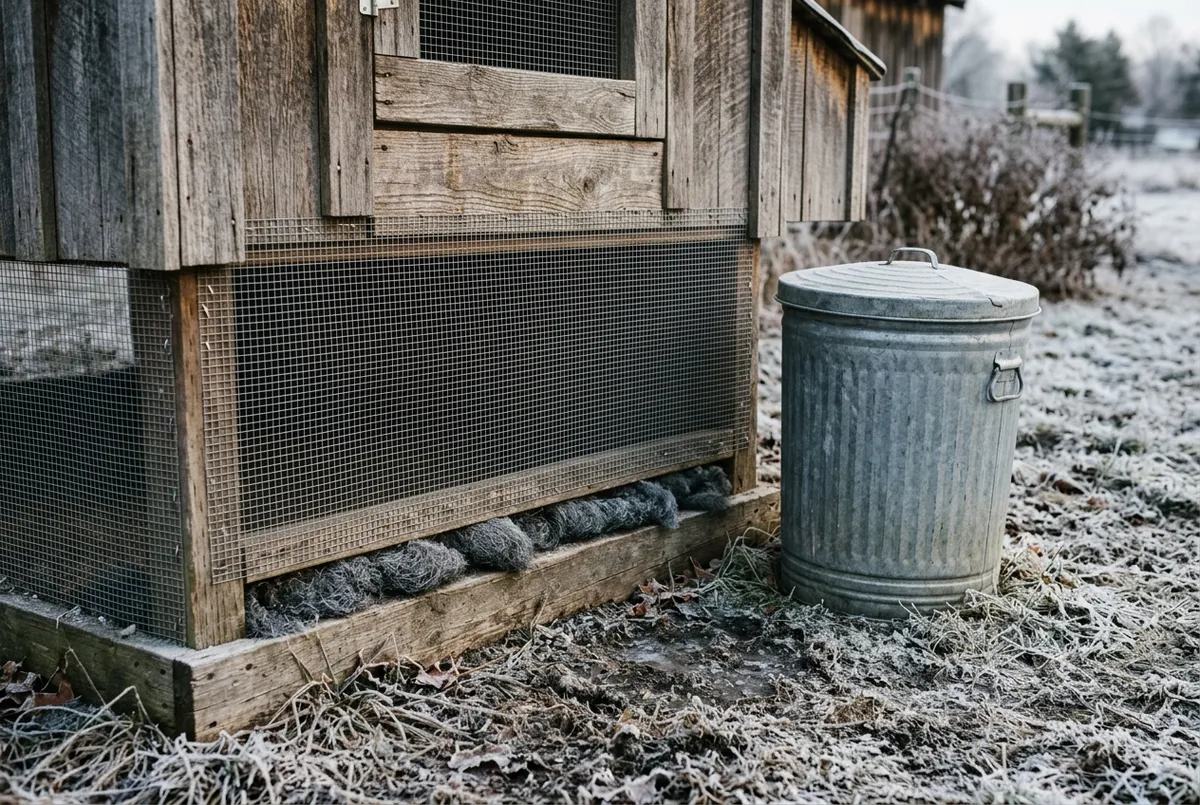
- Gnaw-resistant materials matter: steel wool as a plug for small gaps, sheet metal or wire mesh for bigger ones, while expanding foam, plastic, and wood are ineffective against house mice.
- University of Maryland Extension suggests burying hardware cloth 12 inches to 1.5 feet deep around a coop to stop digging predators, a route above-ground sealing misses.
- Feed in closed containers (preferably metal with tight lids), prompt cleanup of spilled feed, and a clear 3-foot perimeter buffer round out exclusion.
- MSU Extension is explicit that a poultry house cannot be made fully rodent-proof, so this is ongoing exclusion and monitoring, not a one-time fix.
Your coop closes up snug enough in summer, but once the first hard frost hits, every gap in the siding, every crack around a feed bin, and every loose-lidded jar in the pantry starts looking like an open door to something small, hungry, and looking for a warm place to spend the winter. Mice and rats do not wait for an invitation. They test every seam a structure has, and once one gets inside a coop or a stocked pantry, it rarely leaves on its own. An extension publication beats a guess when the stakes are a winter’s worth of stored feed and food.
The short answer: Walk the coop and pantry now and seal anything wider than a quarter inch with gnaw-resistant materials, since mice fit through openings that small and rats need only a half inch. Extension guidance points to steel wool packed into small gaps, sheet metal or wire mesh for bigger ones, buried hardware cloth around the coop’s base, closed feed containers (preferably metal), and a clear 3-foot buffer around the structure. None of it makes a coop fully rodent-proof for good, but done before winter, it closes the entry points rodents are most actively hunting for right now.
Why Fall Is the Deadline, Not a Suggestion
Rodents do not move into structures year-round at the same rate. NC State Extension’s Urban Pests program flags winter as rodents’ most active season for entering buildings, because they are actively seeking food and shelter from the cold (NC State Urban Pests (NC State Extension)). That timing is why fall is the window that matters. UC IPM adds that where outdoor house mouse populations exist, they frequently enter homes in autumn when nighttime temperatures become colder (UC IPM: House Mouse Pest Notes). Sealing before the seasonal push, rather than after mice are already inside, is the difference between an afternoon of caulk and hardware cloth and a winter-long infestation to reverse.
How Big a Gap Actually Lets a Rodent In
Most people underestimate how little space a rodent needs. Mississippi State University Extension’s poultry-house guidance puts a hard number on it: mice can pass through openings as small as a quarter inch in diameter, and rats need only a half inch (Mississippi State University Extension Service). NC State Extension gives a looser rule of thumb, saying mice can squeeze through an opening the size of a dime or larger, and UC IPM says house mice can pass through openings 3/8 inch wide. The quarter-inch figure is the tightest of these, and it is the standard to check every seam, corner, and utility penetration against, not “does this look tight,” but “does this gap measure smaller than a quarter inch.” A tape measure or a spare quarter-inch drill bit held up to a gap is a faster field check than eyeballing it, since a seam that looks sealed from three feet away can still be wide enough for a mouse to squeeze through at close range. A slow, deliberate walk of the whole exterior matters more than a quick glance from the yard.
Start With the Coop: A Perimeter Walk
The most efficient way to find these gaps is a slow walk around the coop’s exterior, checking every seam at ground level and up.
Doors and Siding Seams
MSU Extension recommends confirming that load-out and walk-in doors close and seal tightly, and that corrugated metal siding has tight corner seams. Doors are an easy first check: shine a light along the bottom edge and the hinge side after dark, and any daylight or draft coming through is a gap worth measuring against the quarter-inch standard. Corner seams on metal siding are the second common failure point, since panels that were tight when installed can shift or gap over time.
Utility Penetrations
Openings around feed augers, water lines, and electrical conduits are the gaps people forget, because they were never meant to be sealed tight in the first place, just functional. MSU Extension calls these out specifically as spots that need proper sealing, and they are worth checking last on the walk, once the more obvious door and siding gaps are handled, since they are easy to miss on a quick pass. If a coop uses an automatic coop door, the housing and wiring penetration for that unit is worth the same quarter-inch check as any other utility line.
Bury Hardware Cloth Around the Base
Sealing what is visible above ground does not stop rodents from digging in underneath. For a coop specifically, University of Maryland Extension recommends digging a trench 12 inches to 1.5 feet deep around the entire coop and burying hardware cloth there, which it says prevents digging predators (University of Maryland Extension). Rats are burrowers too; MSU Extension notes the Norway rat prefers a burrow 8 to 18 inches below the ground. This is more labor than sealing a seam, since it means digging a trench around the coop’s perimeter, but it addresses an entry route that no amount of door-sealing or siding repair touches.
Use Materials Rodents Can’t Chew Through
Sealing a gap with the wrong material just delays the problem. Extension guidance favors gnaw-resistant options. Iowa State University’s Center for Food Security and Public Health advises sealing any opening greater than a quarter to a half inch with a durable material such as steel wool packed tightly into the opening, and using materials that cannot easily be gnawed or pecked through, such as concrete, sheet metal, wire mesh, aluminum, or brick (Iowa State CFSPH). UC IPM calls steel wool scouring pads a good temporary plug that may rust over time, and recommends sealing cracks around pipes, vents, and utility cables with metal or concrete (UC IPM: House Mouse Pest Notes). Caulk is a weaker fallback: NC State Extension says it may be used in some cases but may not be as long lasting. For the larger gaps, sheet metal or metal hardware cloth are the options, but mesh with half-inch openings is larger than the mouse standard above, so where mice are the concern the openings need to stay at or under a quarter inch.
The same logic rules out cheaper substitutes that look similar at a glance. Plastic sheeting or screening, rubber, wood, or spray foam by itself might block a draft, but Iowa State and UC IPM both list gnawable materials like these as inadequate or ineffective for plugging rodent holes (UC IPM specifically names expanding foam). The material has to be something a rodent’s teeth cannot get through, which in practice narrows the list down to metal and concrete: steel wool as a temporary plug for small gaps, wire mesh or sheet metal for larger ones.
Clear the Perimeter and Remove the Food Source
Sealed openings only solve half the problem if the ground around the structure is still an invitation. MSU Extension recommends keeping at least a 3-foot buffer around the coop’s perimeter clear of brush, trash, and weeds, so that burrows and rodent runs are easy to spot before they turn into an established nest. A cleared buffer also removes the cover rodents use to approach a structure unseen, which makes the coop a less attractive target in the first place.
Feed storage matters just as much as the buffer. Iowa State’s CFSPH advises storing feed in closed containers, preferably metal with tight-fitting lids (Iowa State CFSPH). MSU Extension adds that feed spills should be cleaned up promptly, both inside and outside the house, since scattered feed is exactly the kind of easy food source that draws rodents in and keeps them coming back even after the building itself is sealed. Rodents drawn in by spilled feed are also a biosecurity concern beyond the nuisance factor: MSU notes they spread diseases to poultry flocks by contaminating feed and bird living areas with urine and droppings, and Iowa State’s CFSPH says rodents can spread salmonellosis; anyone tightening up exclusion this fall is worth pairing it with a broader look at coop biosecurity against avian flu.
Apply the Same Standard to the Pantry
Much of the guidance above is not specific to poultry buildings. UC IPM applies the same quarter-inch gap standard to ordinary buildings, which means the same walk-and-seal approach used on a coop applies just as directly to a pantry, mudroom, shed, or any other room where food is stored for winter. Check baseboards, the gaps around pipes under a sink, dryer vents, and the same load-out-door-style seals around any exterior door leading into a food storage area. The same gnaw-resistant materials apply too: steel wool as a plug for small gaps, sheet metal or wire mesh for larger ones, since UC IPM lists expanding foam among the materials that are ineffective for plugging mouse holes, in a pantry wall as much as in a coop wall.
Storage habits inside the pantry matter for the same reason feed storage matters in the coop. Tight-fitting, gnaw-resistant containers keep a rodent from turning one unsealed bag into an established food source, and a pantry that stays orderly, without spilled grain or open bags left out, gives rodents less reason to keep testing the walls once the obvious gaps are closed.
Cleaning Up Droppings and Nests Safely
If the perimeter walk turns up droppings or a nest, the cleanup has its own steps. The Centers for Disease Control and Prevention says not to sweep or vacuum rodent urine, droppings, or nesting materials, because that can spread virus-containing droplets into the air (Centers for Disease Control and Prevention, 2024-04-08). Instead, wear rubber or plastic gloves and spray the urine and droppings until very wet with a bleach solution or an EPA-registered disinfectant. Let it soak for 5 minutes, or follow the product label. The bleach mix is 1.5 cups of household bleach in 1 gallon of water (1 part bleach to 9 parts water), made fresh before each use. Then wipe it up with paper towels and put them in a covered garbage can.
For a closed shed or outbuilding, CDC says to open all doors and windows for 30 minutes before cleaning and to leave the area during that time. On a dirt floor, spray the floor with disinfectant. A dead rodent or a nest gets the same spray and 5-minute soak, then goes into a plastic bag that is knotted closed and placed inside a second knotted bag. Wash gloved hands, remove the gloves, then wash bare hands with soap and warm water.
What “Rodent-Proof” Actually Means Long-Term
It is worth setting expectations honestly here, because MSU Extension is candid on this point: totally rodent-proofing a poultry house is not possible. That is not a reason to skip the work above, but it does reframe the goal. Sealing gaps, burying hardware cloth, storing feed properly, and clearing the perimeter is not a one-time project that gets crossed off a list and forgotten. It is ongoing exclusion and monitoring, the same way a fence needs periodic checking rather than a single installation.
In practice, that means the fall walk described above is the first pass, not the only one. A coop and pantry sealed well this fall should need far less attention through winter than one left untouched, but a seasonal recheck, especially after any structural repair or new equipment install that opens a fresh utility penetration, is what keeps the sealing effective rather than a one-season fix that quietly fails by the following winter. Wood settles, metal siding shifts with temperature swings, and a buried hardware cloth barrier can be undermined by erosion or a new landscaping project years later, so treating this as a habit rather than a checklist item is what separates a coop that stays clear through the cold months from one that needs the same fight repeated every year.
The most efficient order to tackle this: walk the coop perimeter first and note every gap against the quarter-inch standard, seal the small ones with steel wool and the larger ones with sheet metal or hardware cloth, bury hardware cloth around the base if it has not been done before, move feed into closed containers (preferably metal with tight lids), clear brush and debris back to a 3-foot buffer, and then repeat the same seal-and-check process on the pantry or any other food storage space before the cold fully sets in.
Frequently Asked Questions
- How small a gap can mice actually get through?
- Mice can pass through openings as small as a quarter inch, and rats need only a half inch, per Mississippi State University Extension's poultry-house guidance.
- What time of year are rodents most likely to move into a coop or pantry?
- Winter is rodents' most active season for entering structures, since they are actively seeking food and shelter from the cold, per NC State Extension's Urban Pests program, which makes fall the ideal window to seal up before that pressure peaks.
- What materials actually keep rodents out long-term?
- Iowa State University's Center for Food Security and Public Health advises sealing openings with durable, gnaw-resistant material such as tightly packed steel wool, sheet metal, or wire mesh, and says plastic sheeting, wood, and rubber are not adequate. University of California IPM adds that expanding foam is ineffective for plugging holes used by house mice.
- Can a coop ever be made completely rodent-proof?
- No. Mississippi State University Extension is candid that totally rodent-proofing a poultry house is not possible, so the realistic goal is ongoing exclusion and monitoring rather than a single fix.
- Does burying hardware cloth around a coop actually stop burrowing?
- University of Maryland Extension recommends digging a trench 12 inches to 1.5 feet deep around the coop and burying hardware cloth there to prevent digging predators. Rats are burrowers too, so it adds protection, but it does not replace sealing gaps and keeping feed secure.
Sources & references
- Mississippi State University Extension Service: Controlling Rodents on the Poultry Farm (opens in new tab)
- NC State Urban Pests (NC State Extension): Rodent-Proofing for Winter (opens in new tab)
- Iowa State University CFSPH: Vectors, Rodents and Birds (opens in new tab)
- UC IPM: House Mouse Pest Notes (opens in new tab)
- University of Maryland Extension: Predator Control (opens in new tab)
- Centers for Disease Control and Prevention, How to Clean Up After Rodents (opens in new tab)
Before you go
The Renter's Homestead Pack
Self-reliance projects for the yard you don't own — container yields, a raised bed built to move with you, balcony preservation basics, and the landlord questions to ask first.
Free guide
The Renter's Homestead Pack
Self-reliance projects for the yard you don't own — container yields, a raised bed built to move with you, balcony preservation basics, and the landlord questions to ask first.